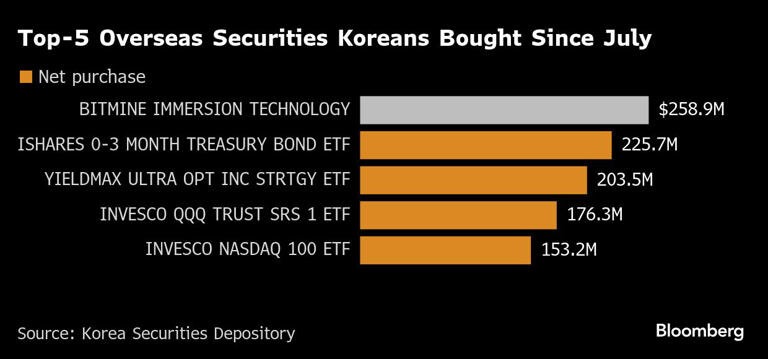
- South Korea retail bought $259M of BitMine since July; most purchased foreign security.
- BitMine shifted to an ETH treasury holding about $3.6B; ETH touched ~$4,300.
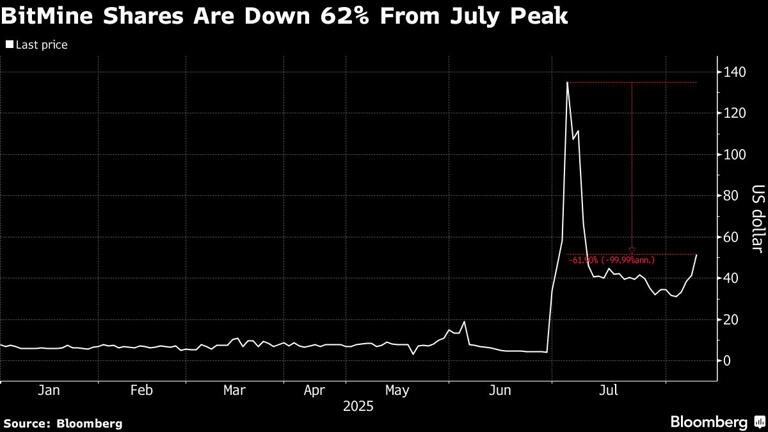
- Shares rose over 3,000% to a July peak, then dropped 62%.
BitMine Immersion Technologies Inc. has drawn steady attention from retail traders in South Korea, reflecting a growing interest in stocks tied to digital assets. The company, backed by Peter Thiel’s Founders Fund, has shifted from Bitcoin mining to operating as a digital-asset treasury focused on Ether. Its holdings now include about $3.6 billion worth of ETH, according to strategicethreserve.xyz. Recent market moves, including Ether reaching $4,300 for the first time since December 2021, have added to the activity around the stock. Since early July, investors in South Korea have purchased $259 million worth of BitMine shares, making it the most traded foreign security during that time. This trend highlights how local traders connect equity markets with cryptocurrency exposure.
South Korea retail flows into BitMine: the summer surge
Since the start of July, investors in South Korea have bought a net $259 million of BitMine shares, making it the most purchased foreign security in that stretch, based on Korea Securities Depository figures. The timing synced with a broader crypto updraft. Ether topped $4,300 over the weekend, the highest level since December 2021, and the rally pulled crypto-sensitive equities along for the ride.
BitMine stood out not just because it was moving, but because of what it now holds and how it positions itself. The company’s transition is central to this attention. It no longer markets itself primarily as a miner but as a digital-asset treasury. Instead of expanding hash rate, it aims to accumulate and hold cryptocurrency on balance sheet. According to data compiled by strategicethreserve.xyz, BitMine now controls the largest Ether treasury, valued at about $3.6 billion. That simple headline number gave traders in South Korea a clear anchor: a way to express a view on Ether through a US-listed equity that is already liquid and news-driven.
The flow also reflects a wider habit across South Korea’s retail base. Roughly one third of the population—about 18 million people—takes part in digital-asset markets. Participation ranges from leveraged crypto exchange-traded funds to newly listed names such as stablecoin issuer Circle Internet Financial Ltd. Against that backdrop, a stock like BitMine looks familiar: a ticker with straightforward exposure to a token theme, and daily volatility that offers frequent entries and exits.
Ether-first treasury play: inside BitMine’s pivot
BitMine’s approach lands in a lineage of listed balance-sheet strategies popularized by Michael Saylor’s playbook, but with a different core asset. The company is not trying to be another Bitcoin proxy. Its thesis is Ether-forward. A treasury concentrated in ETH tilts the stock toward catalysts that matter specifically for the Ethereum ecosystem while keeping the structure simple for equity traders. For investors in South Korea, this offers a path into an ETH-centric idea during hours when local crypto venues are busy and US markets are open.
The mechanics are easy to follow. When ETH rises, the mark-to-market value of BitMine’s holdings rises, and the stock tends to track that move—often with more amplitude. When ETH cools, the company’s equity usually cools faster. That convex profile is part of the appeal and part of the risk. It also explains why headline numbers carried weight this summer: ETH above $4,300 revived memories of the last cycle’s highs and gave context to the $3.6 billion treasury figure, which is large enough to matter and simple enough to understand.
BitMine is not alone in treating a listed company as a crypto balance-sheet vehicle. Other digital-asset treasury names have appeared around assets ranging from Binance-linked BNB to Litecoin. But BitMine’s ETH focus, Founders Fund backing, and the speed of its summer move made it a distinct case study for traders in South Korea who look for liquid proxies tied to specific tokens rather than broad crypto baskets.
South Korea risk appetite, market structure, and what comes next
The behavior of BitMine’s shares shows the trade-off clearly. After the company announced its plan to stockpile Ether, the stock surged more than 3,000% into a July peak, then fell 62%. That kind of range is not a side note; it is the shape of the investment. For an audience in South Korea used to rapid swings in leveraged crypto ETFs and newly listed names, the pattern felt familiar: fast upside, sharp drawdowns, and a steady drumbeat of catalysts from token prices and corporate updates.
Context matters for the next phase. If capital in South Korea continues to look for equity wrappers around crypto, daily flows can remain heavy even as prices fluctuate. ETH’s path will carry more weight than any single corporate headline because the company’s balance sheet is now the story. Investors will watch treasury policy, disclosures, and any changes in how BitMine accumulates or custodies assets. They will also track how closely the stock’s behavior maps to ETH moves on quiet days versus event days, since that correlation often guides position sizing.
There is a social element too. When a large pool of retail traders focuses on the same names, short bursts of momentum become part of the expected rhythm. That can push prices beyond what a balance-sheet snapshot might imply and can pull them back just as quickly. For investors in South Korea, understanding that rhythm is as important as reading the latest treasury tally. The appeal is in the mix: a clear ETH thesis in corporate form, local familiarity with crypto trading patterns, and an accessible route through a US-listed ticker.
Conclusion
BitMine’s rise into the retail spotlight can be traced to a few concrete facts: a pivot from mining to a digital-asset treasury, an Ether reserve around $3.6 billion, and a market phase that carried ETH above $4,300 for the first time since late 2021. Add in net purchases of $259 million from investors in South Korea since early July and the outline sharpens. The opportunity and the risk are the same force seen from different sides. This is an equity that behaves like a levered ETH proxy, capable of a 3,000% climb and a 62% drop in the same season. For traders in South Korea, that clarity—asset, structure, and range—explains both the draw and the discipline the trade demands.
Disclaimer
The information provided in this article is for informational purposes only and should not be considered financial advice. The article does not offer sufficient information to make investment decisions, nor does it constitute an offer, recommendation, or solicitation to buy or sell any financial instrument. The content is opinion of the author and does not reflect any view or suggestion or any kind of advise from CryptoNewsBytes.com. The author declares he does not hold any of the above mentioned tokens or received any incentive from any company.
Featured image created by AI