⚡ Quick Navigation
- Bitcoin $68K Support: Critical technical level under pressure — what breaks below mean for 2026
- Pi Network March 12 DEX: 16M+ migrated users preparing for first decentralized exchange launch
- Solana Institutional Play: Morgan Stanley ETF filing drives SOL rebound to $142 with $420 targets
- XRP Regulatory Setup: CLARITY Act hopes and Kraken integration position XRP for institutional flows
- 2026 Investment Strategy: Risk-adjusted portfolio allocation for volatile market conditions
Best Crypto to Buy 2026: Top Investment Picks for Bitcoin, Pi Network & Solana
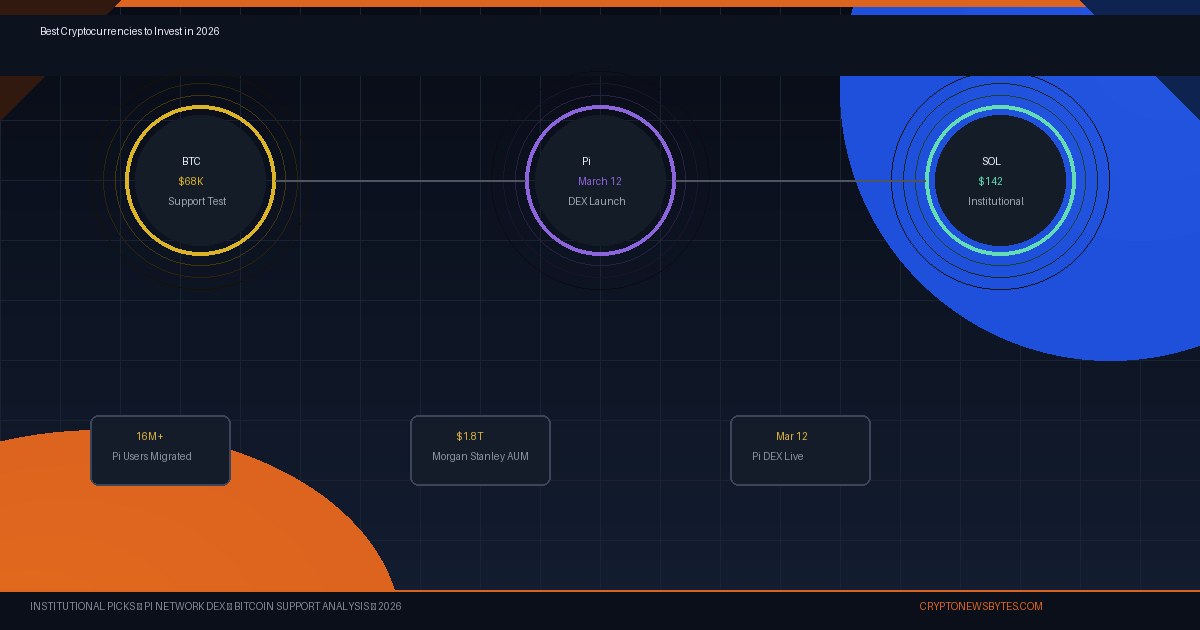
Finding the best crypto to buy 2026 requires understanding three critical market dynamics unfolding in February: Bitcoin’s crucial ,000 support test, Pi Network’s historic March 12 DEX launch affecting 16 million users, and Solana’s institutional validation driving SOL to 2. As Bitcoin extends its week-long selloff with over $1 billion in liquidations, investors evaluating the best crypto to buy 2026 must balance established assets like Bitcoin with high-growth institutional picks like Solana and emerging infrastructure plays like Pi Network.[CoinDesk]
This comprehensive guide to the best crypto to buy 2026 examines picks across three distinct categories: Bitcoin’s K support level and what it means for the broader market, Pi Network’s DEX launch affecting 16 million migrated users, and institutional favorites like Solana and XRP that are attracting Wall Street’s attention despite market turbulence.
Whether you’re seeking stability through Bitcoin’s established network effects, speculative upside through Pi Network’s Open Mainnet expansion, or institutional validation through Solana and XRP, understanding the technical, fundamental, and sentiment drivers behind each asset is essential for identifying the best crypto to buy 2026 for your portfolio.
These metrics define the best crypto to buy 2026 investment landscape.
Best Crypto to Buy 2026 #1: Why Bitcoin’s $68K Support Matters
Bitcoin’s current price action around $68,000 represents far more than a number on a chart — it’s a critical psychological and technical inflection point that could determine whether 2026 becomes a year of recovery or extended consolidation. As of mid-February 2026, Bitcoin is trading approximately 46% below its October 2025 all-time high of $126,000, with the $68K–$70K zone emerging as the market’s most closely watched support level.[Analytics Insight]
Why $68,000 Is the Line in the Sand
The $68,000 level has become crucial for three interconnected reasons. First, it represents the approximate cost basis for a significant cluster of long-term Bitcoin holders who accumulated during the 2024–2025 bull run. Market participants view the $68,000 to $70,000 zone as a key technical area, citing heavy prior trading activity concentrated in this range.[CoinDesk]
Second, liquidity data shows $70,000 as a mechanical level with clustered liquidation points just below. A clean break under $68,000 would risk triggering a cascade of forced selling as leveraged long positions are liquidated, potentially accelerating a move toward the high-$60,000 or even mid-$50,000 range where deeper support exists.
Third, prediction markets have begun pricing in this downside scenario. On Polymarket, contracts tied to Bitcoin’s 2026 price outcomes now skew toward lower levels, with traders assigning the highest probability to prices at or below $65,000 — a stark reversal from January’s six-figure optimism.
What Happens If Bitcoin Breaks $68K Support
If Bitcoin fails to hold the $68,000 level on a sustained basis (defined as multiple daily closes below this threshold), technical analysts point to two potential downside targets:
| Price Level | Significance | Distance from $68K |
|---|---|---|
| $60,000–$65,000 | 200-week EMA and high-volume trading zone from 2024 | -5% to -12% |
| $50,000–$53,000 | 100% Fibonacci extension; aligns with September 2024 lows | -22% to -26% |
These levels are not predictions but rather identified zones where buying interest has historically emerged. As technical analysis patterns have shown in past Bitcoin cycles, support levels that held during prior corrections often become key battlegrounds in subsequent downtrends.
What Bitcoin Needs to Reclaim Bullish Momentum
For Bitcoin to shift from defensive consolidation to renewed uptrend, analysts identify three resistance levels that must be reclaimed in sequence:
🎯 Bitcoin’s Path Back to All-Time Highs
Level 1: $84,000–$85,000 — This consolidation range top represents the first meaningful resistance. Reclaiming this level would signal that near-term selling pressure has been absorbed.
Level 2: $89,000 (50-day EMA) — Moving above the 50-day exponential moving average would mark a technical shift from downtrend to potential uptrend structure.
Level 3: $97,000 (200-day EMA) — This is the critical threshold. Only a confirmed breakout above $97,000 would signal a return to the broader uptrend and open the path toward new all-time highs above $126,000.[Finance Magnates]
Until Bitcoin reclaims the $97,000 resistance, the overall market structure remains bearish despite any short-term relief rallies. This reality has significant implications for altcoin performance, as Bitcoin’s price direction continues to dictate broader market sentiment in 2026. For investors evaluating the best crypto to buy 2026, Bitcoin remains the foundational holding that anchors any serious portfolio.
Institutional View on Bitcoin’s 2026 Outlook
Despite near-term technical weakness, institutional perspectives on Bitcoin remain constructive over longer timeframes. Ark Invest’s 2026 Big Ideas report projects Bitcoin could reach over $760,000 by 2030, while more conservative 2026 targets from major banks range from $100,000 to $150,000 depending on macro conditions.[The Motley Fool]
The key variable is Federal Reserve policy. As institutional adoption continues expanding through ETFs and corporate treasury allocations, Bitcoin’s correlation with liquidity conditions has intensified. A return to accommodative monetary policy could serve as the catalyst for Bitcoin to break above current resistance levels.
Best Crypto to Buy 2026 #2: Pi Network’s March 12 DEX Launch
While Bitcoin dominates headlines with its $68K support test, Pi Network is quietly executing one of the most compelling best crypto to buy 2026 infrastructure stories. With over 16 million users successfully migrated to the Open Mainnet and a decentralized exchange (DEX) launch scheduled for March 12, 2026, Pi Network represents a fundamentally different investment thesis than established cryptocurrencies.
The v19.6, v19.9, and v20.2 Upgrade Sequence
Pi Network’s roadmap for Q1 2026 centers on a mandatory multi-stage protocol upgrade moving the network from version 19 toward Stellar-based Protocol v23. This is not routine maintenance — it’s foundational infrastructure work preparing the network for decentralized applications, DEX functionality, and real economic activity.[Bitget]
The upgrade sequence unfolded as follows:
| Version | Date | Key Features | Status |
|---|---|---|---|
| v19.6 | Feb 12–15, 2026 | Performance optimization, security hardening, transaction speed improvements | ✅ Complete |
| v19.9 | Feb 27, 2026 | Horizon compatibility, system stability, DEX preparation | ⏳ Scheduled |
| v20.2 + Pi DEX | March 12, 2026 | Protocol v23 activation, DEX launch, Testnet2 closure | ⏳ Scheduled |
Node operators who failed to upgrade to v19.6 by the February 15 deadline were automatically disconnected from the network, demonstrating the Core Team’s commitment to maintaining network integrity even at the cost of short-term node count reductions.
What the March 12 Pi DEX Launch Actually Means
The Pi DEX represents the network’s first major utility layer beyond simple peer-to-peer transfers. When it launches on March 12, 2026, the DEX will enable:
- Peer-to-peer Pi trading directly on the blockchain without centralized exchanges
- Token swaps between Pi and ecosystem tokens being built on the Provenance blockchain
- Liquidity provision allowing Pioneers to earn yield by providing trading liquidity
- Price discovery for Pi Coin without reliance on unregulated offshore exchanges
Importantly, the DEX launch coincides with the closure of Testnet2, marking Pi Network’s full transition to a production blockchain environment. This is not a speculative roadmap item — it’s infrastructure that has been stress-tested with over 100 tokens in preparation for live deployment.[Hoka News]
Pi Network Price Action and Migration Momentum
Pi Coin price experienced notable volatility surrounding the v19.6 upgrade, with reports indicating a 40% gain between February 11 and February 16 as the upgrade deadline approached and was successfully completed. PI was trading near $0.20 during this period, though it remains significantly below its post-mainnet launch peak of $2.98.[MoneyCheck]
The current price consolidation around $0.13–$0.20 comes despite substantial network growth metrics:
📊 Pi Network Growth Metrics (February 2026)
16,000,000+ verified users successfully migrated to Open Mainnet
2,500,000 previously blocked users unblocked in early 2026 compliance update
100+ tokens stress-tested on Pi DEX infrastructure before launch
March 2026 target for KYC validator rewards distribution (in final testing)
For context, Pi Network now has more verified, KYC-compliant mainnet users than many established blockchain networks have total active addresses. For investors researching the best crypto to buy 2026, Pi Network represents a unique speculative opportunity — the question is whether this user base translates to sustainable economic activity once the DEX and utility apps become fully operational.
Risks and Realistic Expectations for Pi Network Investors
Unlike Bitcoin or Solana, Pi Network remains in price discovery mode with limited exchange liquidity and significant tokenomics unknowns. Pi has a capped supply of 100 billion tokens, with 65% reserved for community mining rewards distributed over time through a declining issuance model.
The primary risk factors include:
- Token unlock schedule: 137 million PI tokens were unlocked in February 2026 alone, creating selling pressure
- Exchange listings: Major centralized exchanges have been slow to list PI, limiting institutional access
- Utility uncertainty: The DEX launch is critical — if trading volumes remain low, price appreciation becomes difficult
- Competitive pressure: Pi must demonstrate advantages over faster, more established Layer-1 networks
As the broader 2026 crypto ecosystem continues developing, Pi Network’s success will depend on converting its massive user base into active economic participants rather than passive holders waiting for price appreciation.
Best Crypto to Buy 2026 #3: Solana’s $142 Institutional Breakout
While speculative assets like Pi Network build infrastructure, Solana has emerged as the institutional choice for investors seeking the best crypto to buy 2026 with proven utility and Wall Street backing. Trading at approximately $142 in mid-February 2026 after a strong rebound from earlier lows, Solana represents a rare combination of institutional validation and significant upside potential.
Morgan Stanley’s $1.8 Trillion Bet on Solana
The game-changing catalyst for Solana in 2026 came on January 6, when Wall Street giant Morgan Stanley filed applications for spot Bitcoin and Solana ETFs with the SEC. Through Morgan Stanley Investment Management, which oversees $1.8 trillion in assets, the bank submitted Form S-1 filings for both the Morgan Stanley Bitcoin Trust and the Morgan Stanley Solana Trust.[Cryptonomist]
This wasn’t a speculative venture capital play — it was a regulated asset manager with fiduciary responsibilities to institutional clients signaling that Solana merits inclusion alongside Bitcoin in professional portfolios. Following the announcement, Solana’s price jumped to $142.41, posting a 6.6% intraday gain and prompting analysts to target a breakout toward the $170–$177 resistance zone.
The proposed Morgan Stanley Solana Trust would integrate features like staking rewards directly into the fund’s net asset value, addressing one of the key advantages Solana offers over Bitcoin: the ability to earn yield while holding the asset. Unlike Bitcoin’s purely store-of-value proposition, Solana holders can lock up their coins to earn steady returns while contributing to network security.
Why Institutions Choose Solana Over Competing Layer-1s
Solana’s institutional appeal stems from measurable technical and economic advantages:
| Metric | Solana | Ethereum L1 | Advantage |
|---|---|---|---|
| Transaction Speed | ~3,000 TPS (real) | ~15 TPS | 200x faster |
| Transaction Cost | $0.00025 avg | $1–$5 (variable) | 4,000x–20,000x cheaper |
| Finality Time | ~400ms | ~6 minutes | 900x faster |
| Staking Yield | 5–7% APY | 3–4% APY | Higher passive income |
These aren’t theoretical advantages — they’re observable network performance metrics that matter for institutional use cases like payment processing, decentralized finance applications, and tokenized asset trading. When WisdomTree announced in February 2026 that it was bringing its full suite of regulated tokenized funds to Solana, it cited these exact performance characteristics as the deciding factor.[Solana.com]
Analyst Price Targets and Institutional Forecasts
Professional analysts covering Solana for institutional clients have issued a range of 2026 price targets based on different adoption scenarios:
The consensus view among institutional analysts is that Solana represents a compelling risk-reward profile for investors who believe high-throughput blockchains will power the next generation of crypto applications — but only for those with sufficient risk tolerance to weather 40–60% drawdowns during risk-off market periods.
Solana’s Competitive Position in 2026
Solana is not without competition. Ethereum’s Layer-2 networks continue improving speed and reducing fees, while other Layer-1 blockchains vie for developers and liquidity. However, among best crypto to buy 2026 institutional picks, Solana’s advantage lies in its singular focus on performance without sacrificing composability — all activity happens on one chain rather than being fragmented across dozens of L2s.
For investors, the question is whether to view Solana as a complement to Bitcoin (different use cases) or as a substitute (better risk-adjusted returns). As institutional allocations continue evolving in 2026, the answer increasingly appears to be “both” — with Bitcoin serving as digital gold and Solana serving as the infrastructure layer for on-chain finance.
XRP: Positioning for Regulatory Clarity and Institutional Flows
XRP rounds out the best crypto to buy 2026 selections, though its investment thesis differs significantly from Solana’s technological advantages. XRP’s potential upside is heavily dependent on regulatory developments — specifically the CLARITY Act and potential approval of XRP-focused ETFs — rather than network performance metrics.
Kraken’s 2026 public listings roadmap includes Pi Network under its “Chains” section, signaling technical review for potential blockchain integration, though this is exploratory rather than confirmed. More significantly for XRP holders, institutional interest has remained steady despite price consolidation, with $1.3 billion in ETF-related inflows and a 57% decline in exchange balances suggesting long-term positioning by sophisticated investors.[Yahoo Finance]
AI model consensus forecasts for XRP show a 200% bull case upside — the lowest of the major institutional picks — but analysts note this reflects binary catalyst structure rather than lack of potential. If regulatory clarity materializes and ETF momentum sustains, XRP could rapidly reprice higher. Without these catalysts, XRP remains range-bound.
Best Crypto to Buy 2026: Portfolio Allocation Strategy
Building the best crypto to buy 2026 portfolio requires balancing conviction in the asset class against recognition that macro conditions remain challenging and price volatility remains extreme. Here’s a risk-adjusted framework for allocating capital across the cryptocurrencies covered in this analysis:
💡 Conservative Allocation (Lower Risk Tolerance)
70% Bitcoin — Core holding providing exposure to established network effects and institutional adoption
20% Solana — Growth position in proven high-performance infrastructure with institutional validation
10% Cash/Stablecoins — Dry powder for deploying if Bitcoin breaks key support levels
0% Pi Network / XRP — Avoid speculative positions until risk tolerance increases
⚡ Aggressive Allocation (Higher Risk Tolerance)
40% Bitcoin — Core stability anchor even in aggressive portfolio
30% Solana — Primary growth position targeting 3x–5x potential
15% Pi Network — Speculative position sizing for March 12 DEX catalyst
10% XRP — Regulatory catalyst play with defined entry/exit
5% Cash/Stablecoins — Minimal cash drag in growth-focused allocation
Regardless of allocation, the most important principle in 2026’s volatile market is dollar-cost averaging (DCA) rather than attempting to time the market. As even traditional financial advisors have begun acknowledging, systematic accumulation during periods of fear has consistently outperformed attempts to catch exact bottoms.
For Bitcoin, consider establishing buy orders at $68,000, $65,000, and $60,000. For Solana, the $130–$140 range represents value relative to institutional price targets. Pi Network requires different evaluation — success depends on DEX launch execution rather than broader market conditions.
Frequently Asked Questions: Best Crypto to Buy 2026
Best Crypto to Buy 2026: Final Verdict on Bitcoin, Pi Network & Solana
The cryptocurrency market in February 2026 presents investors with a rare combination of risk and opportunity. For those seeking the best crypto to buy 2026, Bitcoin’s test of $68,000 support will likely determine whether the broader market enters an extended consolidation phase or accelerates toward deeper corrections. Pi Network’s March 12 DEX launch represents a genuine infrastructure milestone affecting 16 million users, making it a speculative but potentially rewarding best crypto to buy 2026 pick for high-risk portfolios. Solana’s institutional validation through Morgan Stanley’s ETF filing has established SOL as the clear alternative to Bitcoin for professional portfolios seeking the best crypto to buy 2026 with growth exposure and Wall Street backing.
Determining the best crypto to buy 2026 depends entirely on individual risk tolerance, investment horizon, and conviction in specific technological or adoption narratives. Bitcoin remains the foundational best crypto to buy 2026 for any serious allocation. Solana offers the most compelling institutional growth story among altcoins. Pi Network represents speculative upside tied to successful DEX adoption. XRP provides exposure to regulatory catalysts. These remain the best crypto to buy 2026 options across different investor profiles and risk appetites.
Regardless of which assets you identify as your personal best crypto to buy 2026 picks, the investment principles remain constant: size positions appropriately, use dollar-cost averaging to smooth volatility, maintain sufficient cash reserves to deploy during panic, and remember that multi-year time horizons have consistently rewarded patient capital in this asset class.
CryptoNewsBytes Editorial Team
Crypto Investment Analysis · CryptoNewsBytes.comCryptoNewsBytes provides in-depth cryptocurrency analysis, market research, and investment insights. For daily crypto market updates and breaking news, visit CryptoNewsBytes.com →
📰 Related Crypto Analysis on CryptoNewsBytes