
Massive Shift in Bitcoin Ownership 2025: Institutions Accumulate 829,000 BTC While Individuals Reduce Holdings
Analysis of River Financial’s February 2026 data reveals significant redistribution of Bitcoin holdings between institutional entities and individual investors throughout 2025, with implications for market structure and long-term price dynamics.
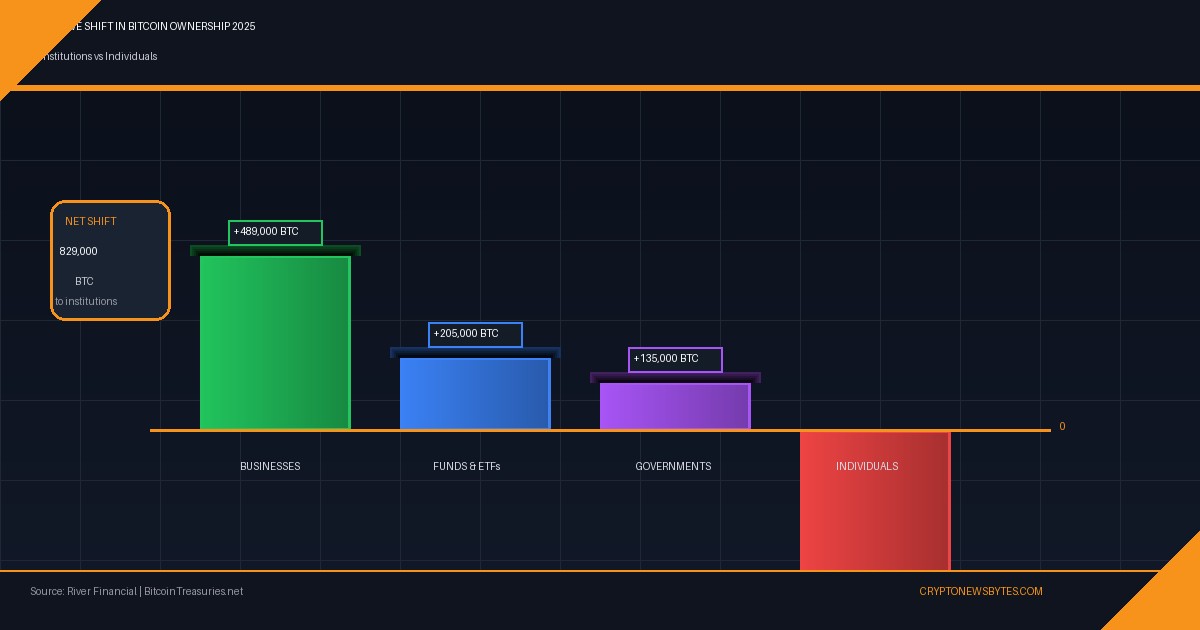
Bitcoin ownership underwent a substantial structural transformation in 2025, according to data released by River Financial in February 2026. The analysis shows that institutional entities—including businesses, investment funds, ETFs, and sovereign governments—increased their combined Bitcoin holdings by approximately 829,000 BTC, while individual investors reduced their positions by 696,000 BTC over the same period.[River Financial]
This redistribution represents approximately 3.3% of Bitcoin’s total 21 million supply changing hands from retail holders to institutional and governmental entities within a single year. The shift marks a measurable transition in Bitcoin’s market structure, with potential implications for liquidity, volatility patterns, and mainstream adoption trajectories. This development builds on trends we’ve analyzed in our Bitcoin Price Prediction 2026 coverage and our assessment of the best crypto to buy 2026.
📊 Key Data Points: 2025 Bitcoin Ownership Changes
Net Bitcoin Accumulation by Entity Type (Calendar Year 2025):
- Businesses: +489,000 BTC
- Investment Funds & ETFs: +205,000 BTC
- Governments: +135,000 BTC
- Individual Investors: -696,000 BTC
- Net Institutional Gain: +829,000 BTC
Source: River Financial internal analysis, BitcoinTreasuries.net data aggregation
Detailed Breakdown of 2025 Bitcoin Ownership Changes
| Entity Type | Net Change (BTC) | % of Total Supply | Year-End Holdings |
|---|---|---|---|
| Businesses (Corporate Treasuries) | +489,000 | +2.33% | 1.38M BTC (6.6%) |
| Funds & ETFs | +205,000 | +0.98% | 1.49M BTC (7.1%) |
| Governments | +135,000 | +0.64% | 441K BTC (2.1%) |
| Individual Investors | -696,000 | -3.31% | 13.66M BTC (65.1%) |
| Net Institutional Accumulation | +829,000 | +3.95% | — |
As of December 31, 2025, individual investors still hold the majority of Bitcoin’s circulating supply at 65.1% (approximately 13.66 million BTC). However, the rate of institutional accumulation in 2025 represents the most significant single-year shift in ownership structure since Bitcoin’s inception, according to River’s historical analysis.[River Adoption Report 2025]
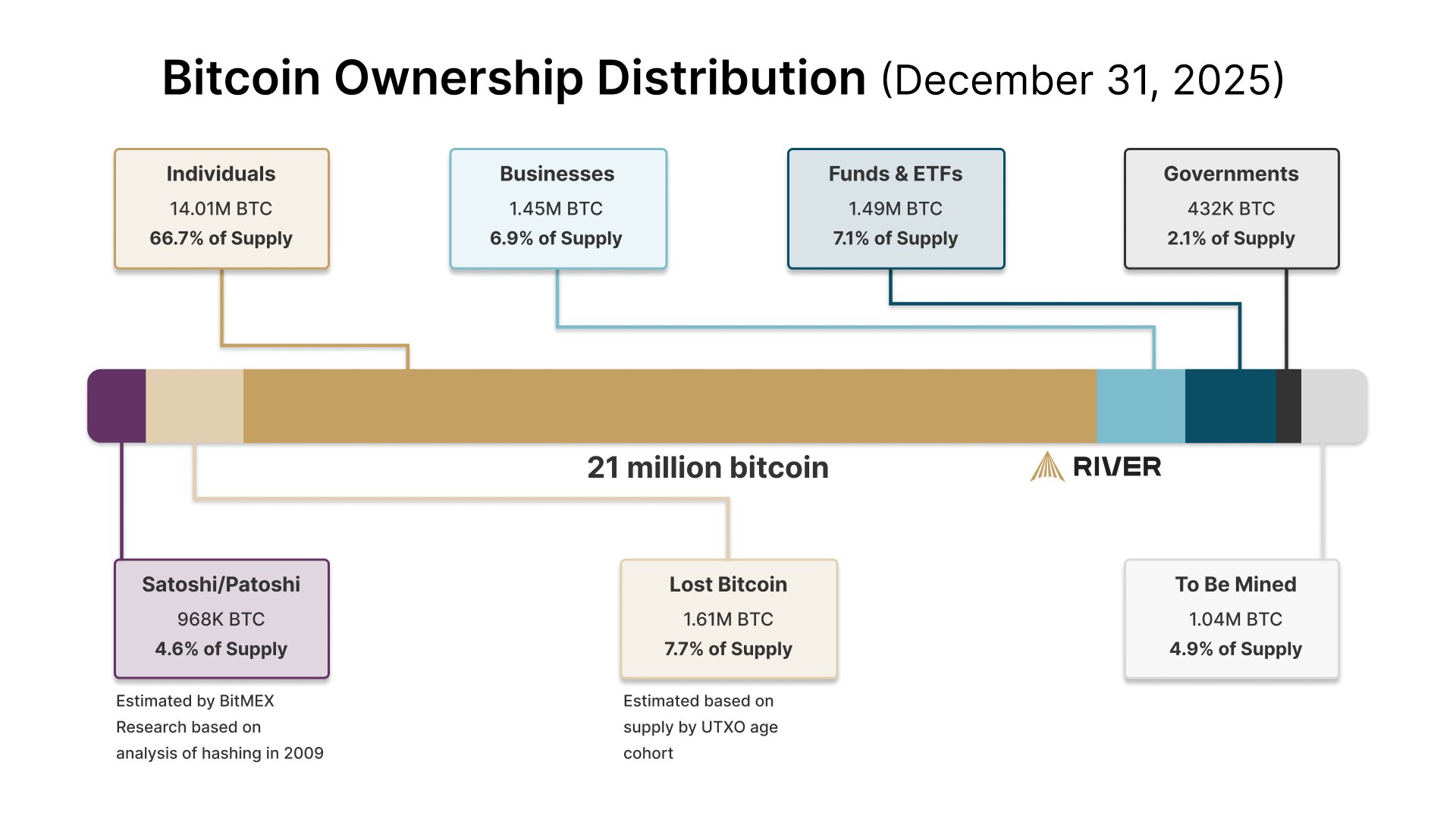
Figure 1: Bitcoin Ownership Distribution as of December 31, 2025. River Financial’s comprehensive analysis shows individuals still dominate at 66.7% of supply (14.01M BTC), while institutions collectively hold approximately 16.1% across businesses (6.9%), funds & ETFs (7.1%), and governments (2.1%). The remaining supply includes Satoshi/Patoshi wallets (4.6%), lost Bitcoin (7.7%), and unmined supply (4.9%). Source: River Financial, BitMEX Research
Corporate Treasury Adoption Leads Institutional Accumulation
Businesses emerged as the largest institutional accumulators in 2025, adding 489,000 BTC to corporate balance sheets. This figure represents a 55% increase over 2024’s corporate accumulation and reflects growing acceptance of Bitcoin as a treasury reserve asset among publicly-traded and private companies.
According to BitcoinTreasuries.net, public companies held over 1.136 million BTC as of early 2026, valued at approximately $74.78 billion at prevailing market prices.[BitcoinTreasuries.net] Major corporate holders include MicroStrategy, Marathon Digital Holdings, Tesla, Block Inc., and Coinbase, among others. The strategic rationale for corporate Bitcoin adoption has evolved significantly, as detailed in our analysis of Bitcoin mining firms’ purchasing strategies and the broader shift toward institutional blockchain adoption.
Corporate treasury accumulation in 2025 — equivalent to $32.2 billion at $66,000 average BTC price
The acceleration in corporate adoption appears driven by several factors identified in River’s analysis. Regulatory clarity improved following spot Bitcoin ETF approvals in early 2024, reducing perceived compliance risks for corporate treasury allocations. Accounting standards for digital assets became more standardized through Financial Accounting Standards Board (FASB) guidance effective January 2025, allowing companies to mark Bitcoin holdings at fair value rather than impairment-only models. Public company adoption also created demonstration effects, with smaller firms following larger pioneers into Bitcoin treasury strategies.
ETF and Fund Inflows Drive Institutional Access
Investment funds and exchange-traded products accumulated 205,000 BTC in 2025, representing the second-largest institutional category. The majority of this accumulation occurred through spot Bitcoin ETFs, which experienced sustained inflows throughout 2025 following their January 2024 regulatory approval in the United States.
BlackRock’s iShares Bitcoin Trust (IBIT) and Fidelity’s Wise Origin Bitcoin Fund (FBTC) led ETF accumulation, with combined net inflows exceeding $15 billion during 2025, according to Bloomberg ETF analyst data. These products provided institutional investors—including pension funds, endowments, and registered investment advisors—with regulated vehicles for Bitcoin exposure without direct custody requirements.
Market Impact Analysis: ETF accumulation creates structural buying pressure distinct from speculative retail flows. ETF issuers must purchase and custody physical Bitcoin to back fund shares, removing supply from liquid markets. This mechanical bid support may contribute to reduced downside volatility during market corrections, as ETF assets tend to exhibit lower redemption rates compared to retail exchange holdings.
Traditional hedge funds and venture capital firms also increased Bitcoin allocations in 2025, though at lower absolute levels than ETF products. The institutional crypto infrastructure supporting this accumulation includes not just custody solutions but also stablecoin liquidity providers like Tether, whose T-bill holdings now rival some nation-states. River’s data aggregates these entities within the broader “Funds” category, which showed particular strength in Q2 and Q4 2025 during periods of Bitcoin price consolidation.
Sovereign Governments Enter Bitcoin Accumulation Phase
Government entities added 135,000 BTC to holdings in 2025, marking a notable expansion of sovereign participation in Bitcoin markets. This category includes both strategic reserves (voluntary acquisitions) and seized assets (law enforcement holdings), though River’s methodology does not disaggregate these subcategories in published figures.
El Salvador continued its Bitcoin accumulation program initiated in 2021, adding an estimated 20,000-25,000 BTC in 2025 through daily purchase programs and geothermal mining operations. Other nations reportedly exploring or implementing Bitcoin reserve strategies include Bhutan, which mines Bitcoin using hydroelectric power—part of the broader trend toward Bitcoin mining clean energy usage that now exceeds 50%—and several Middle Eastern sovereign wealth funds making opportunistic allocations.
The United States government holds significant Bitcoin through asset seizures, estimated at over 200,000 BTC as of early 2026. While these holdings have historically been liquidated through periodic auctions, the pace of sales slowed in 2025, contributing to net government accumulation in River’s dataset.
Retail Distribution: Profit-Taking or Rotation?
The 696,000 BTC reduction in individual holdings during 2025 represents the inverse of institutional accumulation, with retail investors serving as the primary source of supply absorbed by larger entities. Several factors may explain this distribution pattern based on market analysis:
Profit realization behavior: Bitcoin’s price appreciation from approximately $42,000 in January 2025 to peaks above $75,000 in Q4 2025—a volatile period we tracked through our Bitcoin Fear & Greed Index analysis—created significant unrealized gains for holders who accumulated during 2022-2023 bear market lows. Tax optimization strategies at year-end may have contributed to Q4 distribution.
Volatility-driven exits: Bitcoin experienced multiple 20%+ corrections during 2025, including a March drawdown to $52,000 and an August decline to $58,000. These support levels align with our technical analysis of Bitcoin’s triple bottom formation and the critical $68K support level that has defined 2026 market structure. Retail holders historically demonstrate higher volatility sensitivity than institutional participants, leading to distribution during price weakness.
Asset rotation: The emergence of Ethereum ETFs in mid-2024 and sustained altcoin rallies in 2025 may have prompted Bitcoin holders to rotate capital into alternative cryptocurrency assets or traditional financial markets.
Forced liquidations: Leveraged retail positions faced liquidations during volatility spikes, particularly in March and August 2025, contributing to net distribution from individual holders to institutional buyers stepping in as liquidity providers.
Implications for Bitcoin Market Structure
The ownership redistribution documented in 2025 carries several potential implications for Bitcoin’s market dynamics, though outcomes remain uncertain and depend on future adoption trajectories.
Reduced Volatility Potential
Concentration of supply among institutional holders with longer time horizons and lower propensity to trade may reduce Bitcoin’s historical volatility over multi-year periods. Empirical analysis of prior cycles shows that exchange-held Bitcoin (a proxy for readily tradable supply) declined throughout 2025, suggesting tighter available liquidity. However, this relationship is not deterministic—institutional holders can also engage in large-scale distribution during adverse scenarios.
Increased Regulatory Scrutiny
Greater institutional participation likely invites enhanced regulatory oversight of Bitcoin markets, including potential examination of market manipulation, custody standards, and systemic risk considerations if Bitcoin becomes a significant component of corporate balance sheets or pension fund portfolios, particularly as controversial figures like Dave Ramsey continue to question cryptocurrency legitimacy and regulators examine systemic risks.
Mainstream Legitimacy and Adoption Acceleration
Institutional accumulation serves as a social proof mechanism that may accelerate mainstream adoption by reducing perceived reputational and compliance risks for subsequent adopters. The presence of recognized corporate and sovereign entities as Bitcoin holders normalizes the asset class for conservative institutions that previously avoided exposure.
Concentration Risks
While individuals still hold majority supply, increasing concentration among large institutional entities introduces potential systemic risks. Coordinated distribution by major holders could create sudden selling pressure. Corporate bankruptcy or treasury policy reversals could force liquidations. These tail risks merit monitoring as institutional holdings grow.
Data Methodology and Limitations
River Financial’s ownership analysis aggregates data from multiple sources, including BitcoinTreasuries.net public company disclosures, government asset disclosures, ETF regulatory filings, and on-chain analysis to estimate individual holdings. The methodology contains inherent limitations:
Attribution challenges: Distinguishing between entity types based on on-chain addresses involves probabilistic estimation. Some addresses may be misclassified, particularly when institutional custodians hold Bitcoin on behalf of multiple client types.
Opaque holdings: Private companies, sovereign wealth funds, and individuals using institutional custodians may not be fully captured in public disclosure data, potentially understating actual institutional ownership.
Temporal precision: Net changes reported for calendar year 2025 represent aggregated flows and may not reflect intra-year trading activity, which could have been substantially larger in both directions.
Despite these limitations, River’s methodology aligns with industry-standard approaches used by analytics firms including Glassnode, CryptoQuant, and Chainalysis, providing reasonable estimates for directional trends in ownership structure.
Historical Context: How 2025 Compares to Prior Cycles
Bitcoin’s 2025 institutional accumulation represents an acceleration of trends that began in earnest during the 2020-2021 cycle, when MicroStrategy initiated its corporate treasury Bitcoin strategy and spot ETF speculation intensified. However, 2025’s 829,000 BTC net institutional gain significantly exceeds previous annual periods:
2021 saw approximately 400,000 BTC move to institutional and corporate holders, driven primarily by MicroStrategy, Tesla, and initial ETF-adjacent products. 2022-2023 bear market years witnessed muted institutional activity, with some corporate distributions offsetting continued accumulation by long-term conviction holders. 2024’s spot ETF launches created the infrastructure for 2025’s acceleration, with approximately 500,000 BTC flowing into ETF products during 2024.
The 2025 figure thus represents a continuation and amplification of multi-year institutional adoption trends rather than an isolated anomaly.
Outlook: River’s Full Report and Future Trends
River Financial indicated their comprehensive Bitcoin Adoption Report 2025 and Business Report 2025 will provide additional granularity on ownership trends, including sector-specific corporate adoption data, geographic distribution of institutional holdings, and projections for 2026 institutional flows. These reports are scheduled for release in late February 2026.
Early indicators for 2026 suggest continued institutional accumulation, with several major corporations announcing Bitcoin treasury strategies in January 2026 and ETF products maintaining positive net flows. However, macroeconomic conditions—including interest rate policy, regulatory developments, and broader equity market performance—will likely influence the pace and sustainability of institutional demand. Industry insiders expect these ownership trends to be central topics at major 2026 crypto conferences, where institutional participation has become increasingly prominent.
Related Analysis
For deeper context on Bitcoin market dynamics and investment strategies, explore our related coverage:
- Best Crypto to Buy 2026: Institutional Picks and Portfolio Strategy
- Bitcoin Price Prediction 2026: Technical Analysis and Targets
- Bitcoin Fear & Greed Index Analysis: Market Sentiment Breakdown
- Crypto Industry Legal Developments: O’Leary vs BitBoy Defamation Case
- Best Crypto Conferences 2026: Essential Events for Bitcoin Investors