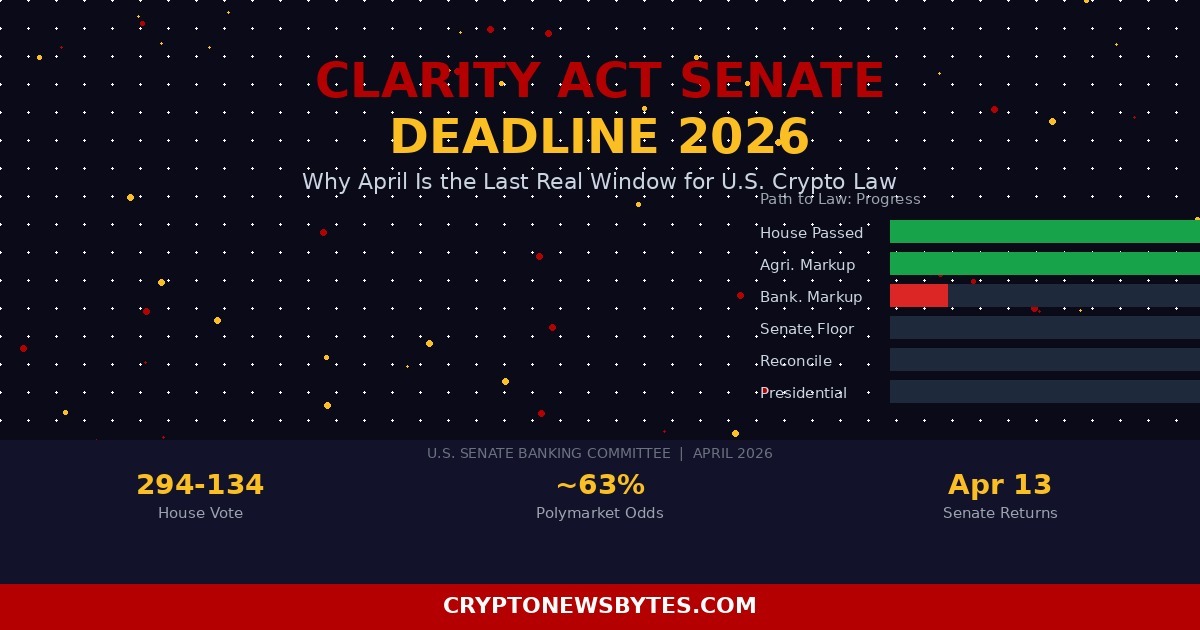
The Senate Banking Committee postponed its CLARITY Act markup on January 14, 2026, the morning it was scheduled to begin. It has not rescheduled. The Senate returns from Easter recess on April 13. Senator Bernie Moreno has said plainly that if the bill does not reach the full Senate floor by May, midterm election dynamics push comprehensive crypto legislation off the calendar for the rest of 2026, and potentially beyond. That makes the next three weeks the most consequential window U.S. crypto regulation has seen in years, and the most important variable has nothing to do with blockchain technology: it is whether two Senate factions can agree on whether a stablecoin balance should earn interest.
Galaxy Research analyst Alex Thorn has flagged that with only 18 working weeks remaining before the midterm recess on October 5, each week of delay compresses available floor time to the point where 2026 passage becomes structurally implausible without Banking Committee clearance by April’s end. Bernstein analysts described the window as “here and now” as far back as January. That window has since narrowed further.
The Bill That Keeps Missing Its Own Deadlines
The Digital Asset Market Clarity Act (H.R. 3633) passed the House of Representatives on July 17, 2025, with a bipartisan vote of 294 to 134. It was written to divide crypto oversight between the SEC and the CFTC, classify most tokens as digital commodities, and create a formal on-ramp for institutional participation. White House crypto adviser David Sacks announced in December 2025 that a Senate markup was confirmed for January. That markup was postponed on the morning it was scheduled to begin, after over 100 amendments had been filed and it became clear the votes were not there.
The Senate Agriculture Committee, which holds jurisdiction over the CFTC-related portions of the bill, moved its version forward on January 27, 2026. The Senate Banking Committee, chaired by Tim Scott, has not yet held its markup. Until Scott’s committee acts, the bill cannot reach the Senate floor. Both committee versions must then be reconciled with each other and with the House-passed text before a final bill can go to the president. That reconciliation process has not begun.
The White House set March 1 as the deadline for banks and crypto firms to resolve the stablecoin yield language. That deadline passed without a public compromise. The Banking Committee then eyed a mid-to-late March markup window. That window also passed, with the Senate entering Easter recess on March 26. The bill now awaits the Senate’s return on April 13, with a markup window targeted for the second half of April.
CLARITY Act Legislative Timeline: A History of Missed Windows
Source: congress.gov, senate.gov, The Block, CoinDesk | April 2026.
| May 2025 | |
| Jul 17, 2025 | |
| Dec 2025 | |
| Jan 14, 2026 | |
| Jan 27, 2026 | |
| Mar 1, 2026 | |
| Mar 20, 2026 | |
| Mar 26, 2026 | |
| Apr 13, 2026 | |
| May 2026 → |
Green = milestone reached. Amber = partial progress. Red = missed window or deadline. Blue = upcoming. Dashed = projected point of no return.
The Four Factions Holding the Bill Hostage
What began as a jurisdictional question between the SEC and the CFTC has become a four-way standoff, each camp capable of slowing the process. Crypto firms, led by Coinbase, want activity-based stablecoin rewards preserved. Coinbase’s CLO Paul Grewal has called the banks’ deposit-flight argument “theoretical, with no evidence whatsoever.” The banking sector, represented by the American Bankers Association, the Bank Policy Institute, and the Independent Community Bankers of America, is fighting any yield-adjacent provision. Standard Chartered has estimated that unrestricted stablecoin yields could redirect up to $1 trillion in bank deposits by 2028, a figure the banking lobby has circulated relentlessly.
The SEC and CFTC have moved on their own track: they signed a memorandum of understanding in March and the SEC issued a fresh interpretive release on March 17, 2026, classifying how federal securities laws apply to certain crypto assets. Those administrative moves deliver some of what Congress had reserved for itself, but only as regulatory guidance, not statute. A future administration can reverse them. The fourth bloc, structural critics including consumer groups like Better Markets and academics like former CFTC Chair Timothy Massad, argue the bill strips investor protections from an asset class that has repeatedly harmed retail participants.
Senate Democrats have added a fifth unresolved issue: an ethics provision that would prohibit sitting government officials and their family members from financial conflicts involving crypto. Bloomberg estimated last summer that President Trump has earned roughly $620 million from family crypto ventures. That provision has not been resolved and its absence has been cited as a reason for Democratic reluctance to supply the 60 votes needed for Senate floor passage.
The Four-Way CLARITY Act Standoff: What Each Camp Wants
Source: CryptoSlate, Elliptic, FinTech Weekly analysis | April 2026.
| Faction | Core Demand | Red Line | Leverage |
|---|---|---|---|
| Crypto firms | Activity-based stablecoin rewards preserved; no passive yield ban | Full yield ban kills ~20% of Coinbase revenue | $193M Fairshake PAC; 2026 midterm spending |
| Banking sector | Complete ban on stablecoin yield and rewards of any kind | Any yield provision = deposit flight risk | $56.7M lobbying spend; ABA, BPI, ICBA unified |
| Regulators (SEC/CFTC) | Statutory basis for joint jurisdiction framework | Administrative moves already partially deliver this | Signed MOU March 2026; issuing own guidance |
| Structural critics | Stronger investor protections; ethics provisions on Trump family | Bill without ethics clause loses Democratic votes | 60-vote Senate threshold requires Democratic support |
Coinbase stablecoin revenue estimated at ~20% of Q3 2025 total revenue per company disclosures.
The Tillis-Alsobrooks Compromise Is Still Not Enough
On March 20, Senators Thom Tillis (R-NC) and Angela Alsobrooks (D-MD) announced a compromise in principle: a ban on passive yield for simply holding stablecoin balances, paired with an allowance for activity-based rewards tied to payments, staking, liquidity provision, or collateral posting. Senate Banking Committee Chair Tim Scott released draft language in January that reflected this structure, barring yield for idle holdings while carving out activity-linked incentives. But the full revised text that Tillis’s office described as following further industry conversations had not been published when the Senate entered recess on March 26. Coinbase and Stripe have not publicly accepted the current draft.
TD Cowen analyst Jaret Seiberg said his firm was increasingly pessimistic that the bill gets done before midterms. The banks entered the recess with their preferred text intact: the baseline heading into any late-April markup is bank-friendly, without the White House’s former crypto czar David Sacks managing the process from inside the administration. Sacks confirmed his 130-day PCAST term had expired. No replacement has been announced.
Senators Lummis and Alsobrooks have described the remaining issues as 99% resolved. Senator Bill Hagerty told a Vanderbilt University digital assets summit that he believes the Banking Committee can advance the bill during the April 13 work period. But Scott controls the calendar. Before he puts a date on it, the yield text must hold, and additional outstanding issues, including DeFi provisions, token classification specifics, and the ethics clause on government officials’ crypto holdings, require resolution.
Five Steps Remain Before a Bill Reaches the President’s Desk
Even if the Senate Banking Committee marks up the bill in late April, the legislative math is demanding. The bill still requires a full Senate floor vote requiring 60 votes to advance past a filibuster, reconciliation of the Banking Committee version with the Agriculture Committee version (markup completed January 27), reconciliation of the combined Senate bill with the House-passed CLARITY Act from July 2025, a final House vote on the reconciled text, and a presidential signature. The reconciliation process in complex legislation typically takes months. None of it has begun.
CLARITY Act: The 5-Step Path to Law (None Completed)
Source: congress.gov legislative process, crypto.news, FinTech Weekly | April 2026.
1 | Senate Banking Committee Markup Targeted: Late April 2026. Tim Scott controls scheduling. Stablecoin text and ethics clause still unresolved. | PENDING |
2 | Full Senate Floor Vote (60-vote threshold) Requires bipartisan Democratic support. Ethics clause absence could cost votes. Must happen before August recess. | NOT STARTED |
3 | Senate Banking + Agriculture Reconciliation The two Senate committee versions must be merged. Agriculture markup done Jan 27; Banking Committee not yet marked up. | NOT STARTED |
4 | Senate-House Reconciliation Combined Senate bill must align with House-passed CLARITY Act (July 2025). Differences in DeFi, classification, and fee structures require resolution. | NOT STARTED |
5 | Presidential Signature Trump has expressed support. March 8 post conditioning signature on SAVE Act passage was an earlier complication now largely resolved. | NOT STARTED |
Step 1 is the decisive gate. Missing it before May effectively kills the 2026 window per Senator Moreno and Galaxy Research’s floor-time analysis.
What Passage Odds Actually Mean for Institutional Capital
Polymarket prices a 63% chance of the CLARITY Act being signed in 2026, down from roughly 72% in early March. JPMorgan analysts led by Nikolaos Panigirtzoglou have described passage by midyear as a “positive catalyst” for digital assets, citing regulatory clarity, institutional scaling, and tokenization growth as key drivers. Goldman Sachs separately identified the regulatory backdrop as a primary driver of institutional crypto adoption in a report earlier this year, noting that 35% of surveyed institutions cite regulatory uncertainty as the biggest hurdle to allocation.
Standard Chartered analyst Geoffrey Kendrick has projected that CLARITY Act passage could unlock a $4 to $8 billion surge in XRP ETF inflows alone, and broader institutional crypto allocations could follow as the legal framework around asset classification and exchange registration becomes permanent federal law rather than reversible regulatory guidance. For assets like XRP, SOL, ADA, and AVAX, the difference matters: the SEC’s March 17 interpretive release on digital commodities can be undone by a future administration. The CLARITY Act cannot.
For Bitcoin and Ethereum, the direct impact of CLARITY is more limited since both are already treated as commodities under existing regulatory practice. The indirect benefit is institutional confidence: large asset managers and pension funds that have been waiting for a unified statutory framework before scaling allocations may be more willing to commit capital when the rules are law, not guidance. BlackRock’s staked Ethereum ETF push and the broader tokenized real-world assets market, which stands at $27.59 billion according to RWA.xyz data as of April 2026, are both more structurally secure with statutory clarity behind them.
CLARITY Act Passage Odds vs. Institutional Barriers to Crypto Allocation
Source: Polymarket, Goldman Sachs institutional survey, JPMorgan research | April 2026.
| CLARITY Act 2026 Passage (Polymarket) | |
| Garlinghouse (Ripple) estimate | |
| Institutions citing regulatory uncertainty as #1 barrier | |
| Institutions planning to increase crypto AUM in 12 months | |
| Kalshi 2026 passage odds (as of Mar 20) |
Goldman Sachs institutional survey data from 2026 report. Polymarket as of early April 2026. Kalshi as of March 20, 2026.
The Risks Neither Side Is Discussing Openly
The CLARITY Act’s proponents argue the bill is essential to keeping the U.S. from ceding crypto innovation to jurisdictions that have already moved. The EU’s MiCA framework is in effect. Hong Kong has a functioning VATP licensing regime. Singapore, the UAE, and Japan all have statutory crypto frameworks. Regulatory arbitrage is already happening, as CoinDesk reported earlier this year. The failure scenario is not just delay; it is institutional capital flowing to jurisdictions with clearer rules while U.S.-based firms operate on administrative guidance that the next SEC chair can reverse.
But the bill’s critics have a legitimate point that has not received enough attention. The CLARITY Act, as written, would classify most tokens as digital commodities under CFTC jurisdiction while limiting SEC oversight. Former CFTC Chair Timothy Massad and groups like Better Markets have argued that the CFTC lacks the budget, staffing, and market-surveillance infrastructure to oversee a market that trades 24 hours a day, seven days a week, globally. The CFTC’s own leadership has acknowledged these constraints. A framework that expands CFTC jurisdiction without expanding CFTC resources could create a compliance structure that looks rigorous on paper but is under-enforced in practice.
The Tillis-Alsobrooks stablecoin compromise also carries an underexplored risk. The current draft bans passive yield but permits activity-based rewards. The definition of “activity” has not been published. Coinbase and Circle will attempt to maximize what qualifies as an activity. Banks will attempt to minimize it. That definitional fight, if it ends up in court rather than in the committee room, could produce years of litigation over whether a given reward program constitutes a banned yield or a permitted activity, undermining the very clarity the bill is meant to provide.
The Political Money Behind the Deadline
Fairshake, the crypto-aligned political action committee, has disclosed a $193 million fundraising total for the 2026 midterm elections. Top donors include Coinbase ($25 million), Ripple Labs ($25 million), and a16z ($24 million). The Fellowship PAC has claimed over $100 million from crypto-supportive donors. The banking sector spent $56.7 million on lobbying in 2025, not all CLARITY-specific, per OpenSecrets. Both industries have enough money and motivation to hold their ground, and both sides know it. The question that neither publicly answers is who loses more by failing. For crypto, the answer is clearer: stagnation. For banks, the current status quo, expensive to maintain but familiar, may be preferable to a regulatory framework that legitimizes crypto as a direct competitor to deposit accounts.
Tim Scott has publicly described the CLARITY Act as essential to cementing America’s role as the crypto capital of the world. Whether that rhetoric translates into a scheduled markup date before April ends is the only question that matters between now and May. The Senate returns April 13. The window, as Bernstein put it months ago, is here and now. It is also, finally, almost closed.
Frequently Asked Questions
What is the CLARITY Act and what would it do?
The Digital Asset Market Clarity Act (H.R. 3633) is U.S. legislation that would establish a federal regulatory framework for digital assets by dividing oversight between the SEC and the CFTC. Most tokens would be classified as digital commodities under CFTC jurisdiction. The bill creates exchange registration requirements, investor protections, and a DeFi carve-out protecting non-controlling software developers. It passed the House 294-134 in July 2025 and is currently stalled in the Senate Banking Committee over stablecoin yield.
Why does the April Senate markup matter so much?
The Senate returns from Easter recess on April 13. The Banking Committee markup is targeted for late April. If the bill does not clear the Banking Committee before May, Galaxy Research’s Alex Thorn has calculated that only 18 working weeks remain before the midterm recess on October 5. Each week of delay compresses floor time until a 2026 signing becomes structurally impossible. Senator Bernie Moreno has said explicitly that missing May pushes the bill off the calendar for the rest of 2026.
What is the stablecoin yield fight actually about?
Banks want to prevent crypto platforms from paying any interest or return on stablecoin balances, arguing it would trigger deposit flight from traditional savings accounts into crypto platforms. Standard Chartered estimated up to $1 trillion in deposits could shift by 2028. Crypto firms argue this is theoretical and that the revenue at stake is a significant share of their business: stablecoin-related income represented approximately 20% of Coinbase’s total Q3 2025 revenue. The Tillis-Alsobrooks compromise bans passive yield on idle balances but permits activity-based rewards, leaving the definition of “activity” unresolved.
What happens to crypto if the CLARITY Act fails in 2026?
The SEC and CFTC have already issued joint guidance and interpretive releases providing some of the clarity the bill would codify. But administrative guidance can be reversed by a future administration. Institutional capital that requires statutory certainty, not reversible regulatory guidance, would remain on the sidelines. The U.S. would continue to operate under a patchwork of state licenses and SEC enforcement actions while the EU’s MiCA framework, Hong Kong’s VATP regime, and other jurisdictions attract regulated crypto activity. The crypto lobby’s $193 million PAC investment for the 2026 midterms reflects the industry’s view of the stakes.
How is the CLARITY Act different from the GENIUS Act?
The GENIUS Act, signed into law by President Trump, covers stablecoin regulation specifically: who can issue stablecoins, what reserves must back them, and which agencies supervise issuers. The CLARITY Act is the broader market structure bill covering everything else: token classification, exchange registration, SEC/CFTC jurisdictional split, DeFi treatment, and investor protections. Both are designed to work together. The GENIUS Act is done. The CLARITY Act is not.
Further Reading
A detailed breakdown of the stablecoin yield negotiations and what the latest compromise language actually says.
The March 17 interpretive release that partially delivers what the CLARITY Act would codify in statute.
How the regulators are using administrative coordination to get ahead of Congressional inaction.
The regulatory parallel track moving alongside, and potentially ahead of, the CLARITY Act.
Context on how the CFTC is positioning itself ahead of an expanded mandate under the CLARITY Act.
The international context: what the U.S. risks by failing to pass the CLARITY Act while other jurisdictions move forward.
This article is for informational purposes only and does not constitute financial advice. Consult a qualified adviser before making investment decisions. Sources: congress.gov H.R.3633, CoinDesk, The Block, Elliptic, FinTech Weekly. Published April 8, 2026.