Travala CEO Juan Otero did not mince words when his company launched Travel MCP on June 5, 2026. “The launch of the world’s first agentic AI travel protocol marks the death of the checkout button.” That is either an extravagant press release line or an accurate description of where crypto payments are heading. Given the numbers behind it, it is closer to accurate.
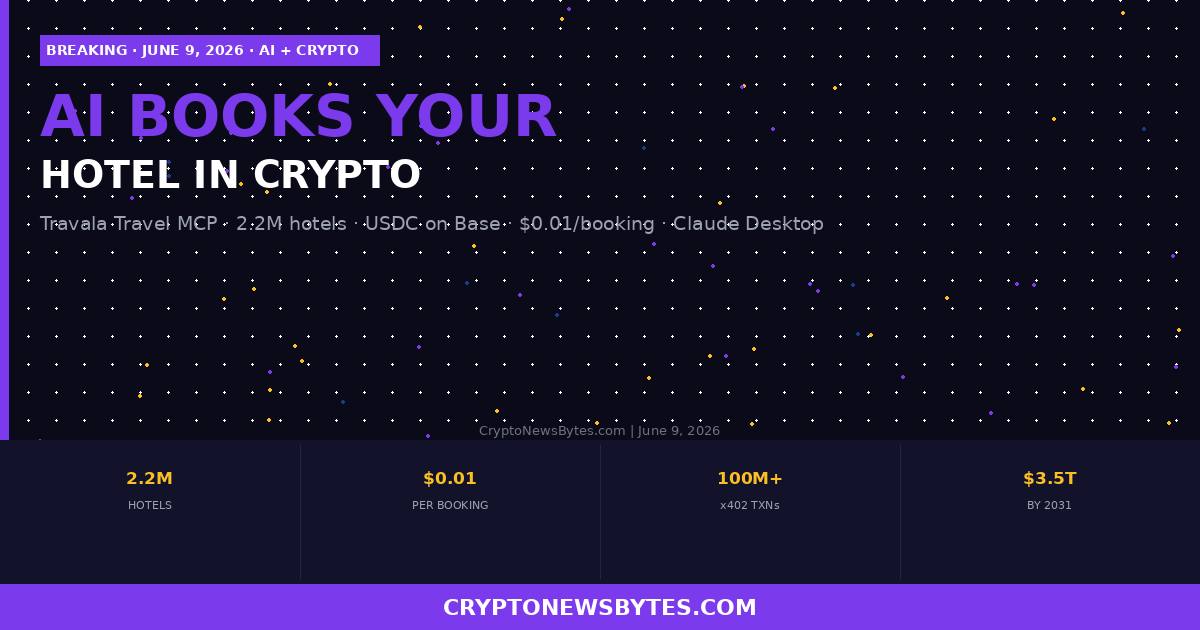
The Singapore-based crypto travel platform launched a protocol that lets AI agents search, compare, reserve, and initiate payment for hotels using USDC on Coinbase’s Base network. The system connects Travala’s inventory of 2.2 million hotel properties across 230 countries, including Marriott, Hilton, and IHG, to AI assistants through the Model Context Protocol. Payments cost approximately one cent per transaction and settle almost instantly. The system is already live through Claude Desktop. A traveler can open a chat, describe what they need, and have an AI agent handle every step of the booking process up to the final payment confirmation, which still requires human approval.
What Travel MCP Actually Does
The Model Context Protocol is an open standard developed by Anthropic that lets AI applications connect to external services, databases, and tools. When Travala integrates its hotel inventory through MCP, it means any AI assistant that supports the protocol, including Claude Desktop, can query Travala’s system, search availability, compare prices, and prepare a reservation as part of a conversation. The payment layer is handled by Coinbase’s x402 protocol on Base: a USDC transaction that costs one cent and settles almost instantly without requiring a blockchain wallet in the traditional sense.
The practical user experience looks like this: open your AI assistant, type “find me a hotel near the Beato Innovation District in Lisbon for two nights from June 4, budget under $200 per night,” and the agent searches Travala’s inventory, surfaces options, presents pricing, and prepares the booking. You confirm the payment. One cent leaves your USDC balance. The booking is made. No separate travel app. No credit card details entered. No checkout page.
The important caveat: final payment authorization still requires the user to approve. The system is not fully autonomous. Travala positions this as intentional: the agent handles research and preparation, the human retains final control. This is how most agentic systems in 2026 work, which is the right design given that payments are irreversible and the legal framework for autonomous AI financial agents is not settled.
The x402 Infrastructure Behind It
Travala’s launch sits on top of infrastructure that has been quietly scaling for over a year. Coinbase’s x402 protocol on Base went from near-zero in mid-2025 to more than 100 million cumulative transactions by Q1 2026. The transactions are largely low-value, consistent with microtransactions like $0.01 API calls, hotel bookings, and content access, but they are growing in size. Fireblocks, MoonPay, Exodus, and Oobit have all launched products aimed at AI-driven stablecoin payments on top of this infrastructure in recent months. The stack is real and scaling.
The developer incentive Travala is offering is also worth noting: a 10% Coinbase Wrapped Bitcoin rebate on completed hotel stays booked through AI agents. That is a meaningful financial incentive for developers integrating travel agents and signals that Travala is treating this as an ecosystem acquisition play, not just a feature launch. The company is paying to seed the agent economy with travel bookings the same way early Airbnb seeded supply with free professional photography.
How an AI Agent Books a Hotel in 2026
Travala Travel MCP on Base via x402 | @cryptonewsbytes
User prompt in AI assistant
“Find me a hotel in Lisbon for two nights, under $200, near Beato.” No app switching. No search engine.
AI queries Travala via MCP
Model Context Protocol connects Claude to Travala’s 2.2M property inventory. Real-time availability and pricing returned.
Agent surfaces options, prepares booking
Comparison presented in conversation. User picks a property. Agent prepares the reservation.
User approves payment
Human confirms. x402 protocol sends USDC on Base. $0.01 transaction fee. Near-instant settlement. Booking confirmed.
Source: Travala, Coinbase x402, CoinTelegraph | @cryptonewsbytes. Not financial advice.
The Market Size and Why This Matters for Crypto Adoption
Morgan Stanley estimates that agentic shoppers could represent 20% of all online commerce by 2030. Separate projections put autonomous AI transaction volumes at $8 billion in 2026 growing to $3.5 trillion by 2031. These numbers are speculative, but the direction is not. The companies building AI agent infrastructure right now, including Anthropic with MCP, Coinbase with x402, and Travala with Travel MCP, are positioning for a world where AI agents spend money on behalf of users as routinely as they provide information.
The crypto angle is specific: stablecoins on efficient Layer 2 networks are the ideal payment rail for AI agents. Traditional payment systems require accounts, authentication flows, and processing delays that make them unsuitable for machine-to-machine transactions at scale. A USDC transfer on Base costs one cent and settles in seconds. That is the infrastructure AI agents need to operate in commerce. Travala’s Travel MCP is one of the first real-world applications that shows what mass adoption via AI agents could actually look like: not users choosing to use crypto, but users choosing to use AI assistants that happen to settle payments in crypto without the user needing to know or care.
1. x402 agentic transaction growth on Base
x402 Protocol: Agentic Transaction Growth on Base
Cumulative transactions | Sources: Chainalysis, BitKE | @cryptonewsbytes
x402 agentic transactions on Base grew from near-zero to 100M+ in under 12 months.
Sources: Chainalysis data via BitKE | @cryptonewsbytes
2. Agentic economy market size projections
The Agentic Economy: Market Size Projections
Morgan Stanley + industry estimates | @cryptonewsbytes
Morgan Stanley projects agentic shoppers at 20% of e-commerce by 2030. Bar scaled for illustration.
Sources: Morgan Stanley, CoinTribune, Travala | @cryptonewsbytes
3. Booking cost: traditional vs AI agent
Booking Cost: Traditional OTA vs AI Agent on Crypto Rails
Per-booking cost comparison | @cryptonewsbytes
A $200 hotel booking costs $30-50 in OTA commission vs $0.01 via AI agent on Base.
Sources: Travala, Coinbase x402 documentation | @cryptonewsbytes
Frequently Asked Questions
Do I need to hold crypto to use Travala’s AI booking?
The payment system uses USDC on Base, so yes, some USDC is required to settle the booking. However, USDC is a dollar-pegged stablecoin and acquiring it is increasingly straightforward through most exchanges and apps. Travala also accepts more than 100 cryptocurrencies and fiat currencies, so AI booking with USDC is one option within a broader payment ecosystem.
Is the AI making payments autonomously without user control?
No. Final payment authorization still requires manual approval from the user. The AI handles search, comparison, and booking preparation. The human approves the payment. Travala has framed this design as intentional, preserving user control while reducing the manual effort of the booking process. Fully autonomous payments remain a future development as legal and technical frameworks for AI financial agents mature.
Further Reading
AI agents paying in USDC depend on the same stablecoin rails the CLARITY Act is regulating. Whether those rails remain open shapes how fast the agentic economy scales.
AI booking travel and crypto exchanges breaking open IPO access are two sides of the same 2026 thesis: crypto infrastructure removing the gatekeepers.
Another example of crypto removing financial friction for users who were previously excluded from the global system.
This article is for informational purposes only and does not constitute financial advice. Sources: CoinTelegraph, Crypto.news, CoinTrust, BitKE, CryptoDnes, CoinTribune, Travala official announcement June 5 2026. Published June 9, 2026.