
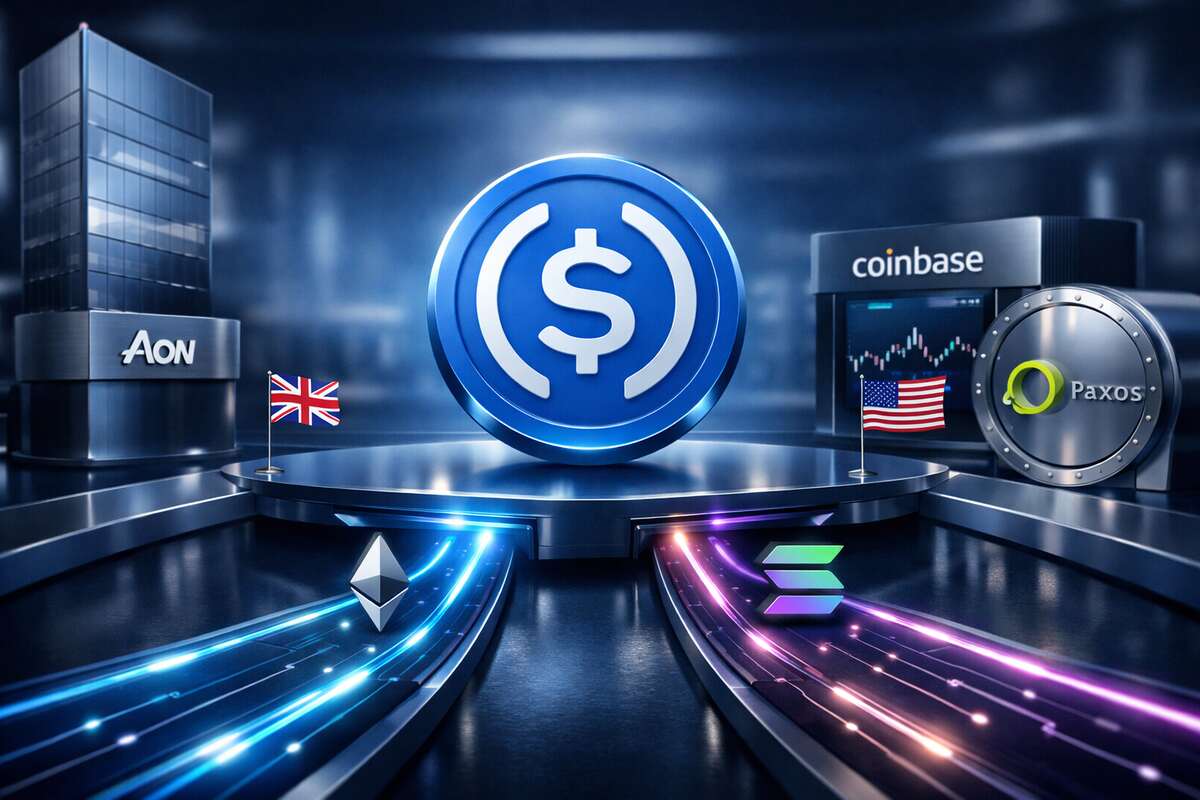
- Aon runs a proof-of-concept using USDC stablecoins on Ethereum and Solana to settle insurance premium payments in collaboration with Coinbase and Paxos
- The trial examines how stablecoin payments could fit into existing insurance and corporate finance systems amid clearer U.S. regulation under the Genius Act
Aon has completed a trial using stablecoins to settle insurance premium payments, signaling an early shift in how large corporate transactions might be processed. The London-headquartered insurance broker, which advises on $5 trillion in assets, tested blockchain-based payments in a controlled environment as stablecoins continue to edge into mainstream finance.
Aon’s Stablecoin Trial and Partners Involved
In its recent proof-of-concept, Aon used a stablecoin to complete premium settlements, working with several major crypto and blockchain firms. The company collaborated with Coinbase, a leading cryptocurrency exchange, and Paxos, a blockchain infrastructure provider, to carry out the test transactions. The payments were conducted using USDC, the dollar-pegged token issued by Circle Internet, on both the Ethereum and Solana blockchains.
According to Aon, this exercise represents what it believes to be the first instance of a large global insurance broker accepting stablecoins for insurance premium settlement, even though the activity was restricted to a demonstration setting. The company did not present it as a full commercial rollout, but as a way to explore how tokenized dollars can be integrated into established insurance payment workflows. The trial underscores growing interest in whether blockchain-based assets can handle high-value, institutional transactions within existing regulatory and operational structures.
How Stablecoins Could Change Insurance Payments
The test highlights potential efficiencies in an area of finance where payments can be slow and complex. Insurance premiums, particularly those tied to cross-border policies and large corporate programs, typically move through multiple banks before reaching their final destination. Conventional clearing processes can stretch over several days when payments cross jurisdictions or involve several intermediaries.
By contrast, proponents of blockchain payments argue that stablecoins allow funds to transfer in minutes, regardless of geography, while also producing an on-chain record that can be audited. In Aon’s trial, USDC on Ethereum and Solana served as the payment rail, illustrating how a dollar-pegged token might operate alongside existing corporate treasury systems. The proof-of-concept did not replace bank channels but instead examined whether blockchain settlement could sit within the same frameworks that corporate finance teams already use.
John King, Aon’s head of corporate portfolio strategy and treasurer, noted that widespread use of stablecoins in corporate payments remains at an early stage. However, he emphasized that the long-term opportunity could be substantial and that the company wants to understand how these mechanisms function within current systems so it can assess efficiency and cost implications as the technology develops.
Regulatory Context and the Growing Stablecoin Market
Aon’s experiment comes at a time when stablecoins, with a combined market size of around $300 billion, are becoming more integrated into traditional financial markets. One key factor has been the clearer regulatory stance in the United States. The U.S. Genius Act, passed in 2025, created a federal framework for stablecoin issuers, establishing rules for reserves and oversight.
This legislation has encouraged a broader set of institutions—including banks, fintech firms and major corporations—to test stablecoin-based payment and settlement models. With defined standards around backing assets and regulatory supervision, companies like Aon are more willing to explore tokenized dollars as part of their payment infrastructure. The proof-of-concept thus reflects both technological experimentation and a response to evolving regulatory guidance.
Aon’s use of USDC in partnership with Coinbase and Paxos also demonstrates how traditional financial firms and crypto-native platforms are starting to collaborate. Blockchain service providers supply the technical rails, while brokers and corporates bring established client networks and existing financial obligations that could eventually move onto these rails if trials prove successful.
Conclusion
Aon’s stablecoin proof-of-concept shows how a major insurance broker is beginning to test blockchain-based settlement for premium payments. By using USDC on Ethereum and Solana with partners Coinbase and Paxos, the firm examined whether stablecoins can fit within its existing systems and regulatory requirements. The initiative reflects a broader trend in which the growing stablecoin market, supported by clearer rules such as those in the U.S. Genius Act, is being evaluated as part of the infrastructure for large-scale corporate finance. While the trial was limited in scope, it points to a possible shift in how cross-border insurance payments and other high-value transactions may be handled in the future.
Disclaimer
The information provided in this article is for informational purposes only and should not be considered financial advice. The article does not offer sufficient information to make investment decisions, nor does it constitute an offer, recommendation, or solicitation to buy or sell any financial instrument. The content is opinion of the author and does not reflect any view or suggestion or any kind of advise from CryptoNewsBytes.com. The author declares he does not hold any of the above mentioned tokens or received any incentive from any company.
Featured image created by AI