Bank of America ’s Quantum-Resistant Blockchain Patent US-12541579-B2
- Bank of America Leads Post-Quantum Security: Patent US-12541579-B2 outlines a quantum-resistant authentication framework, signaling Bank of America’s transition from classical blockchain systems to post-quantum readiness.
- Dynamic, Continuous Authentication: The patent introduces virtual quantum channels and concurrent validation chains that protect user sessions from “Harvest Now, Decrypt Later” attacks.
- Implications for Blockchain and DeFi: This filing sets a potential institutional standard for secure digital asset custody, sovereign identity, and tokenized asset authentication.
As the global financial sector accelerates toward “Q-Day”—the hypothetical moment when quantum computers could break current RSA and elliptic curve encryption standards—Bank of America (BofA) has secured a strategic defensive asset. On February 3, 2026, the U.S. Patent and Trademark Office issued Patent US-12541579-B2, titled “Tracking quantum-based interactions.”
Far from a theoretical exercise, this patent provides a practical framework for quantum-resistant authentication, signaling BofA’s shift from classical blockchain experimentation to post-quantum (PQ) operational readiness. In a world where quantum computing threatens traditional encryption, this move positions the bank at the forefront of next-generation blockchain security.
The Threat: “Harvest Now, Decrypt Later”
Modern blockchain protocols rely heavily on asymmetric cryptography, which remains secure against classical computing attacks. But in a post-quantum landscape, Shor’s algorithm could derive private keys from public keys in seconds, creating a “Harvest Now, Decrypt Later” (HNDL) scenario: attackers capture encrypted data today, waiting for quantum hardware to break it later.
Traditional authentication sessions are particularly vulnerable. In classical systems, once a session is authenticated, it remains static. If a session key is intercepted and decrypted using quantum methods, the entire user history—including transactions, credentials, and access logs—could be exposed. Patent US-12541579-B2 directly addresses this risk, focusing on fortifying the authentication layer against quantum-enabled attacks.
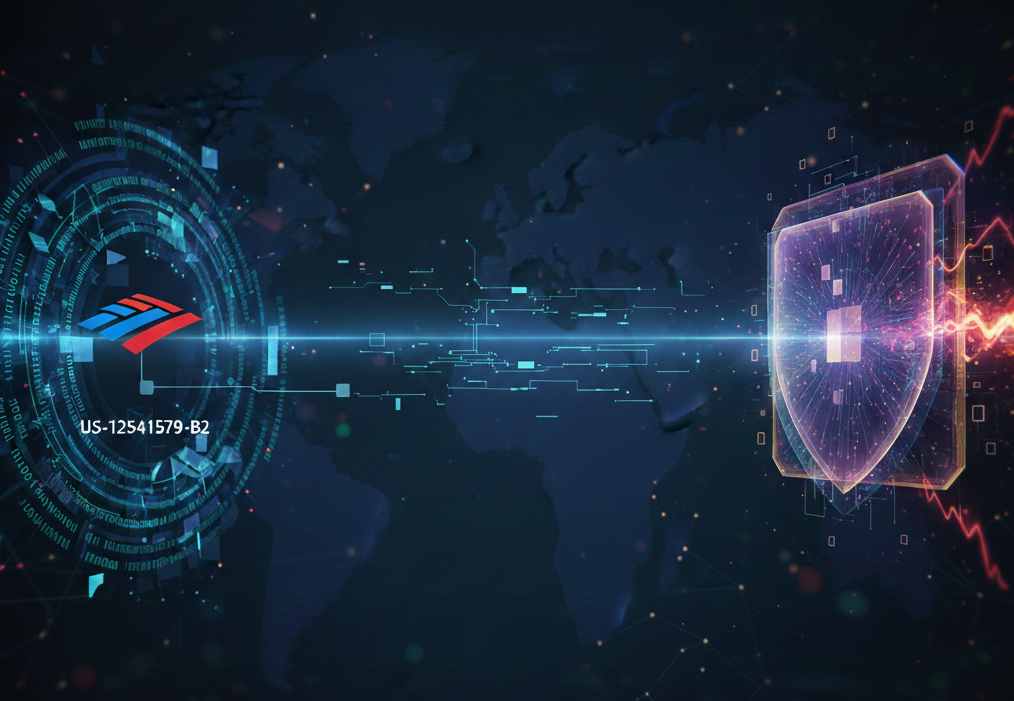
The Solution: Dynamic Virtual Quantum Channels
The BofA filing introduces a sophisticated system that routes an “authentication persona” through a dedicated quantum processor. Key components include:
- Virtual Quantum Channels: Each authentication task is executed through a transient, virtualized channel mapped to a “potential state of quantum information,” inherently resistant to classical interception.
- Concurrent Attribute-Based Chains: Multiple authentication chains run in parallel, validating biometrics, device IDs, geolocation, and behavioral attributes simultaneously.
- Continuous Validation & Scaling: Authentication is no longer a single handshake. The system continuously validates session attributes and scales with additional quantum circuits as workload increases.
This approach transforms authentication from a static process into a dynamic, adaptive, and quantum-hardened mechanism, raising the bar for blockchain security across institutional networks.
Implications for Blockchain and DeFi
While filed by a centralized banking giant, the patent has far-reaching implications for the blockchain ecosystem:
- Institutional Post-Quantum Standards: Banl of America holds nearly 200 blockchain patents, the most of any U.S. financial institution. Their move into Quantum Interaction Tracking may establish a de facto benchmark for enterprise-level post-quantum blockchain practices.
- Trustless Authentication: By validating an “authentication persona” rather than storing raw biometric data in classical databases, the system supports sovereign digital identity and privacy-preserving verification.
- Real-World Asset (RWA) Tokenization: Institutional investors require quantum-safe custody for tokenized assets. BofA’s framework ensures that transfers are executed by authenticated, quantum-verified parties, a crucial step for scaling tokenized real-world assets.
In practice, these developments could shape the next generation of decentralized finance (DeFi) infrastructure, particularly for institutional participants that prioritize security and compliance.
Strategic Analysis: Bank of Americas’s Defensive Moat
Bank of America invests over $12 billion annually in technology, much of it toward next-generation infrastructure. By securing US-12541579-B2, BofA is creating both a legal and technical moat around the access layer of future financial networks.
For developers, investors, and blockchain projects, the filing underscores a vital reality: the race for blockchain dominance is moving off-chain, into cryptographic infrastructure. As the National Institute of Standards and Technology (NIST) finalizes post-quantum standards, BofA’s early capture of Interaction Tracking IP positions them as gatekeepers of secure bridges between quantum systems and blockchain networks.
Conclusion: Preparing for the Quantum Era
Bank of America’s – Patent US-12541579-B2 underscores a critical truth: the security of tomorrow’s financial systems hinges not on faster chains or flashy tokens but on robust, quantum-resistant infrastructure.
Bank of America’s strategic move demonstrates that post-quantum readiness is no longer optional. Institutions that delay quantum-resilient adoption risk exposure, while early movers like BofA are positioning themselves as the guardians of the next era of secure digital assets.
The quantum era is coming. With filings like US-12541579-B2, the largest financial institutions are quietly shaping the security frameworks that will define the future of blockchain and digital finance
References:
- USPTO Patent Full-Text: US-12541579-B2 (Granted Feb 3, 2026)
- BofA Global Research: “Quantum Computing Progress” (Oct 2025
The “Receipts”: Patent Verification
- Patent Number: 12,541,579
- Title: “Tracking quantum-based interactions”
- Grant Date: February 3, 2026
- Assignee: Bank of America Corporation
- Inventors: Michael Young, Manu Kurian, Ana Maxim