
3 Key Takeaways
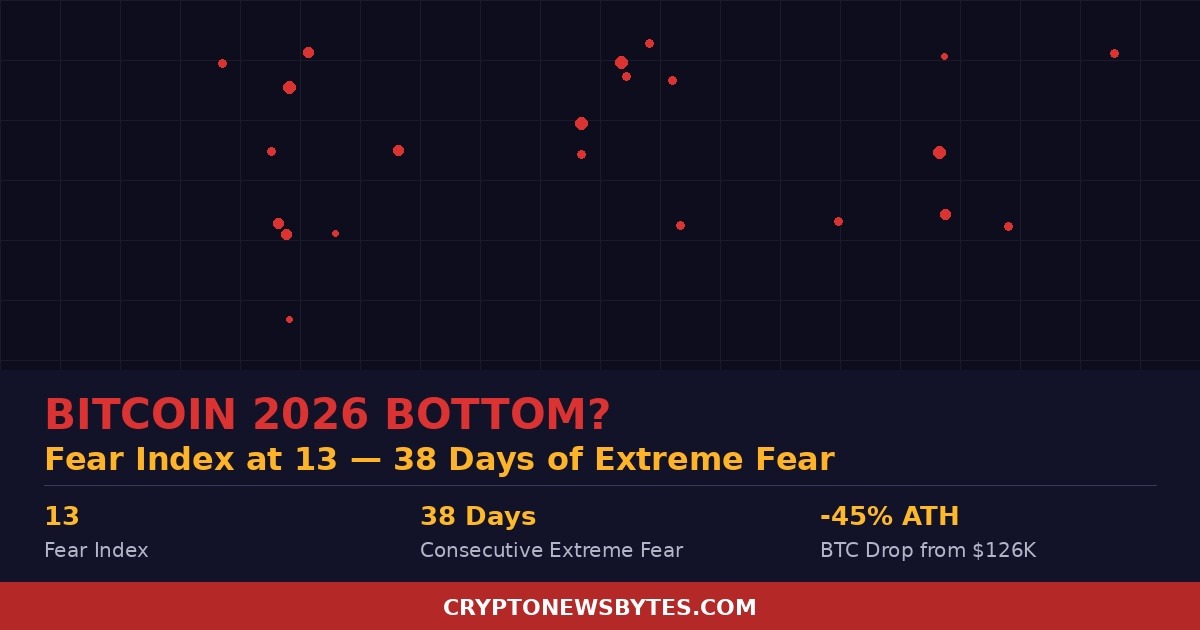
- The Crypto Fear and Greed Index reads 13 (Extreme Fear) as of March 11, 2026, marking 38 consecutive days in extreme fear territory — the longest sustained streak since the Terra and Luna collapse in May 2022, per MEXC and Alternative.me data. Bitcoin has recovered from a $60,062 low in early February to trade around $69,700, a bounce of nearly 16%.
- Bitcoin’s weekly RSI has collapsed to 27.48, its lowest reading since the 2018 bear market capitulation, per Glassnode data. BTC dominance has climbed to 56.9%, with total crypto market cap at $2.45 trillion. Bitcoin is down approximately 45% from its $126,000 all-time high reached in October 2025.
- Options markets are pricing in a 35% probability that Bitcoin trades above $80,000 by the end of June 2026, per Derive.xyz data cited by CoinDesk. Nearly $700 million has flowed into U.S. spot Bitcoin ETFs in March so far, signaling renewed institutional appetite despite — or because of — the extreme fear readings.
Thirty-eight days. That is how long the crypto market has been stuck in extreme fear, according to the Crypto Fear and Greed Index tracked by Alternative.me. It is the longest consecutive streak in that territory since the Terra and Luna ecosystem collapsed in May 2022, wiping out over $40 billion in market value in a matter of days.
The current situation is different from Terra. There has been no catastrophic fraud, no exchange implosion, no single event that triggered the drawdown. What there has been is a brutal combination of macroeconomic pressure — tariff escalation, Fed rate uncertainty, Middle East war risk — that has dragged Bitcoin down 45% from its October 2025 all-time high of $126,000 to a February low of $60,062, before a partial recovery back to approximately $69,700 as of March 11.
The question the data is forcing investors to ask: is this the Bitcoin 2026 bottom, or is there more pain ahead?
Bitcoin 2026 Bottom Signal 1: Fear Index at 13, Longest Streak Since Terra
The Crypto Fear and Greed Index measures market sentiment on a scale from 0 (maximum fear) to 100 (maximum greed), aggregating volatility, trading volume, social media activity, Bitcoin dominance, and search trends into a single daily score. A reading of 13 places the market firmly in “Extreme Fear” — and at 38 consecutive days in that zone, this is not a temporary spike of panic. It is a sustained state of investor despair.
Historical context matters here. The index hit similar lows in three prior episodes that now look like cycle bottoms in hindsight. In December 2018 with BTC at $3,200, the index fell to 10. Investors who accumulated at that reading saw Bitcoin rally above $14,000 within eight months. In March 2020 with BTC at $5,000, the index hit 8. Bitcoin reached $64,000 within 13 months. In November 2022 with BTC at $17,600 following the FTX collapse, the index fell to 12 and stayed in extreme fear for weeks. Bitcoin recovered to $73,000 within 18 months.
The current reading of 13, sustained for 38 days, sits alongside those three prior extreme episodes as one of only four times in the index’s history that sentiment has dropped to 15 or below, according to Spoted Crypto’s analysis of Alternative.me data. Whether that means the Bitcoin 2026 bottom is in, or simply that the market is deeply oversold, is the central analytical question right now.
The caveat is real: past extreme fear readings have occasionally been followed by further declines before the eventual recovery. June 2022 saw multiple weeks of extreme fear readings before BTC found its final low around $17,600 in November 2022. Sentiment alone is not a timing tool. But as a context signal — a measure of how thoroughly bearish the market has become — a 38-day extreme fear streak carries significant historical weight.
Bitcoin 2026 Bottom Signal 2: Weekly RSI at 27 — Lowest Since 2018
Bitcoin’s weekly Relative Strength Index has collapsed to 27.48, its lowest reading since the 2018 bear market capitulation, per Glassnode data cited by Spoted Crypto. The RSI is a momentum oscillator that measures the speed and magnitude of price changes on a scale from 0 to 100. Readings below 30 are traditionally considered “oversold” — a condition that historically has not persisted indefinitely.
In the three prior instances where Bitcoin’s weekly RSI fell below 30, the asset was within a few weeks of a meaningful bottom. In December 2018, the weekly RSI hit approximately 27 before the long-term recovery began. In March 2020 during the COVID crash, the weekly RSI briefly touched similar levels. In June 2022, oversold RSI readings preceded a brief bounce before the final capitulation in November. The current reading at 27.48 places BTC in the same technical neighborhood as those historical troughs.
Technical indicators do not operate in isolation. The broader macro environment — explored in the CryptoNewsBytes Fed rate decision analysis — remains a complicating factor. The Fed held rates at 3.50 to 3.75% with no cut signaled in the near term. Hawkish rate environments have historically compressed Bitcoin’s recovery timeline. But the RSI reading, combined with the fear index data, paints a picture of a market that has been sold down to levels consistent with prior bottoms rather than a market in the middle of a decline.
Bitcoin 2026 Bottom Signal 3: 38 Days of ETF Inflows Drying Up — Then Returning
One of the more remarkable data points in the current market is the behavior of U.S. spot Bitcoin ETFs. After recording $3.8 billion in outflows during February — the largest monthly outflow since the products launched in January 2024 — ETF flows reversed sharply in the first week of March.
According to FXStreet data, spot Bitcoin ETFs recorded two consecutive days of inflows in the first week of March. CoinDesk reported that approximately $1.14 billion in net inflows came in across just three days following the geopolitical turbulence triggered by U.S. and Israeli strikes on Iranian targets. By March 10, total ETF inflows for the month had reached nearly $700 million, per trading economics data.
This pattern — large institutional outflows followed by a sharp reversal as prices stabilize — is consistent with what analysts call “weak hand to strong hand” transitions. The February outflows represented retail and short-term institutional holders reducing exposure at the bottom of the fear cycle. The March inflows represent a different cohort: longer-duration holders who treat extreme fear readings as entry signals rather than exit signals. As covered in the Bitcoin ownership shift analysis on CryptoNewsBytes, institutions accumulated 829,000 BTC throughout 2025 while individual holders reduced positions. That institutional accumulation bias has not reversed.
Bitcoin 2026 Bottom Signal 4: BTC Dominance at 56.9% — Capital Concentration
Bitcoin dominance — BTC’s share of total crypto market capitalization — has climbed to 56.9%, according to CoinGecko data as of March 11. That is the highest reading of the current cycle. The total crypto market cap sits at .45 trillion, down from over .5 trillion at the October 2025 peak.
Rising BTC dominance during a market downturn is a historically consistent pattern in late-stage bear markets. Capital retreats to the most liquid, most institutionally held asset in the space — Bitcoin — while smaller altcoins suffer disproportionate losses. This is confirmed by the altcoin data. As the altcoin crash analysis on CryptoNewsBytes documented, 38% of altcoins are trading near their all-time lows, a drawdown that exceeds the levels seen after the FTX collapse in November 2022.
In prior cycles, peak BTC dominance has tended to precede the broader market recovery by several months. Capital stabilizes in Bitcoin first, then rotates outward into altcoins as confidence returns. The 56.9% dominance reading is not a timing signal on its own, but it is consistent with a late-stage cycle contraction rather than an ongoing mid-cycle correction.
Bitcoin 2026 Bottom Signal 5: Options Market Pricing in an $80K Recovery
Derivatives markets — often more forward-looking than spot price action — are beginning to price in a recovery. According to Nick Forster, founder of on-chain options platform Derive.xyz, current options pricing implies approximately a 35% probability that Bitcoin trades above $80,000 by the end of June 2026, per CoinDesk reporting.
The options skew data tells a complementary story. Bitcoin’s seven-day and 30-day skews have recovered from -25% during the panic lows in early February — when BTC cratered toward $60,000 — back to approximately -6% as of March 11. A skew of -6% means puts (downside protection) are only marginally more expensive than calls (upside bets). At -25%, the market was pricing in a genuine crash scenario. The normalization of skew from -25% to -6% represents a significant shift in how the derivatives market is assessing risk.
Put shorting — the act of selling downside protection contracts for premium income — has also surged across major venues, per Forster’s analysis. Traders who short puts are explicitly betting that prices will not fall further, and are willing to take on downside exposure in exchange for the premium income. This is the behavior of market participants who believe the bottom is in, or close.
The Contrarian Case: Why Extreme Fear Has Been the Signal
The strongest argument for a Bitcoin 2026 bottom is not any individual indicator but the convergence of multiple signals that have historically appeared together at cycle troughs.
Fear Index at 13 — one of only four sub-15 readings in the index’s history. Weekly RSI at 27.48 — the lowest since 2018 bear market capitulation. BTC dominance at 56.9% — peak concentration consistent with late-stage bear phases. Altcoin drawdown exceeding FTX levels — maximum pain across the broader market. ETF inflows returning despite fear — institutional accumulation behavior. Options skew normalizing from -25% to -6% — derivatives market dialing back crash hedging.
Every one of those indicators, in isolation, is interesting. Together, they form a pattern that bears a strong resemblance to the market conditions that preceded Bitcoin’s three most significant recoveries of the past decade. As Michael Saylor has argued — covered in the Bitcoin scarcity analysis on CryptoNewsBytes — there is not enough Bitcoin for everyone who will eventually want it. That scarcity argument does not become more or less true based on whether the fear index reads 13 or 50. But it becomes more actionable at 13.
Historical data from Spoted Crypto’s fear-zone analysis shows that investors who dollar-cost averaged during Fear Index readings below 15 and held for 24 months saw returns ranging from 158% to 1,400% across all prior instances. Past performance does not guarantee future results. But the pattern is consistent enough to deserve serious consideration.
The Bear Case: What Could Push Bitcoin Lower From Here
A hawkish CPI surprise. The U.S. Consumer Price Index report for February was released March 11. Any reading above consensus could reignite rate-hike fears and pressure risk assets through the second quarter. The Fed rate decision analysis on CryptoNewsBytes covers the trajectory in detail.
Tariff escalation. Trump raised the global levy to 15% on March 1 following the Supreme Court’s rejection of his reciprocal tariff framework. Further trade war escalation would increase global economic uncertainty and reduce risk appetite. The $875 million single-day liquidation event in February was triggered by tariff headlines, demonstrating how quickly macro news can cascade into crypto liquidations.
Geopolitical risk premium. The U.S.-Iran war has introduced a sustained risk premium across global markets. While Bitcoin has outperformed gold since Friday, March 7 — climbing 12% while gold fell 2% — an escalation through the Strait of Hormuz disrupting oil supply could trigger a broad risk-off move that would not spare crypto.
Cycle theory says the top is in. The four-year halving cycle would place the cyclical peak in late 2025, which is consistent with Bitcoin’s $126,000 ATH in October 2025. Under this framework, the recovery to $69,700 may be a relief rally within a bear market that has further to run. Standard Chartered’s revised 2026 Bitcoin forecast sits at $50,000 — implying a further 28% drawdown from current prices.
Altcoin capitulation could spread. With 38% of altcoins near all-time lows and BTC dominance climbing, any breakdown in Bitcoin below $65,000 could trigger cascading altcoin liquidations that feed back into broader market panic. The altcoin crash analysis covers the specific risk levels.
A Framework for Decision-Making, Not a Price Prediction
This article does not predict whether the Bitcoin 2026 bottom is in. Nobody can know that in real time. What the convergence of data provides is a decision framework — a way to contextualize risk and opportunity given the current market conditions.
If you are a long-term holder with a two-plus year horizon, the historical data on extreme fear readings is clear: accumulation during sub-15 fear index periods has produced the best risk-adjusted returns in Bitcoin’s recorded history. Every prior instance of sustained extreme fear eventually resolved into significant appreciation. Patience has been rewarded. That does not mean it will be this time — but the base rate is favorable.
If you are a trader, the CPI data, FOMC minutes, and tariff headline flow through mid-March will drive volatility in both directions. The options skew normalization and the 35% probability of $80K by June suggest the market’s directional bias is shifting bullish, but conviction is thin. Reducing leverage and trading the reaction rather than the prediction is the appropriate posture.
If you are waiting for certainty before entering, consider that by the time the fear index returns to 50 and headlines turn constructive, Bitcoin will likely have already recovered 30 to 50% from whatever the actual bottom turns out to be. Every prior cycle bottom was obvious in hindsight and terrifying in the moment. The current situation feels no different.
The fear is real. The 38-day streak in extreme fear is real. The question, as it always is at potential bottoms, is whether you let that fear determine your strategy or simply inform it. As the CryptoNewsBytes Fear and Greed Index all-time low analysis showed, the February reading of 5 was the most extreme in the index’s history. We have recovered from 5 to 13. Whether that is the beginning of the road back or just a pause is the question the next few weeks will answer.
Related Reading on CryptoNewsBytes
- Bitcoin Fear and Greed Index All-Time Low of 5 in 2026: What History Says Happens Next
- Bitcoin Price Analysis March 2026: The Road to $80K
- Altcoin Crash March 2026: Bottom or Worse to Come?
- Ethereum Price Analysis March 2026: Is Capital Rotating From Bitcoin to ETH?
- Bitcoin Price Prediction 2026: Expert Analysis and Key Levels
- Fed Rate Decision March 2026: What It Means for Bitcoin
- Saylor’s Bitcoin Scarcity Math: There Is Not Enough Bitcoin for Everyone
- Massive Shift in Bitcoin Ownership 2025: Institutions Accumulated 829,000 BTC
Frequently Asked Questions
What is the Bitcoin Fear and Greed Index reading right now in March 2026?
As of March 11, 2026, the Crypto Fear and Greed Index reads 13 out of 100, placing market sentiment firmly in the “Extreme Fear” zone, per Alternative.me data. This follows a low of 8 on March 10 and a broader streak of 38 consecutive days in extreme fear territory — the longest sustained stretch since the Terra and Luna collapse in May 2022. Yesterday’s reading was 21, and last week’s was 22, per CoinStats data.
What is Bitcoin’s current price and how far is it from its all-time high?
Bitcoin is trading around $69,700 as of March 11, 2026, recovering from a February low of approximately $60,062. The all-time high was $126,000, reached in October 2025. The current price represents a drawdown of approximately 45% from that peak. Bitcoin briefly pushed above $73,000 on March 10 before pulling back slightly ahead of the CPI data release.
Has the Bitcoin 2026 bottom already been reached?
No one can say definitively whether the Bitcoin 2026 bottom is in. The convergence of extreme fear readings, an oversold weekly RSI of 27.48, returning ETF inflows, and normalizing options skew are all consistent with conditions that have historically appeared near cycle bottoms. However, macro risks — including tariff escalation, Fed rate uncertainty, and the U.S.-Iran war — remain elevated. Standard Chartered has maintained a $50,000 price target for 2026, implying potential further downside from current levels.
What do options markets say about Bitcoin’s price in mid-2026?
According to Derive.xyz founder Nick Forster, cited by CoinDesk on March 11, 2026, current options pricing implies approximately a 35% probability that Bitcoin trades above $80,000 by the end of June. The options skew has also recovered from -25% at the February panic lows to approximately -6%, signaling that traders are reducing their downside hedging and shifting toward a more neutral to bullish posture.
What is Bitcoin dominance in March 2026 and what does it mean?
Bitcoin dominance stands at 56.9% as of March 11, 2026, per CoinGecko data — the highest reading of the current cycle. Rising BTC dominance during a market downturn indicates that capital is concentrating in Bitcoin as a relative safe haven while altcoins suffer larger losses. Historically, peak BTC dominance has tended to precede broader market recovery by several months, as capital eventually rotates from Bitcoin back into higher-risk altcoins during the recovery phase.
What caused the 38-day streak of extreme fear in crypto?
The extended extreme fear period in February and March 2026 reflects a combination of factors: a 45% drawdown in Bitcoin from its October 2025 all-time high, $875 million in single-day liquidations triggered by tariff escalation, $3.8 billion in Bitcoin ETF outflows in February (the largest monthly outflow since the products launched), geopolitical uncertainty from the U.S.-Iran war, and a Fed holding rates at 3.50 to 3.75% with no near-term cut in sight. The streak exceeds the extreme fear period that followed the FTX collapse in November 2022.
Sources: Alternative.me Fear and Greed Index | CoinStats Fear and Greed | CoinDesk (Mar 11, 2026) | Spoted Crypto (Mar 11, 2026) | MEXC News — 38-Day Extreme Fear Streak | FXStreet (Mar 11, 2026) | Trading Economics — BTC/USD | Yahoo Finance BTC-USD
Disclaimer: This article is for informational and educational purposes only and does not constitute financial or investment advice. Bitcoin and cryptocurrency investments carry significant risk, including the possibility of total loss. Past cycle patterns and Fear and Greed Index readings do not guarantee future performance. Historical returns cited are descriptive, not predictive. Always conduct your own research and consult a qualified financial advisor before making investment decisions. Never invest more than you can afford to lose.