Key Facts
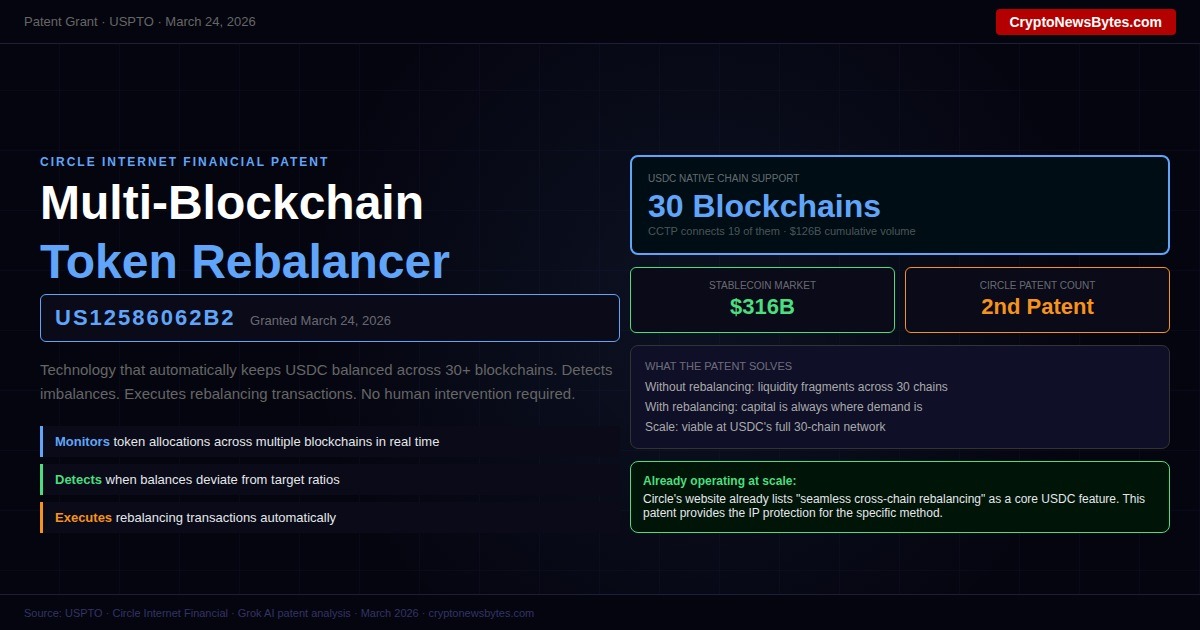
- Patent granted: US12586062B2 was awarded to Circle Internet Financial, Inc. on March 24, 2026 by the United States Patent and Trademark Office
- Title: “Multi-blockchain token rebalancer”, covers technology that automatically keeps token amounts balanced across multiple blockchains to hit target allocation ratios
- How it works: The system continuously monitors token balances across chains, detects when allocations deviate from target ratios, and automatically executes rebalancing transactions to restore balance, no human intervention required
- Why it matters: USDC exists natively on 30+ blockchains. Uneven liquidity across chains creates capital inefficiency and friction. This patent protects Circle’s automated solution for managing USDC distribution at network scale
- Context: Circle’s CCTP has already processed $126 billion in cumulative cross-chain transfer volume across 19 blockchains as of December 2025. This patent covers the intelligence layer above CCTP that automates liquidity management
In This Article
- Patent Details: US12586062B2
- How the Multi-Blockchain Token Rebalancer Works
- The Problem It Solves: Fragmented Cross-Chain Liquidity
- How It Connects to Circle’s CCTP Infrastructure
- What This Means for USDC on 30 Blockchains
- The Competitive Moat: Circle’s Growing IP Portfolio
- Broader Implications for DeFi and Cross-Chain Finance
- Frequently Asked Questions
The Circle multi-blockchain token rebalancer patent changes how stablecoin infrastructure is protected. On March 24, 2026, the United States Patent and Trademark Office granted Circle Internet Financial, Inc. patent US12586062B2, titled “Multi-blockchain token rebalancer.” The patent covers a system that automatically monitors token allocations across multiple blockchains simultaneously, detects when balances deviate from preset target ratios, and executes rebalancing transactions to restore the intended distribution, all without manual intervention.
For the stablecoin industry, this is significant. USDC currently operates natively on 30 blockchains. Managing liquidity across that many chains manually would be operationally impossible at scale. The technology described in this patent is the automated engine that makes cross-chain stablecoin management feasible for billions of dollars in daily volume, and Circle now holds the patent on a specific implementation of it.
Patent Details: US12586062B2
The patent number US12586062B2 places it in the B2 classification, meaning it is a granted utility patent that has undergone at least one round of examination and amendment before issuance. This is Circle’s second publicly known patent, following its 2023 first patent for parallel block processing in blockchains, also a foundational infrastructure patent rather than a product-level feature.
How the Multi-Blockchain Token Rebalancer Works
The core technical concept is straightforward in principle and complex in execution. Think of it as an automatic portfolio rebalancer, but instead of managing asset allocations across stocks and bonds, it manages token allocations across blockchains.

The Problem It Solves: Fragmented Cross-Chain Liquidity
To understand why this patent matters, you need to understand the liquidity fragmentation problem that defines multi-chain stablecoin management today.
When USDC exists simultaneously on 30 blockchains, it does not distribute itself evenly. Demand is highly uneven across chains and changes constantly. A surge in DeFi activity on Solana might require large amounts of USDC for lending protocols and AMM pools. A slowdown in Ethereum NFT activity might leave USDC sitting idle in wallets and pools that are not actively deploying it. Meanwhile, a new L2 chain onboarding institutional clients might be starved of USDC even as established chains have excess supply.
| Problem | Without Rebalancer | With Rebalancer |
|---|---|---|
| Uneven demand across chains | Liquidity accumulates where it was used last, not where it is needed | Automated detection and correction keeps liquidity where demand is |
| Manual management overhead | Treasury teams must monitor 30+ chains and execute transfers manually | System handles detection and execution programmatically |
| Capital inefficiency | Idle USDC on over-supplied chains earns nothing while under-supplied chains face shortages | Capital is continuously optimised across the full network |
| Reaction lag | Human-managed rebalancing reacts after the fact, hours or days late | Automated system responds in near real-time as imbalances develop |
| Scale constraints | Managing 30 chains manually is not operationally viable at USDC’s volume | Automated system scales to any number of chains without added human overhead |
The scale of the problem is significant. Circle’s CCTP had processed $126 billion in cumulative cross-chain transfer volume across 19 blockchains as of December 2025. USDC is natively available on 30 blockchains. Managing liquidity across that network without automation would require a treasury operations team running 24 hours a day across every time zone, and would still be too slow to respond to real-time demand shifts.
How It Connects to Circle’s CCTP Infrastructure
Circle’s Cross-Chain Transfer Protocol, CCTP, is the existing production infrastructure for moving USDC between blockchains. As of December 2025, CCTP connects 19 of the 30 chains where USDC is natively available and has processed $126 billion in cumulative volume. Circle also shipped a Fast Transfer feature for below-finality speed and a Hooks feature for deeper composability.
CCTP is the execution layer, it provides the mechanism for moving tokens between chains securely, using a burn-and-mint model where USDC burned on one chain is minted on another backed by Circle’s reserve attestation. What CCTP does not inherently provide is the intelligence layer that decides when to move tokens, how much to move, and where to send them.
The multi-blockchain token rebalancer patent covers that intelligence layer. In a production system combining both technologies, CCTP would be the transport mechanism and the rebalancer would be the automated dispatcher, continuously monitoring allocations, identifying imbalances, and instructing CCTP to execute the appropriate transfers. Together they form a complete automated cross-chain liquidity management system.
What This Means for USDC on 30 Blockchains
The practical implications for USDC’s multi-chain network fall into three areas.
Operational efficiency at scale. With 30 supported chains and $316 billion in total stablecoin market cap, the ability to automate cross-chain liquidity management is not a convenience, it is an operational necessity. The patented rebalancer makes it possible for Circle to manage USDC liquidity across an expanding chain ecosystem without linear growth in operational overhead. As USDC adds more supported chains, the automated system scales without requiring proportionally more treasury management resources.
Faster liquidity response to market demand. In DeFi markets, liquidity shortfalls on a given chain can develop within hours as a new protocol attracts attention or a large institutional flow moves through. An automated system that detects these imbalances and rebalances within minutes rather than hours provides meaningfully better liquidity depth for the protocols and users who depend on USDC.
The stablecoin yield context. The timing of this patent grant is notable. The CLARITY Act stablecoin yield deal was reached just four days before this patent was granted. The yield framework permits activity-based rewards tied to usage. Efficient cross-chain liquidity management, which drives higher USDC utilisation and therefore higher yield on reserves, becomes more valuable in a regulatory environment where stablecoin economics are being formalised in statute.
The Competitive Moat: Circle’s Growing IP Portfolio
This is Circle’s second publicly known patent. The first, for parallel block processing in blockchains, was awarded in late 2023 and specifically addressed the challenge of processing USDC transactions on high-throughput chains like Solana. Both patents share a common thread: they protect infrastructure that makes USDC operationally viable at network scale rather than product features visible to end users.
Jeff Tang, Circle’s Chief Intellectual Property Counsel, described patents in the 2023 announcement as “a receipt of innovation, a reflection of the hard and novel work done by our developers every day” that “protect our open architecture and grant us freedom to operate.” The multi-blockchain rebalancer patent extends that protection to one of the most operationally critical components of USDC’s multi-chain infrastructure.
For competitors, the patent creates a specific technical constraint. Any stablecoin issuer or cross-chain protocol seeking to implement an automated multi-blockchain token rebalancer using a similar target-ratio detection and execution approach would need to either license the technology from Circle, develop a sufficiently distinct technical implementation, or argue that the patent’s claims are not novel. The patent does not prevent competitors from building cross-chain stablecoins, it protects a specific implementation of the automated rebalancing method.
Broader Implications for DeFi and Cross-Chain Finance
The multi-blockchain token rebalancer patent matters beyond USDC. The underlying problem, how to maintain efficient liquidity allocation across a fragmented multi-chain ecosystem, is one of the defining infrastructure challenges of the multi-chain era. It affects every asset class that exists across multiple blockchains, not just stablecoins.
DeFi protocols that deploy liquidity across multiple chains face the same rebalancing challenge. Liquid staking protocols managing staked assets on multiple networks face it. Cross-chain lending protocols face it. Any institutional treasury managing tokenised assets across blockchain networks faces it. The patent establishes Circle as an early IP holder in a space that is likely to become increasingly commercially important as multi-chain architecture becomes the default for digital asset infrastructure.
As Circle’s own 2026 product vision noted, the company is focused on “making CCTP an even more systemic interoperability layer for USDC so that businesses and users have access to USDC liquidity that moves safely and predictably across blockchains where it is needed.” The rebalancer patent is the IP foundation for that product direction.
Frequently Asked Questions