⚡ Key Highlights
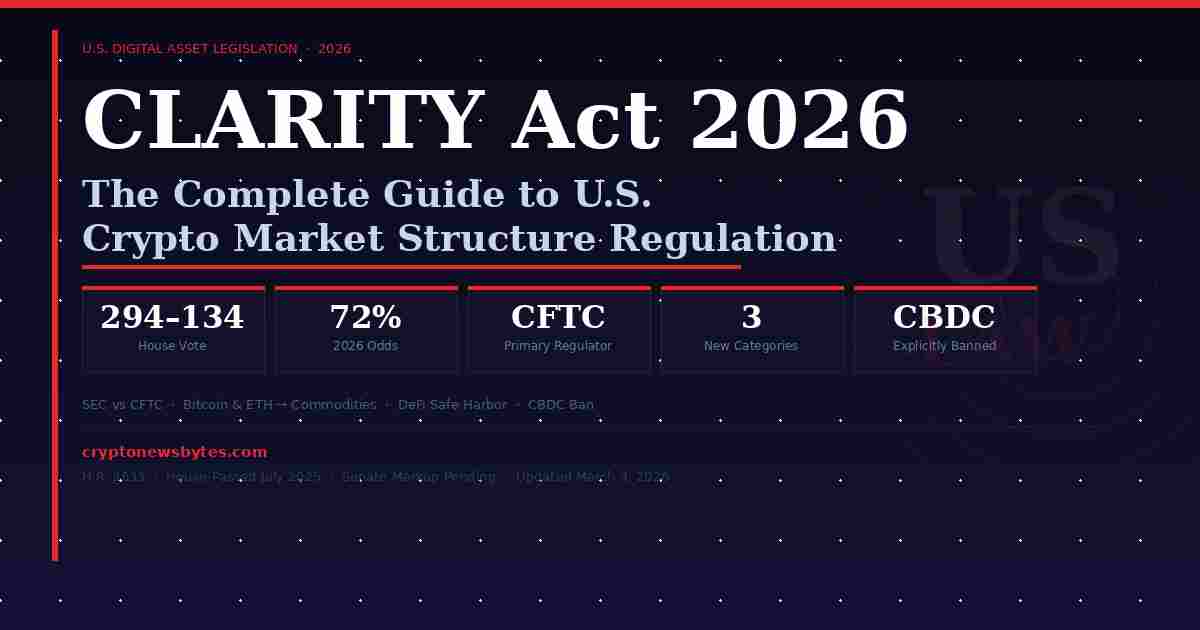
- The House passed the CLARITY Act with a bipartisan vote of 294 to 134 in July 2025 — but the Senate has two competing drafts and no final vote scheduled as of March 2026.
- The bill gives the CFTC exclusive jurisdiction over digital commodity spot markets, ending the SEC vs. CFTC standoff that has defined U.S. crypto regulation for a decade.
- Bitcoin, Ethereum, and most major Layer 1 tokens are expected to be classified as digital commodities under CFTC oversight — not securities under the SEC.
- Exchanges, brokers, and dealers must register under new CFTC categories: Digital Commodity Exchange (DCE), Digital Commodity Broker (DCB), and Digital Commodity Dealer (DCD).
- DeFi protocols that are truly decentralized get an explicit safe harbor — but protocols with admin keys, governance tokens, or identifiable teams face contested classification.
- Stablecoins are governed separately under the GENIUS Act. The CLARITY Act limits CFTC and SEC jurisdiction over permitted payment stablecoins to transactions on registered entities only.
- The bill contains a hard CBDC ban — the Federal Reserve cannot issue or test a central bank digital currency without explicit Congressional authorization.
- Prediction markets price 2026 signing odds at 72%, but Senate reconciliation between the Banking and Agriculture Committee drafts remains the critical obstacle.
- What Is the CLARITY Act?
- Why the CLARITY Act Was Introduced
- SEC vs. CFTC: Who Gets What — and Who Wins
- How the CLARITY Act Defines Digital Assets
- Is Your Token a Security? The Classification Flowchart
- Who Must Register — and Under What Framework
- DeFi Provisions: Safe Harbor or Contested Ground?
- CLARITY Act 2026 Legislative Timeline
- Impact by Sector — What Changes for Your Business
- CLARITY Act vs. GENIUS Act
- CLARITY Act vs. MiCA
- Risks and Criticisms
- What Crypto Companies Should Do Now
- Frequently Asked Questions
What Is the CLARITY Act 2026?
The CLARITY Act 2026 — officially the Digital Asset Market CLARITY Act (H.R. 3633) — is the most comprehensive piece of U.S. crypto market structure legislation ever passed by a chamber of Congress. Introduced on May 29, 2025 by House Financial Services Committee Chairman French Hill and co-led by House Agriculture Committee Chairman G.T. Thompson, the CLARITY Act 2026 is a fundamental attempt to end more than a decade of regulatory ambiguity in U.S. digital asset markets.
The bill passed the full House with a strong bipartisan vote of 294 to 134 in July 2025, with the White House signaling support. As of March 2026, it is working through the Senate, where the Senate Banking Committee (chaired by Senator Tim Scott) and the Senate Agriculture Committee (led by Senator John Boozman) are reconciling two separate drafts.
The CLARITY Act is not a stablecoin bill — that is the GENIUS Act, signed into law in 2025. Instead, the CLARITY Act governs the broader crypto market structure: which assets are commodities, which are securities, who can run an exchange, and how DeFi is treated under U.S. law. Together the two laws form the first comprehensive federal framework for digital assets in U.S. history.
Why the CLARITY Act Was Introduced
The CLARITY Act did not emerge from a vacuum. It is a direct response to nearly a decade of regulatory dysfunction in U.S. crypto markets — a period defined by agency turf wars, enforcement-driven rulemaking, and a string of high-profile legal battles that left the industry without a coherent compliance framework.
The SEC Enforcement Era That Made the CLARITY Act Necessary
Under former SEC Chair Gary Gensler, the U.S. Securities and Exchange Commission pursued an aggressive enforcement strategy, filing lawsuits against major crypto platforms while refusing to provide clear registration pathways. The SEC sued Coinbase, alleging it operated as an unregistered securities exchange. It sued Binance on similar grounds. It pursued enforcement actions against Kraken, Ripple Labs, Terraform Labs, and dozens of smaller token issuers — all without Congress ever definitively resolving whether crypto assets were securities in the first place.
The Ripple Case: The Lawsuit That Accelerated the CLARITY Act
The Ripple Labs vs. SEC lawsuit became the most consequential legal battle in U.S. crypto history. A 2023 federal court ruling found that XRP sold on secondary markets to retail investors was not a security — a partial victory for the industry that directly contradicted the SEC’s position. The decision created a circuit split in U.S. case law and made clear that courts, not regulators, were effectively defining crypto regulation by default. The CLARITY Act is Congress’s answer: write the definitions into statute so courts and agencies stop making it up as they go.
The CFTC’s Competing Claims — and How the CLARITY Act Resolves Them
While the SEC sued exchanges, the U.S. Commodity Futures Trading Commission was simultaneously asserting its own jurisdiction over crypto. The CFTC had long maintained that Bitcoin and Ethereum were commodities — not securities — placing them under its oversight. This created the central absurdity of U.S. crypto regulation: two agencies claiming authority over the same market, with no statutory resolution, and firms unable to get clear compliance guidance from either.
Stablecoin Collapse and the Push for the CLARITY Act
The collapse of TerraUSD (UST) in 2022, which wiped out approximately $40 billion in market value in days, accelerated Congressional appetite for regulatory action. The failure demonstrated that unregulated stablecoins posed systemic risks extending beyond individual investors. While the GENIUS Act addresses stablecoins directly, the TerraUSD collapse was a catalyst for the broader market structure reform the CLARITY Act represents.
SEC vs. CFTC: Who Gets What — and Who Wins
The central innovation of the CLARITY Act is its clean separation of regulatory authority between the two principal U.S. financial regulators. The bill draws a bright line that has eluded regulators, courts, and the industry for years — and in doing so, it fundamentally reshapes the balance of power between the SEC and CFTC over the crypto market.
| Asset Type | Primary Regulator | Key Rules |
|---|---|---|
| Digital Commodities Bitcoin, Ethereum, most Layer 1s | CFTC | Exclusive spot market jurisdiction; trading via registered DCEs, DCBs, DCDs |
| Investment Contract Assets Tokens sold as investment contracts | SEC | Securities Act applies; ongoing disclosure requirements; securities exchange registration |
| Permitted Payment Stablecoins USDC, EURC, and compliant issuers | CFTC + SEC | Shared oversight limited to transactions on registered entities; governed primarily by the GENIUS Act |
| Mixed Digital Assets Tokens that may evolve from security to commodity | Joint CFTC/SEC | Joint rulemaking required; transitional classification framework |
| Fully Decentralized Protocols True DeFi — no identifiable issuer | Neither | Explicit safe harbor for software developers and peer-to-peer activity |
Importantly, the SEC retains anti-fraud and anti-manipulation authority even in CFTC-jurisdiction markets. A digital commodity trading on a registered exchange can still trigger SEC enforcement if fraud is involved. The two agencies must also coordinate on joint rulemaking covering definitions, mixed assets, and delisting procedures.
Who Wins and Who Loses Under the CLARITY Act
✅ Winners
- CFTC — gains massive new jurisdiction over the largest crypto spot markets
- Bitcoin holders — BTC permanently classified as digital commodity, not security
- Ethereum holders — ETH gets commodity classification; removes SEC overhang
- Compliant exchanges — clear registration path; institutional access unlocked
- Institutional investors — regulated framework lowers compliance barriers for pension funds and RIAs
- Token issuers (mature networks) — path out of securities classification via maturity test
❌ Losers / At Risk
- SEC — loses jurisdiction over most major crypto assets; authority reduced to early-stage tokens and enforcement
- Offshore exchanges — U.S.-customer service now requires registration or exit
- DeFi front-ends — centralized interfaces must meet new compliance standards
- New token projects — remain under SEC oversight until blockchain “maturity” standard is met
- Stablecoin yield providers — Senate draft proposes ban on yield on stablecoin balances
- Unregistered intermediaries — provisional registration window is time-limited
How the CLARITY Act Defines Digital Assets
The definition of digital commodity is the most consequential — and contested — element of the entire bill. Classification determines which agency regulates an asset, what disclosure obligations apply, and what platforms can legally trade it. Getting this wrong exposes firms to significant legal risk.
Under the CLARITY Act, a digital commodity is a digital asset whose value is intrinsically linked to the use of its blockchain network. The term explicitly excludes securities, derivatives, and stablecoins. The key distinguishing concept is the “mature blockchain” standard: a network must demonstrate sufficient decentralization and adoption before the assets running on it qualify for CFTC-only treatment.
🔍 Likely Asset Classifications Under the CLARITY Act
| Asset | Likely Classification | Regulator | Key Reason |
|---|---|---|---|
| Bitcoin (BTC) | Digital Commodity | CFTC | Fully decentralized; no identifiable issuer; CFTC has long maintained commodity view |
| Ethereum (ETH) | Digital Commodity | CFTC | Proof-of-stake transition; SEC’s own 2024 finding supports non-security status |
| Solana (SOL) | Likely Digital Commodity | CFTC | Mature network; pending maturity certification under final rules |
| USDC / USDT | Permitted Payment Stablecoin | Shared CFTC/SEC | Governed primarily by GENIUS Act |
| New Token ICOs | Investment Contract Asset (initially) | SEC | Fundraising context; SEC disclosure rules apply until maturity standard met |
| XRP | Contested / Likely Commodity | TBD | Post-Ripple ruling; secondary market sales already found non-security by court |
| NFTs (fractionalized) | Contested | TBD via rulemaking | Fractional investment characteristics trigger securities analysis |
| DeFi governance tokens | Contested | TBD via rulemaking | Depends on decentralization level of issuing protocol |
Is Your Token a Security? The Classification Flowchart
One of the most practical questions any crypto project, exchange, or investor faces is the one the bill is designed to answer: is this token a security or a commodity? While the final definitions will be set by joint CFTC/SEC rulemaking, the CLARITY Act’s framework points clearly in the following direction.
🔀 Token Classification Decision Tree Under the CLARITY Act
Who Must Register — and Under What Framework
The CLARITY Act creates three new CFTC registration categories that did not previously exist in U.S. law. Any platform or firm operating in digital commodity markets needs to determine which category applies — or whether an existing SEC-registered pathway is more appropriate.
📋 CFTC Registration Categories Under the CLARITY Act
| Category | Who It Covers | Key Requirements |
|---|---|---|
| Digital Commodity Exchange (DCE) | Centralized platforms matching buyers and sellers of digital commodities | Full CFTC registration; publish source code, transaction history, and asset economics; 20-day listing certification; must join a registered futures association |
| Digital Commodity Broker (DCB) | Firms executing buy/sell orders on behalf of clients | CFTC registration; customer asset protection; AML/BSA compliance; financing agreements subject to CFTC rules |
| Digital Commodity Dealer (DCD) | Market makers and principal traders | CFTC registration; capital adequacy; risk management standards; conflict-of-interest rules apply |
| Qualified Digital Asset Custodian | Entities holding digital assets on behalf of clients | State or federal authorization; banks and trust companies have structural advantage; must segregate customer assets |
| SEC-Registered ATS / Broker-Dealer | Traditional securities participants wanting to trade digital commodities | Notification to CFTC (not full CFTC registration); SEC retains jurisdiction; can operate ATSs for digital commodities under revised SEC rules |
A provisional registration regime applies during the transition period. Firms that apply for registration are considered compliant under provisional status — provided they protect customer assets and allow CFTC access to books and records. They may continue listing previously listed assets until joint definitional rulemaking is finalized.
DeFi Provisions: Safe Harbor or Contested Ground?
The CLARITY Act includes an explicit exclusion for decentralized finance activities — something DeFi developers have lobbied for since the first major U.S. crypto regulatory proposals emerged. The core principle: regulatory focus should be on control, not code. If no party controls a protocol, no party can be required to register.
- The exclusion applies to fully decentralized protocols with no identifiable issuer or controlling party. This is a high bar that most current protocols do not clear.
- Protocols with admin keys, upgradeable contracts, or governance systems dominated by a founding team may not qualify as “fully decentralized” under the final rules.
- Front-end operators and centralized intermediaries interacting with DeFi protocols are explicitly subject to tailored risk-management, cybersecurity, and compliance requirements.
- The CFTC is directed to conduct a formal DeFi study — rulemaking guidance defining the boundary will follow, potentially expanding the definition of what “counts” as centralized.
- Protocols with fee collection or governance token distributions to identifiable founders remain in a legal gray zone until the study and rulemaking are complete.
The practical implication: most major DeFi protocols in their current form probably do not meet the fully-decentralized standard. True peer-to-peer transactions without any identifiable intermediary are protected. Everything else requires specific legal analysis of the protocol’s architecture, governance, and team structure.
CLARITY Act 2026 Legislative Timeline: Where the Bill Stands
The Senate’s two-committee structure is the primary bottleneck. The Banking Committee oversees the SEC’s portion; the Agriculture Committee oversees the CFTC’s. Aligning their drafts — particularly on stablecoin yield, DeFi scope, ethics provisions, and jurisdictional edge cases — is the hardest remaining legislative task.
CLARITY Act 2026: Impact by Sector — What Changes for Your Business
For Crypto Exchanges (CEXs)
This is transformational. Exchanges like Coinbase, Kraken, and Gemini face a clear choice: register as a Digital Commodity Exchange with the CFTC, operate as an SEC-registered ATS/broker-dealer, or face enforcement action. Registration provides legal certainty and institutional access — but at cost. Listing any new digital commodity requires publishing source code, transaction history, and economic details, with a 20-day certification process before trading begins.
For Crypto Brokers and Market Makers
The new DCB and DCD registration categories create specific compliance obligations around customer asset protection, AML/BSA requirements, capital adequacy, and conflict-of-interest management. Firms currently operating under no-action relief or informally will need formal CFTC registration. The provisional registration window provides a transition period — but the clock starts on enactment.
For Stablecoin Issuers
Stablecoins are governed primarily by the GENIUS Act, but the CLARITY Act has direct implications for how stablecoins interact with registered exchanges and custodians. The Senate draft’s proposed ban on yield/interest on stablecoin balances is the most commercially significant active dispute — it would force platforms like Coinbase to discontinue yield products on USDC. How this is resolved in Senate reconciliation will determine the competitive landscape for U.S. stablecoin distribution. See our GENIUS Act vs. MiCA comparison for the global stablecoin regulatory picture.
For Token Issuers and Projects
New token projects face a two-stage compliance reality. At launch, a token sold in a fundraising context is an investment contract asset under SEC oversight — disclosure requirements apply. Once the underlying blockchain achieves the “maturity” standard (sufficient decentralization and adoption), the project can seek reclassification as a digital commodity. The transition pathway is valuable but not automatic: it requires active certification, legal analysis, and coordination with the CFTC. Projects should begin documenting their decentralization evidence now.
For DeFi Protocols
The safe harbor is real but narrow. Truly decentralized protocols — no identifiable team, no admin keys, no insider governance token distributions — are protected. Most major protocols are not there yet. Front-end operators face the clearest risk: the bill explicitly brings centralized interfaces interacting with DeFi under tailored compliance standards. Protocol teams should conduct a decentralization audit before the bill’s definitions are finalized in rulemaking.
For Venture Funds and Token Investors
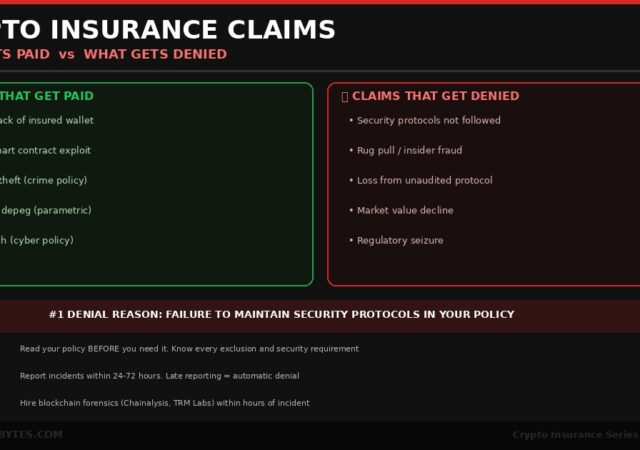
The CLARITY Act’s investor protection requirements — asset segregation, complaint handling, mandated risk disclosures, insurance-equivalent protections — create a safer environment for institutional and retail investors alike. For venture funds with crypto positions, the maturity test creates a clear exit from securities classification for portfolio companies, potentially reducing the regulatory overhang on token-based investments. The crypto insurance gap also becomes more addressable once custodian requirements are codified. Regulated exchanges lower compliance barriers for pension funds, endowments, and RIAs allocating at scale. JPMorgan analysts have described CLARITY Act passage as a “positive catalyst” for digital assets, citing regulatory clarity, institutional scaling, and tokenization growth.
For Non-U.S. Companies Serving U.S. Customers
The CLARITY Act’s jurisdiction is not limited to U.S.-based firms. Foreign exchanges, brokers, or dealers serving U.S. persons in digital commodities are subject to the registration requirements regardless of headquarters location. The bill directs the GAO to study risks posed by foreign intermediaries serving U.S. customers without equivalent oversight — widely read as a precursor to formal enforcement action against offshore platforms.
CLARITY Act vs. GENIUS Act: How the Two Bills Work Together
The GENIUS Act and the CLARITY Act are designed as complementary pillars of the first comprehensive U.S. digital asset regulatory framework — but they govern different things. Understanding the boundary between them is essential for any crypto firm operating in the United States.
| Feature | GENIUS Act | CLARITY Act |
|---|---|---|
| Primary scope | Payment stablecoins only | Digital commodities, investment contract assets, market structure |
| Status (March 2026) | Signed into law (2025) | Pending Senate (House-passed) |
| Primary regulator | OCC / Federal Reserve / state regulators | CFTC (commodities), SEC (securities) |
| Reserve requirements | 1:1 backing; U.S. Treasuries, cash, or equivalents | N/A — not a reserve bill |
| Yield / interest | Issuers banned from paying yield on stablecoin balances | Senate draft extends this ban to service providers holding stablecoins |
| DeFi treatment | Minimal specific treatment | Explicit safe harbor for fully decentralized protocols |
| Bitcoin / ETH | Not covered | Classified as digital commodities under CFTC |
| Exchange registration | Not covered | New DCE / DCB / DCD CFTC registration categories |
| CBDC | Not addressed | Explicitly banned without Congressional authorization |
Together, the two bills cover nearly the full spectrum of U.S. digital asset activity. The GENIUS Act governs what you can issue as a stablecoin. The CLARITY Act governs everything that gets traded, who can run an exchange, and what assets are securities vs. commodities.
CLARITY Act vs. MiCA: Key Differences for Global Operators
If your firm operates in both the U.S. and EU markets, you are navigating two frameworks that share some goals but diverge significantly in structure. There is no mutual recognition between them — dual compliance is required. For the full EU breakdown, see our complete MiCA 2026 compliance guide and the GENIUS Act vs. MiCA side-by-side comparison.
| Provision | CLARITY Act (U.S.) | MiCA (EU) |
|---|---|---|
| Scope | Digital commodities + investment contract assets + stablecoins (via GENIUS Act) | All crypto assets and service providers including stablecoins |
| Primary regulator | CFTC (commodities) + SEC (securities) | National Competent Authorities (BaFin, AMF, DNB, etc.) |
| Single license | No — separate SEC/CFTC frameworks | Yes — one CASP license; passporting across 27+ EU states |
| DeFi treatment | Explicit safe harbor for fully decentralized protocols | Exclusion for fully decentralized (contested interpretation) |
| Stablecoin yield | Senate draft proposes ban; House version silent | Not explicitly banned; EMT custody rules apply from March 2026 |
| CBDC | Explicitly banned without Congressional authorization | Digital euro framework in development; no equivalent ban |
| Hard compliance deadline | TBD — bill not yet enacted | July 1, 2026 — CASP authorization required |
| Mutual recognition | None. Separate compliance programs required for U.S. and EU markets. | |
The critical practical point: MiCA is already law with a July 1, 2026 hard deadline. The CLARITY Act is still in the Senate. Firms needing dual-market compliance should prioritize MiCA now while monitoring CLARITY Act Senate progress closely.
CLARITY Act 2026: Risks and Criticisms
Despite its broad bipartisan support in the House, the CLARITY Act is not without significant criticism — from both sides of the regulatory debate. A balanced view of the risks is essential for companies making compliance decisions before enactment.
Does It Weaken Investor Protection?
Critics from the investor advocacy community argue that shifting large portions of the crypto market from SEC oversight to the CFTC systematically weakens investor protection. The SEC’s disclosure-heavy framework — prospectuses, financial reporting, registration requirements — creates accountability that CFTC commodity regulation does not replicate for spot markets. Consumer advocates note that retail crypto investors often have less protection under commodity frameworks than under securities law, particularly in cases of fraud and misrepresentation by issuers.
Is DeFi Truly Exempt — or Just Unregulated?
The DeFi safe harbor has drawn criticism from regulators and compliance experts who argue the bill creates an easily exploitable loophole. The “fully decentralized” standard is inherently difficult to define and enforce — and the history of DeFi protocols suggests that many projects claiming decentralization retain meaningful control through admin keys, foundation treasuries, or founder-dominated governance. Critics argue the bill may effectively exempt large, systemically significant protocols from oversight based on a standard they can engineer their way into.
Industry Lobbying Concerns
The bill’s drafting process was heavily influenced by crypto industry lobbying, particularly from exchanges that benefit most from shifting jurisdiction away from the SEC. The Senate Banking Committee’s January 2026 controversy — in which Coinbase publicly withdrew support over a provision that would have banned yield products on stablecoins — illustrates the degree to which specific commercial interests are shaping the legislation in real time. Critics argue this creates a framework that protects incumbent exchanges more than it protects investors.
The Two-Committee Senate Problem
The structural challenge of reconciling Senate Banking and Agriculture Committee drafts creates genuine legislative risk. The two committees have different policy priorities, different political pressures, and different views on where the SEC/CFTC line should be drawn. Failed reconciliation — or a watered-down compromise — could produce a bill that satisfies neither agency, creates new ambiguities, and triggers a new round of litigation to resolve them.
Preemption of State Law
The bill’s interaction with state money transmission laws, state securities laws, and state-chartered custodian frameworks has not been fully resolved. Several state regulators have expressed concern that federal preemption under the CLARITY Act could displace existing state frameworks that provide meaningful consumer protections at the local level — particularly for retail investors in states with aggressive consumer protection regimes.
CLARITY Act 2026: What Crypto Companies Should Do Now
The CLARITY Act has not yet been enacted, but firms that wait for enactment to begin compliance planning will be behind from day one. The provisional registration window is time-limited, and the definitional rulemaking that follows enactment will move quickly. Here is a practical compliance roadmap for the most common firm types.
✅ Compliance Action Checklist — CLARITY Act Preparation
- Classify your assets now. Map every token you issue, trade, or custody against the CLARITY Act’s digital commodity / investment contract asset / stablecoin framework. Identify which assets are likely to require SEC disclosure treatment and which are candidates for digital commodity classification. Don’t wait for final rules — the framework is clear enough to begin internal analysis.
- Determine your registration category. Decide whether you are a DCE, DCB, DCD, or custodian under the CLARITY Act framework — or whether the SEC-registered ATS/broker-dealer pathway is more appropriate for your business model. Each path has different capital, disclosure, and operational requirements.
- Audit your decentralization posture (DeFi projects). If you operate a DeFi protocol, conduct a formal decentralization audit before the bill’s definitions are finalized. Document your governance structure, admin key policies, token distribution, and any team control mechanisms. The safe harbor is worth fighting for — but it requires evidence.
- Review stablecoin product exposure. If your business involves yield or interest on stablecoin balances, model the impact of the Senate Banking Committee’s proposed yield ban. Plan for both outcomes — yield permitted and yield banned — so you are not caught off-guard by the Senate’s final position.
- Engage qualified U.S. regulatory counsel. The intersection of CFTC commodity law, SEC securities law, and the new CLARITY Act registration categories is technically complex. Firms that try to navigate this without specialized counsel risk misclassification, provisional registration errors, or enforcement exposure during the transition period.
- Assess customer asset segregation compliance. All registration categories under the CLARITY Act require robust customer asset protection. Review your current custody arrangements against the Qualified Digital Asset Custodian standards. For custodians specifically, map your existing state or federal authorizations against the new requirements. See our crypto insurance guide for context on how insurance obligations interact with these custody standards.
- Monitor Senate markup developments actively. The Senate Banking Committee markup — when scheduled — will be the single most important legislative event for the CLARITY Act in 2026. Follow the Senate Banking and Agriculture Committees directly and track changes to the stablecoin yield provision, DeFi definitions, and jurisdictional edge cases. Subscribe to regulatory tracker services from firms like Latham & Watkins, K&L Gates, or Arnold & Porter for real-time updates.
- Plan for the EU simultaneously. If you serve EU customers, the MiCA July 1, 2026 deadline is already here. Don’t let CLARITY Act uncertainty delay your EU compliance work — MiCA is law and enforced. Run both compliance tracks in parallel.
Frequently Asked Questions About the CLARITY Act
📰 Crypto Regulation 2026 Series
- The GENIUS Act Explained: What Every Crypto Company Needs to Know in 2026
- MiCA Regulation 2026: The Complete Compliance Guide for Crypto Companies
- GENIUS Act vs. MiCA: The Complete Comparison for Global Operators
- You are here: CLARITY Act 2026 — The Complete Guide for Crypto Companies
- Coming next: SEC vs. CFTC After the CLARITY Act — Who Controls What in 2026