
3 Key Takeaways
- The Clarity Act remains stalled in the Senate as of March 2026, with the Banking and Agriculture Committees unable to reconcile competing drafts. President Trump has urged Congress to pass the bill “ASAP,” warning that delays could push the industry overseas
- Key March developments: Kraken’s Fed master account approval, the stablecoin yield fight that fractured industry support, and the Fed’s March 18 rate decision all directly impact the Clarity Act’s path to passage
- The DC Blockchain Summit and Digital Asset Summit in New York this month could produce critical public statements from regulators that signal whether the Senate will move to markup before the summer recess
Clarity Act Update March 2026: Where the Bill Stands Now
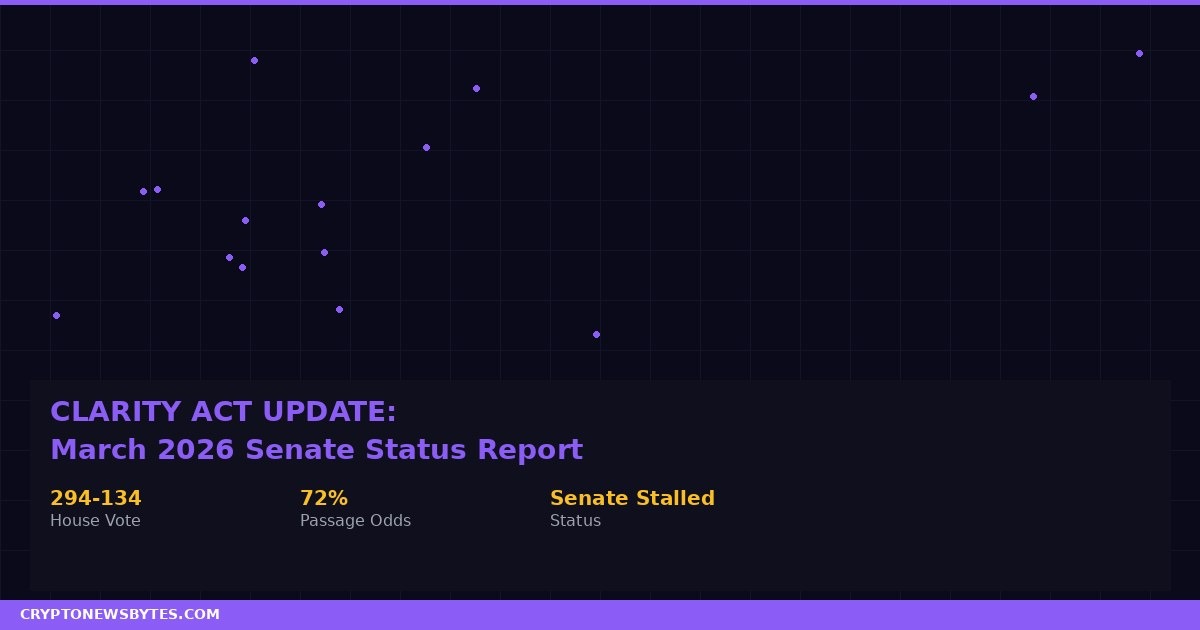
The Clarity Act update for March 2026 is a story of momentum stalled by complexity. The most comprehensive piece of U.S. crypto market structure legislation, which passed the House with a bipartisan vote of 294-134 in July 2025, remains stuck in the Senate without a scheduled markup or vote. The delay is not from lack of political will but from a collision of competing interests: banking lobbies fighting stablecoin yields, two Senate committees claiming jurisdiction, and unresolved questions about DeFi treatment and tokenized securities.
For the full legislative background, see our CLARITY Act 2026 Complete Guide and SEC vs CFTC jurisdiction analysis. This article covers what has changed since those pieces were published and what to watch in the weeks ahead.
The Clarity Act in March 2026: What Changed
Several developments in late February and early March have directly affected the Clarity Act update timeline and legislative momentum:
Trump’s public pressure. President Trump accused major banks of trying to undermine the digital asset agenda in a Truth Social post, writing that “the U.S. needs to get Market Structure done, ASAP” and warning that banks should not “hold the Clarity Act hostage.” Treasury Secretary Scott Bessent has signaled a spring signing target, though the Senate timeline makes this increasingly ambitious.
The stablecoin yield fight bleeds over. The battle over interest-bearing stablecoins under the GENIUS Act framework has directly delayed the Clarity Act. When Coinbase CEO Brian Armstrong withdrew support for the Senate Banking Committee’s draft stablecoin provisions in January, it fractured the industry coalition needed to push market structure legislation forward. The Senate Banking Committee postponed its scheduled markup, and that delay cascaded into the Clarity Act timeline. Bank of America’s $6 trillion stablecoin warning intensified the banking lobby’s resistance.
Kraken’s Fed master account. The historic approval on March 4 demonstrated that crypto integration with traditional finance is proceeding operationally even as the legislative framework remains incomplete. Banking groups called the approval “improper” and “dangerous,” adding fuel to their push for stricter controls in the Clarity Act.
The Fed’s March 18 rate decision. The Federal Reserve’s upcoming rate announcement could shift the macro backdrop. After easing in late 2025, markets are watching for guidance on whether cuts continue. Looser monetary policy historically supports risk assets, including crypto, and could build political momentum for passing the Clarity Act during a rising market rather than a falling one.
Clarity Act Update: Three Unresolved Problems Blocking the Senate
The Clarity Act update for March centers on three issues that remain unresolved between the Senate Banking Committee (chaired by Tim Scott) and the Senate Agriculture Committee (led by John Boozman):
1. The DeFi safe harbor. The House version provides an explicit safe harbor for truly decentralized protocols. The Senate draft language is less clear, and banking committee members have pushed for narrower definitions. Protocols with admin keys, governance tokens, or identifiable teams could face contested classification. This ambiguity is a deal-breaker for significant portions of the crypto industry.
2. Tokenized securities treatment. BlackRock CEO Larry Fink has said the firm plans to trade all stocks and bonds using tokens. The Clarity Act must define how tokenized versions of existing securities interact with both SEC oversight and CFTC commodity markets. The Senate has not reconciled competing approaches, and the SEC vs CFTC jurisdiction question remains the most politically sensitive element.
3. CBDC language. The House version contains a hard ban on the Federal Reserve issuing or testing a central bank digital currency without Congressional authorization. The Senate version has weakened this provision, and as Catherine Austin Fitts warned, if the CBDC ban is removed while stablecoins implement programmable money functionality through Treasury pipes, the distinction between private stablecoins and a CBDC becomes academic.
March Events to Watch
Two industry events this month could move the Clarity Act update needle:
DC Blockchain Summit (Washington, D.C.). Regulators, lawmakers, and industry leaders will gather in Washington. Public statements from CFTC or SEC officials about the Clarity Act’s timeline, DeFi provisions, or registration requirements could signal whether the Senate is moving toward markup. Comments from Senator Lummis (who championed Kraken’s Fed approval) and Senator Scott will be closely watched.
Digital Asset Summit (New York). Asset managers, crypto firms, and compliance professionals will discuss the practical implications of the emerging regulatory framework. Any signals about the Senate timeline or compromise positions on DeFi and tokenized securities could move markets.
Beyond events, the key indicator is whether the Senate Banking Committee schedules a markup. Without a markup before the summer recess, passage in 2026 becomes significantly less likely, and prediction market odds (currently at 72% for 2026 signing) would likely decline.
What the Clarity Act Means for the Jane Street Case
An underappreciated connection: the Jane Street insider trading lawsuit is directly testing the legal questions the Clarity Act is trying to resolve legislatively. How do insider trading rules apply when the “securities” in question might be commodities? What constitutes material nonpublic information in DeFi? Are market makers with private protocol access insiders?
If the Clarity Act passes before the Jane Street case reaches trial, it would provide the legal framework the court needs to adjudicate these questions. If it does not pass, the court will be forced to create that framework through judicial precedent, potentially producing a ruling that shapes crypto regulation more than any legislation could.
Clarity Act Update Bottom Line: Spring 2026 Is the Window
The Clarity Act update for March 2026 is cautiously optimistic but time-constrained. The political will exists (bipartisan House vote, Presidential support, Treasury backing). The obstacles are procedural and lobbying-driven, not ideological. But Washington’s legislative calendar is unforgiving. If the Senate Banking and Agriculture Committees cannot reconcile their drafts and schedule a markup by May-June 2026, the bill risks being pushed into 2027 by the midterm election cycle.
For crypto companies, the action items remain the same as outlined in our full Clarity Act guide: classify your tokens under the bill’s digital commodity framework, begin CFTC registration preparation, assess DeFi safe harbor eligibility, and budget for compliance infrastructure. The bill is coming. The only question is when.
Crypto Regulation 2026 Series
- CLARITY Act 2026: The Complete Guide
- SEC vs CFTC: Who Regulates What After the Clarity Act
- The GENIUS Act Explained: Stablecoin Regulation
- MiCA Regulation: Crypto Compliance Guide
- How to Get a Crypto License: Country Guide
- Crypto Tax Reporting: CARF & DAC8 Guide
- Kraken Gets Fed Master Account: What It Means
- Bank of America: $6T Stablecoin Deposit Warning
- The Invisible Noose: Stablecoins and the Control Grid
Sources: CoinPedia | Investing News Network | The Block | Kraken
Disclaimer: This article is for informational and educational purposes only and does not constitute financial, investment, or legal advice. Legislative timelines are subject to change. The Clarity Act has not been signed into law as of publication. Always do your own research (DYOR) and consult qualified advisors.