
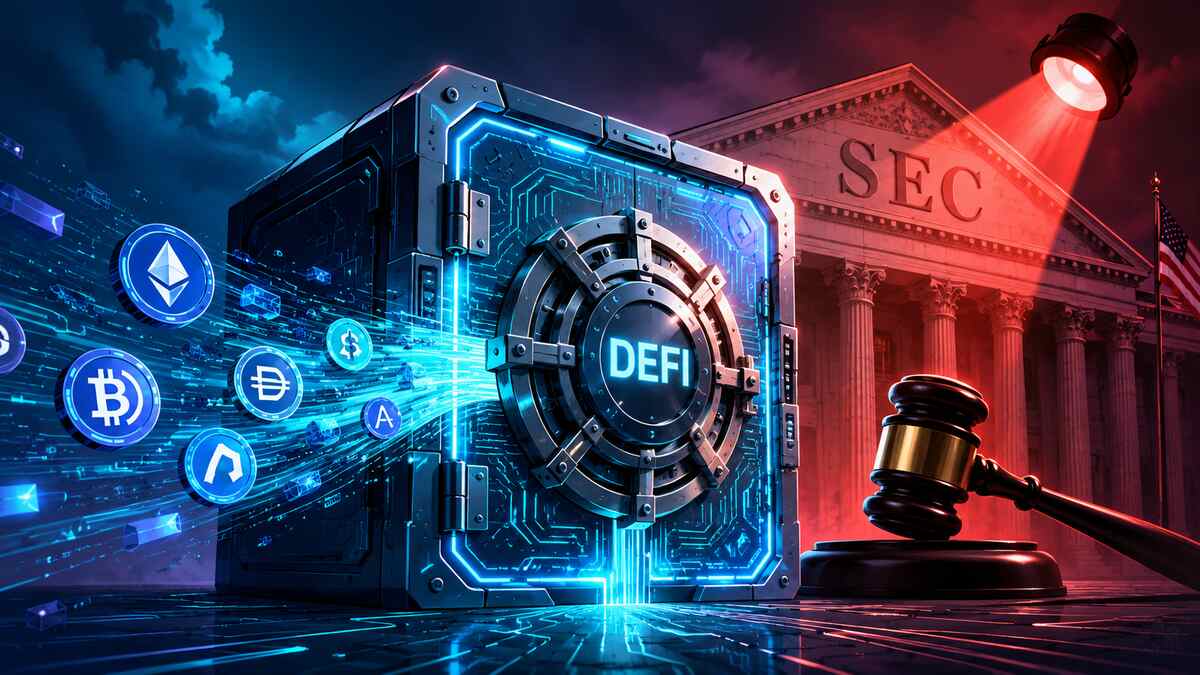
- SEC Commissioner Hester Peirce said some DeFi vaults may fall under federal securities laws.
- Certain onchain lending strategies could face similar legal questions depending on how they are structured.
- MORPHO fell about 5% after the statement, while curated vault assets reportedly reached $8.6 billion.
DeFi vaults drew fresh regulatory attention after SEC Commissioner Hester Peirce said some products in the sector, together with certain onchain lending strategies, may fall within federal securities laws. Her statement focused on how these products are structured, managed and controlled rather than simply on their use of blockchain technology. Peirce said many crypto activities may remain outside the SEC’s authority, but moving an activity onchain does not automatically change its legal status. The comments also affected the market, with MORPHO, a major provider of vault infrastructure, falling roughly 5% and underperforming the broader crypto market.
DeFi vaults draw closer SEC scrutiny
Peirce said DeFi vaults can take many forms, from fully automated smart contracts to products in which managers or curators select strategies, rebalance assets or delegate those decisions to other parties. Those differences may become important when regulators assess whether a vault involves the type of management, discretion or investor relationship already addressed by federal securities laws.
She added that some DeFi vaults could resemble investment companies or investment advisers that are already subject to established securities rules. Her remarks suggested that the SEC may focus on legal structure, managerial authority and the role of third parties instead of treating blockchain-based design as an automatic exemption from regulation.
How DeFi vaults are expanding
DeFi vaults have become a fast-growing part of decentralized finance because they allow users to deposit crypto into smart contracts that allocate capital across lending markets and other yield-generating strategies. Users can receive returns from those allocations without managing every position themselves, although the level of automation and human involvement differs significantly from one product to another.
In some vaults, preset smart-contract rules determine how funds are deployed and rebalanced. In others, professional curators decide which markets, assets or strategies should receive capital. That distinction matters because Peirce emphasized that managerial control and decision-making authority may influence whether a product resembles a regulated investment activity under existing securities law.
Vault-based products have also moved beyond core decentralized finance platforms. Coinbase and Robinhood have used vault-related approaches to offer yield on stablecoin balances, showing how DeFi vaults are reaching larger consumer-facing crypto businesses. Their expansion into widely used platforms makes questions about structure, oversight and regulatory classification more significant for the broader market.
Vaults.fyi told CoinDesk that, as of July, curated vaults held $8.6 billion across 788 products and had reached 1.4 million users. That reported scale helps explain why Peirce’s comments received immediate attention. A legal interpretation affecting DeFi vaults could influence protocols, curators, exchanges and consumers that rely on these products for automated yield strategies.
Onchain lending faces similar legal questions
Peirce said some onchain lending strategies may also raise securities law questions depending on their specific facts and circumstances. She pointed to decisions involving interest rates, collateral requirements and supported assets as examples of features that may shape the analysis, particularly when identifiable parties actively set or adjust those terms.
Her broader message was that using blockchain infrastructure does not by itself place a financial product outside the SEC’s reach. A lending strategy may still fall within existing federal securities laws when its structure, management or economic function resembles an activity that is already regulated, even when transactions are executed through smart contracts.
SEC asks DeFi vault developers to engage
Peirce invited developers to engage with the SEC instead of assuming that blockchain-based products automatically sit beyond the agency’s authority. Her statement indicated that builders should examine how vaults and asset-deployment tools interact with existing securities requirements before relying on technical architecture alone as the basis for their legal position.
She also acknowledged that newer methods of deploying assets may offer meaningful benefits. However, she argued that those benefits will depend partly on addressing regulatory questions early. For teams building DeFi vaults or onchain lending products, engagement with regulators may help clarify how management, control and product design affect their obligations.
Conclusion
The SEC statement placed DeFi vaults under sharper regulatory focus as the sector continues to grow and reach larger crypto platforms. Peirce said the central issue is not whether a product operates onchain, but whether its structure, management and decision-making resemble activities already covered by securities law. She applied similar reasoning to certain onchain lending strategies, especially when rates, collateral terms or asset choices are actively determined. MORPHO’s roughly 5% decline showed how quickly the market reacted. For developers and platforms, the message was clear: blockchain rails alone do not determine legal status, and direct engagement with the SEC may be necessary.
Disclaimer
The information provided in this article is for informational purposes only and should not be considered financial advice. The article does not offer sufficient information to make investment decisions, nor does it constitute an offer, recommendation, or solicitation to buy or sell any financial instrument. The content is opinion of the author and does not reflect any view or suggestion or any kind of advise from CryptoNewsBytes.com. The author declares he does not hold any of the above mentioned tokens or received any incentive from any company.
Featured image created by AI