
⚡ Key Highlights
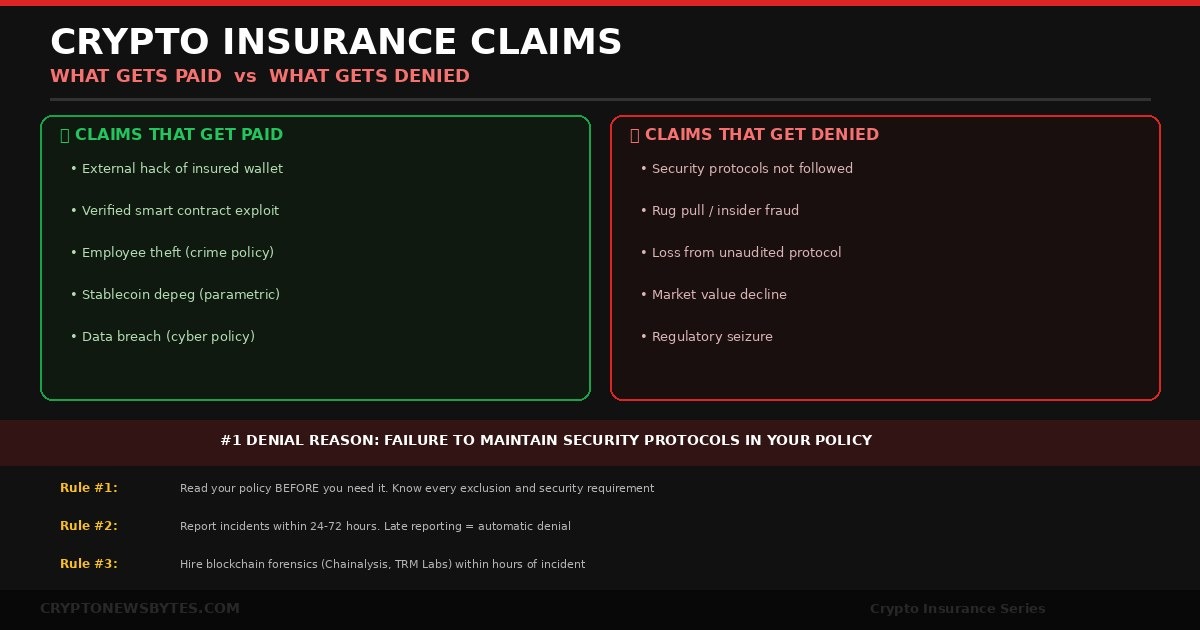
- Crypto insurance claims are paid when the loss matches a covered event AND the policyholder met all security requirements. The most commonly paid claims involve external hacking of insured wallets, verified smart contract exploits, and employee theft from custodial systems
- Claims are most commonly denied for: failure to follow required security protocols (like multi-sig), losses from unaudited protocols, insider fraud by founding teams (rug pulls), market value decline, and regulatory actions
- On-chain insurance (Nexus Mutual) has paid $18M+ in claims since 2019. The largest payouts came from smart contract exploit claims and stablecoin depeg events in 2022-2025
- Traditional insurers deny an estimated 40-60% of crypto claims, primarily because policyholders failed to maintain the security standards required by their policies (cold storage ratios, multi-sig enforcement, employee access controls)
- The #1 rule for getting claims paid: document everything. Transaction logs, security audit reports, incident response timelines, and proof of compliance with policy conditions are essential
- After the $2.72B in 2025 hacks, insurers have tightened underwriting. The gap between what exchanges think is covered and what actually pays out is the industry’s biggest blind spot
Crypto Insurance Claims: The Reality Gap
Buying crypto insurance is only half the battle. The real test comes when you file a claim. And the results are often surprising: many crypto companies discover at claim time that their loss is not covered, their security failed to meet policy requirements, or the claims process is far slower and more adversarial than expected. This guide breaks down what actually gets paid, what gets denied, and how to position yourself to recover.
Claims That Get Paid
| Claim Type | Why It Gets Paid | Key Requirements |
|---|---|---|
| External hack of insured hot wallet | Clear covered event with blockchain evidence | Must meet cold/hot storage ratio in policy |
| Verified smart contract exploit | Technical evidence shows code vulnerability exploited | Protocol must have been audited pre-exploit |
| Employee theft (crime policy) | Covered under fidelity/crime insurance | Must have background checks, access controls documented |
| Stablecoin depeg (on-chain) | Parametric trigger met (price below threshold) | Oracle confirms depeg condition, automatic payout |
| Data breach (cyber policy) | Covered under cyber liability for KYC data exposure | Must have met cybersecurity standards in policy |
Claims That Get Denied
| Claim Type | Why It Gets Denied | How to Avoid |
|---|---|---|
| Hack but security protocols not followed | Policy required 95% cold storage; exchange held 60% hot | Maintain exact security ratios in your policy |
| Rug pull / insider fraud by founders | Excluded as intentional act by insured party | Cannot be insured against your own fraud |
| Loss from unaudited protocol | Policy excludes protocols without professional audit | Only interact with audited protocols; verify coverage scope |
| Market value decline | Not an insurable event; insurance covers incidents, not markets | Use hedging/options for market risk, not insurance |
| Regulatory seizure or sanctions | Government action exclusion in most policies | Maintain full licensing compliance |
How to Maximize Your Chances of Getting Paid
✅ Claims Success Checklist
1. Read your policy before you need it. Understand every exclusion, every security requirement, every notification obligation. Most denials stem from policyholders not knowing what their policy actually requires.
2. Maintain all required security protocols. If your policy requires 95% cold storage, multi-sig with 3-of-5 approval, and quarterly penetration testing, document compliance continuously. Insurers audit this at claim time.
3. Report incidents immediately. Most policies require notification within 24-72 hours. Late reporting is a common grounds for denial.
4. Preserve all evidence. Transaction logs, blockchain forensics, server logs, employee access records, communication records. Do not alter or delete anything.
5. Engage forensics immediately. Hiring a blockchain forensics firm (Chainalysis, TRM Labs) within hours strengthens your claim by providing independent evidence of the attack vector.
6. Work with your broker. Your insurance broker advocates for you in the claims process. Engage them immediately, not after the insurer pushes back.
Frequently Asked Questions
📰 Crypto Insurance & Security Series
- Crypto Insurance in 2026: Why the Industry’s Biggest Problem Is Not Hackers
- Best Crypto Insurance Providers in 2026 Compared
- $2.72B Stolen in 2025: Crypto Insurance Lessons Every Founder Needs
- Smart Contract Insurance: How to Protect Your DeFi Protocol
- NFT Insurance: Can You Insure Digital Art and Collectibles?
- You are here: Crypto Insurance Claims: What Gets Paid and What Gets Denied
- Will Parametric Insurance for DeFi Replace Traditional Policies?
Sources: Relm Insurance | NAIC | Woodruff Sawyer | NamecoinNews
Disclaimer: This article is for informational purposes only. Claims outcomes depend on specific policy terms, jurisdictions, and facts. Consult your insurance broker and legal counsel for claims guidance.