3 Key Facts
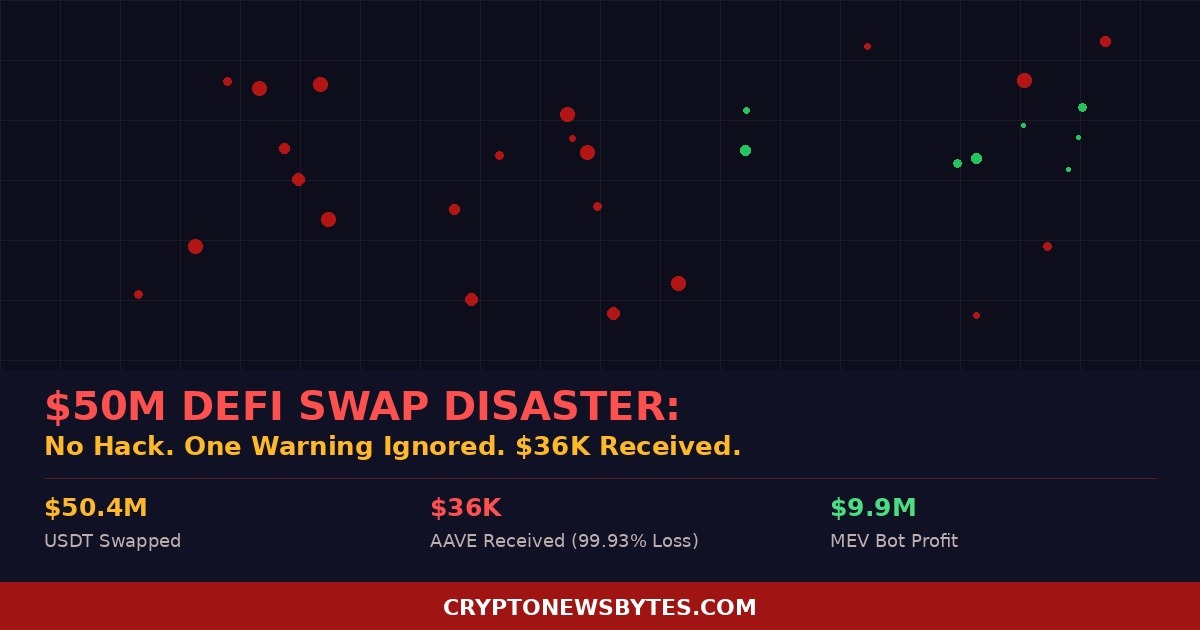
On March 12, 2026, wallet 0x98b…7ac8 used the Aave interface to swap $50,432,688 in aEthUSDT and received just 327 aEthAAVE worth $36,297 — a 99.93% loss. The trade routed through CoW Protocol into a SushiSwap pool containing only ~$73,000 in liquidity. Aave founder Stani Kulechov confirmed the interface displayed an extraordinary price impact warning, which the user accepted via checkbox on their mobile device.
In the same Ethereum block, an MEV bot flash-borrowed $29M in WETH from Morpho, bought AAVE at fair market value (~$114) via Bancor, waited for the victim’s order to inflate the SushiSwap price to ~$154,000 per AAVE, then sold into the pool and repaid the loan. Net profit: $9.9 million in approximately 12 seconds.
Both Aave and CoW Protocol confirmed their infrastructure functioned exactly as designed. There was no hack, no exploit, no smart contract bug. The pre-execution quote already showed fewer than 140 AAVE for $50M — visible before the user clicked confirm. Aave has offered a $600,000 fee refund. The $50M loss is unrecoverable.
This is the story of the most expensive checkbox in DeFi history. At roughly 10pm UTC on March 12, 2026, a single Ethereum transaction turned $50.4 million into $36,000. No hack. No exploit. No bug in the smart contracts. Every protocol involved executed exactly as designed. The person on the other end clicked a warning box, confirmed the trade on their phone, and watched $50 million disappear in 30 seconds.
In the same block, a bot had already seen it coming. It borrowed $29 million, positioned itself on the other side of the trade, and walked away with $9.9 million in profit. The victim’s loss funded the bot’s gain directly. This is what happens when a $50 million market order meets a $73,000 liquidity pool on a public blockchain.
| $50.4M USDT Swapped | $36K AAVE Received | $73K Pool Liquidity | $9.9M MEV Bot Profit |
The On-Chain Facts: What the Transaction Record Shows
📎 Verify on-chain: Etherscan transaction · Dune Analytics
The critical detail is in the token types. The wallet was swapping aEthUSDT and aEthAAVE — Aave’s interest-bearing deposit wrapper tokens, not spot USDT or spot AAVE. This was executed through Aave’s collateral swap feature, which lets borrowers shift their collateral allocation without manually withdrawing and re-depositing. Legitimate and useful. But at $50 million in a single order routed into a pool with $73,000 in it, the math becomes catastrophic.
How the Routing Path Destroyed $50 Million
CoW Protocol’s solver selected a three-leg path: Aave V3 to unwrap the aEthUSDT, Uniswap V3 to convert USDT to WETH, and SushiSwap to convert WETH to AAVE. The first two legs executed cleanly. The third one did not.
| Step | Protocol | What Happened | Result |
|---|---|---|---|
| 1 — Aave V3 | aEthUSDT → USDT | $50.4M aEthUSDT redeemed for raw USDT. Aave has ample USDT liquidity. Executes cleanly at fair rate. | ✅ Fine |
| 2 — Uniswap V3 | USDT → WETH | $50.4M USDT swapped for ~18,400 WETH through a deep, liquid pool. Executes at a reasonable rate. | ✅ Fine |
| 3 — SushiSwap ⚠️ | WETH → AAVE | 18,400 WETH routed into a pool with ~$73,000 total liquidity. AMM curve drives AAVE price to ~$154,120. Only 327 AAVE received. | 💥 Fatal |
| 4 — Aave V3 | AAVE → aEthAAVE | 327 AAVE wrapped back to aEthAAVE. Transaction marked successful on-chain. All steps executed as coded. | ✅ Done |
Aave engineer Martin Grabina confirmed the core issue on X: the quote shown before execution already displayed fewer than 140 AAVE for $50M. To be precise, this was the raw pre-fee, pre-final-impact figure shown in the order’s quote field — meaning the actual output was even worse once fees and residual slippage applied. The user saw this number, checked the confirmation box, and proceeded on their mobile device.
High Level Details: How $50M Became $36K
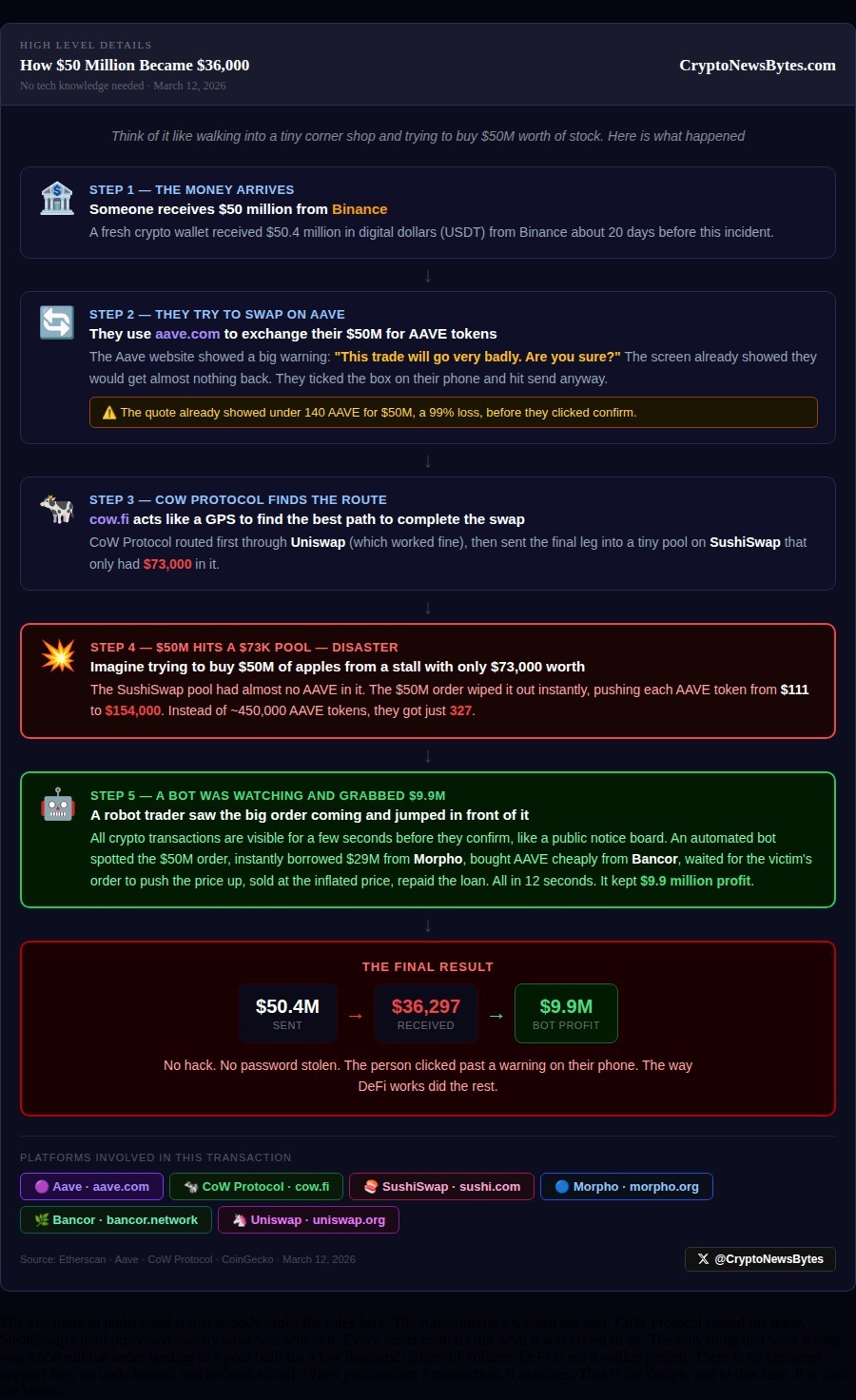
The mechanics of an AMM (automated market maker) like SushiSwap follow a constant product formula: x × y = k. When you push a very large order into a very small pool, you consume most of the tokens on one side, and the price the curve quotes for the remaining tokens becomes exponentially worse. At $50.4 million hitting a $73,000 pool, the curve essentially ran out of AAVE at any reasonable price, leaving 327 tokens at an average cost of $154,120 each. This is not a glitch. This is AMM math working exactly as designed.
The MEV Bot: How It Made $9.9M in One Ethereum Block (~12 Seconds)
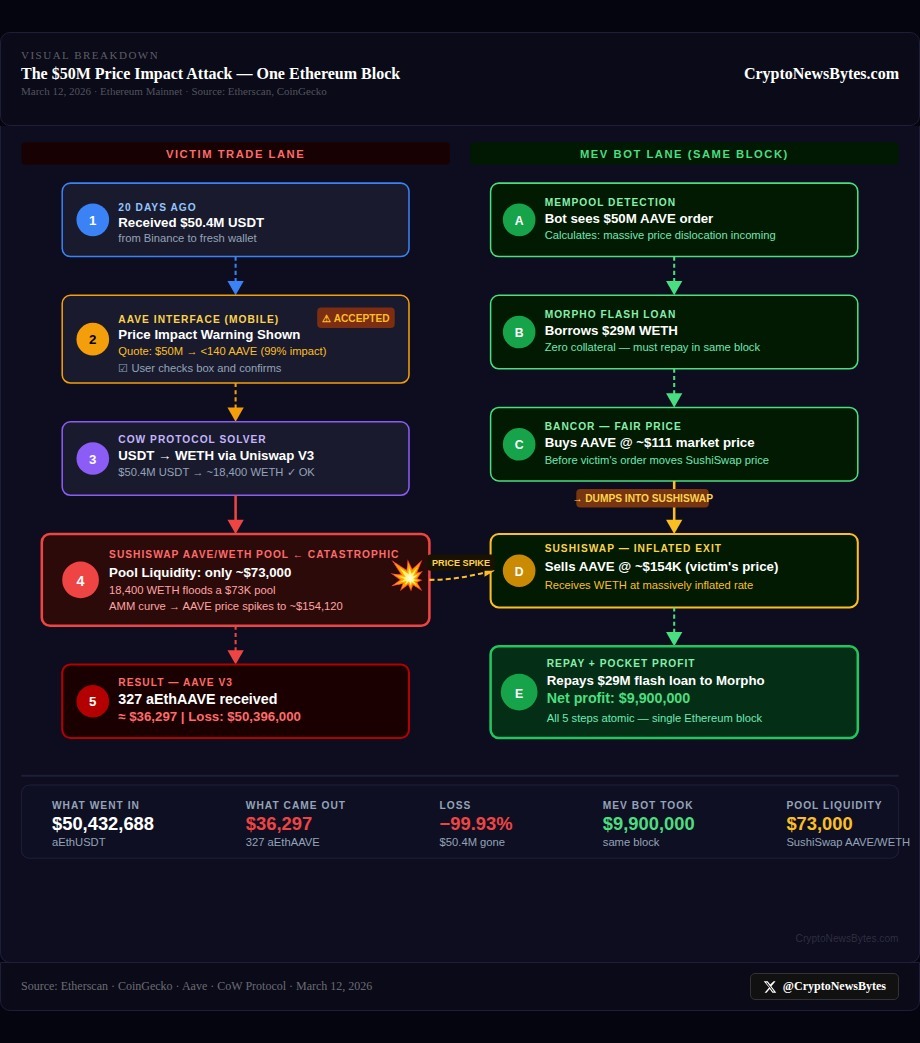
While the victim’s transaction sat in Ethereum’s public mempool — visible to anyone watching — an MEV bot spotted it and calculated the profit opportunity in milliseconds. MEV (Maximal Extractable Value) bots monitor every pending transaction and insert their own transactions around large incoming orders. In this case the bot had roughly 12 seconds.
MEV Bot Execution — 5 Steps, One Ethereum Block
| 1 | Flash borrow $29M WETH from Morpho. No collateral needed — the full amount must be repaid within the same block or the entire sequence reverts with zero loss. |
| 2 | Buy AAVE at fair value (~$114) via Bancor before the victim’s order executes. The bot now holds AAVE purchased at market price. |
| 3 | Victim’s $50.4M order hits SushiSwap. AMM curve drives AAVE’s effective price from ~$114 to ~$154,000 per token. The bot’s pre-purchased AAVE is now worth dramatically more. |
| 4 | Sell AAVE back into the pool at the inflated price. The bot receives WETH at far above fair value — capturing the price dislocation the victim’s order created. |
| 5 | Repay the $29M flash loan to Morpho plus fee. Everything settles atomically in one block. |
💰 Net profit to MEV bot: $9.9M extracted in one Ethereum block
The MEV bot did not steal from the victim in any conventional sense. It legally inserted its own transactions around a predictable large order in a public mempool using flash loans and arbitrage mechanics native to Ethereum’s design. The bot captured the price dislocation. Without it, the value would have been captured by other arbitrageurs in subsequent blocks anyway.
Price Impact vs Slippage: The Most Important Distinction in This Story
This is the most critical technical point — and the one Aave’s own engineer clarified publicly. The problem was not slippage. It was price impact. Confusing them matters for understanding what went wrong and who is responsible.
| Price Impact — What Happened Here | Slippage — What the Warning Said |
|---|---|
| The loss already embedded in the quote before you execute. Caused by your order being too large for the available pool liquidity. Visible in the output quote before signing. The user’s quote showed under 140 AAVE for $50M — a 99% price impact — before hitting confirm. | The difference between the quoted price and the executed price, caused by market movement between signing and confirmation. A 1% tolerance protects against post-quote market moves only. It does not protect against a quote already showing near-total loss. Setting slippage to 0% would not have saved this trade. |
What Aave, CoW Protocol, and the Community Said
| Aave / Stani Kulechov | CoW Protocol / CoW DAO | Community / On-Chain Analysis |
|---|---|---|
| Interface warned about extraordinary slippage and required explicit checkbox confirmation. CoW Swap routers functioned as intended. Outcome was “clearly far from optimal.” Aave will return $600K in fees and is investigating additional safeguards. | No protocol exploit or malicious behavior. Transaction executed according to the parameters of the signed order. The interface showed clear price impact warnings. CoW DAO stated: “despite clear warnings that showed the user they would lose nearly all of the value of their transaction, the user chose to proceed.” CoW DAO also confirmed it would refund any protocol fees on its side. | YAM (@yieldsandmore) identified the routing path on-chain: “mostly bad routing done by most aggregators.” Grabina confirmed the pre-execution quote showed under 140 AAVE for $50M before fees — the user had all the information to abort before execution. |
Separately, just one day before this incident, approximately $27 million in wrongful liquidations occurred on Aave due to a temporary oracle mispricing of wstETH, a Lido liquid staking token. Lido confirmed it would compensate affected users. The two incidents are technically unrelated — but arriving in the same news cycle, they together raised legitimate questions about DeFi infrastructure robustness for very large capital operations.
The $600K Refund — and the Governance Backstory
Kulechov announced Aave would refund approximately $600,000 in protocol and partner fees collected from the transaction. CoW DAO separately confirmed it would also refund any protocol fees associated with the transaction on its side. That number is notable beyond this incident alone. In February 2026, an Aave governance forum post alleged that 100% of CoW Swap partner fees generated through the Aave interface — between 15 and 25 basis points per swap — had been routed to a private Aave Labs address rather than the Aave DAO treasury. A governance bounty in the same $370,000 to $600,000 range was proposed for the community member who uncovered the routing. The refund figure aligns precisely with that fee tier, raising questions about the source of the refund that the community is watching closely.
How to Avoid a DeFi Swap Loss: Six Rules
The $50M AAVE trade is an extreme case. But the mechanics that destroyed $50 million operate at every scale. The same warning checkboxes skimmed over at $50M are skimmed over at $5,000. Here is what every user should check before confirming any large swap.
| Rule | Why It Matters |
|---|---|
| Check pool liquidity first | A $73K pool cannot absorb a $50M order. Before any large swap, check the destination pool’s total liquidity. If your order exceeds 5% of pool depth, find a different route or use an OTC desk. |
| Read price impact, not just slippage | Price impact is the loss built into the quote itself. If it shows above 2–3%, your order is too large for that pool. Above 10% is a serious warning. Above 50% means stop immediately. |
| Cross-check the output amount | Before signing, open CoinGecko or a CEX and check the live market price. If the interface quotes AAVE at $154,000 and CoinGecko shows ~$114, those two numbers tell you everything. The gap is your price impact made visible. |
| Split large orders | For any order above $100K, split across multiple pools, time across multiple blocks, or use an institutional OTC desk. Each smaller order creates less price impact and gets a fairer average rate. |
| No mobile for large trades | Stani confirmed the user accepted the warning on mobile. Small screens compress warnings and make large numbers harder to verify. For any transaction above $10,000, verify every number on desktop before signing. |
| Use MEV protection | Any large market order on Ethereum’s public mempool is visible to MEV bots. Use Flashbots Protect RPC, CoW’s limit order functionality, or private RPC endpoints that hide your transaction until block confirmation. |
Community Reaction
The incident spread rapidly across crypto social media on March 12–13, 2026. The consensus was uniform: no hack, no exploit, complete user error — but one enabled by a routing path that no well-designed interface should allow for a $50 million order. The tweet that broke the story by InvestorJordan (@InvestorJordan) went immediately viral:
“20 days ago a fresh wallet received $50.4M USDT from Binance. Just a bit ago, they swapped the entire amount for 327 AAVE worth ~$36K routed through CoW Protocol via Sushiswap. They paid $154K per AAVE. In the same block, an MEV bot immediately flash borrowed $29M WETH from Morpho, bought AAVE via Bancor @ fair value, and dumped the AAVE into the Sushiswap pool, repayed the flash loan, and pocketed $9.9M.”
— InvestorJordan (@InvestorJordan), March 12, 2026
The “$154K per AAVE versus market price of ~$114” figure became the immediate shorthand for what went wrong. Aave founder Stani Kulechov responded within hours. CoW Protocol issued its own statement the same evening. YAM (@yieldsandmore), who first identified the routing path on-chain, noted the issue was “mostly bad routing done by most aggregators” — and that the pre-execution quote was accurate, making the routing choice the failure point rather than the interface display.
Frequently Asked Questions
📰 Related Coverage on CryptoNewsBytes
Disclaimer: This article is for informational and educational purposes only and does not constitute financial or investment advice. On-chain data and figures are sourced from publicly available transaction records (Etherscan), Ledger Donjon research, and statements by Aave, CoW Protocol, and market commentators as of March 12–13, 2026. DeFi involves significant financial risk including total loss of funds. Always verify transaction details, pool liquidity, and price impact before executing large swaps.