

- Delaware lawmakers introduce bills to license stablecoin issuers, define digital assets in banking law and update money transmission rules
- Proposed rules aim to clarify requirements for crypto firms operating in the state and could influence how exchanges and issuers choose their jurisdiction
Delaware is moving to formalize its approach to digital assets with new legislation targeting stablecoins and crypto-related banking rules, aiming to reinforce its position as a crypto-friendly jurisdiction while addressing regulatory gaps that have pushed some firms to other states.
Delaware stablecoin bill targets licensing and reserves
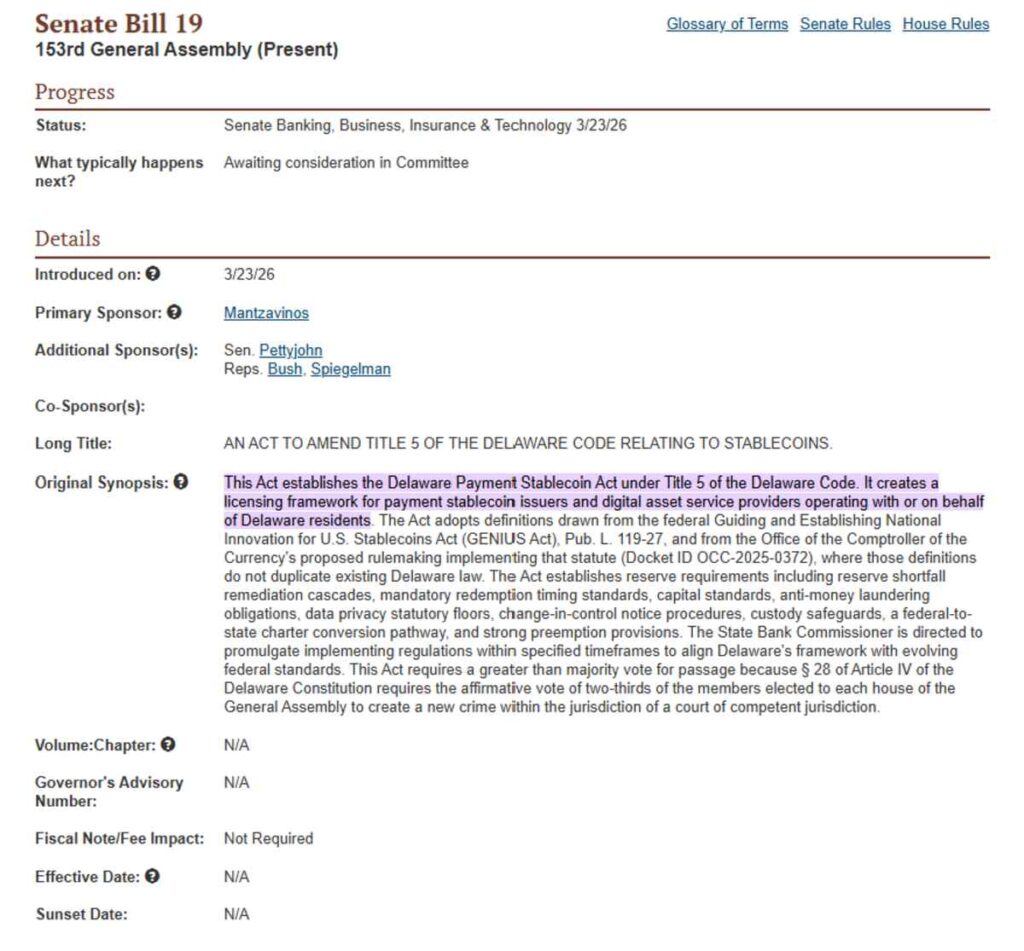
The Delaware Payment Stablecoin Act (Senate Bill 19) is the centerpiece of the state’s latest crypto push, creating a dedicated licensing framework for stablecoin issuers and digital asset service providers operating in Delaware. The bill borrows terminology and definitions from the US Stablecoins Act (also known as the GENIUS Act) and other federal models, signaling an effort to align state-level standards with emerging federal norms.
Under the proposal, stablecoin issuers would be subject to specific operational guardrails. These include mechanisms to remediate reserve shortfalls, enforce mandatory redemption timelines, and maintain defined capital standards. Anti-money laundering obligations are also built into the framework, positioning stablecoin oversight squarely within broader financial compliance structures rather than treating it as an exception.
If the bill passes, the State Bank Commissioner would be directed to design and implement the detailed rule set within a prescribed period. That would effectively make Delaware one of the states with a bespoke regulatory regime for stablecoins, at a time when issuers are evaluating which jurisdictions provide the clearest and most durable rules for operations in the US.
Delaware banking overhaul adds digital asset definitions
Alongside the stablecoin bill, lawmakers introduced the Delaware Banking Modernization Act (Senate Bill 16), a broader update to state banking law that touches on digital assets. While most of the bill focuses on traditional finance, such as corporate governance and organizational standards for banking institutions, it also seeks to explicitly define digital assets within Delaware’s banking code.
By adding digital asset terminology to legacy banking statutes, the bill aims to reduce uncertainty around how crypto-related activities intersect with existing financial regulations in the state. Clear definitions are intended to clarify how banks and other regulated entities can interact with tokens, stablecoins, and related services, potentially smoothing the path for integrated crypto-banking products.
Delaware has a history of courting blockchain and crypto businesses, including the Delaware Blockchain Initiative launched in 2016 under then-Governor Jack Markell. However, some high-profile crypto and technology companies, such as Coinbase, left the state last year, with Coinbase reincorporating in Texas after criticizing Delaware’s Chancery Court. Supporters of the new bills argue that stronger, clearer digital asset statutes could help reverse that outflow and put the state back on the map for crypto firms choosing a corporate home.
Both Senate Bill 16 and Senate Bill 19 must still clear several hurdles. The next step is review by the Senate Banking Committee, followed by debate in the full Delaware Senate before any potential enactment.
Broader Delaware push on virtual currency and money transmission
The stablecoin and banking bills are part of a wider digital asset agenda in Delaware. Lawmakers plan to introduce another measure, the Delaware Money Transmission & Virtual Currency Modernization Act, in the coming days. According to the announcement, that proposal will focus on consumer protections and harmonizing the types of activities that trigger licensing obligations for money transmitters and virtual currency businesses.
Together, the three initiatives are designed to “modernize” the state’s financial regulatory regime with crypto explicitly in scope. For exchanges, wallet providers, payment processors, and other digital asset operators, standardized licensing triggers and clarified money transmission rules could reduce compliance ambiguity when assessing whether to base operations in Delaware.
Federal crypto policy momentum alongside Delaware’s moves
Delaware’s legislative efforts coincide with renewed federal activity around digital assets. At the national level, US Senator Bill Cassidy stated on X that he intends to push forward a bill to update federal crypto tax rules, developed in partnership with Senator Cynthia Lummis and first introduced in September. The proposal targets several friction points in current tax treatment of digital assets, including a $300 de minimis exemption for small crypto purchases, ending double taxation for miners and stakers, and aligning digital asset taxation more closely with other financial instruments.
On the regulatory front, the US Securities and Exchange Commission recently submitted two proposed rules to the White House’s Office of Management and Budget for review. One of those proposals would classify most crypto assets on the market as not being securities under federal law, a shift that could significantly affect token issuers, exchanges, and on-chain projects if implemented as described.
For states like Delaware that are trying to refine their own crypto frameworks, the outcome of these federal initiatives will influence how far they can go in crafting bespoke digital asset regimes without conflicting with federal oversight.
Conclusion
Delaware’s new legislative package—anchored by a stablecoin licensing bill and a banking code overhaul that formally recognizes digital assets—marks a renewed attempt to position the state as a hub for crypto businesses. With additional money transmission and virtual currency reforms on the way, the state is seeking to provide clearer rules for stablecoin issuers and other digital asset firms at a time when federal lawmakers and regulators are also reshaping the US crypto landscape. Whether these measures are enough to draw companies back to Delaware will depend on how the bills progress through the legislature and how they align with the evolving national framework.
Disclaimer
The information provided in this article is for informational purposes only and should not be considered financial advice. The article does not offer sufficient information to make investment decisions, nor does it constitute an offer, recommendation, or solicitation to buy or sell any financial instrument. The content is opinion of the author and does not reflect any view or suggestion or any kind of advise from CryptoNewsBytes.com. The author declares he does not hold any of the above mentioned tokens or received any incentive from any company.
Featured image created by AI