

- U.S. bitcoin ETFs ended a weeks-long outflow streak, with $471.1 million on Friday and $144.9 million on Monday as bitcoin rebounded toward $70,000
- Total spot bitcoin ETF NAV stands at $90.053 billion, about 6.37% of bitcoin’s market cap, with $54.834 billion in historical net inflows.
U.S. bitcoin ETFs have broken a nearly month-long pattern of steady redemptions, signaling a shift in sentiment toward the cryptocurrency. After weeks of investor outflows that began in mid-January, spot funds tracking bitcoin posted back-to-back inflows for the first time in almost four weeks, aligning with a rebound in the underlying asset from recent lows.
Consecutive inflows mark a shift in Bitcoin ETF sentiment
The turn in flows began on Friday, when U.S. spot funds tied to bitcoin drew $471.1 million in new capital. That intake was followed on Monday by an additional $144.9 million, marking two consecutive sessions of net inflows. The renewed demand coincided with bitcoin climbing from a low of $60,000 to around $70,000, suggesting some investors were willing to re-enter after the pullback.
These inflows contrast with the pattern seen after mid-January, when bitcoin retreated from a peak near $98,000 to $60,000. The price decline prompted investors to withdraw millions from spot products that had rallied earlier in the month. While the correction triggered notable selling from some holders, the latest data show that not all investors exited, and many have maintained or expanded positions as prices stabilized.
The move back into bitcoin ETFs comes against a backdrop of heightened volatility. Despite sharp swings in price, the broader market has not fully unwound the gains in assets under management that had accumulated since last year. The recent inflows indicate that a segment of the market views the retracement as an opportunity rather than a reason to abandon exposure.
Bitcoin ETFs show resilience in assets under management
Even with the turbulence in spot prices, the overall size of the Bitcoin ETF market has held up. Figures from Checkonchain indicate that the combined holdings of 11 U.S. funds slipped only 7% since October, falling from 1.37 million BTC to 1.29 million BTC. This modest decline in assets under management stands in contrast to the underlying asset’s performance over the same period.
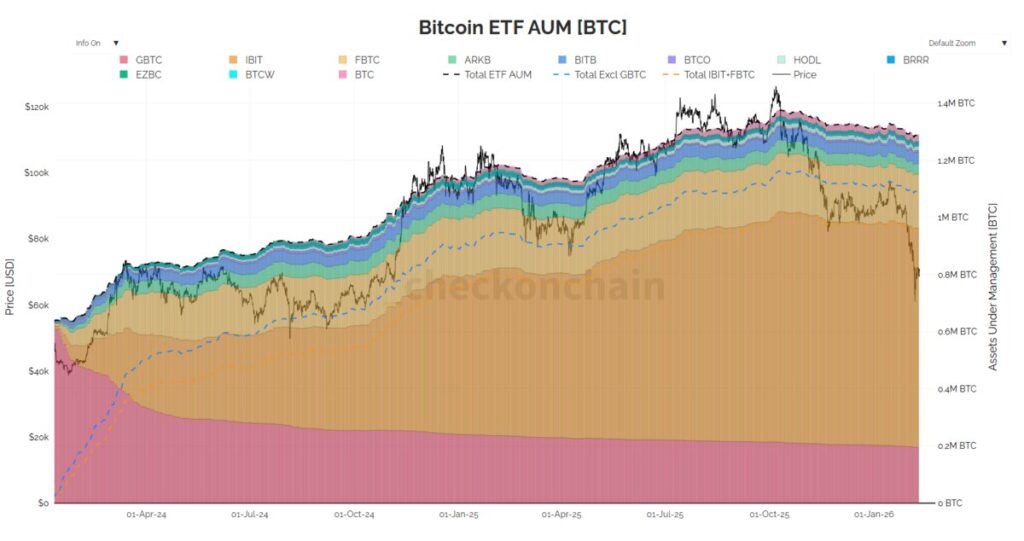
According to the same dataset, bitcoin itself has fallen by more than 40% from its all-time high above 126,000 BTC in October. The mismatch between the scale of the price drop and the relatively limited reduction in ETF holdings suggests that many investors continue to view these vehicles as long-term positions rather than short-term trading tools. Assets under management have contracted, but not in proportion to the drawdown in price.
The current total net asset value for U.S. bitcoin spot funds stands at $90.053 billion. That figure represents 6.37% of bitcoin’s entire market capitalization, underscoring the role that these products now play in channeling institutional and retail demand. Since launch, the cumulative historical net inflow into U.S. spot funds has reached $54.834 billion, pointing to persistent interest despite recent bouts of selling.
For market participants tracking structural trends, the stability in AUM across a period of steep price declines is a key indicator. It implies that a substantial portion of capital allocated to bitcoin ETFs is anchored in long-horizon strategies, with investors willing to absorb volatility in exchange for continued exposure.
Leading Bitcoin ETFs diverge on flows and performance
Within the broader market for bitcoin ETFs, individual products have seen different investor behavior. The Grayscale Bitcoin Mini Trust ETF, trading under the ticker BTC, recorded the largest net inflow on Monday. It attracted $131 million in a single day, extending its historical total net inflow to $2.071 billion. This performance highlights steady demand for this particular fund even as the wider market experiences price swings.
Another prominent product, the Ark Invest and 21Shares ETF known as ARKB, also posted positive flows on Monday. It registered a daily net inflow of $14.087 million, bringing its cumulative net inflow above $1.488 billion. Together, BTC and ARKB illustrate that several vehicles remain attractive, continuing to accumulate assets while bitcoin trades below its January peak.
Not all major funds moved in the same direction. The BlackRock Bitcoin ETF, traded as IBIT, experienced the largest net outflow on Monday, with $20.854 million leaving the product. Despite that setback, IBIT’s historical net inflow remains sizable at $61.82 billion. This shows that even when short-term sentiment turns cautious for a particular fund, its longer-term intake can still be substantial.
The contrasting flows across BTC, ARKB, and IBIT underscore that investors are selective in their allocations. Some favor certain issuers or fee structures, while others may be adjusting positions for liquidity or portfolio reasons. Overall, however, the combined data show net additions to bitcoin ETFs over the most recent sessions, reinforcing the idea that the segment as a whole retains support.
Conclusion
The latest figures from U.S. bitcoin ETFs indicate a cautious but measurable return of investor interest following a period of sustained redemptions. Consecutive inflows of $471.1 million on Friday and $144.9 million on Monday occurred as bitcoin recovered from $60,000 to around $70,000, suggesting that some market participants saw value in re-entering via spot funds.
Despite a more than 40% drop in bitcoin from its October all-time high, the aggregate assets under management of 11 U.S. funds have slipped only 7%, from 1.37 million BTC to 1.29 million BTC. With a total net asset value of $90.053 billion and historical net inflows of $54.834 billion, the market for these products remains sizeable. Divergent flows across individual funds such as BTC, ARKB, and IBIT highlight differences in investor preferences, but the broader picture shows that bitcoin ETFs continue to hold a firm place in portfolios even amid ongoing price volatility.
Disclaimer
The information provided in this article is for informational purposes only and should not be considered financial advice. The article does not offer sufficient information to make investment decisions, nor does it constitute an offer, recommendation, or solicitation to buy or sell any financial instrument. The content is opinion of the author and does not reflect any view or suggestion or any kind of advise from CryptoNewsBytes.com. The author declares he does not hold any of the above mentioned tokens or received any incentive from any company.
Featured image created by AI