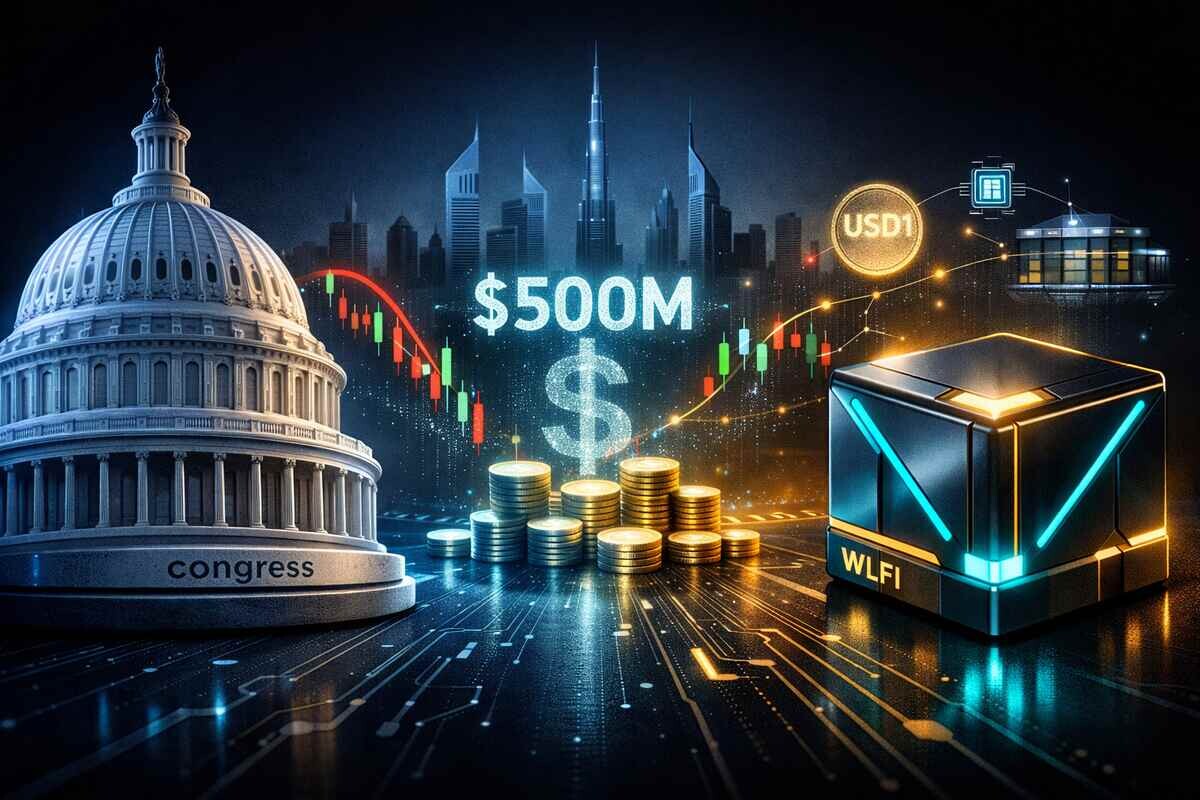
- Congress is examining a $500 million UAE-linked stake in Trump-related crypto firm WLFI and requesting detailed company records
- lawmaker ro khanna is focusing on timing, foreign ties, WLFI’s USD1 stablecoin, and links to AI chip exports and Binance
A new dispute in Washington is drawing attention to how foreign money interacts with politically connected crypto ventures, with Congress now examining a $500 million investment tied to a member of the United Arab Emirates royal family. The funding, directed to World Liberty Financial, a digital asset project associated with the Trump family, has prompted lawmakers to question whether the deal poses conflict-of-interest or national security risks. The transaction’s timing, just ahead of Donald Trump’s formal return to the White House, has added to the intensity of scrutiny.
Congress presses for details on $500 million UAE crypto deal
US Representative Ro Khanna has launched a formal inquiry into the investment, which gave a UAE-linked group a 49% stake in World Liberty Financial, also known as WLFI. On January 16, 2025, an entity connected to Sheikh Tahnoon bin Zayed Al Nahyan signed an agreement to buy nearly half of the company. The deal was completed only days before Trump officially resumed the presidency, placing it squarely in the overlap between private crypto business and public office.
Khanna, acting in his role as ranking member on a select committee with a mandate that includes China-related and broader national security issues, has framed the investigation around the size of the transaction, its timing, and the foreign connections involved. In a post on X on February 5, 2026, he announced that he had opened a probe into what he described as a $500 million UAE investment in a Trump family cryptocurrency company, arguing that the matter concerns public trust and transparency. His inquiry seeks to establish how the deal was reviewed and approved, and whether any specific safeguards were applied given the imminent transition of Trump back into the Oval Office.
Congressional investigators are focusing not only on who negotiated and signed off on the agreement, but also on whether the transaction structure and governance arrangements were designed to prevent undue influence. The fact that WLFI is linked to the Trump family through its founders and management has heightened those concerns, turning the investment into a test case for how closely lawmakers should monitor foreign-backed digital asset ventures connected to political figures.
Scope of the congressional document request
As part of the inquiry, Congress has asked WLFI to turn over extensive documentation. Khanna has sent a letter to company co-founder Zach Witkoff requesting a wide range of records tied to the UAE-backed deal. The request covers ownership and equity documents, information on payment pathways, and internal communications, including emails and messages among executives and board members who discussed or approved the investment.
Lawmakers want a detailed picture of how funds moved into and through WLFI, and whether any internal compliance teams or legal advisers raised warnings. The letter also seeks minutes or notes from board-level meetings in which the transaction was evaluated, as well as any risk assessments prepared in connection with the investment. According to Khanna, this level of detail is needed so that Congress can determine whether foreign capital entering a politically connected crypto project could create indirect channels of influence over US government decisions.
Khanna has set a deadline of March 1, 2026, for WLFI to provide the requested materials. He has said that once the documents are in hand, Congress will examine them to see whether existing conflict-of-interest rules and national security protections adequately address the issues raised by such deals. Lawmakers plan to assess if the transaction complied with current standards or exposes gaps in oversight that might require legislative or regulatory changes.
Congress expands probe into UAE ties
The reported association with Sheikh Tahnoon bin Zayed Al Nahyan has intensified the focus of the congressional probe. Sheikh Tahnoon is a senior security official in the United Arab Emirates, leading some in Congress to worry that investments routed through entities connected to him could provide foreign government-linked actors with a foothold in private US businesses close to political power. The concern is that such positions might, in turn, give those investors indirect leverage over policy choices in Washington.
As the investigation has progressed, Congress has begun looking beyond the investment itself to subsequent US policy decisions involving the UAE. Khanna has highlighted the approval of advanced AI chip exports to the country that occurred after the WLFI deal. He notes that these types of exports are typically subject to tight restrictions due to security considerations, and he has asked whether the timing raises questions about influence or reciprocity, even if no direct link has been established.
The inquiry also covers WLFI’s USD1 stablecoin, which Khanna has said was used in a $2 billion Binance investment that involved a group tied to the UAE. Investigators are examining whether this connection between the company’s digital token, a major crypto exchange, and UAE-linked capital might have intersected with later decisions concerning Binance. Specifically, questions have been raised about whether any of these business relationships had any bearing on the subsequent pardon of Binance founder Changpeng Zhao.
Through this wider lens, Congress is attempting to trace how capital flows, digital assets, and political connections might interact across borders. The objective is to understand whether the combination of a politically affiliated crypto firm, foreign security-linked investors, and large cross-border transactions could pose risks that existing US regulations are not fully addressing.
Conclusion
The dispute over the WLFI investment has pushed Congress to confront how foreign-backed crypto ventures tied to political families should be monitored within the US system. Representative Ro Khanna’s investigation is centered on a $500 million UAE-linked stake in a Trump-associated company, agreed on January 16, 2025, just before Donald Trump’s return to the presidency. Lawmakers have demanded comprehensive records by March 1, 2026, and are examining not only the transaction’s structure but also related issues such as AI chip export approvals, the role of WLFI’s USD1 stablecoin in a $2 billion Binance deal, and the later pardon of Binance founder Changpeng Zhao. While WLFI and the White House have described the investment as a standard commercial arrangement, Congress is treating it as a critical test of transparency, conflict-of-interest protections, and national security safeguards in an era where crypto finance and foreign policy can intersect.
Disclaimer
The information provided in this article is for informational purposes only and should not be considered financial advice. The article does not offer sufficient information to make investment decisions, nor does it constitute an offer, recommendation, or solicitation to buy or sell any financial instrument. The content is opinion of the author and does not reflect any view or suggestion or any kind of advise from CryptoNewsBytes.com. The author declares he does not hold any of the above mentioned tokens or received any incentive from any company.
Featured image created by AI