

- FSB’s 2025 report warns that foreign currency stablecoins, especially US dollar tokens, can create financial stability risks for emerging economies
- The watchdog says crypto assets and stablecoins still have limited real-economy use but calls for closer oversight of liquidity and operational risks
The Financial Stability Board (FSB) is sharpening its focus on the risks posed by foreign currency-denominated stablecoins, warning in its 2025 annual report that these instruments could undermine financial stability in emerging market and developing economies as they grow across borders.
FSB flags risks from foreign currency stablecoins
In its latest report, the FSB cautions that stablecoins tied to foreign currencies, particularly U.S. dollar-denominated tokens used in multiple jurisdictions, may generate “potentially more acute” challenges for emerging economies. According to the watchdog, these risks include the replacement of domestic currencies in everyday activity, diminished reliance on local payment systems, and weaker effectiveness of domestic monetary policy. The FSB also points to potential strains on public finances and the possibility that cross-border stablecoin flows could be used to evade capital flow management rules.
The report underscores that authorities in affected jurisdictions need to track how the stablecoin sector evolves to understand these vulnerabilities. That includes monitoring liquidity risk within stablecoin arrangements, operational weaknesses in issuance and redemption, and the deepening links between stablecoins and the wider financial system. The FSB positions these developments as a direct concern for macroeconomic stability, particularly where local financial systems are more fragile or heavily dollarized.
Regulatory progress and gaps in crypto and stablecoin oversight
The FSB’s 2025 assessment builds on its 2023 global regulatory framework for crypto asset activities and global stablecoin arrangements. While this framework was designed to guide national and regional rules, the board’s review in 2025 found that implementation remains uneven, with significant gaps and inconsistencies across jurisdictions. These discrepancies could create regulatory blind spots and opportunities for regulatory arbitrage as crypto and stablecoin markets operate across borders.
The watchdog reiterates that a coordinated global approach is needed to manage liquidity risk, operational resilience, and the complex interlinkages between crypto markets and traditional finance. As stablecoins become more embedded in trading, lending, or payment infrastructures, the FSB stresses that supervisors must be able to assess how shocks in crypto markets might transmit into banks, payment systems, or other core financial institutions.
FSB view on current crypto and stablecoin usage
Despite the growth of crypto assets and stablecoins in recent years, the FSB notes that they still have limited adoption in real economic activities such as everyday payments. The report states that, at this stage, crypto assets and stablecoins are not widely used in financial services that support the real economy. This assessment suggests that, while market capitalization and trading volumes may be significant, the role of these instruments in core financial intermediation and mainstream commerce remains constrained.
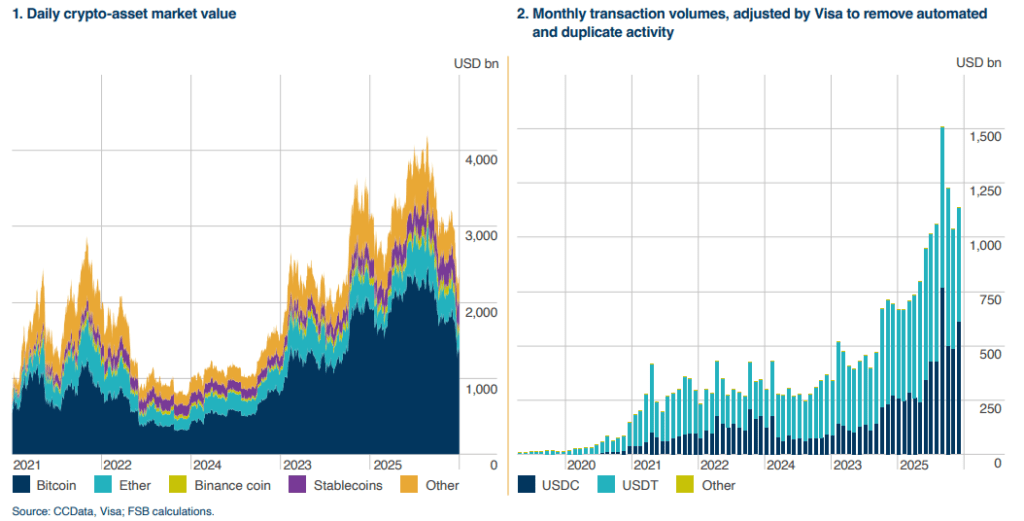
The FSB acknowledges that stablecoins can deliver benefits, including more efficient transactions and potentially lower costs. However, it emphasizes that authorities should continue to monitor vulnerabilities linked to how these instruments are backed, how liquid their reserves are, and how operational processes are designed. As connections between stablecoins and core markets deepen, the potential for disruptions to spillover into traditional finance increases, reinforcing the need for robust oversight.
FSB priorities for 2026 in digital assets and innovation
Looking ahead to 2026, the FSB identifies several areas of focus directly related to crypto assets and stablecoins. Digital innovation around crypto will remain under scrutiny, with the board planning to continue monitoring vulnerabilities tied to stablecoin structures and usage. This includes keeping track of how linkages with traditional financial institutions evolve and where new channels for risk transmission may appear.
Alongside crypto-specific work, the FSB will also monitor vulnerabilities in private credit and nonbank financial intermediation, both of which can intersect with digital asset markets through funding and leverage channels. Cross-border payments are highlighted as another focal point, an area where stablecoins and other crypto-based solutions are often positioned as alternatives or complements to existing systems. The board also signals ongoing work on crisis preparedness and regulatory modernization, which could influence how jurisdictions structure their regimes for crypto and stablecoin issuers as part of broader financial sector reforms.
Conclusion
The FSB’s 2025 report reinforces that foreign currency-denominated stablecoins, especially U.S. dollar-linked tokens circulating across multiple countries, are now a central concern for global regulators focused on emerging markets. While crypto assets and stablecoins still play a limited role in real-economy finance, the FSB is pressing for stronger, more consistent implementation of its international framework and plans to keep digital asset innovation and stablecoin vulnerabilities high on its agenda through 2026.
Disclaimer
The information provided in this article is for informational purposes only and should not be considered financial advice. The article does not offer sufficient information to make investment decisions, nor does it constitute an offer, recommendation, or solicitation to buy or sell any financial instrument. The content is opinion of the author and does not reflect any view or suggestion or any kind of advise from CryptoNewsBytes.com. The author declares he does not hold any of the above mentioned tokens or received any incentive from any company.
Featured image created by AI