- Polymarket’s March 30 fee expansion pushed daily fees above $1 million and lifted revenue close to $1 million on peak days
- The platform is increasing monetization while facing growing regulatory limits, bans in several countries, and new insider trading safeguards
Prediction market polymarket is seeing a sharp increase in fee income after a recent overhaul of its pricing model, even as regulators in multiple regions intensify scrutiny of on-chain betting platforms. New data shows that higher and broader trading fees have quickly translated into stronger revenue, underscoring how crypto-native prediction markets are trying to balance monetization with mounting legal pressure.
Polymarket fee expansion drives revenue surge
DefiLlama data indicates that polymarket’s daily fees climbed from roughly $363,000 on Monday to more than $1 million on both Wednesday and Thursday following a March 30 fee expansion. Revenue, defined as the share of fees retained after incentives are paid out, rose to as much as $995,000 on Wednesday before moderating to about $899,000 on Thursday. These levels mark a significant step up in the platform’s take from trading activity in a matter of days.
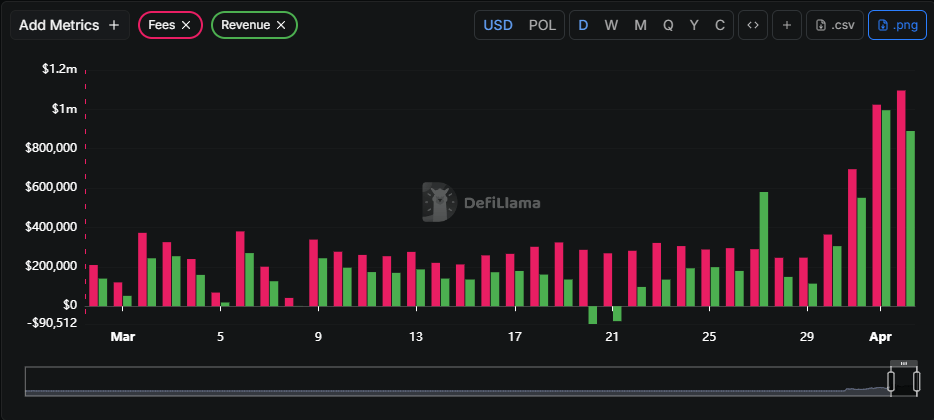
The move stems from a broader fee model that went live on Monday. Previously, polymarket charged taker fees primarily on crypto and sports markets. Under the new structure, taker fees now also apply to additional categories, including finance, politics, economics, culture, weather and tech. Geopolitical and world events remain exempt from taker fees. The expansion effectively widens the share of the platform’s trading universe that is monetized, capturing more of the volume that has driven prediction markets into mainstream discussion.
The rapid change in fee and revenue numbers suggests that users continued to trade despite higher costs in several categories. For investors backing the growth of crypto prediction markets, the move shows how platforms are attempting to convert attention and liquidity into sustainable income streams. Last week, Intercontinental Exchange, the parent company of the New York Stock Exchange, invested $600 million in polymarket, highlighting institutional interest in this segment of the crypto economy.
Regulatory pressures reshape Polymarket and peers
The timing of polymarket’s fee spike coincides with intensifying regulatory focus on prediction markets worldwide. Authorities in Europe, Latin America and the United States are increasingly treating these platforms as subjects of gambling and market integrity rules, directly affecting how crypto-based markets can operate and grow.
In Europe, polymarket has encountered new barriers in 2024. Regulators in Hungary and Portugal moved in January to block or limit local access, citing concerns that the platform functions as unlicensed gambling. Both jurisdictions pointed to licensing gaps, and Portugal highlighted specific worries about political betting. These actions add to the patchwork of country-level constraints that already limit where users can legally trade on crypto prediction platforms.
Argentina has also taken firm action. On March 17, a court ordered a nationwide ban on polymarket, arguing that users could place bets without adequate identity and age checks. The court said that, in practice, this allowed children and adolescents to access the platform and participate without effective controls. Such rulings strike at the core of the compliance frameworks that crypto-native prediction markets must adopt if they aim to serve a broader global audience.
According to its website, polymarket is currently blocked in 33 countries. By comparison, rival platform Kalshi reports that it is prohibited in 52 jurisdictions. These numbers illustrate the extent to which regulatory decisions are shaping the accessible footprint of prediction markets, especially those built on crypto rails and offering token-settled positions.
Market integrity moves by Polymarket and Kalshi
Regulatory scrutiny is not limited to licensing and access. Authorities and observers are also raising questions about market integrity and the potential for insider trading on these platforms. In response to growing criticism over well-timed bets and concerns that sensitive information could be used to profit in prediction markets, both polymarket and Kalshi have started tightening their rules.
On March 24, the two platforms rolled out new trading restrictions designed to curb insider trading. While specific mechanisms were not detailed in the source, the measures are aimed at addressing fears that participants with non-public information could use on-chain markets to monetize that edge. Such concerns are particularly acute when markets track political outcomes, economic indicators or other events where insiders might have early access to data.
Despite the clampdowns and access bans, polymarket and Kalshi are reportedly seeking to expand. Both are exploring new funding rounds that could value each platform at around $20 billion. That target underscores expectations among backers that crypto-based prediction markets can scale significantly if they navigate regulatory risks and demonstrate that their structures can align with emerging compliance requirements.
Conclusion
Polymarket’s rapid increase in daily fees and revenue following its March 30 fee expansion shows that demand for crypto-native prediction markets remains strong, even as regulators tighten oversight across multiple jurisdictions. With new trading restrictions to address insider trading concerns and ongoing efforts to raise large funding rounds, polymarket and its peers are attempting to grow under closer legal and market integrity scrutiny. How these platforms adjust their fee models, access policies and compliance frameworks will shape the next phase of on-chain prediction markets.
Disclaimer
The information provided in this article is for informational purposes only and should not be considered financial advice. The article does not offer sufficient information to make investment decisions, nor does it constitute an offer, recommendation, or solicitation to buy or sell any financial instrument. The content is opinion of the author and does not reflect any view or suggestion or any kind of advise from CryptoNewsBytes.com. The author declares he does not hold any of the above mentioned tokens or received any incentive from any company.
Featured image created by AI