
📋 In This Guide
- United States — CLARITY Act, CFTC, SEC Taxonomy · Full guide →
- European Union — MiCA Full Enforcement July 2026 · Full guide →
- Japan — FIEA Reform and 20% Tax Rate · Full guide →
- Hong Kong — 12 VATPs Licensed, Stablecoin Law Active · Full guide →
- UAE / Dubai — VARA Framework · Full guide →
- Singapore — MAS Payment Services Act · Full guide →
- India — 30% Tax and 1% TDS · Full guide →
- United Kingdom — FCA Crypto Regime · Full guide →
- Global Comparison Table
- FAQ
⚡ Key Takeaways — March 2026
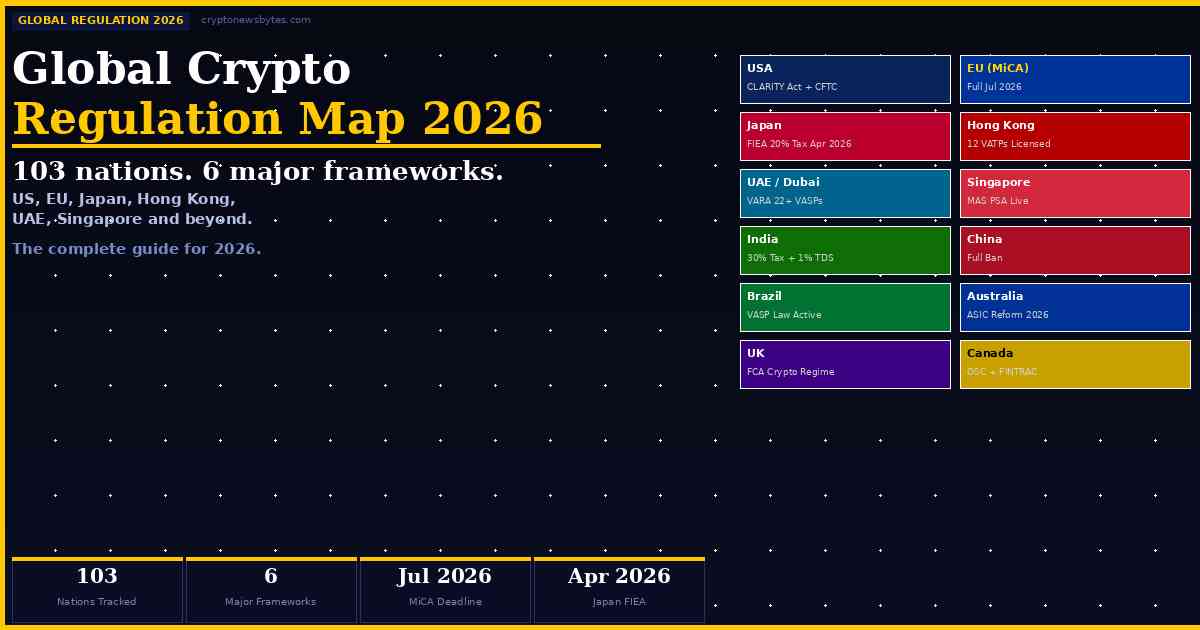
- Over 103 nations now have some form of digital asset regulatory framework in place — up from 68 in 2022.
- The EU’s MiCA is the world’s most comprehensive framework and reaches full enforcement by July 1, 2026. All crypto service providers operating in the EU must be licensed or shut down.
- Japan is implementing the most dramatic reform of 2026 — slashing crypto capital gains tax from 55% to a flat 20% and reclassifying 105 cryptocurrencies under the Financial Instruments and Exchange Act.
- Hong Kong has granted 12 VATP licenses as of February 2026, positioning itself as Asia-Pacific’s leading regulated crypto hub.
- The U.S. CLARITY Act is the most consequential pending legislation globally — its passage or failure will set the tone for institutional crypto adoption worldwide.
- China’s full ban remains in place, but Bitcoin mining continues in grey areas representing approximately 14% of global hashrate.
Crypto regulation in 2026 looks nothing like it did three years ago. In 2022, most governments were still asking basic questions: is Bitcoin a commodity or a security? Can banks hold crypto? Who licenses exchanges? Today, the EU has a fully operational comprehensive framework. Japan is weeks away from implementing the most significant tax reform in its crypto history. Hong Kong has become Asia’s premier regulated hub. And in the United States, the CLARITY Act is the most watched piece of financial legislation on the planet.
This guide covers every major jurisdiction — what the rules are, what is changing, what the deadlines are, and what it means for crypto investors, businesses, and developers operating globally. We update this guide quarterly.
📅 2026 Global Crypto Regulation Timeline
🇺🇸 United States — The CLARITY Act Era
The U.S. is at the most consequential regulatory inflection point in its crypto history. The CLARITY Act — currently awaiting a Senate Banking Committee markup targeted for mid-to-late March 2026 — would be the first comprehensive statutory framework for digital assets in American history. It explicitly classifies Bitcoin and Ethereum as digital commodities under CFTC jurisdiction, creates a market structure for regulated spot trading, and establishes the legal basis for institutional custody and investment products.
SEC Chair Paul Atkins has separately introduced a four-category token taxonomy — digital commodities, collectibles, tools, and tokenized securities — that provides regulatory guidance even before the CLARITY Act passes. The White House has made crypto-friendly regulation a stated policy priority, with the establishment of the first U.S. Strategic Bitcoin Reserve in early 2025 holding approximately 328,000 BTC.
The sticking point delaying the CLARITY Act is a single provision: whether stablecoin issuers and crypto platforms can offer yield on dollar-denominated tokens. Banks, led by the American Bankers Association, rejected a White House compromise on March 5, 2026. The 72% prediction market odds suggest the bill passes in some form before the summer recess.
🇪🇺 European Union — MiCA Full Enforcement July 2026
The Markets in Crypto-Assets Regulation (MiCA) is the world’s first comprehensive, harmonized crypto regulatory framework and applies across all 27 EU member states. MiCA entered full force in December 2024, with a transitional grandfathering period allowing existing providers to continue operating under national rules while seeking MiCA authorization. That transitional period ends for all member states by July 1, 2026 — after which no unlicensed crypto service provider can legally operate anywhere in the EU.
Progress has been uneven. Germany, Ireland, and Spain chose 12-month transitional periods ending December 2025, meaning providers in those countries had to be fully MiCA-compliant by year end. France, Malta, Luxembourg, and Estonia took the full 18-month window, giving providers until July 1, 2026. The Netherlands and Poland implemented just six months, meaning their transitional windows ended in mid-2025 — the strictest in the EU.
Key MiCA provisions include: mandatory CASP (Crypto Asset Service Provider) authorization to operate; stablecoin rules capping non-EUR stablecoins at 1 million daily transactions or €200 million in daily value; 14-day retail withdrawal rights on crypto purchases; fines up to 12.5% of annual turnover for non-compliance; and a single EU-wide license that passports across all 27 member states once obtained. Non-compliant stablecoins including USDT have been delisted from EU-regulated exchanges under MiCA’s stablecoin rules.
🇯🇵 Japan — The Biggest Reform of 2026
Japan is implementing the most significant overhaul of its crypto rules in five years, with changes taking effect from April 2026. At the center of the reform is a dramatic tax cut — from a progressive rate reaching as high as 55% down to a flat 20.315%, aligning crypto gains with the tax treatment of listed equities. The reform applies to approximately 105 cryptocurrencies listed on FSA-registered exchanges, including Bitcoin and Ethereum, reclassified as financial products under the Financial Instruments and Exchange Act (FIEA).
The reform introduces mandatory exchange disclosure requirements for all 105 approved tokens, insider trading prohibitions (extending securities-style laws to crypto for the first time in Japan), near real-time reserve reporting for exchanges, and loss carry-forward provisions allowing traders to offset future gains with past losses for up to three years. Japanese asset managers including SBI Global Asset Management and Daiwa Asset Management are preparing crypto ETF products targeting ¥5 trillion in assets under management, enabled by the new regulatory framework.
The catch: the flat 20% rate applies only to “specified crypto assets” on FSA-licensed exchanges. Tokens on unlicensed platforms, NFTs, and staking or lending rewards remain in a grey area and may still be taxed at the higher miscellaneous income rates.
📖 Full Japan Crypto Regulation Guide →
🇭🇰 Hong Kong — Asia’s Regulated Crypto Hub
Hong Kong has established itself as Asia-Pacific’s leading regulated crypto hub. As of February 2026, the Securities and Futures Commission (SFC) has granted full VATP (Virtual Asset Trading Platform) licenses to 12 exchanges — with Victory Fintech receiving the most recent license on February 17, 2026, ending an eight-month pause in new approvals. All centralized exchanges operating in Hong Kong or actively marketing to Hong Kong residents must hold a VATP license under the Anti-Money Laundering Ordinance (AMLO).
Hong Kong’s Stablecoins Ordinance came into force on August 1, 2025, establishing a licensing regime for fiat-referenced stablecoin issuers under the Hong Kong Monetary Authority (HKMA). Issuers must hold at least HK$25 million in paid-up capital and maintain segregated reserve pools equal to the value of stablecoins issued. There is no capital gains tax on crypto in Hong Kong — making it one of the most tax-efficient regulated jurisdictions globally.
The SFC and Financial Services and Treasury Bureau (FSTB) are targeting 2026 legislation to extend licensing to virtual asset dealers and custodians — expanding the regulated perimeter beyond trading platforms for the first time.
📖 Full Hong Kong Crypto Regulation Guide →
🇦🇪 UAE / Dubai — VARA and DFSA
Dubai’s Virtual Assets Regulatory Authority (VARA) is the world’s only standalone, crypto-dedicated regulatory body and governs virtual asset service providers operating on the Dubai mainland and in most free zones. As of early 2026, VARA has registered 22 entities as approved VASPs, with enforcement actions issued against seven firms found operating without approval. The Dubai International Financial Centre (DIFC) operates under the separate Dubai Financial Services Authority (DFSA) framework.
The UAE offers 100% foreign ownership across most business activities, a zero-income-tax regime, and has made the digital economy a cornerstone of national strategy — making it one of the most attractive jurisdictions globally for crypto businesses. VARA’s Version 2.0 rulebooks, published in May 2025, emphasize activity-based licensing across eight categories of virtual asset activity. Animoca Brands received a broker-dealer and digital asset license from Dubai in early 2026, signaling continued appetite for major crypto firms to establish UAE presence.
📖 Full UAE and Dubai Crypto Regulation Guide →
🇸🇬 Singapore — MAS Licensing Framework
Singapore operates one of the most mature crypto regulatory regimes in Asia under the Monetary Authority of Singapore (MAS) through the Payment Services Act (PSA). The PSA requires all Digital Token Service Providers (DTSPs) to be licensed, with a tiered licensing structure offering flexibility based on business activity and scale — contrasting with Hong Kong’s single mandatory licensing model. Singapore finalized its stablecoin licensing framework in 2023 with a focus on AML/CFT governance.
Singapore imposes no capital gains tax on crypto — long-term holders are not taxed on appreciation. However, businesses that trade crypto as a core activity may have gains classified as income and taxed accordingly. SBI Holdings signaled intent in early 2026 to acquire a majority stake in Coinhako, one of Singapore’s longest-standing crypto exchanges, reflecting continued consolidation in the regulated Singapore market.
📖 Full Singapore Crypto Regulation Guide →
🇮🇳 India — High Tax, Active Market
India has one of the most punishing crypto tax regimes among major economies — a flat 30% tax on all crypto gains with no loss offset permitted across different assets, plus a 1% Tax Deducted at Source (TDS) on all crypto transactions above 10,000 rupees. Despite the tax burden, India maintains a large and active retail crypto market. Approximately 35% of India’s crypto traders comply with the existing tax rules.
India has not banned crypto but maintains an ambiguous stance that has discouraged institutional adoption. The government has repeatedly deferred decisions on comprehensive legislation. The Reserve Bank of India (RBI) continues to advocate for stricter restrictions while the Finance Ministry has signaled openness to clearer frameworks aligned with FATF standards. India’s position in 2026 remains one of high taxation and regulatory uncertainty rather than outright prohibition.
📖 Full India Crypto Regulation Guide →
🇬🇧 United Kingdom — FCA Crypto Regime
The UK’s Financial Conduct Authority (FCA) runs a crypto registration regime that requires all UK-operating crypto asset businesses to register and comply with AML/CTF rules. Full authorization — a higher standard than registration — typically takes 6 to 12 months. The UK left the EU regulatory orbit following Brexit, so MiCA does not apply, and the UK is developing its own comprehensive crypto framework separately.
UK crypto holders pay Capital Gains Tax on profits at 10% (basic rate) or 20% (higher rate), with an annual CGT exemption applying. Income from crypto activities such as mining and staking is taxed as income. The UK government has committed to consulting on a comprehensive crypto regulatory regime in 2026, but no final framework has been published. Despite its fintech prominence, UK crypto media traffic represents only 5.75% of Western European crypto media — significantly below Germany (29.89%) and France (28.74%).
📖 Full UK Crypto Regulation Guide →
Looking for countries with no crypto tax at all? We cover every zero-tax crypto jurisdiction in 2026 in a dedicated guide.
Global Comparison Table — March 2026
| Jurisdiction | Framework Status | Tax on Gains | Key Regulator | BTC Legal? | 2026 Key Date |
|---|---|---|---|---|---|
| 🇺🇸 USA | Pending (CLARITY Act) | Short-term: up to 37% / Long-term: 20% | CFTC + SEC | Yes | Senate Markup Mar 2026 |
| 🇪🇺 EU | MiCA Full Force | Varies by member state (avg 25–30%) | ESMA + NCAs | Yes | All CASPs licensed Jul 1 |
| 🇯🇵 Japan | FIEA Reform Active | Flat 20.315% (from Apr 2026) | FSA | Yes | FIEA effective Apr 2026 |
| 🇭🇰 Hong Kong | VATP Regime Active | None (no CGT) | SFC + HKMA | Yes | Dealer/Custodian Law 2026 |
| 🇦🇪 UAE | VARA Active | None (no income tax) | VARA + DFSA | Yes | Ongoing VASP licensing |
| 🇸🇬 Singapore | PSA Active | None (no CGT) | MAS | Yes | Ongoing DTSP licensing |
| 🇮🇳 India | Restrictive/Unclear | 30% flat + 1% TDS | RBI + MoF | Legal, not regulated | Legislation still pending |
| 🇬🇧 UK | FCA Registration Only | CGT 10–20% | FCA + HMRC | Yes | Full framework 2026 |
| 🇨🇳 China | Full Ban | N/A | PBOC | Banned (grey mining) | No change expected |
| 🇧🇷 Brazil | VASP Law Active | 15–22.5% on gains | Banco Central do Brasil | Yes | Full implementation 2026 |
| 🇦🇺 Australia | ASIC Reform Pending | CGT at marginal rate | ASIC + ATO | Yes | Exchange licensing 2026 |
| 🇰🇷 South Korea | VASP Act Active | 20% on gains over 2.5M KRW | FSC + FSS | Yes | Institutional access 2026 |
❓ Frequently Asked Questions — Crypto Regulation 2026