
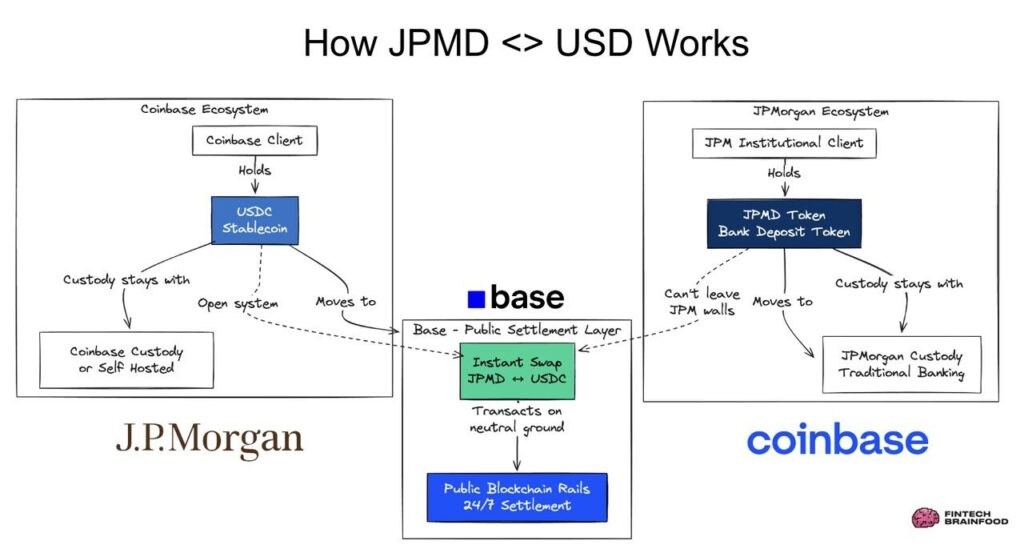
The next major evolution in digital finance isn’t coming from a new token launch or a new blockchain. it’s emerging from the quiet but powerful interoperability forming between JPMorgan, Coinbase, and Base. This architecture shows how bank deposit tokens and crypto-native stablecoins can finally interact through a shared, neutral settlement layer.
This isn’t just a technical upgrade. It’s the foundation for a unified digital dollar infrastructure where institutional money and crypto liquidity flow across the same rails securely, instantly, and 24/7.
Below is a breakdown of how it works, why it matters, and what it unlocks for the future of global settlement.
______
💵 Two Types of Digital Dollars Are Converging
For years, crypto and traditional finance have evolved in parallel with little interoperability. Today, we have two dominant versions of tokenized dollars — each powerful, but siloed.
USDC : The Open, Crypto-Native Dollar
USDC is:
- Public and blockchain-native
- Free-moving across multiple chains
- Programmable and composable in DeFi
- Widely adopted by fintech, exchanges, and global commerce
It operates like the “internet’s USD,” optimized for speed, interoperability, and open financial systems.
JPMD : The Institutional, Bank-Native Representation of Dollars
JPMorgan’s JPMD (JPMorgan Deposit Token) is:
- Permissioned and institutionally regulated
- Designed for high-value payments, settlements, and treasury operations
- Fully backed by bank deposits
- Restricted inside JPMorgan’s private ecosystem
JPMD functions like a tokenized bank deposit — ideal for enterprises but not open to public blockchain movement.
For years, these two worlds couldn’t speak to each other.
That barrier is now dissolving.
⚡ Base: The Neutral Settlement Layer Connecting Both Worlds
Base, Coinbase’s L2 blockchain is becoming a trusted public settlement layer where USDC and JPMD can interact without either side leaving its custody rules.
Here’s why that matters.
Instant Swap: JPMD ↔ USDC
Both assets remain in their native custody environments:
- USDC stays with Coinbase Custody or a self-hosted wallet
- JPMD stays inside JPMorgan Custody and cannot leave its permissioned wall
But on Base, each can be represented in a controlled, auditable way that enables an instant swap on neutral ground.
This means:
- Crypto users can swap into bank-grade liquidity
- Institutional clients can access open stablecoin liquidity
- Neither party compromises compliance or risk boundaries
It’s the first real-world example of public blockchain rails serving as a shared settlement environment between TradFi and crypto.
🛠 Why This Architecture Matters
The significance of this setup extends far beyond one swap.
1. Public Infrastructure Becomes a Shared Commercial Settlement Layer
Instead of a private bank network or a closed crypto ecosystem, a public chain becomes the interoperability layer.
This is a radical shift:
Public blockchains aren’t just for DeFi anymore — they are becoming institutional settlement highways.
2. Custody and Compliance Barriers Remain Intact
Neither JPMorgan nor Coinbase has to compromise:
- JPM keeps regulatory-perimeter control over JPMD
- Coinbase keeps USDC liquid and open
- Base enables controlled interaction between them
This satisfies regulators, institutions, and crypto-native participants simultaneously.
3. Enables True 24/7 Institutional Settlement
Banks still operate on:
- Batch settlements
- Limited hours
- Dependence on legacy rails like ACH, SWIFT, and wire systems
On Base, settlement is:
- Instant
- Programmable
- Global
- 24/7
This is the level of settlement velocity institutions need — especially for cross-border transactions, corporate treasury, and B2B payments.
4. It’s a Prototype for a Unified Digital Dollar Network
If this architecture scales, it could unify:
- Bank deposit tokens
- Stablecoins like USDC and PYUSD
- Tokenized money market funds
- On-chain treasuries
- Real-world asset networks
Every major financial asset could eventually settle through a shared, neutral, programmable layer.
🌍 The Ripple Effects Across Global Finance
This model signals a profound shift in how global money will move.
Banks Gain Access to On-Chain Liquidity
Institutional clients could settle trades, invoices, collateral, and treasury operations instantly — even during weekends and holidays.
Crypto Gains Access to Bank-Grade Infrastructure
Stablecoins benefit from smoother off-ramps, institutional liquidity, and regulatory-grade settlement standards.
Global Payments Become Faster and Cheaper
Cross-border transfers could occur through Base instead of correspondent banking layers, drastically reducing:
- Delays
- Fees
- Settlement risk
A Modular Financial System Emerges
Instead of one network dominating, we’ll see:
- Banks
- Fintech
- Crypto platforms
…all plugging into the same public infrastructure while keeping their identity and compliance rules.
This is financial modularity at internet scale.
🚀 The Big Picture: The First Real Bridge Between TradFi and Crypto
This JPMD ↔ USDC architecture is more than an integration.
It represents the first time a major U.S. bank and a major crypto institution implicitly agree on:
- A shared public settlement fabric
- A neutral, trust-minimized interoperability layer
- A future where digital dollars are compatible, not competitive
In this model:
- JPMD remains a bank dollar
- USDC remains a crypto dollar
- Base becomes the highway that lets them transact seamlessly
This is the architecture of the hybrid financial system — part bank, part blockchain, fully interoperable.
Conclusion: The First Real Blueprint for a Unified Digital Dollar System
The JPMD–USDC interoperability model isn’t just a technical experiment — it’s a strategic turning point in how digital dollars will function in the coming decade. For the first time, a major U.S. bank and a leading crypto institution are aligning around a shared, neutral, programmable settlement layer. This architecture proves that banks don’t need to abandon their compliance walls and crypto doesn’t need to sacrifice openness for institutions to participate. Instead, both ecosystems can preserve their strengths while transacting seamlessly on public blockchain rails.
What Base enables here is bigger than a single integration. It demonstrates that the future of money will not be purely TradFi or purely crypto, but a hybrid model where institutional-grade assets and open stablecoins coexist and interoperate. Digital dollars — whether issued by banks, fintechs, or crypto platforms — will ultimately move across the same high-speed infrastructure, unlocking 24/7 settlement, global liquidity, and unprecedented efficiency.
This convergence marks the beginning of a unified digital financial system: one where value flows as freely as information, and where public blockchains become the connective tissue between the world’s largest financial players. The bridge is finally being built — and the implications will reshape global finance for years to come.
Source pic – AI generated impage