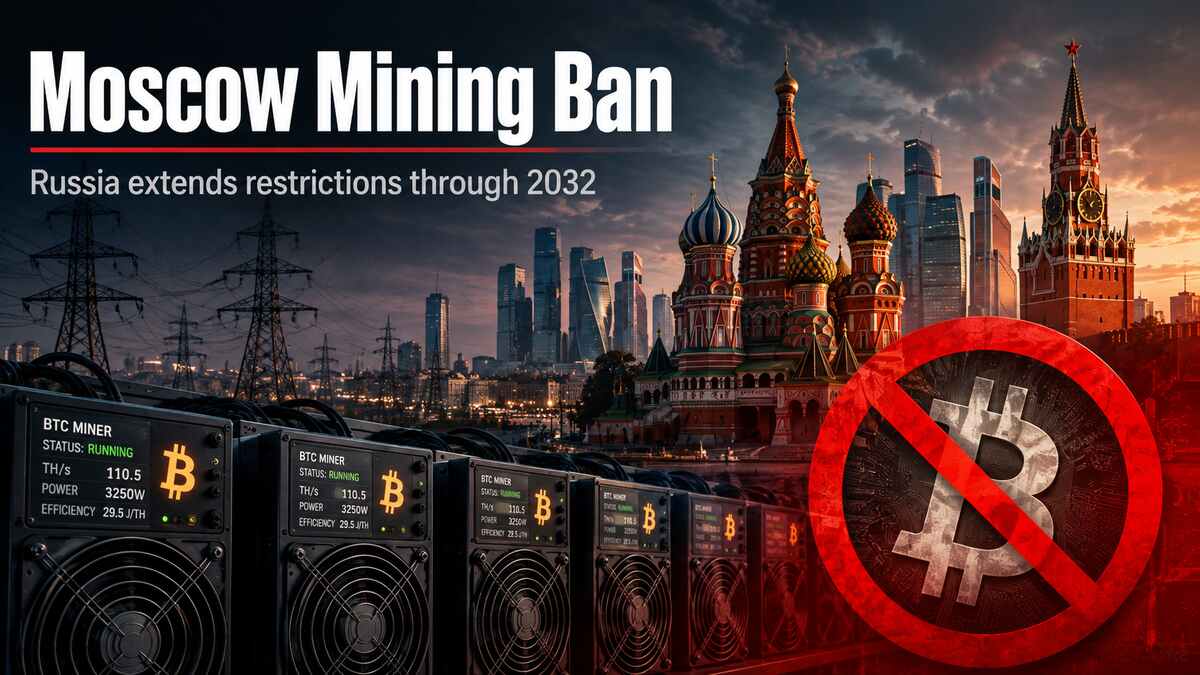
- Russia banned crypto mining in Moscow, the Moscow Region, and parts of Kursk through Dec. 31, 2032.
- The decree also prohibits participation in crypto mining pools.
- Officials said the move is meant to reduce regional power-capacity risks.
Russia has imposed a new Moscow mining ban covering the capital, the surrounding Moscow Region, and parts of Kursk, with restrictions set to remain in place through Dec. 31, 2032. The measure was established under government decree No. 936, signed on July 25 and published on July 31, according to local media reports. It not only prohibits crypto mining in those areas but also bars participation in crypto mining pools. The decision is notable because Russia was estimated to account for 175 exahashes per second in the first quarter, or 16.4% of Bitcoin’s global computing power, placing it second behind the U.S., even though the share located in the newly restricted region is unclear.
Moscow mining ban covers Moscow and nearby areas
The Moscow mining ban applies to Moscow, the broader Moscow Region, and parts of Kursk. Under government decree No. 936, the restrictions will remain in force until Dec. 31, 2032. Local media reports said the decree was signed on July 25 and published on July 31.
The same decree also blocks participation in crypto mining pools, extending the policy beyond operating mining equipment directly in the affected areas. While the restrictions are clearly defined geographically, the source does not say how much of Russia’s overall Bitcoin mining capacity was located inside the newly restricted zone.
Power concerns drive the Moscow mining ban
Russia’s Energy Ministry said a year-round restriction was needed to reduce the risk of power-capacity shortages as energy-intensive mining facilities connect to regional grids. The government’s stated reason for the Moscow mining ban centers on pressure that mining can place on electricity systems.
Interfax reported after the decree was first signed that mining currently consumes about 1 gigawatt in the Moscow power system. It also said the region’s data-center capacity could reach 3.6 GW by 2032, equivalent to 17% of peak demand. Those figures help explain why officials opted for a long-term restriction rather than a shorter temporary measure.
Moscow mining ban in Russia’s broader mining policy
Luxor’s Hashrate Index estimated that Russia accounted for 175 exahashes per second in the first quarter, or 16.4% of Bitcoin’s global computing power. That made the country the second-largest contributor after the U.S. Even so, the source notes that it remains unclear how much of that capacity was concentrated in the areas covered by the Moscow mining ban.
Russia had already been reshaping its mining policy before this decree. The country legalized registered crypto mining in 2024, then later that year banned the activity in 10 regions through March 2031, citing electricity demand. Year-round restrictions were later expanded to southern Irkutsk and most areas of Buryatia and Zabaykalsky Krai.
Sanctions context around Russian mining
Mining has also been linked to Russia’s efforts to manage the impact of Western sanctions. Finance Minister Anton Siluanov said in December 2024 that Russian companies had been using domestically mined bitcoin in international payments after legal changes designed to counter Western restrictions.
Parliamentary legislation passed in July kept Russia’s ban on domestic crypto payments in place, but preserved exceptions for foreign-trade settlements and transactions involving mined cryptocurrency. The source said that structure left the mechanism available as sanctions continued to limit conventional payment channels. Separately, the U.S. Treasury sanctioned BitRiver and 10 subsidiaries in 2022, saying Russian mining companies helped the country monetize energy resources and could offset the impact of sanctions.
Conclusion
The Moscow mining ban adds another long-term regional restriction to Russia’s evolving crypto mining policy. It covers Moscow, the Moscow Region, and parts of Kursk through the end of 2032, while also prohibiting participation in crypto mining pools. Russian officials say the measure is intended to reduce risks to electricity capacity as mining and data-center demand grow. At the same time, the move comes as Russia remains one of the world’s largest Bitcoin mining centers and continues to allow certain foreign-trade uses of mined cryptocurrency. That makes the policy significant not only for local energy planning, but also for the country’s broader approach to mining and sanctions pressure.
Disclaimer
The information provided in this article is for informational purposes only and should not be considered financial advice. The article does not offer sufficient information to make investment decisions, nor does it constitute an offer, recommendation, or solicitation to buy or sell any financial instrument. The content is opinion of the author and does not reflect any view or suggestion or any kind of advise from CryptoNewsBytes.com. The author declares he does not hold any of the above mentioned tokens or received any incentive from any company.
Featured image created by AI