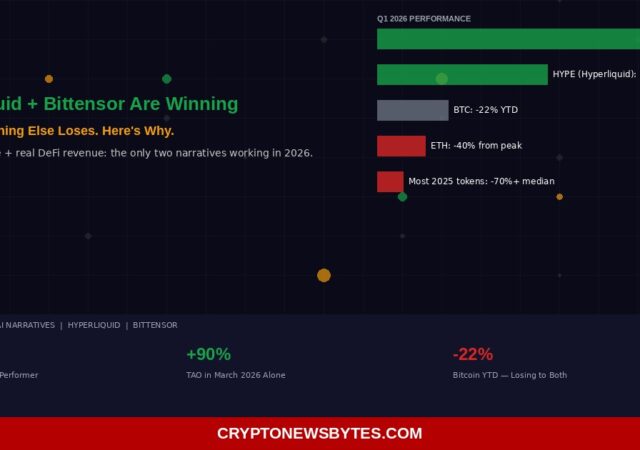
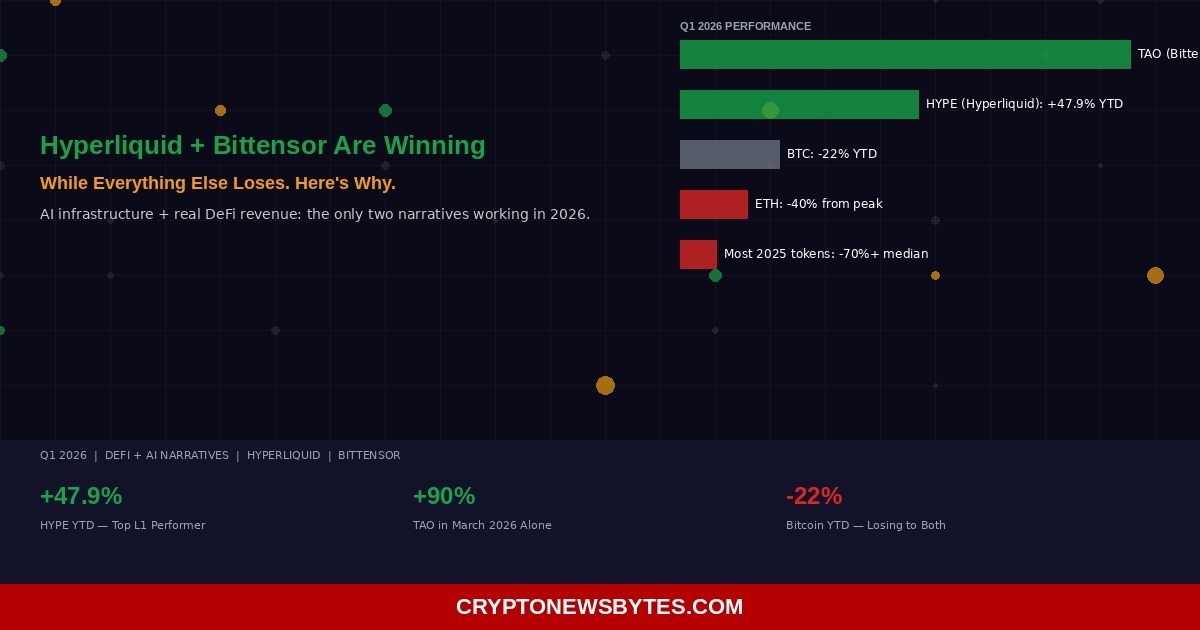
The 2026 crypto market has a simple structure. Bitcoin is down approximately 22 percent year-to-date. Ethereum is down over 33 percent. Solana is roughly flat to slightly negative. The altcoin market at large has 38 percent of tokens trading near all-time lows, worse than the FTX collapse by that measure. Into that landscape, two tokens have done something different. Hyperliquid’s HYPE was up approximately 48 percent year-to-date at its March 30 peak, and remains up over 30 percent YTD as of April 7, making it one of the strongest performers in the top 15 by market cap. Bittensor’s TAO surged 90 percent in March alone, bringing its month-over-month gain to over 100 percent. Neither is behaving like a crypto asset. Both are behaving like the narratives behind them have structural reasons to win that are independent of Bitcoin’s price.
Understanding why requires understanding what HYPE and TAO actually do, and why DeFi infrastructure that generates real fees and AI blockchain that delivers measurable model outputs are the only two stories the market is rewarding in a macro-driven drawdown that has punished everything else.
Updated April 7, 2026: Both tokens pulled back in early April alongside the broader AI and DeFi sector after Iran’s IRGC designated major US tech firms as targets, triggering sector-wide selling. HYPE retraced from its March high near $43 to approximately $37. TAO retraced from approximately $350 to approximately $300. The YTD outperformance thesis remains intact. Both still significantly outperform Bitcoin and most major altcoins year-to-date. The structural arguments in this article, real fee revenue for HYPE and decentralised AI proof of concept for TAO, have not changed.
| HYPE +48% Hyperliquid YTD 2026 vs BTC -22% | TAO +90% Bittensor in March 2026 alone (+102% monthly) | 38% ATL Altcoins Near All-Time Lows, Worse Than FTX |
Q1 2026 YTD Performance: Winners vs the Broader Market
As of March 30, 2026. Sources: CoinGecko, CoinDesk, CoinMarketCap.
| HYPE Hyperliquid, DeFi perps | +48% | |
| TAO Bittensor, AI blockchain | +40%* | |
| Gold Macro safe haven | +20% | |
| BTC Bitcoin | -22% | |
| SOL Solana | -28% | |
| ETH Ethereum | -33% |
*TAO YTD estimated from Jan 1 ~$220 to March 30 ~$315. HYPE YTD from Jan 1 ~$25 to March 30 ~$37. Gold +20% YTD confirmed by CoinDesk March 2026. All figures approximate. Past performance does not indicate future results.
2026 YTD Price Performance: HYPE and TAO vs the Rest
Jan 1, 2026 to April 7, 2026. Source: CoinGecko, CoinMarketCap, Yahoo Finance | @CryptoNewsBytes
| HYPE | +30%+ | |
| TAO | +36% | |
| SOL | ~0% | |
| BTC | -26% | |
| ETH | -40%+ |
HYPE started 2026 at approximately $20 (Jan 1) and peaked near $43 in mid-March before pulling back to ~$37 on April 7. TAO started at approximately $220 (Jan 1), surged to ~$350 in March, and retraced to ~$300. BTC opened 2026 at approximately $93,400. ETH opened near $3,300. All figures approximate based on CoinGecko and CoinMarketCap data.
Indexed Performance: Jan 1, 2026 = 100
How $100 invested on Jan 1, 2026 performs across BTC, ETH, HYPE, and TAO. Source: CoinGecko, CoinMarketCap | @CryptoNewsBytes
| Month | HYPE | TAO | BTC | ETH |
|---|---|---|---|---|
| Jan 1 | 100 | 100 | 100 | 100 |
| Feb 1 | 140 | 136 | 82 | 71 |
| Mar 1 | 150 | 132 | 78 | 64 |
| Mar 30 peak | 215 | 159 | 74 | 62 |
| Apr 7 NOW | 185 | 136 | 73 | 60 |
Indexed values approximate. HYPE Jan 1 ~$20, BTC Jan 1 ~$93,400, ETH Jan 1 ~$3,300, TAO Jan 1 ~$220. April 7 prices: HYPE ~$37, TAO ~$300, BTC ~$68,400, ETH ~$1,980. Bar widths proportional to indexed value.
Why HYPE Outperforms: Protocol Revenue and Buyback Yield vs Competitors
Annualised fee-to-buyback/burn rate as % of market cap. Source: DefiLlama, Buildix Analytics, Tokenomics.com | @CryptoNewsBytes
| HYPE $640M-$843M annual fees | ~7% mcap/yr buyback yield | |
| ETH (EIP-1559) Gas fee burns | ~1.5% mcap/yr burn rate | |
| BNB Quarterly burn mechanism | ~1.2% mcap/yr burn rate | |
| SOL 50% of fees burned | ~0.5% mcap/yr burn rate | |
Annualised Protocol Revenue in Context (2026) HYPE: $640M-$843M Uniswap: ~$500M Lido: ~$300M Aave: ~$180M Launched 16 months ago | ||
HYPE’s 7% annualised buyback yield is approximately 4-5x more aggressive than ETH’s EIP-1559 burn rate. Unlike ETH where fee revenue is declining as Layer 2 networks absorb volume, HYPE’s revenue grows with every new market added via HIP-3 and beyond. Data: DefiLlama, Buildix Analytics, Tokenomics.com. April 2026.
Hyperliquid: The DEX That Makes More Money When Markets Get Worse
The structural reason HYPE has outperformed in a down market is counterintuitive but simple once you understand it. Most crypto tokens are stores of value or governance instruments. Their price tracks sentiment. Hyperliquid is different. HYPE is the native token of a decentralised perpetual futures exchange that generates real fee revenue. It uses 97 percent of those fees to buy back and burn HYPE tokens. More trading activity means more fee revenue, more buybacks, and more supply reduction. The critical insight is that derivatives volume does not collapse in bear markets the way spot volume does. When prices fall, traders do not stop trading. They shift from buying to shorting, hedging, and positioning. Hyperliquid collects fees on every side of every trade.
The numbers bear this out. Hyperliquid’s monthly trading volume rose from $169 billion in December 2025 to over $200 billion in both January and February 2026, even as rival platforms saw volumes collapse. Competitor Aster dropped from $177 billion to under $100 billion over the same period. Hyperliquid’s total cumulative volume since inception crossed $4 trillion in early 2026. The platform generated $14 million in fees in a single week in late March, a 56 percent week-over-week increase, putting it on an annualised run rate exceeding $600 million. Hyperliquid Strategies CEO David Schamis publicly compared this fee generation to Ethereum and Solana and argued HYPE’s market cap does not reflect its 70 percent share of decentralised perpetual futures revenue.
Three product expansions have widened the moat. HIP-3, launched October 2025, lets anyone stake 500,000 HYPE to create markets for any asset, commodities, equity indices, FX pairs. The silver market recorded over $750 million in volume in a single 24-hour period while traditional markets were closed over a recent weekend. Oil and gold markets on Hyperliquid became significant venues during geopolitical events when conventional exchanges were unavailable. HIP-4 adds prediction markets and options-style derivatives with fixed price ranges. HyperEVM, the mainnet Ethereum-compatible smart contract layer, allows traditional DeFi applications to build on top of Hyperliquid’s high-performance infrastructure. Beneath all of this runs HyperBFT, a custom consensus mechanism delivering sub-second finality and 100,000 orders per second throughput. Arthur Hayes, in a March 13 interview with CoinDesk, set a $150 HYPE price target by August 2026 and called the platform’s volume-to-open-interest ratio the lowest among major perpetual DEXs, a signal of genuine rather than wash-traded activity. (CoinMarketCap, March 2026)
Bittensor: The First Decentralised AI Network to Deliver a Model That Competes With Meta
TAO’s 90 percent surge in March 2026 was not a meme move. It had a specific, verifiable catalyst. On March 21, Subnet 3 of the Bittensor network, called Templar, completed the training of Covenant-72B, a 72-billion-parameter large language model trained permissionlessly across Bittensor’s decentralised network by over 70 contributors using commodity internet hardware. The model achieved a 67.1 MMLU score, confirmed in a March 2026 arXiv paper. That score puts it in competitive range with Meta’s Llama 2 70B, a model built by one of the most well-resourced AI labs in the world. The training cost a fraction of what a centralised lab would spend.
Nvidia CEO Jensen Huang then described the project on a podcast as “a modern version of Folding@home,” the distributed computing network that became culturally significant for using idle computers to advance scientific research. That comparison, from the most credible voice in AI hardware, gave Bittensor’s thesis institutional legitimacy it had not previously had at scale. Investor Chamath Palihapitiya framed it as a venture-style opportunity with 200x potential. The result was TAO breaking above $350, reaching a four-month high with daily volume exceeding $900 million.
What underlies the price move is a flywheel that is gaining traction. Bittensor launched Dynamic TAO in February 2025, allowing each of its subnets to operate its own automated market maker with a native token whose price is determined by TAO staked into its reserve. When TAO appreciates, every subnet token appreciates. The total value staked across Bittensor’s subnets has grown from approximately $74,000 a year ago to over $620 million as of March 2026. Q1 2026 revenue from external AI customers paying to use subnet outputs reached $43 million. The network plans to expand from 128 to 256 subnets later this year. Grayscale’s TAO Trust is trading at a premium and a spot ETF filing is pending. TAO has a fixed 21 million maximum supply, mirroring Bitcoin’s hard cap, a structural scarcity argument the market has begun pricing in. (CoinDesk, March 25, 2026)
The Others Worth Watching: PENGU, Monad, and the Broader Spotlight
Pudgy Penguins’ PENGU token sits in an interesting position in this market. Trading around $0.0062 to $0.0070 in late March 2026, it has not matched HYPE or TAO’s performance but has held its market cap better than most NFT-adjacent tokens, which have seen 80 to 95 percent declines from launch valuations. The catalyst here is real: Pudgy World, a free-to-play browser game launched on March 9, 2026, is designed to abstract blockchain entirely from the user experience while using it underneath for ownership and rewards. CEO Luca Netz is targeting a public company listing by 2027. The PENGU KAST/Visa payment card went live in March, expanding utility beyond trading. The risk is that PENGU trades at approximately three times the value of the underlying Pudgy Penguins NFT collection, a disconnect that bearish analysts have flagged as a structural vulnerability. The upside case requires the game to drive meaningful new user acquisition and the payment card to generate genuine transaction volume.
Monad is the story of pre-mainnet hype colliding with post-mainnet reality. MON launched in November 2025 following a $269 million Coinbase ICO from 85,820 participants and an earlier $225 million VC raise. The technology is genuinely impressive: 10,000 TPS, full EVM compatibility, parallel execution, sub-second finality, and over 300 integrated ecosystem projects at launch. The problem is tokenomics and adoption gaps. The token dropped 15 percent in its first hours of trading as sell-the-news dynamics played out. Approximately 46.7 billion tokens allocated to team and investors are locked with a one-year cliff starting in November 2026, creating a sustained supply overhang. On-chain fees as of early 2026 are very low, raising questions about whether developer and user activity can absorb those unlocks. MON currently trades around $0.027, with its fully diluted valuation near $2.5 billion. The bull case requires proving 10,000 TPS attracts the developer migration from Solana and Ethereum L2s that the roadmap promises. The bear case is another well-funded L1 that becomes a ghost chain.
Why These Two Narratives Are Winning When Nothing Else Is
The market in 2026 is not rewarding speculation. It is rewarding protocols that produce cash flows in bear conditions and projects that deliver measurable technical outputs. HYPE and TAO fit both criteria in their respective categories. Hyperliquid earns more when markets are volatile. Bittensor’s Covenant-72B gives it something no other AI crypto project has: a independently verified model output that competes with a product from one of the world’s best-resourced AI labs.
The broader altcoin landscape tells the opposite story. Ethereum is down over 33 percent year-to-date from a peak above $4,950. Solana has retraced more than 57 percent from its 2025 peak. Cardano fell 51 percent in 2025 alone and has continued underperforming in 2026. Bitcoin dominance sits at 56.5 percent, the highest since 2019, meaning capital is consolidating into Bitcoin rather than rotating into altcoins. The Altcoin Season Index reads 35, firmly in Bitcoin Season territory. In that environment, only protocols with real revenue and demonstrable utility have been able to attract and retain capital flows.
What to watch next: for HYPE, the $43 resistance level and whether the team continues exercising restraint in its monthly token allocations, which Hayes identified as the key variable sustaining the bull case. For TAO, whether $43 million in Q1 AI customer revenue grows to displace the $52 million in token emission subsidies that currently prop up validator economics. The subsidy-to-organic-revenue ratio is the single most important number in Bittensor’s valuation story for the rest of 2026.
For broader context on the institutional layer of this market, see our coverage of Goldman Sachs’s crypto bottom call, BlackRock’s staked ETH ETF launch, and the Bitcoin Fear Index analysis. For the regulatory environment that DeFi infrastructure is building into, see the DAO governance attack explainer and the SEC-CFTC five-category framework.
FAQs: HYPE, TAO, and the 2026 Outperformers
Related Coverage on CryptoNewsBytes
The security threat sitting directly under DeFi protocols like Hyperliquid. Understanding governance attack vectors is essential for anyone building or investing in on-chain infrastructure.
Institutional access to staking yield is the demand-side story behind Ethereum’s longer-term recovery thesis, even as it underperforms in Q1 2026.
Tokenized equities on-chain is the macro trend Hyperliquid’s HIP-3 is already capturing through synthetic perpetuals. The formal SEC framework is catching up to what Hyperliquid is already doing.
The institutional macro view on where crypto goes from here, from the firm that is increasing its own crypto exposure.
The regulatory foundation that DeFi protocols like Hyperliquid and AI infrastructure projects like Bittensor are building into. Clarity on what is a commodity vs security changes the legal risk calculus for every major protocol.
Primary sources: CoinMarketCap Hyperliquid data, March 2026 | COINOTAG on-chain volume data | CoinDesk TAO ecosystem report, March 25, 2026 | Buildix Analytics, March 2026 | CoinGecko price data March 30, 2026 | CoinMarketCap. Published March 30, 2026. This article is for informational purposes only and does not constitute financial advice.