- Kraken is offering regulated perpetual futures on tokenized versions of major U.S. stocks, indices and a gold ETF for eligible non-U.S. users
- The products are based on fully collateralized xStocks tokens, trade 24/7 with up to 20x leverage, and will expand to more stocks and ETFs
Kraken is rolling out a new set of derivatives products that it describes as the first regulated perpetual futures tied to tokenized stocks. Aimed at eligible traders outside the U.S., the launch extends crypto-style perpetual contracts to digital representations of major U.S. equities, indices and a gold exchange-traded fund, building on technology acquired through the xStocks platform in December.
Kraken brings perpetual futures to tokenized equities
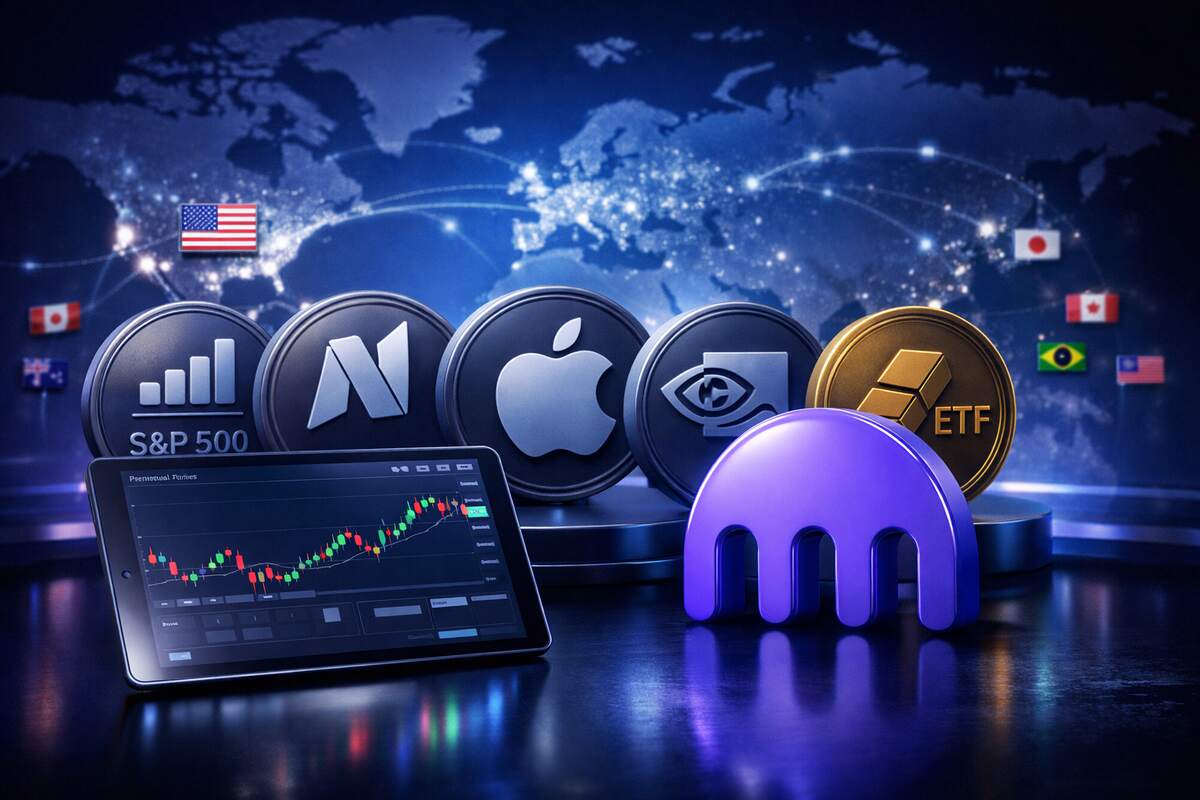
The new offering allows non-U.S. clients in more than 110 countries to trade perpetual futures that reference tokenized versions of well-known financial instruments. Initial markets include digital tokens linked to the S&P 500, the Nasdaq 100, Apple, Nvidia, Tesla and SPDR’s gold ETF, known by its ticker GLD. These contracts are structured as perpetuals, meaning they have no fixed expiry date, trade at all hours and support leveraged positions.
Perpetual futures have already become central to activity in the broader crypto derivatives market. Data from The Block cited by the exchange indicates that decentralized platforms handling perpetual swaps recorded over $600 billion in trading volume in January alone. Within that segment, Hyperliquid accounted for $200 billion in monthly volume, underscoring the scale of demand for this type of instrument among crypto traders. Kraken is seeking to adapt this format to tokenized versions of assets that traditionally trade on conventional stock and commodity exchanges.
The underlying tokens used in these new markets come from xStocks, the tokenized equities provider that Kraken acquired at the end of last year. According to the company, each xStocks token is fully backed on a one-to-one basis by the corresponding equity, index exposure or ETF. This full collateralization is intended to anchor prices to the underlying assets even when U.S. markets are closed, while still enabling around-the-clock trading familiar to participants in digital asset markets.
Structure, leverage and market rationale
Perpetual futures differ from standard futures in several important ways. Traditional contracts have set maturities and must be rolled over or closed at expiration, whereas perps continue indefinitely and rely on funding mechanisms to keep prices aligned with spot markets. For investors, the absence of expiry, combined with 24/7 trading, is a key attraction. Users can open and adjust long or short positions at any time and use these instruments to hedge or gain exposure with less capital locked up compared with direct asset purchases.
Kraken’s tokenized stock perps allow leverage of up to 20x on the underlying xStocks tokens. That means traders can control positions significantly larger than their posted collateral, amplifying both gains and losses. The company frames this as an extension of crypto-native market structure into other asset classes, offering higher flexibility for risk management. Because the tokens track indices and single-name stocks as well as a gold ETF, participants can construct strategies that span a mix of equities and commodities, all within a familiar crypto derivatives environment.
Mark Greenberg, Kraken’s global head of consumer, said the initiative represents an attempt to reconstruct traditional markets for a “crypto-native, always-on world,” pointing to heightened volatility across asset classes as a backdrop for the launch. In a further statement, he characterized regulated tokenized equities offered as perpetual futures as a step toward capital markets in which equities, indices and commodities share the same trading speed, access and flexibility as crypto, with tokenization supporting more robust approaches to managing risk.
The design of the xStocks tokens, which track U.S. stocks and indices while remaining available at any time of day, is intended to reduce the gap between conventional market hours and the continuous nature of crypto trading. For traders outside the U.S., the 24/7 schedule can provide additional opportunities to react to news, macroeconomic developments or price moves in related markets that may occur when underlying exchanges are closed.
Competitive context and future expansion plans
Kraken’s move comes as tokenization firms and exchanges explore new ways to connect traditional financial instruments with on-chain trading infrastructure. The company said it will broaden the list of supported tokenized stocks and ETFs over the coming months, signaling plans to scale beyond the initial group of large-cap U.S. names and benchmark indices.
Other firms are pursuing similar directions. Ondo Finance, which also focuses on tokenized assets, announced earlier in the month that it intends to introduce perpetual trading for its own tokenized stock products. This indicates emerging competition among providers seeking to offer derivatives on top of tokenized representations of conventional securities.
The broader backdrop is a derivatives market where perpetual contracts already dominate crypto trading volumes, particularly on decentralized venues. January’s figure of more than $600 billion in perps volume on blockchain-based exchanges highlights how central this instrument has become for digital asset speculation and hedging. By introducing regulated perpetual futures tied to tokenized equities, Kraken is aiming to tap into that established demand while adding exposure to assets traditionally found in brokerage accounts rather than on crypto exchanges.
In practice, the new products let users who qualify outside the U.S. trade instruments that reflect movements in the S&P 500, the Nasdaq 100, individual large-cap technology and automotive stocks, and gold prices, all through a perpetual futures format. For market participants already accustomed to crypto derivatives, this may provide a familiar structure for diversifying into tokenized versions of traditional assets without leaving the crypto ecosystem.
Conclusion
Kraken’s launch of regulated perpetual futures on tokenized stocks marks a convergence of crypto-native market structures with conventional financial assets. By using fully collateralized xStocks tokens linked one-to-one with equities, indices and a gold ETF, the exchange is extending 24/7, leveraged perpetual trading into new territory for eligible users in more than 110 countries. With plans to expand the product range and rivals such as Ondo Finance preparing similar offerings, the development points to a growing segment where tokenization and derivatives intersect across both digital and traditional markets.
Disclaimer
The information provided in this article is for informational purposes only and should not be considered financial advice. The article does not offer sufficient information to make investment decisions, nor does it constitute an offer, recommendation, or solicitation to buy or sell any financial instrument. The content is opinion of the author and does not reflect any view or suggestion or any kind of advise from CryptoNewsBytes.com. The author declares he does not hold any of the above mentioned tokens or received any incentive from any company.
Featured image created by AI