⚡ Key Highlights
- Terraform Labs bankruptcy administrator Todd Snyder sued Jane Street on February 23, 2026 in Manhattan federal court, alleging insider trading during the May 2022 Terra collapse
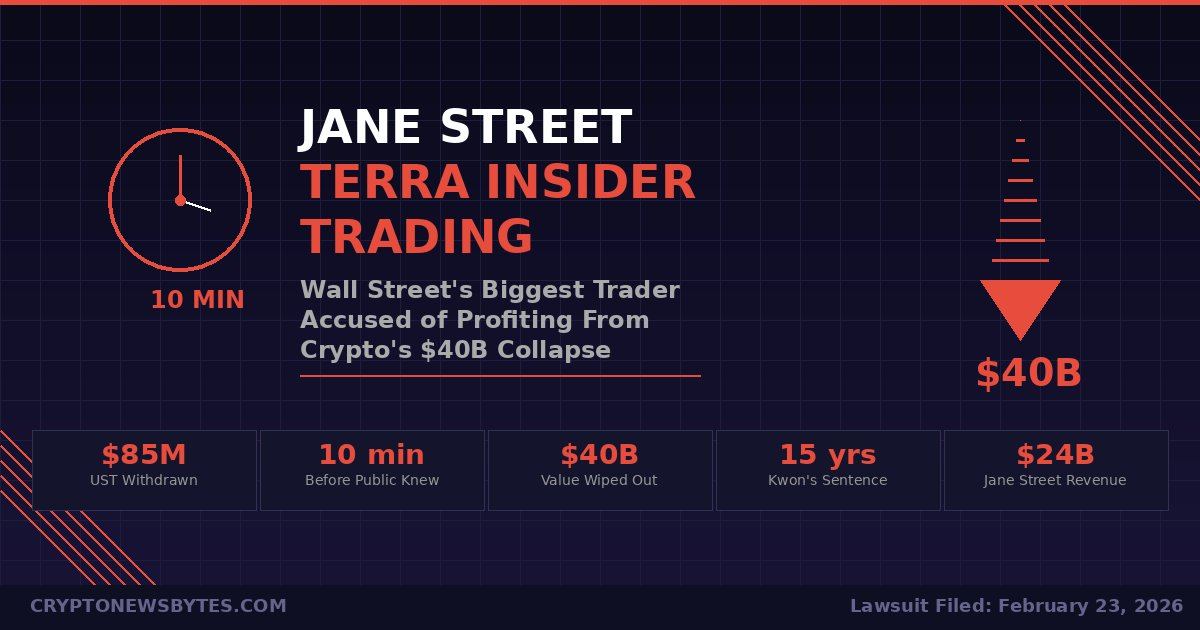
- The Jane Street Terra insider trading lawsuit claims a wallet linked to the firm withdrew $85 million in TerraUSD from Curve3pool less than 10 minutes after Terraform secretly pulled $150 million from the same pool on May 7, 2022
- The lawsuit names Jane Street co-founder Robert Granieri and employees Bryce Pratt and Michael Huang as defendants
- Pratt, a former Terraform Labs intern, allegedly created a private backchannel called “Bryce’s Secret” to share confidential information with Jane Street traders after joining the firm
- The lawsuit alleges Jane Street made trades that “would have been impossible without inside information to which it had unique access”
- This is the second major market maker targeted by the Terraform administrator, following a $4 billion lawsuit against Jump Trading filed in December 2025
- Jane Street called the suit “desperate” and “baseless”, blaming Terraform’s own management for the $40 billion collapse
- Jane Street generated $24 billion in net trading revenue in the first nine months of 2025 alone, surpassing its full 2024 total
Jane Street Terra Insider Trading Lawsuit: Wall Street’s Most Powerful Trader Accused of Profiting From Crypto’s Worst Disaster
The Jane Street Terra insider trading allegations have ripped open one of crypto’s most painful chapters. Three years after the Terra ecosystem collapsed and wiped out $40 billion in investor value, the firm now at the center of the story is not a crypto startup. It is one of the most powerful and profitable trading operations on Wall Street.
On February 23, 2026, Todd Snyder, the court-appointed administrator winding down Terraform Labs, filed a complaint in Manhattan federal court accusing Jane Street Group LLC of using material nonpublic information to front-run trades during the May 2022 collapse of TerraUSD and Luna. The lawsuit alleges that Jane Street did not just watch the collapse unfold. It allegedly positioned itself ahead of the crash, profited from it, and may have helped accelerate it.[CoinDesk]
If the allegations hold, the narrative around Terra’s death spiral may shift from an inevitable algorithmic failure to something far more uncomfortable: sophisticated Wall Street players exiting with massive profits while retail investors were still being told to hold.
What Is Jane Street, and Why Does This Matter?
Jane Street Capital is an American quantitative trading firm headquartered in New York City. Founded in 1999, it has grown into one of the most profitable trading operations in the world, employing approximately 3,000 people across offices in New York, London, Singapore, and Hong Kong.
The numbers are staggering. In the second quarter of 2025, Jane Street reported $10.1 billion in net trading revenue for a single quarter, beating every major Wall Street investment bank. Through the first nine months of 2025, the firm generated $24 billion in net trading revenue, already surpassing its entire 2024 total of $20.5 billion. In 2024, Jane Street captured more than 10% of the North American equity trading market and processed an average of $707 billion in ETF trading volumes every month.[Disruption Banking]
Jane Street is not a household name. It does not advertise. It does not have a CEO. It is described internally as operating like an “anarchist commune” where all employees share in collective profits. It is also, according to this lawsuit, a firm that allegedly used a former Terraform intern as a conduit for confidential information during one of the most devastating events in cryptocurrency history.
The Terra Collapse: A Quick Recap of the $40 Billion Disaster
To understand the Jane Street Terra insider trading allegations, you need to understand what happened in May 2022.
Terraform Labs, co-founded in 2018 by Do Kwon and Daniel Shin, built the Terra blockchain and launched an algorithmic stablecoin called TerraUSD (UST). Unlike traditional stablecoins backed by actual dollar reserves, UST maintained its $1 peg through an algorithm tied to a sister token called Luna. If UST dropped below $1, users could burn UST and mint Luna to restore the peg. If UST rose above $1, the reverse mechanism kicked in.
The system worked until it did not. In May 2022, large withdrawals of UST from liquidity pools triggered a loss of confidence. UST began slipping below its $1 peg. The algorithm tried to compensate by minting massive amounts of Luna, but this hyperinflated Luna’s supply and crashed its price from over $80 to essentially zero in a matter of days. The entire Terra ecosystem collapsed, wiping out approximately $40 billion in market value in under a week.
The fallout was catastrophic. The Terra collapse triggered a chain reaction that brought down crypto lending firms Celsius Network, Voyager Digital, BlockFi, and Three Arrows Capital. It indirectly contributed to the collapse of FTX later that year. Hundreds of thousands of retail investors lost everything. Some victims reported losing their life savings, their marriages, and their retirement funds.
Do Kwon fled, was arrested in Montenegro using a forged passport in March 2023, extradited to the United States in December 2024, pleaded guilty to two criminal counts in August 2025, and was sentenced to 15 years in prison in December 2025. The judge called it “a fraud on an epic, generational scale.”[U.S. DOJ]
The Jane Street Terra Insider Trading Allegations: What the Lawsuit Claims
The complaint, filed by administrator Todd Snyder in the U.S. District Court for the Southern District of New York, alleges that Jane Street obtained material nonpublic information from Terraform Labs insiders and used it to execute trades that front-ran the market during the collapse.
The lawsuit centers on three core allegations:
1. The Backchannel: Bryce Pratt and “Bryce’s Secret”
At the center of the case is Bryce Pratt, a former Terraform Labs intern who joined Jane Street as a full-time employee in September 2021. According to the complaint, Pratt reconnected with his former colleagues at Terraform after joining Jane Street and established a private communication channel described in court documents as a “back-channel source for material non-public information.”[DL News]
The lawsuit alleges this channel, referred to as “Bryce’s Secret,” was used to relay confidential information about Terraform’s internal liquidity decisions, fundraising efforts, and treasury movements to Jane Street traders before any of this information was made public.
2. The 10-Minute Trade: May 7, 2022
The most specific allegation in the lawsuit is what happened on May 7, 2022, the day the Terra collapse began.
On that day, Terraform Labs secretly withdrew 150 million TerraUSD from the Curve3pool, a decentralized liquidity pool for stablecoin trading, without making any public announcement. Kwon later said the withdrawal was intended to move funds to a new liquidity pool.
The lawsuit alleges that within 10 minutes of Terraform’s withdrawal, and before the public knew anything had happened, a wallet linked to Jane Street withdrew an additional $85 million in TerraUSD from the same Curve3pool. According to the complaint, this was Jane Street’s largest-ever single swap.[The Block]
3. The May 9 Group Chat
Two days after the initial withdrawal, with TerraUSD already beginning to slip, Pratt sent a group message to Do Kwon and Jane Street representatives expressing interest in buying Bitcoin or Luna. Kwon replied that Jump Trading co-founder Bill DiSomma should have already contacted them about Terraform’s fundraising efforts.[CoinDesk]
The lawsuit frames this exchange as evidence that multiple Wall Street market makers were in direct, private communication with Terraform’s leadership during the crisis, receiving information that was not available to the millions of retail investors who were watching their holdings evaporate in real time.
Jane Street Terra Insider Trading: Key Facts at a Glance
| Detail | Information |
|---|---|
| Lawsuit Filed | February 23, 2026 (Manhattan federal court) |
| Plaintiff | Todd Snyder, Terraform Labs court-appointed plan administrator |
| Defendants | Jane Street Group LLC, Robert Granieri (co-founder), Bryce Pratt, Michael Huang |
| Allegations | Insider trading, front-running, market manipulation, misappropriating confidential information |
| Key Evidence Alleged | $85M UST withdrawal from Curve3pool within 10 minutes of Terraform’s secret $150M withdrawal on May 7, 2022 |
| Alleged Information Source | Bryce Pratt (former Terraform intern turned Jane Street employee), private “Bryce’s Secret” channel |
| Terra Collapse Losses | ~$40 billion wiped out within one week (May 2022) |
| Related Lawsuit | $4 billion suit against Jump Trading (filed December 2025) |
| Jane Street’s Response | “Desperate,” “baseless,” “opportunistic claims.” Blames Terraform’s fraud. |
Jane Street Terra Insider Trading Timeline: From Partnership to Lawsuit
Jane Street’s Defense: “A Desperate Attempt to Extract Money”
Jane Street has responded aggressively. A spokesperson told the Wall Street Journal:
“This desperate suit is a transparent attempt to extract money when it is well-established that the losses suffered by Terra and Luna holders were the result of a multibillion-dollar fraud perpetrated by the management of Terraform Labs.”
– Jane Street spokesperson, via CoinDesk / Wall Street Journal, February 2026
The defense has a surface-level logic. Do Kwon did commit fraud. He pleaded guilty and is serving 15 years. Terraform’s algorithmic stablecoin was fundamentally flawed. The judge called it “a fraud on an epic, generational scale.”
But as multiple legal observers have pointed out, Terraform’s guilt does not automatically excuse profiting from insider knowledge of its collapse. The question the court will need to answer is not whether Terra was doomed. It is whether Jane Street knew it was going to collapse before the public did, and whether the firm used that knowledge to trade ahead of the disaster.
🔍 Legal Expert Perspective
Andrew Rossow, public affairs attorney and CEO of AR Media Consulting, told Decrypt that the case matters because the court is being asked to set a precedent that “privileged access” in DeFi is a legal liability, not just a competitive advantage. Rossow noted that an “insider” in this context might not be a traditional corporate executive but rather anyone with a private line to a protocol’s decision-making during a crisis.[Decrypt]
If the allegations are proven, the case could signal a shift toward applying the misappropriation theory of insider trading to crypto markets. Under this framework, liability would not depend on a traditional corporate insider relationship. Instead, a market maker could face exposure if it obtained confidential information from a protocol team and used it to trade against the broader market.
The Bigger Picture: Jump Trading, Jane Street, and the Wall Street-Crypto Nexus
The Jane Street Terra insider trading lawsuit does not exist in isolation. It follows a $4 billion lawsuit against Jump Trading filed by the same administrator in December 2025.
That suit alleged Jump Trading “actively exploited” the Terraform ecosystem through a backdoor deal to inflate the value of TerraUSD before it imploded. Jump is also mentioned in the Jane Street complaint. Snyder claims that some of the confidential information reaching Jane Street may have been routed through Jump Trading’s connections to Terraform leadership.
Together, the two lawsuits paint a picture of crypto’s worst disaster being observed, and potentially accelerated, by the very Wall Street firms that were supposed to be providing liquidity and stability. If the allegations in both cases are proven, the narrative shifts from “a flawed algorithm failed” to “sophisticated traders with inside access made sure they got out first, and their exits helped trigger the collapse that destroyed everyone else.”
📊 The Wall Street Market Makers at the Center of the Terra Collapse
| Firm | Lawsuit Filed | Allegation | Damages Sought | Status |
|---|---|---|---|---|
| Jump Trading | December 2025 | Market manipulation, backdoor deal to inflate UST | $4 billion | Ongoing |
| Jane Street | February 23, 2026 | Insider trading, front-running using MNPI | Undisclosed | Newly filed |
What the Jane Street Terra Insider Trading Case Means for Crypto Regulation
The Jane Street Terra insider trading case could set major precedents for how insider trading law is applied to decentralized finance. Traditional securities law relies on clear corporate structures: officers, directors, and employees with fiduciary duties. DeFi protocols do not always fit this mold.
What the Terraform administrator is arguing is that even in crypto, where protocols claim to be decentralized and permissionless, having a “private line to the war room” during a crisis creates legal liability. If the court agrees, the implications are significant:
- Market makers in crypto who maintain private communication channels with protocol teams could face insider trading exposure
- The misappropriation theory could become the primary framework for prosecuting crypto insider trading, where liability arises from trading on confidential information regardless of formal corporate relationships
- Former employees who move between crypto projects and trading firms could face heightened scrutiny about information they carry with them
- Protocol teams may need to implement formal information barriers (similar to investment bank “Chinese walls”) to prevent leakage of market-moving decisions to trading partners
🛡️ Investor Takeaway
The Jane Street Terra insider trading lawsuit reinforces a hard truth for retail crypto investors: in moments of extreme market stress, the most sophisticated players may have information and execution advantages that are invisible on-chain. Smart contracts may be transparent, but the private channels between market makers and protocol teams are not. Until crypto markets develop the same disclosure requirements and information barrier rules that govern traditional securities trading, the playing field remains uneven.
The Human Cost: Victims of the Terra Collapse
Behind the legal and financial mechanics of the Jane Street Terra insider trading allegations are real people who lost everything.
At Do Kwon’s sentencing hearing in December 2025, victims described devastating consequences. One investor told the court his family placed $190,000 of their life savings into TerraUSD and watched it plummet to $13,000. Another victim said his wife divorced him, his sons had to skip college, and he was forced to move back to Croatia to live with his parents. A church group lost approximately $900,000. Over 300 victim impact letters were submitted to the court.[CNBC]
“Your offense caused real people to lose $40 billion in real money, not some paper loss. This was a fraud on an epic, generational scale.”
– U.S. District Judge Paul A. Engelmayer, sentencing Do Kwon, December 2025
If the Jane Street allegations are proven, these victims may reasonably ask: if sophisticated trading firms knew the collapse was coming and profited from it, could the outcome have been different? Could the crash have been slower, less severe, or more orderly if the largest players had not withdrawn $85 million in a single trade before the public knew what was happening?
That is the question this lawsuit will force the courts to answer.
Frequently Asked Questions
Conclusion
The Jane Street Terra insider trading lawsuit forces a question the crypto industry has been avoiding for three years: who really profited from the $40 billion Terra collapse, and did they know it was coming?
Do Kwon is in prison. Terraform Labs is in bankruptcy. Retail investors lost their life savings. And now, the administrator charged with recovering what he can for those creditors is pointing at two of the most powerful trading firms on Wall Street and alleging they did not just survive the crash. They allegedly saw it coming, positioned themselves to profit, and their exits may have helped trigger the very collapse that destroyed everyone else.
Jane Street says the claims are baseless. The courts will decide. But regardless of the outcome, this case has already accomplished something significant: it has put the private channels between Wall Street market makers and crypto protocol teams under a legal microscope for the first time. In an industry that claims transparency as a founding principle, the most important trades may have been happening in private chat rooms that no one else could see.
This article will be updated as the lawsuit progresses and new filings become available.
📰 More on CryptoNewsBytes
Sources: CoinDesk | The Block | Decrypt | DL News | Disruption Banking | Crypto Briefing | ForkLog | U.S. Department of Justice
Disclaimer: This article is based on publicly available court filings, news reports, and official statements as of February 25, 2026. All allegations against Jane Street are unproven and the firm denies wrongdoing. This article does not constitute financial or legal advice. The lawsuit is in its early stages and claims may be revised or dismissed as proceedings develop.