
📋 In This Guide
⚡ Key Takeaways — Japan Crypto Tax 2026
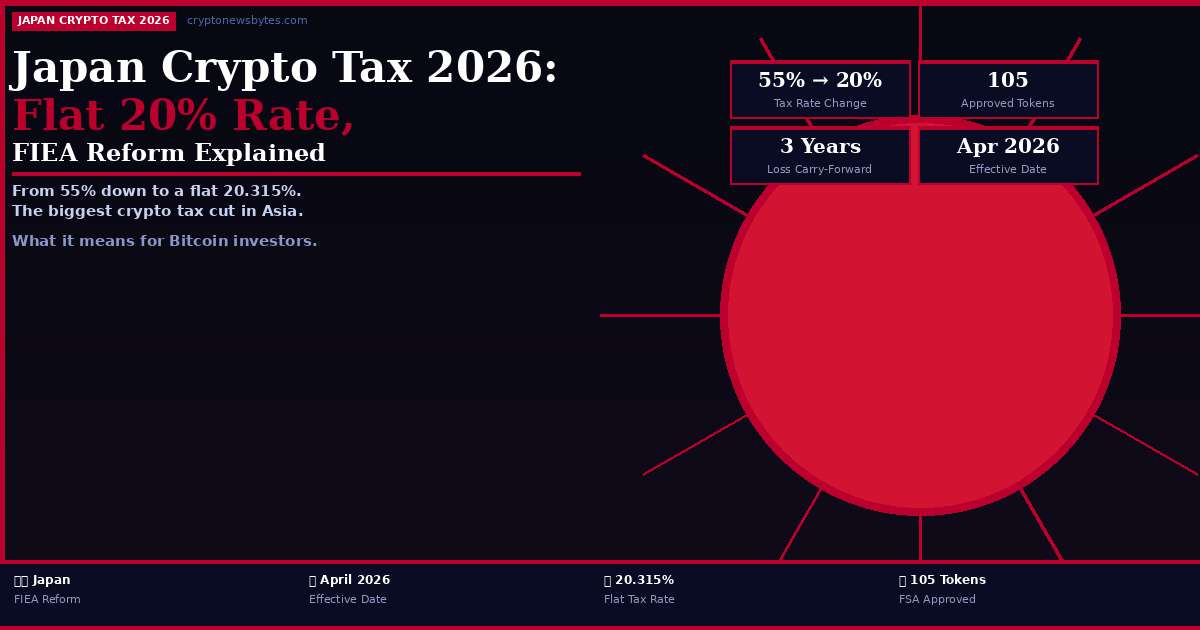
- Japan is cutting crypto capital gains tax from a punishing 55% progressive rate to a flat 20.315%, effective from the fiscal year beginning April 2026.
- The reform applies to 105 cryptocurrencies including Bitcoin and Ethereum, reclassified as “Specified Crypto Assets” under the Financial Instruments and Exchange Act (FIEA).
- A three-year loss carry-forward system is introduced. Investors can offset future gains with past crypto losses for the first time.
- The lower rate applies only to FSA-registered exchange platforms. Tokens on overseas exchanges, NFTs, staking rewards, and DeFi income remain in a grey area.
- Japan’s first XRP ETF has already launched, with Bitcoin and Ethereum ETFs expected to follow once the FIEA framework is fully operational.
- The ruling Liberal Democratic Party and Japan Innovation Party endorsed the reform blueprint on December 19, 2025. Diet passage is expected before April.
Japan is about to implement the biggest crypto tax cut in Asia. For years, the country’s treatment of digital asset gains as “miscellaneous income”, taxed at progressive rates reaching as high as 55%, keeping serious investors on the sidelines and pushed crypto-active Japanese residents toward overseas exchanges. Starting in the fiscal year beginning April 2026, Japan crypto tax 2026 rules change dramatically: a flat 20.315% rate on gains from approved tokens, loss carry-forward provisions, and a full reclassification of 105 cryptocurrencies as regulated financial products. Here is everything investors and businesses need to know.
Japan’s Old Crypto Tax System: Why 55% Killed the Market
Under Japan’s existing rules, crypto gains are classified as “miscellaneous income” and stacked on top of all other income: salary, business income, rental income. The combined progressive rate climbs as high as 55% for high earners: 45% national income tax plus 10% local inhabitant tax. A Tokyo-based professional earning 10 million yen in salary who also made 5 million yen in Bitcoin gains would be taxed on the total 15 million yen, pushing them deep into the highest tax bracket.
This structure created a deeply perverse incentive. Selling crypto to lock in gains triggered a massive tax bill. Holding indefinitely deferred tax but locked up capital. Converting one cryptocurrency to another, even within the same platform, was a taxable event under miscellaneous income rules. Japanese crypto traders effectively faced a 55% transaction tax on every active portfolio rebalance, making active trading economically punishing compared to simply holding equities in a conventional brokerage account where the same 20% flat rate already applied.
The New System: Flat 20.315% and How It Works
The reform introduces a separate taxation regime for “Specified Crypto Assets”, a new legal category created under the amended FIEA. The exact rate is 20.315%, composed of 15% national income tax, a 2.1% reconstruction surtax, and 5% local inhabitant tax. This mirrors precisely the tax treatment already applied to gains from listed stocks, investment trusts, and equity ETFs in Japan.
❌ Old System (Until Mar 2026)
- Classified as miscellaneous income
- Progressive rate up to 55%
- Stacked on top of all other income
- No loss carry-forward
- No offset against other asset losses
- Every crypto-to-crypto trade taxable
- NFTs, staking all miscellaneous income
✅ New System (From Apr 2026)
- Specified Crypto Assets: separate taxation
- Flat 20.315% rate
- Not stacked on salary or other income
- 3-year loss carry-forward
- Offset gains with prior crypto losses
- FSA-registered exchange trades qualify
- NFTs and staking still grey area
Critically, the flat 20.315% applies only to transfers of Specified Crypto Assets made through registered Crypto Asset Trading Businesses. The exact wording from the PwC Japan tax update confirms this: transfers must be made to “those who engage in a Crypto Asset Trading Business” registered under the FIEA to qualify for the separate tax treatment. Gains realized through overseas exchanges, peer-to-peer transactions, or DeFi protocols do not qualify for the flat rate under the current proposal.
FIEA Reclassification: 105 Tokens Treated Like Stocks
The tax reform is inseparable from a structural regulatory overhaul. Japan’s Financial Services Agency is reclassifying approximately 105 cryptocurrencies as financial products under the Financial Instruments and Exchange Act, the same legal framework governing listed equities, investment trusts, and bond instruments in Japan. This is not just a tax change. It is a full integration of approved digital assets into Japan’s mainstream financial regulatory system.
The reclassification brings significant new obligations for exchanges and investors alike. Exchanges must provide mandatory disclosure documents for all 105 approved tokens, similar to prospectus requirements for listed securities. Insider trading prohibitions apply to approved tokens for the first time. Market manipulation and front-running are now explicitly illegal under securities-style law. Exchanges must establish liability reserves of up to ¥40 billion to guarantee customer compensation in cases of theft or operational failure. Near real-time reserve reporting is required.
In exchange for these obligations, approved tokens gain significant benefits: eligibility for bank custody arrangements, inclusion in investment trust structures, access to margin trading under codified rules, and the right to be held in regulated ETF products. A whitelist of approximately 150 assets is being prepared by the FSA. The 105 confirmed tokens include Bitcoin and Ethereum, with major tokens by market cap expected to qualify. Memecoins, highly speculative assets, and tokens that cannot demonstrate adequate disclosure standards are likely to remain outside the whitelist.
What Qualifies and What Does Not
| Asset / Activity | New 20% Rate? | Tax Treatment |
|---|---|---|
| Bitcoin (BTC) | ✅ Yes | Flat 20.315%, FSA-registered exchange trades only |
| Ethereum (ETH) | ✅ Yes | Flat 20.315%, FSA-registered exchange trades only |
| XRP, major altcoins | ✅ Likely | If on FSA whitelist: flat 20.315% |
| Memecoins / micro-caps | ❌ Unlikely | Miscellaneous income, up to 55% |
| NFTs | ❌ No | Miscellaneous income, up to 55% |
| Staking rewards | ⚠️ Grey area | Likely miscellaneous income pending clarification |
| DeFi / lending income | ⚠️ Grey area | Likely miscellaneous income pending clarification |
| Overseas exchange trades | ❌ No | Miscellaneous income, up to 55% |
| Crypto ETFs (coming) | ✅ Yes | Separate 20% tax as investment trust products |
Loss Carry-Forward: The Hidden Benefit
Buried in the reform details is a provision that experienced traders will find just as valuable as the rate cut itself: a three-year loss carry-forward system. Under Japan’s current rules, if you lose money on crypto in one year, that loss disappears. It cannot be used to offset gains in future years. The new system changes this entirely.
Starting with fiscal year 2026, losses incurred from transfers of Specified Crypto Assets can be carried forward for up to three years to offset capital gains from future transfers of other Specified Crypto Assets. A trader who loses ¥2 million in a volatile 2026 market can use that loss to reduce taxable gains in 2027, 2028, or 2029. This provision, long available to equity market participants in Japan, brings crypto investors to genuine parity with stock traders, removing one of the most significant structural disadvantages of crypto investing in Japan.
Japan’s Crypto ETF Push
The FIEA reclassification unlocks something Japanese institutional investors have been waiting for: regulated crypto ETF products. Japan launched its first XRP exchange-traded fund in early 2026. Bitcoin and Ethereum ETFs are in active preparation at asset managers including SBI Global Asset Management and Daiwa Asset Management, which have publicly targeted ¥5 trillion in crypto-linked assets under management once the FIEA framework is fully operational.
The significance of Japan-listed crypto ETFs extends beyond domestic investors. Japan’s institutional market is among the largest in Asia, with pension funds, insurance companies, and trust banks managing assets of tens of trillions of yen. If even a fraction of that capital gains access to Bitcoin through regulated ETF structures, the demand implication for a fixed-supply asset is significant, a dynamic directly connected to the Bitcoin scarcity argument covered in our Saylor Bitcoin scarcity analysis.
What It Means for Bitcoin and Ethereum Investors
For Japanese retail investors, the reform is unambiguously positive. The combination of a dramatically lower tax rate, loss carry-forward provisions, and access to regulated ETF products removes the three biggest structural barriers to domestic crypto participation. The FSA’s approval of a whitelist approach also provides clarity that was previously absent. Investors can now assess with reasonable certainty whether their holdings qualify for favorable tax treatment.
For international investors watching Japan, the reform signals something more significant: one of the world’s most conservative and rules-bound financial regulatory environments has concluded that cryptocurrency belongs inside the mainstream financial system rather than outside it. Japan’s approach: tax it like equities, regulate it like securities, let ETFs hold it, is the same framework that the U.S. CLARITY Act is attempting to implement through the SEC’s token taxonomy and CFTC oversight structure.
❓ Frequently Asked Questions — Japan Crypto Tax 2026