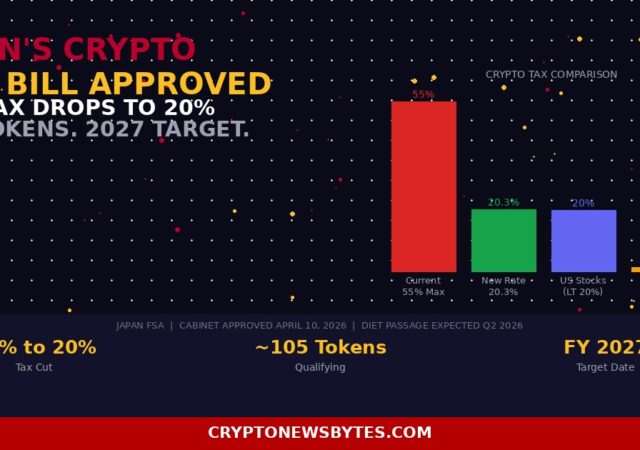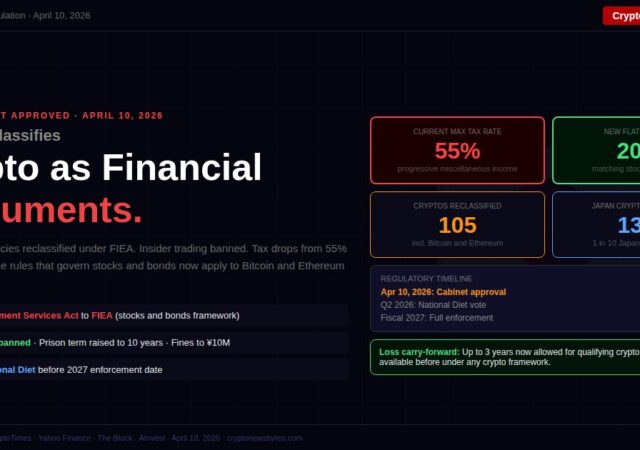
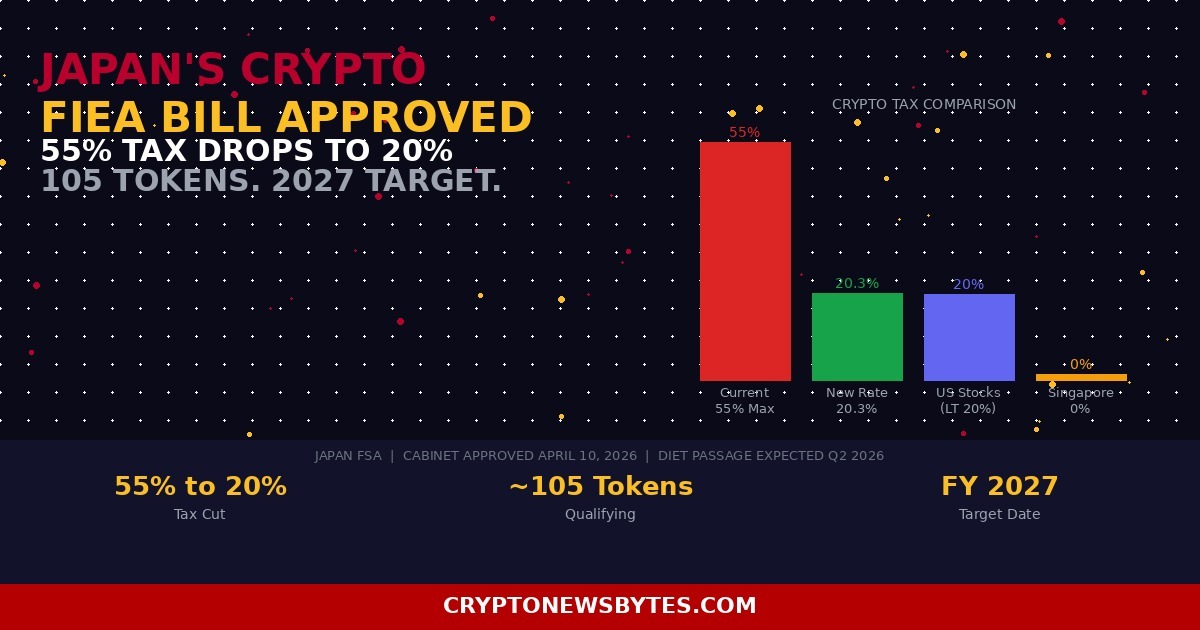
Japan’s Cabinet approved a landmark amendment to the Financial Instruments and Exchange Act on April 10, 2026, reclassifying cryptocurrency as a financial instrument on par with stocks and bonds. The bill, advanced by the Financial Services Agency after more than a year of working-group deliberations, now proceeds to the National Diet for final passage. If enacted in the current parliamentary session, the changes take effect in fiscal year 2027. For Japan’s 13 million crypto account holders, one number matters above all others: the maximum tax rate on approved crypto gains drops from 55% to a flat 20.315%.
That is not a minor adjustment. Under the current system, a Japanese investor realizing ¥10 million in Bitcoin gains faces a tax bill above ¥5 million at the highest income bracket. Under the new rate, that same gain results in roughly ¥2 million in tax. The ¥3 million difference on a single trade represents real capital available to reinvest, hold, or allocate to new products. Finance Minister Satsuki Katayama, speaking after the cabinet meeting, framed the reforms as an effort to “expand the supply of growth capital” and accelerate Japan’s official 2026 Digital Year agenda, which aims to shift the country’s historically cash-heavy household savings into productive investment.
But the headline rate is only part of the story. The 20% rate applies only to approximately 105 “Specified Crypto Assets” traded on Japan’s 30 FSA-licensed exchanges. Staking rewards, lending income, NFTs, and any token traded on offshore or unlicensed platforms stay at the old miscellaneous income rates, which can still reach 55%. The two-tier system the FIEA bill creates is as important as the rate itself.
From Payment Tool to Financial Product: Why the Classification Shift Matters More Than the Tax
Since 2017, Japan has regulated crypto under the Payment Services Act, which treated digital assets primarily as a form of electronic money. That framework worked adequately for consumer protection in the early exchange era, but it left a significant gap as crypto evolved into an investment vehicle: the PSA contained no provisions against insider trading, imposed no disclosure obligations on token issuers, and offered no framework for institutional investors to hold crypto as a regulated financial asset. The result was a market where retail investors could be harmed by practices that would be explicitly illegal in equity markets but carried no penalty in crypto.
Moving crypto under the FIEA changes this comprehensively. The bill introduces an explicit ban on trading based on non-public material information, the same insider trading prohibition that governs Japan’s stock markets. It requires annual financial disclosures from crypto asset issuers, giving investors standardized information comparable to what they receive from listed companies. It renames “crypto asset exchange operators” as “crypto asset trading operators,” a semantic shift that reflects functional reality: these entities are not just payment processors but investment platforms. And it dramatically raises enforcement penalties: operating without registration carries a maximum prison sentence of 10 years, up from 3, and fines of ¥10 million, up from ¥3 million.
For institutional investors, including pension funds, insurance companies, and asset managers, the classification shift is the prerequisite for participation. Under the PSA framework, most institutional mandates could not legally include crypto because the asset class lacked the regulatory structure that investment policy statements require. Under the FIEA, that barrier falls. Banks and insurance companies will now be able to hold crypto for investment purposes and, if they choose, register as licensed exchanges. Nomura Holdings, Japan’s largest investment bank, has already announced plans to launch a domestic crypto exchange by end of 2026 via its Laser Digital subsidiary. SBI Holdings and at least four other major asset managers have been building product teams in anticipation of this shift for months.
Japan Crypto Regulation: Payment Services Act vs. FIEA
Source: PwC Japan Financial Services Tax News, FSA proposal, CryptoTimes | April 2026. | @cryptonewsbytes
| Feature | PSA (Until 2027) | FIEA (From FY2027) |
|---|---|---|
| Classification | Payment instrument | Financial instrument (investment asset) |
| Max tax rate (gains) | Up to 55% | Flat 20.315% |
| Loss carryforward | ✗ | ✓ 3 years |
| Insider trading ban | ✗ | ✓ Explicit prohibition |
| Issuer disclosures | ✗ | ✓ Annual mandatory |
| Institutional access | Restricted / limited | Banks, insurers, asset managers eligible |
| Crypto ETFs permitted | ✗ | ✓ After Investment Trust Act amendment (~2028) |
| Max penalty (unregistered) | 3 yrs prison / ¥3M fine | 10 yrs prison / ¥10M fine |
PSA = Payment Services Act. FIEA = Financial Instruments and Exchange Act. FIEA rate is 20.315% inclusive of 15% national income tax, 2.1% reconstruction surtax, and 5% local inhabitant tax. | @cryptonewsbytes
Which Tokens Qualify for 20% and Which Do Not
The 20% rate is not a blanket reduction for all crypto gains in Japan. It applies specifically to “Specified Crypto Assets” handled by businesses registered as Crypto Asset Trading Operators under the FIEA framework. According to PwC Japan’s Financial Services Tax News analysis of the December 2025 tax blueprint, the rate applies to transfers of Specified Crypto Assets made on or after January 1 of the year following the FIEA amendment’s entry into force, meaning January 1, 2027 if the Diet passes the bill in the current session.
Approximately 105 tokens currently listed on Japan’s 30 licensed exchanges are expected to qualify. Bitcoin, Ethereum, XRP, Solana, and high-liquidity assets including regulated stablecoins USDC, USDT, and the yen-pegged JPYC are widely expected to be on the approved list. Assets from the JVCEA Green List, the Japan Virtual and Crypto Assets Exchange Association’s vetted institutional catalogue which includes Avalanche, Polygon, Cosmos, and Aave, are also expected to qualify. The FSA’s criteria for Specified Crypto Asset status include transparency of underlying protocol, security track record, market integrity, and mandatory issuer disclosures.
What explicitly does not qualify is equally important. Staking rewards and lending income remain classified as miscellaneous income taxable at progressive rates up to 55%, regardless of which token is involved. NFTs are excluded. Any token traded exclusively on overseas or unlicensed platforms, which includes several Bybit and Bitget configurations as of current licensing status, does not qualify. An investor choosing between an approved token on bitFlyer or SBI VC Trade at 20% and the same token on an offshore platform faces a tax differential that, in most market conditions, dwarfs any expected fee difference. The two-tier system functions as a regulatory gravitational pull toward licensed domestic exchanges.
20% Rate: What Qualifies and What Stays at Up to 55%
Source: PwC Japan Financial Services Tax News Dec 2025, FSA proposal, coindoo.com analysis | April 2026. | @cryptonewsbytes
| QUALIFIES (Flat 20%) | DOES NOT QUALIFY (Up to 55%) |
|---|---|
| ✓ Bitcoin, Ethereum, XRP, Solana gains | ✗ Staking rewards (all tokens) |
| ✓ ~105 JVCEA-listed tokens on licensed exchanges | ✗ Lending / yield income |
| ✓ USDC, USDT, JPYC on licensed platforms | ✗ NFT sales (all categories) |
| ✓ AVAX, MATIC, ATOM, AAVE (JVCEA Green List) | ✗ Unlisted altcoins |
| ✓ 3-year loss carryforward on qualifying gains | ✗ Trades on offshore/unlicensed platforms |
| ✓ Derivatives on Specified Crypto Assets (FIEA licensed) | ✗ Crypto-to-crypto swaps on DEXs (under review) |
Final qualified token list subject to FSA determination upon FIEA enactment. DEX treatment under review; FSA exploring a separate lighter-touch regulatory category for decentralized protocols. Stablecoin gains from approved tokens on licensed exchanges do qualify; it is the yield/income from holding that does not. | @cryptonewsbytes
The 2027 Timeline: Five Steps Between Cabinet Approval and Your Tax Return
The April 10 cabinet approval is a significant gate but not the final one. The bill now goes to the National Diet, Japan’s sole legislative body, for debate and a vote. Diet passage is expected in the second quarter of 2026, given strong ruling coalition support from the Liberal Democratic Party and the Japan Innovation Party. Once the Diet passes the FIEA amendment, the FSA must draft and publish implementing regulations, which set the specific criteria for Specified Crypto Asset status, the detailed disclosure requirements for issuers, and the transitional rules for existing exchange operators.
Per the PwC Japan analysis of the tax blueprint, the 20% rate applies to transfers made on or after January 1 of the year following FIEA amendment enforcement. If the Diet passes the bill and implementing regulations are in place before year-end 2026, the rate becomes effective January 1, 2027. If there are delays, the effective date shifts to January 1, 2028. The Investment Trust Act amendment that would unlock formal crypto ETFs requires a separate legislative process and is currently targeted for completion around 2027-2028, with ETF products expected to list by 2028 per Nikkei Asia reporting.
Japan Crypto FIEA Bill: From Cabinet to Your Tax Return
Source: PwC Japan, FSA timeline, Nikkei Asia via CoinDesk, CryptoTicker | April 2026. | @cryptonewsbytes
| Apr 10, 2026 | Cabinet Approval Cabinet approves FIEA amendment. Finance Minister Katayama confirms government backing. Bill submitted to National Diet. | DONE |
| Q2 2026 | Diet Passage National Diet debates and votes on the FIEA amendment. LDP-JIP ruling coalition expected to pass. Industry groups monitoring compliance-cost provisions. | PENDING |
| H2 2026 | FSA Implementing Regulations FSA publishes token eligibility criteria, disclosure requirements for issuers, and compliance deadlines for exchanges. Exchanges begin transition from PSA to FIEA licensing. | NOT STARTED |
| Jan 1, 2027 | 20% Rate Effective (Target) Flat 20.315% rate applies to transfers of Specified Crypto Assets made on or after this date. Loss carryforward system begins. 3-year carryforward period starts accumulating. | TARGET |
| ~2027-2028 | Investment Trust Act Amendment Separate legislation classifies crypto as “specified assets” eligible for investment trusts. Nomura and SBI product teams activate. ETF listing applications submitted to Tokyo Stock Exchange. | PLANNED |
| ~2028 | Spot Crypto ETFs on Tokyo Stock Exchange Nikkei Asia reports 2028 as target for first listings. SBI Global targeting ¥5 trillion ($32B) AUM within 3 years of rollout. Nomura building index and custody infrastructure via Laser Digital. | FORECAST |
Jan 1, 2028 is the fallback effective date if Diet passage and implementing regulations are not finalized before year-end 2026. Crypto ETF timeline subject to separate Investment Trust Act amendment and Tokyo Stock Exchange approval processes. | @cryptonewsbytes
Nomura, SBI, and the Institutional Pipeline Japan Just Unlocked
The institutional pipeline behind the FIEA bill is substantial and already partially mobilized. Nomura Holdings, managing roughly ¥110 trillion ($673 billion) in client assets, is building Japan’s first major bank-linked crypto exchange via its Laser Digital subsidiary, targeting launch by end of 2026. SBI Global Asset Management has been the most aggressive in forward preparation: the firm is targeting ¥5 trillion ($32 billion) in crypto AUM within three years of ETF product rollout, and SBI Holdings is planning to launch Japan’s first crypto ETF tracking Bitcoin and XRP once the Investment Trust Act amendment enables it.
A Nikkei survey published in late 2025 identified six major Japanese asset managers actively building crypto investment trust products: Daiwa Asset Management, Asset Management One, Amova, Mitsubishi UFJ Asset Management, and SMBC Nikko Securities alongside Nomura. A Laser Digital survey from 2025 found that 54% of Japanese institutional investors said they planned to invest in crypto assets within three years. The FIEA bill gives them the legal structure to act on that intent. SBI’s president Tomoya Asakura described the opportunity as making crypto products “a key vehicle to move money from savings to investments,” directly citing Japan’s long-standing policy goal of activating the country’s ¥1,000 trillion ($6.5 trillion) in household savings.
The ETF market size estimates, while large, are measured against the U.S. comparison point. The U.S. spot Bitcoin ETF market has grown to over $115 billion in assets since January 2024. Japan’s 2028 ETF market is projected at roughly ¥1 trillion ($6.5 billion), about 5-6% of U.S. scale, reflecting measured initial adoption from a population that has historically kept over half its household assets in cash despite all government incentives to invest. The FIEA bill’s real leverage is not ETF AUM on day one. It is the removal of the compliance barrier that has kept institutional mandates from allocating to crypto at all.
Japan’s Institutional Crypto Pipeline: Who Is Building What
Source: Nikkei Asia, CoinDesk, Yahoo Finance, Laser Digital survey 2025 | April 2026. | @cryptonewsbytes
| Institution | AUM / Size | Crypto Plan | Status |
|---|---|---|---|
| Nomura Holdings | ¥110T client assets | Crypto exchange (Laser Digital), BTC/ETH ETFs, custody | ACTIVE |
| SBI Holdings | SBI VC Trade, SBI Global AM | BTC + XRP ETF, ¥5T AUM target, first mover position | ACTIVE |
| Daiwa Securities | Japan’s 2nd largest broker | Crypto exchange evaluation underway, internal planning confirmed | PLANNING |
| Mitsubishi UFJ AM | MUFG group | Crypto investment trust product development confirmed | PLANNING |
| SMBC Nikko | Japan’s 3rd largest broker | Dedicated DeFi department established; crypto exchange evaluation | PLANNING |
54% of Japanese institutional investors surveyed by Laser Digital (Nomura subsidiary) said they plan to invest in crypto within 3 years (2025 survey). Japan’s projected crypto ETF market at launch: ~¥1 trillion ($6.5B), per industry estimates. U.S. comparison: $115B+ in Bitcoin ETF AUM as of April 2026. | @cryptonewsbytes
Japan’s Big Three Exchanges: How bitFlyer, Coincheck, and Bitbank Are Positioned
bitFlyer is Japan’s largest exchange by market share, holding FSA registration number 00003 and the distinction of being the first FSA-licensed platform in the country. Founded in 2014 by former Goldman Sachs trader Yuzo Kano, it has expanded to the U.S. and Europe and acquired FTX Japan in July 2024. Coincheck, owned by Monex Group and ranked second, is the dominant retail platform with over 40 tradeable tokens, Japan’s only crypto NFT marketplace, and deep retail penetration through convenience store deposits. Bitbank, ranked third, is the professional trader’s platform of choice: it consistently leads Japanese domestic exchanges in XRP and altcoin spot volume, runs negative maker fees of -0.02%, and is built on full TradingView integration.
All three are FSA-licensed and will automatically qualify as Crypto Asset Trading Operators under the FIEA framework, meaning their listed tokens will be among the first eligible for the 20% rate. The upside is real: lower taxes should unlock dormant retail capital and draw institutional clients who currently avoid Japan’s 55% regime. The pressure point is compliance cost. Mandatory liability reserves, issuer disclosure obligations, and stricter enforcement penalties will raise operating costs across all three platforms. The Japan Blockchain Association has warned this dynamic could accelerate consolidation among smaller exchanges, reinforcing the structural advantage of the top three and the incoming bank-backed platforms from Nomura and SBI.
Japan’s Top 3 Crypto Exchanges: Market Share, Volume, and FIEA Position
Source: CoinGecko Japan exchange study (market share), Coinranking (daily volume estimate), Datawallet 2026 review. Market share data from CoinGecko 2023 study – most recent verified academic-grade analysis of Japanese domestic exchange rankings. | @cryptonewsbytes
| Exchange | Rank | Market Share | Est. Daily Volume | Strength | FIEA Status |
|---|---|---|---|---|---|
| bitFlyer | #1 | ~38% | ~$80M–$100M | Retail breadth, global licenses (JP/US/EU), zero hack record, acquired FTX Japan 2024 | QUALIFIES |
| Coincheck | #2 | ~27% | ~$50M–$70M | Monex Group backing, 40+ tokens, NFT marketplace, convenience store deposits | QUALIFIES |
| Bitbank | #3 | ~14% | ~$25M–$40M | Pro traders, -0.02% maker fee, TradingView integration, #1 for XRP/altcoin spot volume | QUALIFIES |
Market share figures from CoinGecko’s peer-reviewed Japan exchange study (2023), the most cited independent ranking of domestic Japanese exchanges. Daily volume estimates are approximations based on available Coinranking data and proportional scaling from market share; Japanese exchanges do not uniformly publish real-time volume. All three hold FSA registration and will automatically qualify as Crypto Asset Trading Operators under FIEA. | @cryptonewsbytes
Japan Crypto Exchange Market Share: Top 5
Source: CoinGecko Japan Exchange Study | @cryptonewsbytes
CoinGecko Japan exchange market share study (2023) – most recent verified independent analysis of domestic Japanese exchange rankings. All five exchanges hold FSA licenses and qualify under FIEA. | @cryptonewsbytes
The Risks the FIEA Bill Does Not Resolve
The Japan Blockchain Association, the country’s primary crypto industry lobby, has been supportive of the tax reform while raising pointed concerns about compliance costs. The JBA’s president issued a direct warning during the FSA working-group process that higher compliance requirements could threaten the business viability of smaller Japanese exchanges. The new framework requires mandatory liability reserves from exchanges to cover potential hacking losses, a provision designed to protect users but which represents a substantial capital requirement that mid-sized platforms may struggle to meet. The JBA’s concern is that the FIEA framework, designed with large institutional operators in mind, could accelerate consolidation among Japan’s 30 licensed exchanges toward the handful with bank-backed capital.
The two-tier tax system also creates structural tensions for DeFi. The FSA is exploring a separate lighter-touch regulatory category for decentralized protocols, but no framework has been finalized. Crypto-to-crypto swaps on DEXs remain in a grey area. Staking rewards staying at 55% is a particular friction point: it means that a Japanese investor who holds Ethereum and earns staking yield faces one of the highest staking income tax rates among major economies, even as their capital gains on the same ETH tokens drop to 20%. The incentive structure pushes holders toward exchange trading rather than protocol participation, which may not align with long-term network health goals. As Ethereum’s Glamsterdam upgrade approaches in June 2026, the staking tax question becomes more acute.
Finally, the 2027 effective date depends on Diet passage, implementing regulation finalization, and exchange licensing transitions all running on schedule. Japan’s regulatory history with crypto shows a pattern of careful, staged implementation rather than rapid deployment. Compared to jurisdictions that have moved faster, including the EU’s MiCA and Hong Kong’s VATP framework, Japan’s timeline is measured. That deliberateness is part of why the FIEA bill arrived with strong political consensus. It is also why investors should treat January 1, 2027 as a target, not a guarantee.
What Japan’s Move Signals for the Rest of Asia and Global Regulation
Japan is the world’s third-largest economy. Its decision to classify crypto as a financial instrument under its core securities framework, rather than carving out a separate crypto-specific regime, carries significant weight in global regulatory discussions. The FIEA approach aligns with the direction the EU took with MiCA, treating crypto as an investment asset subject to investor protection rules equivalent to traditional securities. It diverges from the U.S. CLARITY Act approach, which is still working through the question of whether most tokens should be CFTC commodities or SEC securities. Japan has effectively answered that question for its domestic market: specified tokens are financial instruments, period.
The timing also matters. The U.S. CLARITY Act faces its own April-May window for Senate Banking Committee markup before midterm dynamics take over. American crypto firms are simultaneously pursuing OCC trust bank charters to build regulated custody infrastructure. The global picture in April 2026 is one of converging institutional frameworks: the EU has MiCA, Japan now has FIEA-reclassification moving to Diet, and the U.S. is in the final legislative push for CLARITY. The jurisdictions that complete this infrastructure buildout in 2026 position themselves to capture institutional capital flows that are currently sitting on the sidelines waiting for regulatory certainty. The on-chain RWA market and the institutional ETF markets that follow clear legal frameworks directly reward first movers.
Global Crypto Capital Gains Tax Comparison: Japan’s Reform in Context
Source: PwC Japan, global tax summaries, Coinpaprika, global-crypto-regulation-map | April 2026. | @cryptonewsbytes
| Japan (current, max) | |
| United States (short-term) | |
| Germany (held under 1yr) | |
| United States (long-term) | |
| Japan (new, Specified Assets) | |
| Singapore | |
| Germany (held over 1yr) |
Japan’s new 20.315% rate for Specified Crypto Assets aligns with the U.S. long-term capital gains rate and Japanese stock/investment trust rates. Staking income and NFT gains in Japan remain at progressive rates up to 55% regardless of the FIEA reform. | @cryptonewsbytes
How the FIEA Reform Flows Through to Investors: Decision Tree
Source: PwC Japan Financial Services Tax News, FSA proposal | @cryptonewsbytes
Decision tree effective from January 1, 2027 (target), subject to Diet passage and FSA implementing regulations. DEX treatment under review by FSA – not yet classified. The two-tier system creates a gravitational pull toward the ~30 FSA-licensed domestic exchanges. | @cryptonewsbytes
Frequently Asked Questions
What is the Japan FIEA crypto bill and when was it approved?
Japan’s Cabinet approved an amendment to the Financial Instruments and Exchange Act on April 10, 2026, reclassifying approximately 105 cryptocurrencies as financial instruments rather than payment tools. This shifts primary regulatory oversight from the Payment Services Act, which governed crypto as a form of electronic money since 2017, to the FIEA framework that governs stocks and bonds. The bill now proceeds to the National Diet for final passage, expected in Q2 2026, with implementation targeted for fiscal year 2027.
Which cryptocurrencies qualify for Japan’s new 20% tax rate?
Approximately 105 tokens currently listed on Japan’s 30 FSA-licensed exchanges are expected to qualify as Specified Crypto Assets for the flat 20.315% rate. These include Bitcoin, Ethereum, XRP, Solana, USDC, USDT, and the yen-pegged JPYC stablecoin, as well as JVCEA Green List assets including Avalanche, Polygon, Cosmos, and Aave. The FSA will publish final eligibility criteria after Diet passage. Staking rewards, lending income, NFT gains, and profits from unlicensed or overseas platform trades all remain at progressive miscellaneous income rates up to 55%.
When does the 20% crypto tax rate actually take effect in Japan?
The target effective date is January 1, 2027, which is January 1 of the year following FIEA amendment enforcement. This requires Diet passage of the bill, FSA publication of implementing regulations, and exchange transition from PSA to FIEA licensing, all before year-end 2026. If any of those steps slip, the effective date defaults to January 1, 2028. The three-year loss carryforward system also begins on the effective date.
When can Japanese investors buy crypto ETFs?
Not until approximately 2028, per Nikkei Asia reporting. Crypto ETFs require a separate amendment to Japan’s Investment Trust Act classifying crypto as a “specified asset” eligible for investment trusts. That legislation is a distinct process from the FIEA reclassification bill approved April 10. Once the Investment Trust Act is amended, products would also need Tokyo Stock Exchange approval. Nomura, SBI, Daiwa, and Mitsubishi UFJ asset management arms are all building ETF product infrastructure but no launches are imminent. SBI’s asset management arm is targeting ¥5 trillion ($32 billion) in AUM within three years of launch.
What does Japan’s FIEA bill mean for global crypto regulation?
Japan, the world’s third-largest economy, has made an explicit policy choice to classify crypto as a financial instrument under its core securities law rather than maintaining a separate crypto-specific regime. This aligns Japan with the EU’s MiCA direction and puts pressure on jurisdictions still debating classification, including the United States where the CLARITY Act stablecoin yield fight is still unresolved. For institutional capital, Japan’s FIEA framework creates a clear legal structure enabling pension funds, insurance companies, and asset managers to hold crypto within regulated investment mandates. Combined with the OCC trust charter wave in the U.S. and MiCA implementation in the EU, Japan’s FIEA approval represents a third major jurisdiction completing the regulatory infrastructure that institutional capital has been waiting for.
Further Reading
Where Japan’s FIEA framework sits within the broader global regulatory landscape in 2026.
The U.S. counterpart to Japan’s regulatory move, and what happens if the Senate Banking Committee misses its April window.
The U.S. institutional custody infrastructure being built in parallel with Japan’s FIEA framework.
The U.S. precedent that Japan’s Nomura and SBI are explicitly building toward with their own ETF product strategies.
The broader on-chain asset ecosystem that Japan’s FIEA framework is designed to enable at institutional scale.
Why Japan’s 55% staking tax becoming a friction point intersects directly with Ethereum’s upcoming staking improvements.
This article is for informational purposes only and does not constitute financial advice. Consult a qualified adviser before making investment decisions. Sources: PwC Japan Financial Services Tax News, CoinDesk / Nikkei Asia, CryptoBriefing, CryptoTimes. Published April 13, 2026.