
⚡ Case at a Glance
- Verdict: February 13, 2026 — U.S. District Court, Southern District of Florida
- Judge: Hon. Beth Bloom — Default judgment against Ben Armstrong
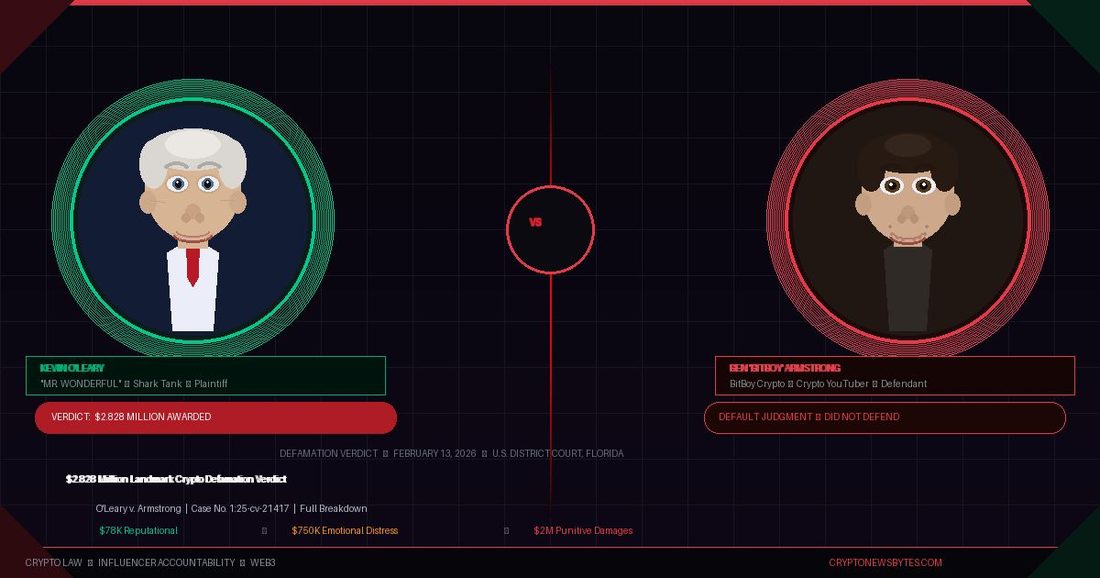
- Total Award: $2.828 million in damages to Kevin O’Leary
- Why Armstrong Lost by Default: Failed to respond to the lawsuit despite being properly served
- The Allegation: Armstrong falsely called O’Leary a “real-life murderer” on X (Twitter) in March 2025
- Armstrong’s Defence: Cited incarceration and serious mental health conditions — rejected by court
- Industry Impact: Landmark ruling on influencer accountability and online defamation in crypto
Introduction: When Crypto Drama Meets the Courtroom
On February 13, 2026, a federal court in Miami delivered one of the most significant legal verdicts in cryptocurrency media history. Kevin O’Leary — the Canadian businessman, veteran investor, and Shark Tank star known worldwide as “Mr. Wonderful” — was awarded $2.828 million in a defamation lawsuit against Ben Armstrong, the fallen crypto influencer who built a massive audience under the name BitBoy Crypto.
The case centred on a series of posts Armstrong made on X (formerly Twitter) in March 2025, in which he falsely accused O’Leary of being a murderer and claimed he had paid millions to cover up his involvement in a fatal 2019 boating accident. Armstrong posted O’Leary’s private cell phone number and urged his followers to “call a real-life murderer.” Those posts were seen by roughly 156,000 people.
O’Leary sued. Armstrong, despite being properly served, largely failed to mount a legal defence. The court entered a default judgment against him — meaning the court accepted O’Leary’s claims as uncontested — and awarded damages covering reputational harm, emotional distress, and punitive punishment.
But this story is more than a courtroom drama. It raises serious questions about the line between free speech and defamation online, the mental health crisis Armstrong was navigating, O’Leary’s own complicated history in crypto, and what this verdict means for the entire ecosystem of influencers who shape opinion — and investment decisions — across the Web3 space.
Here is the full story, covering both sides.
The Verdict: $2.828 Million in Damages
Judge Beth Bloom of the U.S. District Court for the Southern District of Florida issued her ruling on February 13, 2026, entering a default judgment against Armstrong after he failed to appear or adequately respond throughout the proceedings. The damages were broken down into three categories:
The reputational damages of $78,000 compensated O’Leary for measurable harm to his professional standing. The emotional distress award of $750,000 reflected the court’s findings that O’Leary experienced ongoing anxiety, security concerns, and personal suffering as a result of Armstrong’s posts. The $2 million in punitive damages — the largest portion of the award — was specifically designed to punish Armstrong’s conduct and send a message to other influencers about the real-world consequences of reckless online accusations.
The court also declined to set aside the default judgment, despite Armstrong’s last-minute petition on January 9, 2026, arguing he had been unable to respond due to incarceration and mental illness. The judge noted that Armstrong had already demonstrated the ability to file motions — including a request for a continuance — despite those same conditions, undermining his argument that he was incapable of mounting a defence.
Who Is Kevin O’Leary? The Full Picture
Kevin O’Leary
Plaintiff — “Mr. Wonderful”Canadian businessman, co-founder of The Learning Company (sold to Mattel for ~$3.7B), Shark Tank investor since 2009, former FTX spokesperson, and active crypto investor. Net worth estimated above $400 million.
Ben “BitBoy” Armstrong
Defendant — “BitBoy Crypto”Former crypto YouTuber with 1.5M+ subscribers at peak. Founded BitBoy Crypto in 2018, ousted from his own company in 2023. Faced multiple arrests, regulatory scrutiny, and a string of personal controversies since 2023.
Kevin O’Leary is not a simple victim in this story. Born in 1954 in Montreal, he made his first fortune by co-founding SoftKey Software Products, later renamed The Learning Company, which he sold to Mattel in 1999 for a reported $3.7 billion. He has since built a career as a prolific investor and television personality, most notably on Shark Tank, the American entrepreneurship competition show where investors evaluate startup pitches.
O’Leary’s crypto journey has been turbulent. He initially called Bitcoin “a digital game” and “useless currency” as recently as 2019. By 2021, he had reversed course and become one of the most visible institutional voices for crypto adoption — and in 2021, he accepted a $15 million deal to become a paid spokesperson for FTX, the exchange founded by Sam Bankman-Fried.
“I put about $9.7 million into crypto. Yes I’m a shareholder in FTX International. That’s a zero.”
When FTX collapsed in November 2022 in one of the largest financial frauds in history, O’Leary lost his entire investment. He and other celebrity endorsers including Tom Brady and Larry David were sued in a class-action lawsuit by FTX customers. A federal judge ultimately dismissed most of those claims, but the episode damaged O’Leary’s reputation in the crypto community and gave his critics — including Armstrong — ammunition.
Critics have argued that O’Leary’s paid promotion of FTX without sufficient due diligence contributed to retail investors losing money. His defenders point out that he was also a victim of Bankman-Fried’s fraud. Both things can be true simultaneously — and both are relevant context for understanding why Armstrong chose O’Leary as a target.
Who Is BitBoy Crypto? Rise, Fall, and Free Fall
To understand why Armstrong made the posts that triggered this lawsuit, you first need to understand the trajectory of a man who went from crypto millionaire to courtroom defendant in less than three years.
Ben Armstrong was born in 1982 and first bought Bitcoin in 2012 at just $12.50 per coin. He launched the BitBoy Crypto YouTube channel in February 2018, and his straightforward, accessible style of explaining complex crypto topics quickly attracted a loyal audience. By early 2022, the channel had surpassed 1.5 million subscribers, and Armstrong’s social media reach across all platforms had exceeded 5 million followers. At its peak, the BitBoy empire was generating an estimated $500,000 per month in revenue — from ads, speaking fees, and undisclosed paid promotions.
That last point became the source of his first major controversy. In 2022, blockchain researcher ZachXBT published an investigation revealing that Armstrong had charged up to $40,000 for YouTube reviews, $20,000 for X posts, and $10,000 for Telegram promotions — without disclosing these payments to his audience. Several of the projects he promoted — including DISTX, HEX (later labelled a Ponzi scheme by the SEC), and SAFEMOON (charged with fraud by U.S. regulators in 2023) — later collapsed or faced regulatory action, leaving investors with significant losses.
“BitBoy is the perfect example of why this industry needs some kind of guideline for consumer protection.”
The unravelling accelerated in August 2023, when Armstrong was ousted from his own company, HIT Network, amid allegations of substance abuse and workplace misconduct. His parent company stated he had caused “emotional, physical and financial damage” to employees. Armstrong denied the drug allegations but acknowledged the personal turmoil. That same week, he was arrested during a live-streamed confrontation outside a former business partner’s home over a disputed Lamborghini.
By October 2023, Armstrong had announced his divorce publicly — in a post on X that also tagged the woman he had been having an affair with. His revenue collapsed from $500,000 per month to roughly $50,000 per month by November 2023. He owed HIT Network $250,000 in outstanding obligations by December 2024. He was spending an estimated $100,000 per month on legal fees and had begun missing court appearances.
In March 2025, just weeks before he directed his attention at O’Leary, Armstrong was arrested in Florida on two felony counts for written threats directed at a judge in Cobb County, Georgia — each charge carrying a potential 5 to 10 year prison sentence. It was against this backdrop of personal and legal chaos that he began posting about O’Leary.
The 2019 Lake Joseph Boating Accident: What Actually Happened
The defamatory posts Armstrong made were centred on a real and tragic event. On the night of August 24, 2019, a boat owned by Kevin O’Leary collided with another vessel on Lake Joseph in Muskoka, Ontario, Canada. The crash resulted in the deaths of two people: Gary Poltash, a 64-year-old man from Florida, and Susanne Brito, a 48-year-old Canadian woman who died two days later in hospital. Three other passengers were injured.
The key facts established by the subsequent Canadian legal proceedings are these: Kevin O’Leary was a passenger in the boat, not the operator. His wife, Linda O’Leary, was at the helm at the time of the collision. The accident occurred late at night, around 11:30 PM. O’Leary’s legal team argued from the outset that the other boat had been operating without its navigation lights on — a claim the other boat’s owner disputed.
Linda O’Leary was charged with careless operation of a vessel. After a 13-day trial with extensive evidence including video footage, witness statements, and expert analysis of boat lighting, she was acquitted. The judge concluded that the other vessel had indeed been operating without its lights on — and that this was the primary cause of the collision. No charges were ever laid against Kevin O’Leary, and no civil liability was established against him or his wife.
| Detail | Fact |
|---|---|
| Date of Accident | August 24, 2019 — late night, Lake Joseph, Ontario |
| Boat Operator | Linda O’Leary (Kevin’s wife) — Kevin was a passenger |
| Fatalities | Gary Poltash (64) and Susanne Brito (48) |
| Charge Against Linda | Careless operation of a vessel |
| Outcome of Trial | Acquitted — judge found other boat had no lights on |
| Charges Against Kevin | None — was never charged with any offence |
| Armstrong’s Claim | O’Leary was a “murderer” who “paid millions to cover it up” — FALSE |
This context matters enormously. Armstrong did not invent the boating accident — it was a real, documented tragedy. What he invented was O’Leary’s guilt. The accident had already been fully litigated. The court had already found a clear cause. Yet Armstrong chose to present it as a covered-up murder, attributing to O’Leary a role he never played in an outcome he had no control over.
What Armstrong Actually Said and Did: His Side of the Story
In late March 2025, over the course of approximately one week, Ben Armstrong posted a series of messages on X that the court would later characterise as a sustained harassment campaign. Those posts cumulatively drew around 156,000 views.
Armstrong’s key posts included direct accusations that O’Leary was a “real-life murderer,” claims that O’Leary had “paid millions” to conceal his role in the 2019 accident, and — most provocatively — the posting of O’Leary’s private cell phone number alongside an invitation to his followers to “call a real-life murderer.” That post triggered a 12-hour suspension from X. Armstrong’s response was to continue posting.
“You can’t sue me. You can’t stop me. I’m a rabid dog with my teeth sunk deep into your leg.”
Armstrong’s legal team — in filings submitted before he effectively abandoned his defence — argued that his posts were expressions of opinion rather than statements of fact, and that Armstrong was motivated by genuine concern for justice rather than malice. They also raised First Amendment considerations, arguing that public figures like O’Leary must accept a higher threshold of criticism.
Armstrong himself has suggested he believed he was acting in the public interest, arguing that O’Leary’s FTX involvement had caused financial harm to thousands of retail investors, and that powerful people should be held publicly accountable. From this perspective, his campaign against O’Leary was framed as a form of activism — a whistleblower exposing a wrongdoer — rather than harassment.
However, Armstrong’s argument has a fundamental legal problem: the specific claims he made — that O’Leary committed murder and paid millions to cover it up — are not matters of opinion. They are statements of verifiable fact. And they were demonstrably false, as established by the Canadian court proceedings that had already concluded years before Armstrong’s posts.
⚖️ O’Leary’s Argument
Armstrong made false, verifiable statements of fact — not protected opinion. The boating accident had been fully litigated; Linda O’Leary was acquitted. Kevin was never charged. Armstrong caused real, measurable harm: security costs, emotional distress, career disruption, and reputational damage — all while knowing the claims were false.
🗣️ Armstrong’s Argument
Public figures must tolerate vigorous criticism. O’Leary promoted FTX to retail investors and suffered no consequences. Armstrong claims his campaign was motivated by public interest and accountability, and that his mental health conditions — including bipolar disorder and Cotard’s syndrome — impaired his judgment and legal participation.
Full Case Timeline: From Boating Accident to Verdict
Armstrong’s Defence: The Mental Health Dimension
One of the most striking aspects of this case is the mental health picture that emerged from Armstrong’s court filings. In documents submitted in an attempt to overturn the default judgment, Armstrong disclosed diagnoses of Bipolar disorder, Narcissistic personality disorder, Dissociative identity disorder, and Cotard’s syndrome — a rare and severe psychiatric condition sometimes called “walking corpse syndrome,” in which a person believes they are dead.
A sealed filing in the case reportedly contains documentation of these diagnoses. An affidavit from Armstrong’s uncle stated that in December 2025, Armstrong had told his psychiatrist that he believed he was “dead and in a waiting room for Hell.” His attorney also referenced these conditions as an explanation for his failure to engage with the legal proceedings in a timely manner.
The court was not unsympathetic to the reality of Armstrong’s condition but declined to accept it as a legal excuse. The judge pointed out a key contradiction: Armstrong had, despite these same conditions, managed to file a motion for a continuance. The ability to file one legal document undermines the claim that mental illness made it impossible to file others.
This is one area where fair observers may reasonably disagree with the outcome. The question of whether someone suffering from severe psychiatric conditions — including a disorder characterised by the belief that one is dead — can meaningfully participate in federal civil litigation raises genuine ethical concerns that go beyond the legal standard applied here. Armstrong’s mental health deterioration was real, documented, and severe. Whether the legal system adequately accounted for that is a separate question from whether his posts were defamatory.
O’Leary’s Case: Real Harm, Real Consequences
While Armstrong’s mental health situation commands some sympathy, the harm O’Leary experienced as a result of the posts was also real and well-documented. The court found that:
| Type of Harm | Detail |
|---|---|
| Security Costs | O’Leary increased annual security spending by an estimated $200,000 following Armstrong’s disclosure of his private phone number |
| Personal Safety | O’Leary testified the posts caused “100 percent” concern for his personal safety, citing Armstrong’s “very energetic” follower base |
| Emotional Impact | Posts “reopened old wounds” from the 2019 accident, a traumatic event O’Leary’s family believed they had moved past |
| Professional Disruption | Similar to the original accident period, when O’Leary’s speaking engagements dried up and Shark Tank production paused for six months |
| Reputational Damage | 156,000 views of posts falsely calling him a murderer — a label that persists online regardless of legal outcomes |
The court also noted Armstrong’s pattern of hostile communications extending beyond O’Leary, including emails and messages sent to judges in separate legal proceedings — behaviour the court cited as evidence of actual malice in the defamation context.
What This Verdict Means for Crypto Influencers
This case matters well beyond the two individuals involved. It establishes several important precedents for the rapidly evolving world of crypto media and influencer culture:
1. Online Posts Are Not Legally Consequence-Free
The single most important message from this verdict is that making false statements of fact about a real person — even on social media, even in a fast-moving news cycle — carries legal risk. The $2 million punitive component was explicitly designed to deter similar behaviour by other influencers with large platforms.
2. Platform Suspensions Are Not Legal Protection
Armstrong was suspended from X for 12 hours after posting O’Leary’s phone number. He continued anyway. The fact that platforms impose their own penalties does not insulate a poster from civil liability.
3. Default Judgments Happen — and They Are Costly
Armstrong’s failure to engage with the legal process was arguably his most damaging decision. A default judgment on liability means the court accepted O’Leary’s version of events as uncontested. Had Armstrong mounted a substantive defence — including a First Amendment argument, truth as a defence (for the FTX-related criticisms that were arguably fair comment), or a mental capacity argument raised earlier — the outcome might have been different.
4. The FTX Complexity Remains Unresolved
This verdict does not resolve the broader ethical question of whether O’Leary should face more accountability for his FTX involvement. The class-action lawsuit against him and other celebrity endorsers was largely dismissed, but the moral debate in the crypto community continues. Armstrong’s underlying grievance — that O’Leary profited from promoting a fraudulent exchange — may have had moral weight even if his method of expressing it was legally indefensible.
Balanced Verdict: Was Justice Served?
✅ Arguments That Justice Was Served
Armstrong made provably false statements of fact. The boating case had been litigated and decided. He published O’Leary’s phone number and invited harassment. He continued after being warned. He was properly served and had opportunities to defend himself. The punitive award deters future influencer misconduct.
⚠️ Arguments That Raise Concerns
A default judgment means the case was never argued on its merits. Armstrong’s severe mental illness was documented and genuine. The court never heard a First Amendment defence. O’Leary’s FTX conduct was ethically questionable. The $2.8M award against a person in financial crisis may be uncollectable in practice.
FAQ: Kevin O’Leary vs BitBoy Defamation Case
Conclusion: A Landmark Verdict With Layers
The O’Leary v. Armstrong verdict is the most significant defamation ruling to emerge from the crypto influencer space to date. A $2.828 million judgment, a comprehensive timeline of documented harm, and a federal court’s explicit condemnation of Armstrong’s conduct together send a clear message: online audiences in crypto may be large and loyal, but they do not confer legal immunity on the people commanding them.
And yet this case resists simple conclusions. Armstrong’s descent from millionaire influencer to a man who reportedly believes he is dead is a human tragedy alongside a legal one. His underlying criticism of O’Leary — that a powerful man faced no consequences for profiting from FTX’s fraud — reflects genuine community anger that did not disappear with this verdict. The method was legally indefensible. The frustration behind it is more complicated.
O’Leary, for his part, has emerged with a legal victory that validates his position on the boating accident claims. But his own accountability for the FTX episode remains a live debate in the crypto community — one that no court ruling will settle.
For the broader Web3 ecosystem, this case is a marker. The industry is maturing. Courts are paying attention. Influencers are being held to the same legal standards as any other publisher. And the era of assuming that posting from behind a YouTube channel or X account insulates you from real-world consequences is definitively over.
CryptoNewsBytes Editorial Team
Crypto News & Legal Analysis | CryptoNewsBytes.comCryptoNewsBytes.com is your go-to source for crypto news, education, and analysis covering Bitcoin, Ethereum, XRP, regulations, Web3, and DeFi. Our team follows developments in crypto law and influencer accountability closely. Visit CryptoNewsBytes.com →
📰 More Crypto Coverage on CryptoNewsBytes
📚 Sources & References
- Bloomberg Law — Kevin O’Leary Wins $2.8 Million in Influencer Defamation Lawsuit (Feb 14, 2026) — Official verdict coverage, Judge Bloom ruling, damages breakdown
news.bloomberglaw.com - Reason / Volokh Conspiracy — Mr. Wonderful v. BitBoy Crypto: O’Leary Awarded $2.8M (Feb 13, 2026) — Full court opinion, findings of fact, Armstrong mental health filings
reason.com/volokh - Crypto Briefing — Shark Tank’s Kevin O’Leary wins $2.8M defamation suit (Feb 13, 2026) — 156,000 views figure, $200K security cost, default judgment details
cryptobriefing.com - DL News — BitBoy sued for defamation for calling Kevin O’Leary a ‘real-life murderer’ (March 28, 2025) — Original lawsuit filing coverage, Armstrong’s X posts, Lamborghini arrest background
dlnews.com - Crypto News — Who is BitBoy Crypto? Ben Armstrong’s Many Controversies — Rise and fall timeline, 1.5M subscriber peak, 2023 collapse, divorce, arrest history
cryptonews.com - Crypto.news — How Ben Armstrong turned BitBoy into a brand — then lost it all — Revenue data, CFTC subpoena, ZachXBT investigation, felony charges for judge threats
crypto.news - Wikipedia — Kevin O’Leary — Biographical background, boating accident details, FTX spokesperson role and losses
en.wikipedia.org/wiki/Kevin_O’Leary - TMZ — Kevin O’Leary Says Video is Smoking Gun in Boat Crash (August 2019) — Original accident reporting, Lake Joseph details, fatality timeline
tmz.com - Inc. Magazine — Shark Tank’s Kevin O’Leary Shares His Secret to Investing in Crypto (Sept 2025) — FTX class action dismissal, current crypto investment strategy
inc.com
All sources verified as of February 14, 2026. Case: O’Leary v. Armstrong, S.D. Fla., No. 1:25-cv-21417. For the latest crypto legal news visit CryptoNewsBytes.com.