
⚡ Key Highlights
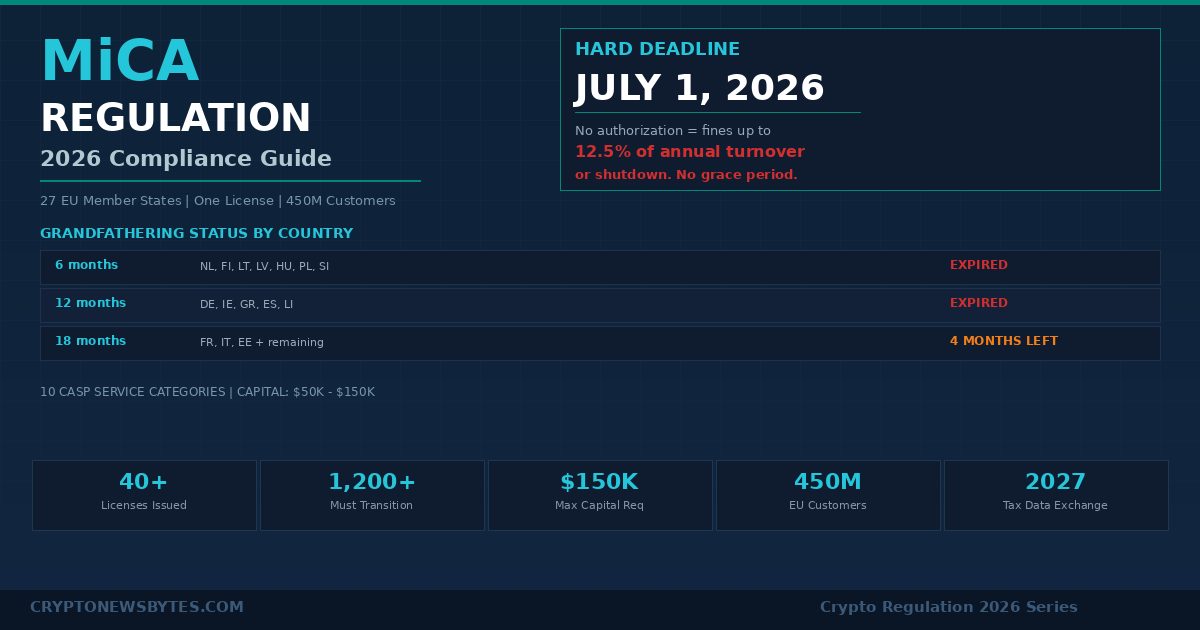
- July 1, 2026 is the hard deadline. After this date, any Crypto Asset Service Provider (CASP) operating in the EU without MiCA authorization faces fines up to 12.5% of annual turnover or shutdown
- MiCA regulation creates a single licensing regime across all 27 EU member states. One authorization grants “passporting” rights to serve 450 million potential customers across the entire EU
- More than 40 CASP licenses have been issued since December 2024, with the Netherlands, Malta, and Germany leading. Over 1,200 crypto businesses must complete the transition before July 2026
- Capital requirements range from $50,000 to $150,000 depending on service type, with stablecoin issuers facing significantly higher thresholds
- Stablecoin issuers face the strictest rules: 1:1 reserve backing, quarterly audits, mandatory whitepapers, and starting March 2026, potential dual licensing under both MiCA and PSD2 for E-Money Token custody
- USDT remains non-compliant with MiCA, forcing EU exchanges to delist it. USDC and EURC (Circle) are positioned as the compliant alternatives
- DAC8 tax reporting began January 1, 2026. CASPs must now collect detailed user transaction data for mandatory cross-border tax reporting starting in 2027
- Grandfathering periods vary wildly: Netherlands and Finland already expired. Germany, Ireland, Spain expired at 12 months. Remaining states expire July 1, 2026
MiCA Regulation Crypto: What It Is and Why the July 2026 Deadline Is Non-Negotiable
The MiCA regulation crypto framework (Markets in Crypto-Assets Regulation, EU 2023/1114) is the European Union’s comprehensive legal framework for crypto assets. It replaces the patchwork of 27 different national registration regimes with a single, harmonized licensing system that covers every crypto asset service provider operating within the EU.[ESMA]
The MiCA regulation crypto framework has been rolling out in phases since June 2024. Stablecoin rules (for Asset-Referenced Tokens and E-Money Tokens) took effect on June 30, 2024. The full CASP authorization regime became mandatory on December 30, 2024. But a grandfathering clause gave existing operators up to 18 months to transition, creating a final hard deadline of July 1, 2026.
After July 1, 2026, there is no informal grace period. ESMA has explicitly warned that enforcement will be robust from day one. Any CASP operating without authorization faces administrative fines up to 12.5% of annual turnover for legal entities (or up to 5 million euros for individuals), license revocations, public “name and shame” enforcement decisions, and potential personal liability for executives including industry bans.[Cyfrin]
MiCA Regulation Crypto: Who Needs a CASP License
Under MiCA regulation, any legal person providing crypto-asset services to clients on a professional basis within the EU needs authorization. The regulation covers ten categories of service:
| Service Category | What It Covers | Minimum Capital |
|---|---|---|
| Custody and administration | Holding crypto assets or keys on behalf of clients | $150,000 |
| Trading platform operation | Running a crypto exchange or matching engine | $150,000 |
| Exchange (crypto-to-fiat) | Converting crypto to fiat or vice versa | $150,000 |
| Exchange (crypto-to-crypto) | Swapping one crypto asset for another | $150,000 |
| Order execution | Executing buy/sell orders on behalf of clients | $50,000 |
| Placement | Marketing crypto assets to investors | $50,000 |
| Transfer services | Transferring crypto between addresses on behalf of clients | $50,000 |
| Portfolio management | Managing crypto portfolios on a discretionary basis | $125,000 |
| Advice | Providing personalized crypto investment recommendations | $50,000 |
| Order transmission | Transmitting client orders to third parties | $50,000 |
Crucially, MiCA regulation applies regardless of where a company is headquartered. If you serve EU customers, you need MiCA authorization. This catches U.S.-based exchanges, Asian platforms, and offshore entities that previously served EU users without local licensing.[CryptoImpactHub]
The Passporting Advantage: One License, 27 Countries
The single most valuable feature of MiCA regulation for crypto companies is EU-wide passporting. Once authorized by one National Competent Authority (NCA), a CASP can provide services across all 27 member states plus the European Economic Area countries (Norway, Iceland, Liechtenstein), giving access to roughly 450 million potential customers.
Before MiCA, companies needed separate registrations in every country they operated in. A company operating in Germany, France, and the Netherlands needed three different authorizations under three different regimes. MiCA eliminates this entirely. One license, one set of compliance requirements, access to the entire EU market.
This creates a powerful incentive for MiCA regulation crypto compliance. The flip side is equally powerful: without authorization, a business loses access to the entire EU market after July 1, 2026.
MiCA Regulation Crypto: Stablecoin Rules (ARTs and EMTs)
The MiCA regulation crypto stablecoin rules reserve the most stringent requirements for stablecoins, which the framework divides into two categories:
💶 Stablecoin Categories Under MiCA
E-Money Tokens (EMTs) reference a single official currency (like USD or EUR) and function primarily as payment instruments. USDT, USDC, and EURC fall into this category. EMT issuers must hold 1:1 reserves in liquid assets, publish detailed whitepapers, undergo quarterly audits, and starting March 2026, may need dual authorization under both MiCA and PSD2 for custody and transfer services. This dual licensing could double compliance costs for affected issuers.
Asset-Referenced Tokens (ARTs) reference multiple currencies, commodities, or other assets (think a stablecoin backed by a basket of currencies). ARTs face even stricter oversight from the European Banking Authority (EBA), including enhanced capital requirements, liquidity buffers, and recovery/wind-down planning. Significant ARTs (those with large user bases or transaction volumes) face additional supervisory requirements.
The practical impact is already visible: USDT (Tether) remains non-compliant with MiCA, and EU-based exchanges have been forced to delist it or restrict access for EU customers. Circle’s USDC and EURC, which have obtained MiCA-compliant status, are positioned to capture the European stablecoin market. This compliance advantage could reshape global stablecoin market share significantly.
MiCA Regulation Crypto: The Grandfathering Countdown
The MiCA regulation crypto grandfathering clause provided existing VASPs (Virtual Asset Service Providers) a window to continue operating under their national licenses while transitioning to CASP authorization. However, the implementation varies dramatically across member states:[Skadden]
| Transition Period | Countries | Status |
|---|---|---|
| 6 months (Jun 2025) | Finland, Latvia, Lithuania, Hungary, Netherlands, Poland, Slovenia | Expired |
| 12 months (Dec 2025) | Germany, Ireland, Greece, Spain, Liechtenstein | Expired |
| 18 months (Jul 1, 2026) | France, Italy, Estonia, and remaining member states | 4 months remaining |
In jurisdictions where the grandfathering period has already expired, all crypto service providers must now be fully MiCA-compliant. Companies in remaining jurisdictions have at most four months. The application process alone typically takes months of preparation, meaning companies that have not started are already at serious risk of missing the deadline.
DAC8 and Tax Reporting: The Second Compliance Layer (New for 2026)
Running parallel to the MiCA regulation crypto framework is DAC8 (the Eighth Directive on Administrative Cooperation), which went live on January 1, 2026. DAC8 implements the OECD’s Crypto-Asset Reporting Framework (CARF) across the EU, requiring CASPs to collect detailed user transaction data for mandatory cross-border tax reporting.
⚠️ DAC8 Tax Reporting: What CASPs Must Do Now
Data collection started January 1, 2026. CASPs must now collect and store detailed transaction data for every user, including transaction amounts, dates, counterparty information, and wallet addresses.
First cross-border information exchange: 2027. EU tax authorities will begin exchanging crypto transaction data across borders, covering all of 2026. This is not voluntary transparency. It is mandatory tax reporting with penalties for failure.
Infrastructure requirements. Many platforms were not built for this level of data collection. CASPs need to upgrade systems to handle sender/recipient data verification while ensuring platforms can integrate with inter-CASP data exchange protocols. The compliance cost and technical complexity are significant.
The combination of MiCA regulation crypto authorization requirements and DAC8 tax reporting creates a dual compliance burden that is reshaping the operational infrastructure of every crypto business operating in Europe.
MiCA Regulation Crypto: What It Means for Your Business
For EU-based CASPs: If you have not started your MiCA application, you are already behind. The application process requires hundreds of pages of documentation covering governance structures, AML/KYC procedures, IT security, business continuity plans, capital adequacy, and client asset segregation policies. NCAs have up to 25 business days just to assess completeness, followed by a rigorous question-and-answer period. Start now or risk losing EU market access entirely.
For non-EU companies serving EU customers: The MiCA regulation crypto framework applies to you too. If you serve EU users, you need authorization. Many U.S.-based exchanges and Asian platforms that previously operated freely in Europe must now choose: obtain a MiCA license, partner with a licensed EU entity, or withdraw from the EU market.
For stablecoin issuers: Compliance determines survival in the EU. Tether’s non-compliance is already reshaping market share in Circle’s favor. Issuers must decide whether the EU market justifies the compliance investment. For those that proceed, dual licensing (MiCA plus PSD2) may be required from March 2026 for certain EMT services.
For DeFi protocols: MiCA explicitly states it does not apply to “fully decentralized protocols with no identifiable issuer.” However, the definition of “fully decentralized” remains contested. Protocols with identifiable teams, governance tokens, or fee-collecting front-ends may face arguments that they are not truly decentralized and therefore require CASP authorization. This is the gray zone to watch.
For investors: MiCA regulation’s client protection requirements (asset segregation, complaint handling, risk disclosures) create a safer environment for retail and institutional investors. Regulated exchanges must segregate customer assets, maintain insurance or equivalent protections, and submit to regular audits. This aligns with the insurance frameworks covered in our crypto insurance guide, where MiCA-mandated insurance is a key driver of the growing market.
MiCA Regulation Crypto vs the GENIUS Act: Key Differences
Both frameworks regulate stablecoins and crypto service providers, but they differ in scope, structure, and approach. Here is how they compare on the provisions that matter most:
| Provision | MiCA (EU) | GENIUS Act (US) |
|---|---|---|
| Scope | All crypto assets and service providers | Payment stablecoins only |
| Stablecoin reserves | 1:1 backing required | 1:1 backing required |
| Licensing | CASP license from national authority | OCC charter, bank subsidiary, or state license |
| Passporting | Yes (27 EU states + EEA) | No (U.S. only, state/federal split) |
| Yield/interest | Not explicitly banned | Banned for issuers |
| Capital (min) | $50K-$150K (by service type) | $5M (de novo federal issuers) |
| Max fine | 12.5% of turnover | TBD (rulemaking in progress) |
| Hard deadline | July 1, 2026 | January 18, 2027 |
| Mutual recognition | None. Dual compliance required for companies operating in both jurisdictions | |
The critical takeaway: there is no mutual recognition between MiCA and the GENIUS Act. Companies operating in both the EU and U.S. must maintain separate compliance programs, separate reserve structures, and separate licensing. For a full breakdown of the U.S. framework, see our complete GENIUS Act guide.
Frequently Asked Questions About MiCA Compliance
📰 Crypto Regulation 2026 Series
- The GENIUS Act Explained: What Every Crypto Company Needs to Know
- You are here: MiCA Regulation 2026: The Complete Compliance Guide
- GENIUS Act vs MiCA: The Complete Comparison for Crypto Companies
- Coming next: SEC vs CFTC: Who Regulates What in Crypto After the CLARITY Act
🔒 Security & Insurance Series
- Crypto Insurance in 2026: Why the Industry’s Biggest Problem Is Not Hackers
- Crypto in 2026: $16B Insurance Market Coming, But 90%+ Still Uninsured
- Cyber Insurance for Crypto Firms: What’s Covered, What’s Not
- Best Crypto Insurance Providers in 2026 Compared
- $2.72B Stolen in 2025: The Crypto Insurance Lessons Every Founder Needs
- Will On-Chain Parametric Insurance Replace Traditional Policies for DeFi?
- Figure Technology Data Breach: Hackers Dump 2.5GB Stolen Records
- Step Finance Hack: $40M Stolen, Platform Shuts Down
- Top 10 Cybersecurity Trends in Crypto & Blockchain 2025
Sources: ESMA | Skadden | Cyfrin | CryptoImpactHub | LegalNodes | Sumsub | The Block | Chainstack | Contact Advisory
Disclaimer: This article is for informational purposes only and does not constitute legal, financial, or regulatory advice. MiCA implementation timelines and requirements vary by EU member state. All information is based on publicly available sources as of March 1, 2026. Consult qualified EU regulatory counsel for advice specific to your jurisdiction and business model.