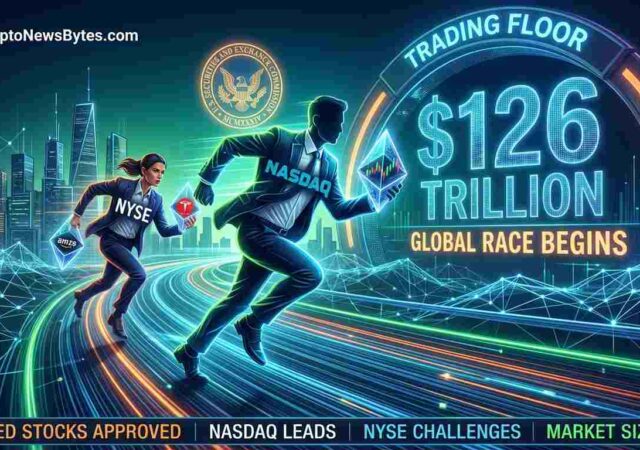

On March 18, 2026, the same day the SEC and CFTC published their joint token taxonomy, the Securities and Exchange Commission quietly approved a second landmark rule. Under Release No. 34-105047, the agency greenlit Nasdaq’s proposal to allow certain stocks and ETFs to trade and settle as blockchain-based tokens alongside their traditional equivalents. The two approvals landed on the same day. That was not a coincidence.
The Nasdaq approval, which the exchange had been seeking since September 2025, means Russell 1000 stocks and ETFs tracking the S&P 500 and Nasdaq 100 can now be tokenized. A tokenized share carries the same ticker, the same CUSIP number, the same dividend rights, and the same voting rights as a traditional share. It trades on the same order book at the same price. Settlement still runs through the Depository Trust Company. The difference is that the underlying record of ownership sits on a blockchain rather than in a legacy database.
That may sound incremental. It is not. The first token-settled trades on Nasdaq could take place as early as the third quarter of 2026, once the DTC completes system updates and participants are onboarded. And by the time those first trades settle, two of the largest exchange operators in the world will be racing each other to capture the market.
| $126T Global Equity Market on the Line | $33B RWA Market Mar 2026 (from $5.5B a year ago) | $25B OKX Valuation After ICE Investment |
The Market Behind the Race: Real-World Asset Tokenization Growth
Total RWA on-chain market vs tokenized stocks segment. Source: RWA.xyz, MEXC research | March 2026.
| RWA Market Mar 2025 | $5.5B | |
| RWA Market Mar 2026 | $33B | |
| Tokenized Stocks On-Chain | $1.09B | |
| Ondo Finance Share | 61% | |
| Kraken xStocks Share | 24% |
RWA market grew 6x in 12 months. The $1.09B tokenized stock segment is less than 0.001% of the $126 trillion traditional equity market it is targeting. That gap is what Nasdaq, NYSE, ICE, OKX, Kraken, and Securitize are all racing to close.
Nasdaq Has Kraken. NYSE Has OKX. The Race Is Real.
Nasdaq moved first on the regulatory front. But NYSE’s parent, Intercontinental Exchange, moved earlier on the partnership front. On March 5, 2026, ICE announced a strategic investment in crypto exchange OKX at a $25 billion valuation, securing a board seat and a deal that gives OKX’s 120 million users access to NYSE tokenized equities. The investment, reported to be approximately $200 million, is not a passive financial play. ICE’s vice president of strategic initiatives, Michael Blaugrund, said explicitly that the company’s future competitors may not look like CME or Nasdaq. They might look like DeFi protocols or super apps.
On March 9, Nasdaq responded by announcing its partnership with Kraken’s parent company Payward. The arrangement designates Kraken’s xStocks platform, which has already processed over $25 billion in transaction volume and has more than 85,000 unique holders, as the primary settlement infrastructure and global distribution channel for Nasdaq-tokenized shares. International markets, starting with Europe, are the primary target. U.S. investors are excluded under the current plan pending further regulatory steps.
Then on March 24, NYSE moved again. Intercontinental Exchange tapped BlackRock-backed tokenization specialist Securitize, which is SEC-registered as a transfer agent and is targeting a 2026 public listing via a SPAC deal, to help design the infrastructure behind NYSE’s tokenized securities platform. Securitize is expected to be among the first firms eligible to mint tokenized versions of NYSE-listed stocks and ETFs on the platform, pending regulatory approval. Its broker-dealer arm would also participate in trading, giving it a foothold across both issuance and market activity.
Within a single week, the competitive map crystallised: Nasdaq and Kraken on one side, NYSE and ICE with OKX and Securitize on the other. Both are chasing the same outcome, blockchain-based settlement of traditional equities, but through different strategies. Nasdaq’s model is conservative, keeping everything within the existing DTC framework. ICE’s model is more ambitious, connecting NYSE equities directly to 120 million crypto-native users through OKX.
What a Tokenized Stock Actually Is (and What It Is Not)
The most important thing to understand about Nasdaq’s approved framework is what it does not change. A tokenized share is not a DeFi token. It is not permissionless. It does not trade 24/7 yet. It does not bypass intermediaries. Under the SEC-approved model, a tokenized share of Apple or Microsoft is legally identical to a traditional share. Same ticker, same CUSIP, same voting rights, same dividend. It trades on the same Nasdaq order book with the same execution priority. Settlement runs through the DTC in the same T+1 cycle.
What changes is the record of ownership. Instead of sitting in a legacy securities database, it sits on a blockchain. That record is programmable, potentially available 24/7 once further regulatory steps are taken, and interoperable with other blockchain-based systems. Corporate actions like dividend payments and proxy voting can be automated rather than processed manually through custodians.
Kraken’s Val Gui, general manager of xStocks, called the approval “a clear signal the $126 trillion equity market will be shifting onto blockchain rails.” Ian De Bode, president of Ondo Finance, which currently holds 61 percent of the tokenized stock market, described it as progress toward 24/7 markets even in permissioned form. (CoinDesk, March 18, 2026)
The RWA Market Behind This Race
The competitive intensity makes more sense when you look at the market that is forming around tokenized real-world assets. The RWA market has grown from $5.5 billion to $33 billion in twelve months as of March 2026. Tokenized stocks specifically have reached $1.09 billion on-chain, tripling since mid-2025. Total monthly transfer volume is running at $2.48 billion. The market is still tiny relative to the $126 trillion traditional equity market it is targeting, but the growth trajectory is what Nasdaq and NYSE are positioning for.
This directly connects to the regulatory framework that the SEC and CFTC established on March 17. The joint token taxonomy classified digital securities as the category that remains fully under SEC jurisdiction. Tokenized stocks, which are digital representations of existing registered securities, fit neatly into that classification. The back-to-back approvals on March 17 and 18 were not coincidental. The taxonomy came first, clarifying what the rules are. The Nasdaq approval came second, showing what can be built under them.
For the full context on the SEC and CFTC token taxonomy that preceded this approval, see our coverage of the SEC’s 16 digital commodities classification and the joint SEC-CFTC framework. For the Morgan Stanley MSBT Bitcoin ETF filing that landed on the same week, see our Morgan Stanley MSBT coverage.
FAQs: Nasdaq Tokenized Stocks and the NYSE Race
Related Coverage on CryptoNewsBytes
The bank-issued ETF that landed the same week, and what it means that Wall Street is now building its own crypto infrastructure rather than using someone else’s.
The token taxonomy that preceded the Nasdaq approval by one day, and why the sequencing of these two SEC actions matters.
The joint regulatory vision that is enabling the tokenization race to happen at all.
The DC Blockchain Summit panel that mapped the next phase of institutional adoption, the Nasdaq approval is the first major proof point.
The Saylor thesis that sits behind the tokenization trend: Bitcoin as the base layer for a new digital capital market infrastructure.
Primary sources: SEC Release No. 34-105047 (March 18, 2026) | CoinDesk | FinTech Weekly | Fortune | The Block. Published March 30, 2026.