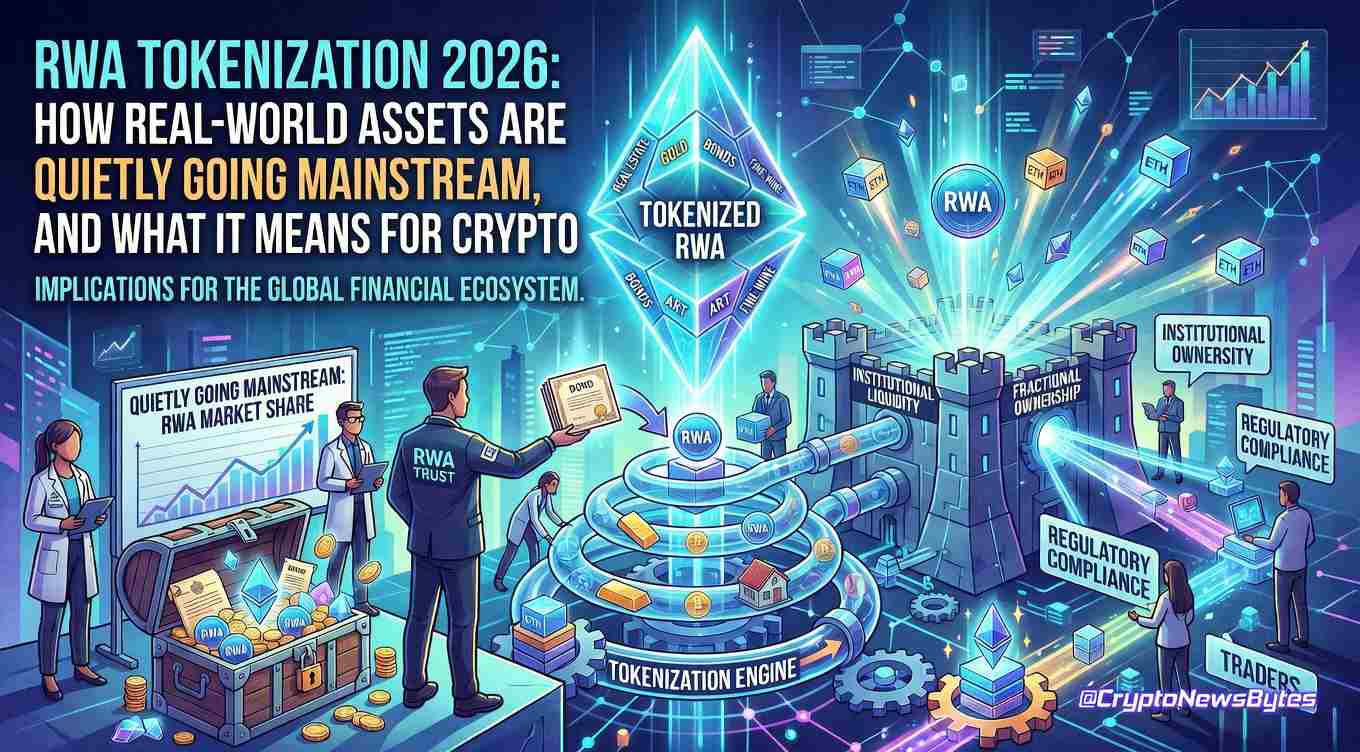
While most of the crypto market spent Q1 2026 in various stages of decline, one corner of the industry has been quietly growing at a pace that has Wall Street paying serious attention. The total value of real-world assets tokenized on public blockchains crossed $12 billion in March 2026, up from roughly $5 billion at the start of 2025. That is a 140 percent increase in 15 months. BlackRock’s tokenized treasury fund has grown to $1.9 billion in assets. Franklin Templeton’s on-chain government money fund holds approximately $700 million. Ondo Finance, which allows retail investors to access US Treasury yield directly through their crypto wallets, manages over $1.4 billion. JPMorgan has processed over $900 billion in tokenized repo transactions since launching its Kinexys platform.
Real-world asset tokenization is not a new idea. The concept has been discussed in blockchain circles since 2017. What is different in 2026 is that the legal frameworks, custody infrastructure, and institutional distribution networks have matured to the point where genuinely large pools of capital are moving on-chain. This is not speculative. The assets being tokenized are US Treasury bonds, private credit loans, commercial real estate, and commodities like gold. The entities doing the tokenizing are BlackRock, JPMorgan, Goldman Sachs, HSBC, and Citi. McKinsey projects the RWA tokenization market could reach $2 trillion by 2030. Standard Chartered’s CEO Bill Winters told a 2025 conference that he expects the majority of financial transactions to eventually settle on blockchain. Whether those projections prove accurate, the direction is clear.
| $12B+ Total RWA On-Chain, March 2026 | +140% Growth Since Jan 2025, 15 Months | $2T McKinsey Projection by 2030 |
What Is RWA Tokenization and How Does It Actually Work
Tokenization is the process of creating a blockchain-based digital token that represents ownership of, or a claim on, a real-world asset. The token and the underlying asset are linked through a legal structure, typically a special purpose vehicle or a fund. The smart contract that governs the token enforces rules: who can hold it, how it can be transferred, when yield is distributed. The underlying asset remains in traditional custody, a Treasury bond held by a regulated custodian, a property titled to an LLC, a gold bar in a vault, but the economic exposure to that asset can now be traded, transferred, or used as collateral on blockchain networks 24 hours a day, seven days a week, without requiring a broker, a settlement period, or a brokerage account.
The value proposition differs by asset class. For US Treasuries, the benefit is primarily access and settlement. A crypto-native investor can hold tokenized Treasury yield directly in a self-custodied wallet, earn approximately 4 to 5 percent APY, and use the token as collateral in DeFi protocols, all without converting to fiat or opening a brokerage account. For institutional investors, the benefit is operational: tokenized assets settle in seconds rather than T+2 days, dramatically reducing counterparty risk in repo markets and lending. For private credit, tokenization opens access to a historically exclusive asset class to a broader investor base while providing borrowers faster and cheaper access to capital. For real estate, it enables fractional ownership of high-value properties that previously required minimum investments of hundreds of thousands of dollars.
The Five Asset Classes and Where They Stand in April 2026
Tokenized US Treasuries are the dominant category at approximately $5.8 billion in on-chain value as of March 2026, according to rwa.xyz. Three products account for the majority of this market. BlackRock’s BUIDL fund, managed through Securitize and now live on nine blockchain networks, is the largest single product at $1.9 billion. It invests in short-term US Treasuries and repos, distributing yield to token holders daily and maintaining a stable $1.00 token price. Ondo Finance operates USDY and OUSG with a combined $1.4 billion in assets, with USDY functioning effectively as a yield-bearing stablecoin: holders earn Treasury yield simply by holding the token, with no staking or lockup. Franklin Templeton’s BENJI token, running on Stellar and Ethereum since 2021, now holds approximately $700 million. These three products together hold roughly $4 billion, all in products that launched without meaningful legal or operational precedent.
Private credit tokenization grew 180 percent year-over-year in 2025, with platforms including Centrifuge, Maple Finance, and Goldfinch originating over $3.2 billion in on-chain loans. Centrifuge connects real-world borrowers, small businesses, invoice financiers, trade finance participants, with crypto-native capital, with yields typically ranging from 8 to 15 percent. Maple Finance focuses on institutional borrowers including crypto market makers and fintech lenders. The risk profile is meaningfully higher than tokenized Treasuries: private credit defaults do occur, and on-chain enforcement mechanisms are still maturing. But the yield premium reflects that risk, and the market has grown significantly despite it.
Tokenized gold and commodities represent approximately $1.2 billion on-chain, led by Paxos (PAXG) and Tether (XAUT). The value proposition is simple: gold ownership without storage costs or physical delivery, with the ability to transfer globally in seconds. Tokenized real estate remains the smallest established category at approximately $2 to $3 billion across multiple platforms, with platforms like RealT enabling fractional ownership of US residential properties for investments as small as $50 per property. Corporate bonds and private equity tokenization are early-stage but accelerating, with UBS, EIB, and Goldman Sachs all having completed tokenized bond issuances. (Blocklr RWA Guide, March 2026)
RWA Tokenization by Asset Class: On-Chain Value April 2026
Source: rwa.xyz live data; Blocklr; MetaMask RWA categories. April 2026. Stablecoins excluded (separate category).
| US Treasuries | ~$5.8B | |
| Private Credit | ~$3.2B | |
| Real Estate | ~$2.5B | |
| Commodities (Gold) | ~$1.2B | |
| Corporate Bonds / Other | ~$1.8B |
Ethereum hosts approximately 65% of all tokenized RWA value. Stellar, Polygon, Solana, Avalanche, and BNB Chain account for most of the remainder. MakerDAO (now Sky) holds over $2 billion in RWA collateral backing DAI, making it the largest DeFi consumer of tokenized assets.
$12B+ On-Chain RWA: Market Share by Asset Class and Blockchain
April 2026. Source: rwa.xyz, Blocklr, MetaMask RWA categories | @CryptoNewsBytes
By Asset Class
| US Treasuries | 48% | |
| Private Credit | 27% | |
| Real Estate | 10% | |
| Commodities | 5% | |
| Bonds / Other | 10% |
By Blockchain (% of total RWA value)
| Ethereum | 65% | |
| Stellar | 9% | |
| Polygon | 7% | |
| Solana | 5% | |
| Avalanche | 4% | |
| Other | 10% |
Ethereum’s 65% dominance reflects its institutional credibility, smart contract maturity, and the fact that BlackRock BUIDL, Ondo Finance, and most major tokenized Treasury products launched on Ethereum first. Stellar’s 9% share is driven primarily by Franklin Templeton’s BENJI fund. Figures based on distributed public blockchain value; platform-locked assets on private chains (JPMorgan Kinexys) are not included.
Why Wall Street Is Moving Faster Than Expected
The question most observers were asking in 2023 was whether traditional financial institutions would actually adopt blockchain infrastructure for asset management, or whether the announcements would remain at the pilot and press release stage. By April 2026, the answer is clear: the pilots have scaled. BlackRock’s BUIDL did not stay at $100 million. It grew to $1.9 billion across nine chains and became the dominant institutional benchmark for tokenized Treasury products. JPMorgan’s Kinexys platform processed over $900 billion in tokenized repo transactions, not a pilot but operational clearing infrastructure. In February 2026, BlackRock partnered with Securitize to integrate BUIDL into the UniswapX protocol, the first time a major Wall Street institution officially adopted DeFi infrastructure for trading tokenized securities.
The drivers are structural rather than speculative. Tokenized assets settle in seconds rather than T+2 days, eliminating a form of counterparty risk that costs financial institutions billions annually in capital reserves. Smart contracts automate interest distribution, reducing operational costs for fund administration. Blockchain-based ownership records reduce fraud and reconciliation failures in private markets. And for crypto-native capital allocators, the DeFi protocols, stablecoin issuers, and crypto hedge funds that hold billions in stablecoins earning zero yield, tokenized Treasuries offering 4 to 5 percent APY are a directly substitutable, superior product. MakerDAO’s decision to hold over $2 billion in tokenized RWAs as collateral backing DAI is not a philosophical choice. It is a yield optimisation decision made by a protocol trying to remain competitive. That same logic applies across every stablecoin issuer and DeFi protocol managing large treasury positions.
The SEC and CFTC’s March 17, 2026 joint interpretive release, which classified 16 crypto assets as digital commodities, also matters here. For tokenized securities specifically, the regulatory framework has been shifting from enforcement-oriented to enablement-oriented. The SEC closed its investigation into Ondo Finance with no charges. The CLARITY Act, if passed, would codify the regulatory foundation for tokenized assets into statute. For our coverage of the regulatory environment, see the SEC/CFTC five-category framework and the Nasdaq tokenized stocks explainer.
RWA Tokenization Market Growth: 2022 to 2026
Total on-chain RWA value (excluding stablecoins). Source: rwa.xyz; Blocklr; multiple sources. McKinsey 2030 projection shown separately.
| 2022 | ~$5B | |
| Jan 2025 | ~$5B | |
| Mid 2025 | ~$8B | |
| Apr 2026, NOW | $12B+ | |
| 2030 (McKinsey) | $2 Trillion (projected) |
McKinsey $2 trillion by 2030 projection assumes regulatory frameworks mature, institutional custody infrastructure scales, and secondary market liquidity develops across tokenized asset classes. Current growth rate of ~140% in 15 months is ahead of most 2023 forecasts.
The Risks Nobody Is Talking About
The RWA narrative is genuinely compelling and the numbers are real. But several risks deserve clear-eyed examination alongside the growth story. Smart contract risk is the most immediate: tokenized assets depend on smart contracts that could contain vulnerabilities, and the Drift Protocol hack, in which $285 million was drained from a DeFi protocol in 12 minutes through a combination of oracle manipulation and governance compromise, is a reminder of what that risk looks like in practice. Tokenized Treasury funds that integrate with DeFi protocols as collateral inherit some of that risk.
Legal enforceability in bankruptcy scenarios is largely untested. Tokenized asset structures are designed to provide bankruptcy remoteness, but what that actually means for a token holder if the issuing entity fails has not been decided in court at scale. The legal infrastructure is built on existing fund and securities law adapted to blockchain, not on law written specifically for tokenized assets. When the first major tokenized asset issuer faces a serious distress event, the legal framework will be stress-tested in ways that current documentation does not fully anticipate.
Market concentration is also a structural concern. BlackRock’s BUIDL alone accounts for over 40 percent of the tokenized Treasury market. That level of concentration means BUIDL’s redemption mechanics, custody arrangements, and counterparty relationships effectively define the systemic risk profile for the entire category. And liquidity in many tokenized asset products remains thin: private credit tokens and tokenized real estate in particular have limited secondary markets, meaning investors who need to exit quickly may find the on-chain settlement speed advantage negated by bid-ask spreads that can be very wide.
FAQs: RWA Tokenization in 2026
Related Coverage on CryptoNewsBytes
The next frontier of RWA tokenization: equities. Russell 1000 and S&P 500/Nasdaq 100 ETF tokens, on-chain settlement via DTC, first trades targeted for Q3 2026.
BlackRock’s approach to Ethereum staking through a regulated ETF wrapper, the institutional template for how traditional finance packages on-chain yield for mainstream access.
The March 17 regulatory release that classified Bitcoin, Ethereum, Solana, and 13 others as digital commodities. The legal foundation a tokenized asset fiduciary needs to conduct prudence reviews.
The risk that sits underneath the RWA growth story. When tokenized assets integrate with DeFi protocols as collateral, they inherit DeFi’s smart contract and governance risks. The Drift hack is the defining 2026 example.
The legislative fight that determines whether tokenized assets can offer yield in regulated US products. The CLARITY Act outcome shapes the addressable market for RWA tokenization directly.
Primary sources: rwa.xyz live data, April 2026 | Blocklr RWA Guide, March 2026 | MetaMask RWA Categories, April 2026 | McKinsey RWA tokenization report | BlackRock BUIDL fund data via Securitize. Published April 10, 2026. This article is for informational purposes only and does not constitute financial or investment advice.