
⚡ Key Highlights
- The SEC vs CFTC crypto jurisdiction battle is being resolved through the CLARITY Act and joint Project Crypto initiative. After years of overlapping claims and regulation-by-enforcement, the two agencies are moving toward a clear split
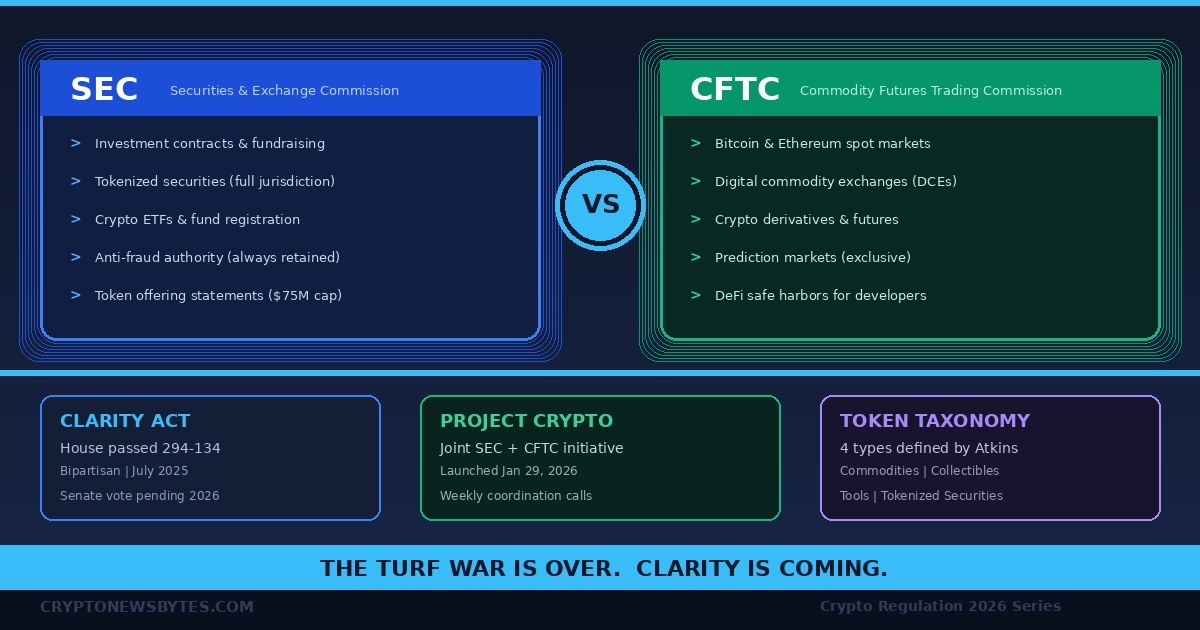
- Under the emerging framework: the CFTC gets exclusive jurisdiction over digital commodity spot markets (Bitcoin, Ethereum, and most tokens on mature blockchains). The SEC retains authority over investment contracts (fundraising, token issuances, and securities)
- The CLARITY Act passed the House in July 2025 with a bipartisan 294-134 vote. Senate action is pending in 2026. The Senate Agriculture Committee advanced its version in January 2026
- SEC Chair Paul Atkins and CFTC Chair Michael Selig launched joint Project Crypto on January 29, 2026, signaling the end of the “turf war” era and the start of coordinated oversight
- The Atkins token taxonomy: digital commodities/network tokens, digital collectibles, digital tools (all NOT securities) vs tokenized securities (SEC jurisdiction). Investment contracts can “end” when issuer promises are fulfilled
- The Howey test remains the legal standard for determining if a token is a security, but the SEC now acknowledges it has limits and that most crypto assets currently trading are not securities
- Payment stablecoins are excluded from both SEC and CFTC jurisdiction under the CLARITY Act. They fall under the GENIUS Act framework instead
SEC vs CFTC Crypto: Why This Matters for Every Crypto Company
For years, the single biggest compliance question in U.S. crypto was: “Is my token a security or a commodity?” The answer determined whether the SEC vs CFTC crypto jurisdiction applied to your project, your exchange, and your users. Get it wrong, and you faced enforcement action from whichever agency decided to claim jurisdiction.
That era is ending. The CLARITY Act (Digital Asset Market Clarity Act of 2025) is drawing a bright line between SEC and CFTC responsibilities for the first time. And even before the legislation passes the Senate, both agencies launched joint Project Crypto on January 29, 2026, signaling coordinated oversight rather than jurisdictional competition. For crypto companies operating in the U.S. or serving U.S. customers, understanding the SEC vs CFTC crypto split is now essential for licensing decisions, product design, and compliance architecture.[Morrison Foerster]
The History: How We Got to the SEC vs CFTC Crypto Turf War
The jurisdictional conflict did not happen overnight. It grew from a fundamental gap in U.S. law: crypto assets did not exist when the Securities Act of 1933 and the Commodity Exchange Act were written.
The SEC claimed jurisdiction over any digital asset that qualified as an “investment contract” under the Howey test, a 1946 Supreme Court case involving orange grove investments. Under former Chair Gary Gensler (2021-2025), the SEC took an aggressive stance that the vast majority of crypto tokens were securities. The agency brought over 100 enforcement actions against crypto companies, including high-profile cases against Coinbase, Ripple, Kraken, and numerous token issuers, without ever writing crypto-specific rules.[Baker McKenzie]
The CFTC classified Bitcoin and Ethereum as commodities and asserted jurisdiction over crypto derivatives (futures, options, swaps) and fraud in spot commodity markets. But its authority over spot markets was limited: the CFTC could pursue fraud and manipulation but could not require exchanges to register or comply with ongoing oversight standards for spot trading.
The result was a legal gray zone. The same token could be treated as a security by the SEC and a commodity by the CFTC. Exchanges did not know which agency to register with. Token issuers faced conflicting guidance. The Ripple case illustrated the absurdity: a federal judge ruled that XRP sales to institutional investors were securities but the same XRP sold on exchanges to retail traders was not. Courts, lawmakers, and the industry all called for Congress to intervene.
The CLARITY Act: Drawing the Line Between SEC and CFTC
The CLARITY Act is the legislative answer to the SEC vs CFTC crypto jurisdiction problem. Introduced in May 2025, it passed the House in July 2025 with bipartisan support (294-134). The Senate Agriculture Committee advanced its version (the Digital Commodity Intermediaries Act) in January 2026. Final Senate passage and reconciliation are expected in 2026.[Senate Banking Committee]
The Act creates three categories of digital assets:
| Category | Definition | Primary Regulator | Examples |
|---|---|---|---|
| Digital Commodities | Value intrinsically linked to a functional, decentralized blockchain | CFTC (exclusive jurisdiction over spot markets) | Bitcoin, Ethereum, most Layer-1 tokens on mature blockchains |
| Investment Contract Assets | Tokens sold with promises of managerial effort (Howey test) | SEC (primary market, fundraising, disclosures) | ICO tokens, pre-sale tokens with issuer promises |
| Payment Stablecoins | Fiat-backed tokens for payment. Excluded from SEC/CFTC scope | OCC, Federal Reserve, state regulators (under GENIUS Act) | USDC, USDT, PYUSD |
The critical innovation is that digital commodities get CFTC exclusive jurisdiction over spot markets. This gives the CFTC authority it never had before: the power to require exchanges, brokers, and dealers trading digital commodities to register, follow conduct rules, and maintain ongoing compliance. SEC-registered platforms (like alternative trading systems) can also trade digital commodities through a notification process, but under CFTC-consistent rules.[Arnold & Porter]
SEC vs CFTC Crypto: The Complete Jurisdiction Split
Here is how oversight responsibilities divide under the emerging framework:
| Activity / Asset | SEC | CFTC |
|---|---|---|
| Bitcoin and Ethereum spot trading | No jurisdiction | Exclusive jurisdiction |
| Digital commodity exchanges | Can trade via notification (if SEC-registered ATS) | Registration required (DCEs, brokers, dealers) |
| Token fundraising / ICOs | Primary jurisdiction (offering statements required) | No jurisdiction |
| Secondary market trading of tokens initially sold as investment contracts | Anti-fraud authority remains. Atkins supports trading on non-SEC platforms | Can trade on CFTC-registered or state-regulated platforms |
| Crypto derivatives (futures, options, swaps) | No jurisdiction | Exclusive jurisdiction |
| Payment stablecoins | Limited (on registered entities only) | Limited (treated as digital commodities when transacted on CFTC-registered entities) |
| Tokenized securities | Full jurisdiction (securities laws apply regardless of form) | No jurisdiction |
| Crypto ETFs | Full jurisdiction (fund registration, disclosure) | Jurisdiction over underlying commodity derivatives |
| DeFi protocols | Considering exemptions for truly decentralized protocols | Exploring safe harbors for software developers |
| Prediction markets / event contracts | No jurisdiction | Exclusive jurisdiction (withdrawn prior restrictions) |
The Atkins Token Taxonomy: How Tokens Get Classified
In November 2025, SEC Chair Paul Atkins delivered a landmark speech outlining a practical framework for token classification. This taxonomy is now being jointly codified with the CFTC through Project Crypto. It fundamentally changes how the SEC vs CFTC crypto split works in practice.[SEC.gov]
The four token types:
Tokens That Are NOT Securities (CFTC or no federal regulator)
1. Digital Commodities / Network Tokens. Assets intrinsically linked to and deriving value from a functional, decentralized blockchain. Examples: Bitcoin, Ethereum, Solana, and most Layer-1 tokens. These fall under CFTC jurisdiction.
2. Digital Collectibles. NFTs and unique digital assets that do not carry expectations of profit from managerial efforts. No federal securities regulation applies.
3. Digital Tools. Tokens that function as access keys, utility credentials, or software components. Not securities even when sold as part of an investment contract, provided the issuer’s promises have been fulfilled.
Tokens That ARE Securities (SEC jurisdiction)
4. Tokenized Securities. Traditional securities (stocks, bonds, fund shares) represented on a blockchain. Securities laws apply regardless of the technology used to represent the asset. The SEC has confirmed that “economic reality trumps labels.”
The most important innovation in Atkins’ framework is the concept that investment contracts can end. Under the Howey test, a token sold as part of an investment contract (with issuer promises of development, marketing, or returns) qualifies as a security. But once the issuer fulfills those promises, the blockchain matures, and the token operates on a decentralized network, the investment contract terminates. The token then becomes a digital commodity under CFTC jurisdiction. This “graduation” concept could reclassify hundreds of tokens that were previously treated as securities.
Project Crypto: The End of the SEC vs CFTC Turf War
On January 29, 2026, SEC Chair Atkins and CFTC Chair Selig held a joint event at CFTC headquarters announcing that Project Crypto would become a shared initiative. This was the first time in over a decade that both agencies publicly emphasized collaboration over competition in crypto regulation.[Consumer Financial Services Law Monitor]
The joint initiative focuses on several priorities: developing a shared crypto asset taxonomy to replace ad-hoc classification, reducing duplicative compliance requirements for firms operating across both regimes, expanding eligible forms of tokenized collateral for derivatives markets, creating safe harbors for DeFi software developers, and facilitating the onshoring of crypto products (including perpetual contracts) that have developed offshore due to U.S. regulatory uncertainty.
The operational changes are already underway. The agencies have committed to weekly coordination calls, shared market surveillance data, joint rulemaking on overlapping issues, and a coordinated approach to delisting decisions. Chair Selig confirmed that the CFTC’s separate “Crypto Sprint” initiative would merge into Project Crypto rather than running in parallel.[Alvarez & Marsal]
How SEC vs CFTC Crypto Rules Affect Exchanges and Platforms
The practical impact for crypto exchanges is significant. Under the CLARITY Act framework:
Centralized exchanges listing digital commodities (Bitcoin, Ethereum, and tokens on mature blockchains) will need to register with the CFTC as Digital Commodity Exchanges (DCEs). This is new. Previously, the CFTC could only pursue fraud and manipulation in spot markets but could not require registration. DCEs will face conduct rules, cybersecurity requirements, anti-manipulation standards, and ongoing reporting obligations.
Exchanges that also list tokens classified as investment contract assets will need to navigate dual registration or use the CLARITY Act’s notification process. SEC-registered alternative trading systems can trade digital commodities by notifying (not registering with) the CFTC, provided their rules are consistent. This is designed for platforms like Coinbase that operate across both securities and commodity classifications.
DeFi protocols face a more favorable environment than under the previous SEC regime. Both agencies are exploring safe harbors for software developers and protocols that are genuinely decentralized. Chair Selig specifically committed to not treating code publishers as regulated intermediaries. However, protocols with identifiable teams, fee extraction, or governance token voting may still face oversight. The CLARITY Act includes a mandatory study on DeFi to inform future rulemaking.
Custody providers benefit from clarity as well. The CLARITY Act creates a “qualified digital asset custodian” category that can include banks, trust companies, and state-licensed entities. Custody of digital commodities falls under CFTC-consistent standards, while custody of tokenized securities follows SEC rules.
SEC vs CFTC Crypto: What the Howey Test Actually Means Now
The Howey test is not going away. It remains binding Supreme Court precedent for determining whether a transaction constitutes an investment contract. But the SEC under Chair Atkins is interpreting it more narrowly than under Gensler.
The four elements of Howey: (1) an investment of money, (2) in a common enterprise, (3) with a reasonable expectation of profits, (4) derived from the essential managerial efforts of others. All four must be present for a token sale to qualify as an investment contract.
Atkins’ key innovation: the issuer’s representations or promises must be “explicit and unambiguous.” And crucially, investment contracts can terminate. When an issuer fulfills its promises, the blockchain becomes functional and decentralized, and the token trades on secondary markets without reliance on the issuer’s efforts, the Howey test no longer applies. The token “graduates” from a security to a digital commodity.
This matters practically because it means tokens that were sold in ICOs as securities can eventually trade on CFTC-regulated platforms without SEC registration. The CLARITY Act codifies this with a $75 million exemption for token offerings on mature blockchains, requiring an offering statement but not full SEC registration.
How This Connects to the GENIUS Act and MiCA
The SEC vs CFTC crypto split is one piece of a three-part U.S. regulatory framework:
| Legislation | What It Covers | Status |
|---|---|---|
| GENIUS Act | Payment stablecoins: reserves, licensing, redemption, OCC oversight | Signed into law Jul 18, 2025 |
| CLARITY Act | Market structure: SEC vs CFTC jurisdiction, exchange registration, token classification | House passed Jul 2025. Senate pending |
| Anti-CBDC Act | Prohibits Federal Reserve from issuing central bank digital currency directly to individuals | Bundled with CLARITY Act |
Together, the GENIUS Act and CLARITY Act create the complete U.S. crypto regulatory framework: GENIUS handles stablecoins, CLARITY handles everything else. The EU’s MiCA handles all of this in a single regulation, which is why the GENIUS Act vs MiCA comparison shows the U.S. approach as more fragmented but also more specialized.
SEC vs CFTC Crypto: What This Means for Your Business
If you operate an exchange: Start preparing for CFTC registration as a Digital Commodity Exchange if you list Bitcoin, Ethereum, or other digital commodities. If you also list tokens that may be investment contract assets, plan for dual compliance or the CLARITY Act’s notification pathway.
If you issue tokens: The Atkins taxonomy gives you a clearer path. Tokens on mature, decentralized blockchains can trade as digital commodities under CFTC jurisdiction. Tokens sold with issuer promises start under SEC oversight but can graduate. File an offering statement under the CLARITY Act’s exemption (up to $75M over 12 months) rather than full SEC registration.
If you build DeFi protocols: The environment is more favorable than at any point since 2020. Both agencies are exploring safe harbors for software developers. But “decentralized” must be genuine. If your team controls governance, extracts fees, or makes promises about future development, you may still face regulatory obligations.
If you invest in crypto: The jurisdiction split gives you clearer protections than ever before. Digital commodities on CFTC-registered exchanges will have anti-fraud, anti-manipulation, and conduct standards that did not exist for spot crypto markets. Tokenized securities on SEC-registered platforms retain full investor protections including disclosure requirements and insider trading rules. Payment stablecoins under the GENIUS Act have statutory reserve requirements and redemption rights. If you are defrauded, you now have a clear regulator to turn to based on asset class, rather than the previous confusion where neither agency would claim responsibility. The overall safety infrastructure is stronger than at any point in crypto’s history, which directly supports the growing crypto insurance market.
For U.S. competitiveness: The combined GENIUS Act + CLARITY Act framework positions the U.S. to compete directly with the EU’s MiCA for global crypto business. Clear rules reduce the “regulatory arbitrage” that has driven crypto companies to offshore jurisdictions like the Cayman Islands, Dubai, and Singapore. The White House Office of Management and Budget issued a Statement of Administration Policy in 2025 supporting the CLARITY Act’s goals, signaling executive branch alignment with making the U.S. “the crypto capital of the world.” If the Senate passes the CLARITY Act in 2026, the U.S. will have the most specialized and detailed crypto regulatory framework of any major economy.
Frequently Asked Questions
📰 Crypto Regulation 2026 Series
- The GENIUS Act Explained: What Every Crypto Company Needs to Know in 2026
- MiCA Regulation 2026: The Complete Compliance Guide for Crypto Companies
- GENIUS Act vs MiCA: The Complete Comparison for Crypto Companies
- You are here: SEC vs CFTC: Who Regulates What in Crypto After the CLARITY Act
- How to Get a Crypto License in 2026: Country-by-Country Guide
- Coming next: Crypto Tax Reporting 2026: CARF, DAC8, and Global Compliance Guide
🔒 Security & Insurance Series
- Crypto Insurance in 2026: Why the Industry’s Biggest Problem Is Not Hackers
- Best Crypto Insurance Providers in 2026 Compared
- $2.72B Stolen in 2025: The Crypto Insurance Lessons Every Founder Needs
- Figure Technology Data Breach: Hackers Dump 2.5GB Stolen Records
- Step Finance Hack: $40M Stolen, Platform Shuts Down
- Top 10 Cybersecurity Trends in Crypto & Blockchain 2025
Sources: SEC.gov | Morrison Foerster | Baker McKenzie | Consumer Financial Services Law Monitor | Alvarez & Marsal | Arnold & Porter | Senate Banking Committee | Congressional Research Service | K&L Gates | Latham & Watkins | PSBP Law | Kroll
Disclaimer: This article is for informational purposes only and does not constitute legal, financial, or regulatory advice. The CLARITY Act has not yet been signed into law. SEC and CFTC positions described here reflect publicly stated views as of March 2026 and may change through rulemaking or legislation. Consult qualified legal counsel for advice specific to your business.