
⚡ Key Points
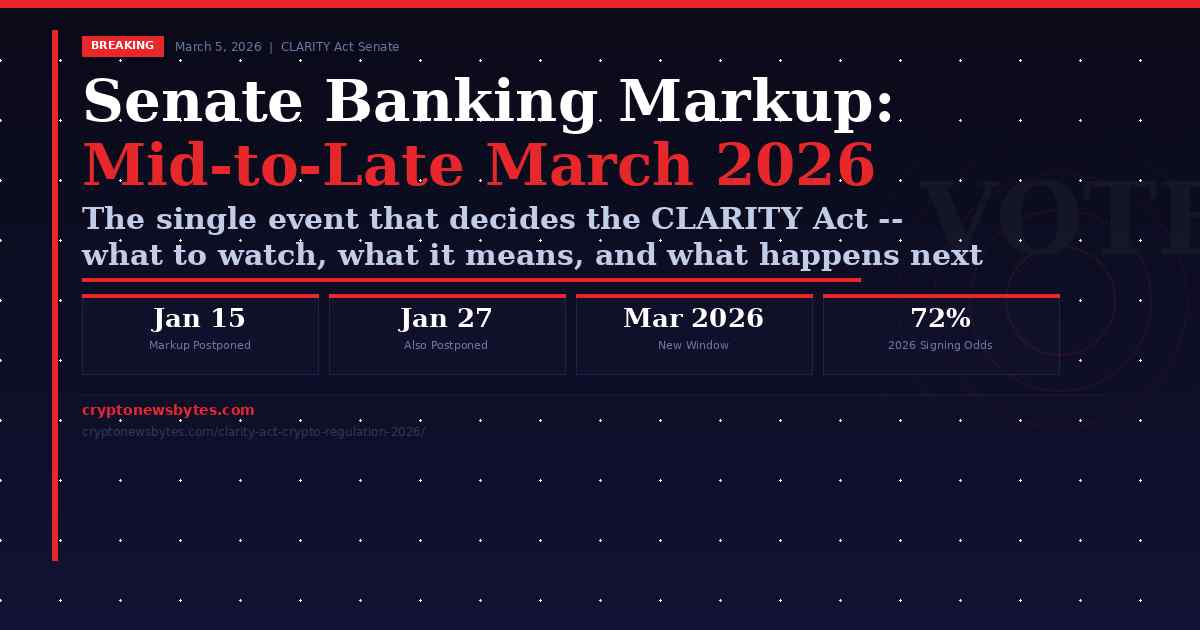
- The Senate Banking Committee markup — the single procedural vote that determines whether the CLARITY Act advances to the full Senate — is now eyed for mid-to-late March 2026, according to a White House reporter as of March 2.
- The markup has already been postponed twice: January 15 was cancelled after Coinbase withdrew support, and January 27 was also delayed.
- The Senate Agriculture Committee advanced its portion of the bill on January 29, 2026 — the CFTC-related framework is ready. Only the Banking Committee’s markup is outstanding.
- Three unresolved issues are blocking the markup: stablecoin yield, developer protections, and ethics provisions targeting Trump family crypto conflicts of interest.
- Senate Banking Chair Tim Scott says both parties “remain at the table working in good faith” but has given no confirmed date.
- Prediction markets price 2026 CLARITY Act signing at 72% — but the window is narrowing fast. Summer recess and the 2026 midterm campaign season are approaching.
Of all the events that could determine whether the CLARITY Act becomes law in 2026, one matters more than any Trump Truth Social post, any Dimon CNBC interview, or any Polymarket prediction: the Senate Banking Committee markup. Until Senate Banking Chair Tim Scott schedules and holds that vote — advancing the committee’s version of the bill — the CLARITY Act cannot reach the full Senate floor. And until it reaches the floor, it cannot become law.
The markup has now been postponed twice. A White House reporter said on March 2 that the bill’s final text is “very close” to moving forward, with mid-to-late March now the target window. This is what the markup is, why it keeps getting delayed, what needs to happen before it can be scheduled, and exactly what to watch for in the coming weeks.
What Is a Senate Committee Markup?
A markup is the formal process by which a Senate committee considers, amends, and votes on a bill before sending it to the full Senate floor. It is called a “markup” because members literally mark up the legislative text with amendments during the session. For the CLARITY Act, the Senate Banking Committee markup involves:
- Senators proposing and debating amendments to the Banking Committee’s draft text
- A committee vote on whether to advance the bill — requiring a simple majority
- If advanced: the Banking Committee’s draft must then be reconciled with the Senate Agriculture Committee’s draft (which passed January 29)
- The merged Senate bill must then be reconciled with the House-passed CLARITY Act (H.R. 3633, passed 294–134 in July 2025)
- Only then can the merged bill go to a full Senate floor vote
The Full Timeline: Every Postponement and What Caused It
- July 17, 2025House passes CLARITY Act 294–134 — bipartisan vote sends H.R. 3633 to the Senate with strong momentum.
- Nov 2025Senate Banking Committee releases discussion draft — a 32-page initial framework building on the House bill. Industry begins reviewing.
- Jan 12, 2026Senate Banking releases full amendment text — includes 137 proposed modifications, many from the banking lobby. Stablecoin yield ban extended to service providers.
- Jan 14, 2026Coinbase CEO Brian Armstrong withdraws support — citing the passive yield ban and developer protection gaps. Senator Tim Scott postpones the January 15 markup indefinitely.
- Jan 21, 2026Senate Agriculture Committee releases updated text — focusing on CFTC-related digital commodity intermediaries.
- Jan 29, 2026Senate Agriculture Committee advances its bill 12–11 — along party lines. CFTC portion is ready. Banking Committee portion is still stalled.
- Feb 2026White House sets March 1 deadline for banks and crypto firms to resolve stablecoin yield dispute. Negotiations continue behind closed doors.
- Mar 1, 2026White House deadline lapses without a deal — no public agreement on stablecoin yield. Negotiations described as ongoing.
- Mar 2, 2026White House reporter: final text “very close” — Senate Banking Committee eyeing mid-to-late March markup window.
- Mar 3, 2026Trump posts on Truth Social — publicly demands Congress pass the CLARITY Act, calls out banks for 137 amendments. Eric Trump follows with “mass panic” post on X.
- Mid-Late Mar 2026Target markup window — unconfirmed. Watch the Senate Banking Committee’s public calendar for a formal scheduling announcement.
The Three Unresolved Issues Blocking the Markup
1. Stablecoin Yield
The most public dispute. Banks want a hard ban on yield paid on idle stablecoin balances. Coinbase wants to keep paying 3.5% on USDC. The January draft extended the GENIUS Act yield ban to service providers — that provision triggered Coinbase’s withdrawal. The most likely compromise: transaction-based rewards permitted, yield on idle balances addressed via separate rulemaking with rate parameters to be set later. For a full breakdown of this dispute, see our Dimon analysis piece.
2. Developer Protections
Charles Hoskinson’s central objection — and one that Senate Democrats have also raised. The current draft does not clearly protect software developers who deploy but do not control protocols. The separately introduced Promoting Innovation in Blockchain Development Act of 2026 attempts to address this, but the question is whether its protections will be incorporated into the CLARITY Act text before the markup or handled separately.
3. Ethics Provisions
Senate Democrats are pushing for provisions that would bar senior government officials — including the President — from issuing or profiting from digital assets while in office. The demand is a direct response to the Trump family’s involvement in World Liberty Financial and its USD1 stablecoin. Republicans have resisted, arguing these provisions are outside the Banking Committee’s jurisdiction. This is the least technical but most politically charged of the three sticking points.
Three Signals to Watch Right Now
Industry participants and political analysts have identified three concrete events that would signal the markup is actually imminent — rather than just hoped for.
- The Senate Banking Committee’s markup appears on its public calendar — this is the most definitive signal. No calendar listing = no imminent vote.
- Updated draft language circulates publicly — specifically language that resolves the stablecoin yield treatment. If a revised draft emerges that Coinbase does not immediately reject, the markup can proceed.
- The White House issues a public statement supporting the compromise text — Trump’s Truth Social posts are pressure tactics; a formal White House endorsement of specific compromise language would be the clearest signal that a deal has been struck.