
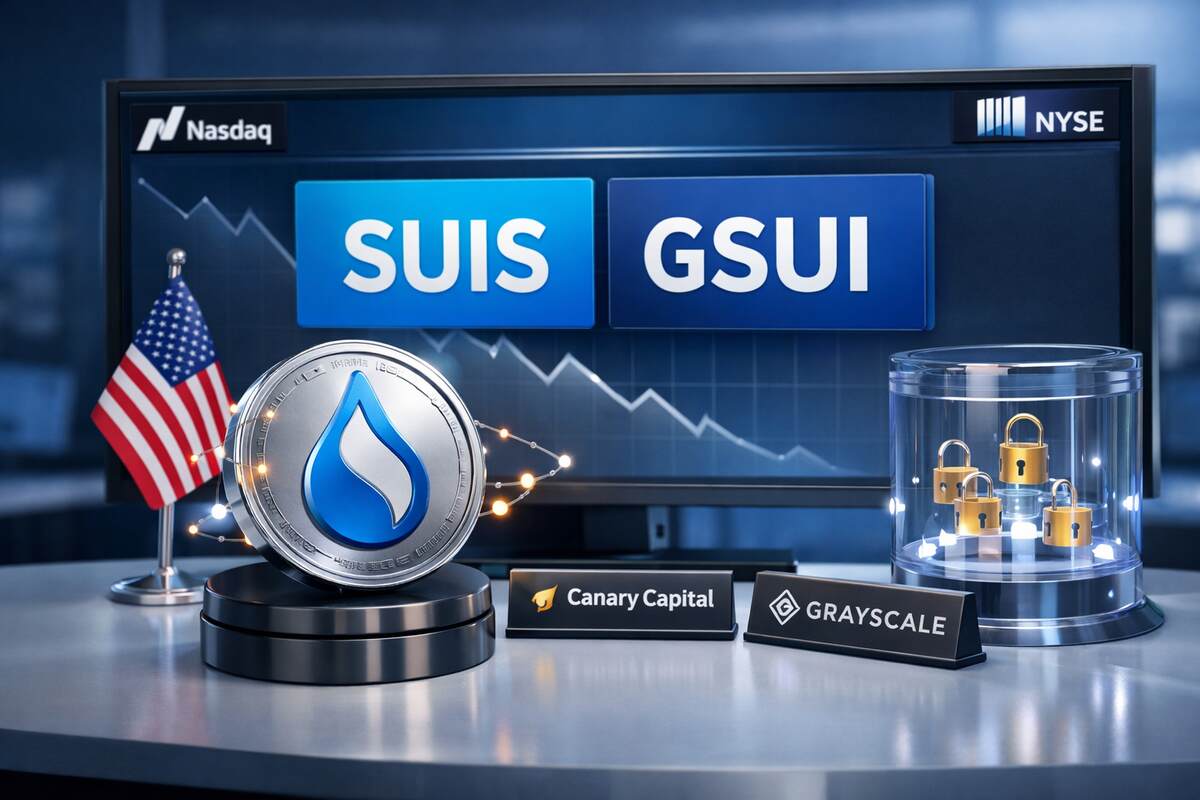
- Canary Capital and Grayscale have launched the first SUI ETFs on major US exchanges, both designed to include staking exposure for investors.
- The SUI token has dropped to $0.95 and is down nearly 40% over 30 days, while the network recently faced its second major outage since 2023.
The first exchange-traded funds tied to SUI have begun trading in the United States, marking a new stage of institutional access for the layer-1 blockchain. Fund managers Canary Capital and Grayscale have each brought products to market that track the network’s native token, offering both price and staking exposure amid a period of volatility for the broader digital asset sector.
New ETFs bring regulated access to SUI
Two products now provide listed exposure to SUI on major U.S. exchanges. Canary Capital’s vehicle, the Canary Stake SUI ETF, has started trading on the Nasdaq, where it appears under the ticker SUIS. Grayscale, a long-time crypto asset manager, has converted its existing Grayscale SUI Trust into a spot ETF. That fund now trades on the New York Stock Exchange with the ticker GSUI.
Grayscale described GSUI as an exchange-traded product structured to give investors access to both the token and its staking activity. Krista Lynch, Senior Vice President for ETF Capital Markets at the firm, said in a press release that the product is intended to offer a straightforward route to participate in a network positioned for scalable, real-world applications and what the company views as the next generation of digital experiences.
Canary’s fund is also built around the staking component of SUI . Chief Executive Officer Steven McClurg said the ETF is designed so that investors can receive net staking rewards generated through the blockchain’s proof-of-stake mechanism. That construction makes both SUIS and GSUI part of a growing group of listed products that aim to mirror not only token price performance but also yield from network participation.
The path to listing was lengthy for Canary. The firm had been working toward a SUI ETF launch for much of the past year. In March 2025, Cboe, which owns the Chicago Board Options Exchange, submitted documentation to the U.S. Securities and Exchange Commission intended to advance the approval process. At that time, the SUI token was trading at $1.98, a level that contrasts sharply with more recent pricing.
Sui’s technology and token economics
Sui went live in 2023 as a layer-1 blockchain positioned as a competitor to Solana. The project drew attention for its underlying technology stack, which uses Move, a programming language derived from Rust. The design aims to support high transaction throughput, near-instant processing, and scalability suitable for complex on-chain applications.
The network relies on a delegated proof-of-stake consensus model. Under this arrangement, token holders can delegate their SUI to validators, who then participate in block production and earn staking rewards. Both the Canary and Grayscale ETFs are built to reflect that staking dimension, seeking to pass a portion of those rewards to fund investors after fees and costs.
From a supply perspective, the blockchain has a fixed upper limit of 10 billion SUI tokens. That cap defines the maximum number of tokens that can exist on the network. While the exact distribution schedule and circulating supply at any given time are not detailed here, the total cap is a central feature of the asset’s tokenomics and could influence how market participants evaluate scarcity and long-term valuations.
Market performance and recent challenges for SUI
The launch of the new ETFs comes at a time when SUI has been under pressure along with the rest of the digital asset market. According to data from crypto price aggregator CoinGecko, the token is currently trading at $0.95. That price reflects a decline of nearly 1% over the past 24 hours and represents a substantial drop from the $1.98 level recorded in March 2025, when Cboe filed paperwork on behalf of Canary with the SEC.
Over the last 30 days, SUI has fallen by nearly 40%, underscoring the magnitude of the drawdown. This move has occurred against a backdrop of weakness across crypto assets more generally, with global market capitalization slipping to $2.4 trillion. The new ETFs are therefore debuting in an environment where investors are reassessing risk exposure to layer-1 networks, including those billed as high-performance alternatives to incumbent chains.
Operational reliability has also been in focus. The SUI network suffered an outage last month that lasted almost six hours, marking its second significant downtime event since its launch in 2023. Episodes of this kind are closely watched by users and institutional allocators, as they can influence perceptions of technical robustness and suitability for high-throughput or mission-critical applications. For a blockchain promoted on speed and scalability, repeated interruptions may shape how potential ETF investors evaluate both the technology and the sustainability of staking yields embedded in products like SUIS and GSUI.
Conclusion
The debut of spot ETFs tied to SUI on Nasdaq and the New York Stock Exchange gives both retail and institutional investors new regulated avenues to gain exposure to the 2023-era layer-1 network. Canary Capital’s SUIS and Grayscale’s GSUI each integrate staking into their structures, aiming to reflect not only price changes but also rewards from the delegated proof-of-stake system that underpins the chain. These launches coincide with a sharp price decline for the token, a broader market downturn, and a recent six-hour network outage, factors that together frame the risk landscape for those considering sui-focused exchange-traded products.
Disclaimer
The information provided in this article is for informational purposes only and should not be considered financial advice. The article does not offer sufficient information to make investment decisions, nor does it constitute an offer, recommendation, or solicitation to buy or sell any financial instrument. The content is opinion of the author and does not reflect any view or suggestion or any kind of advise from CryptoNewsBytes.com. The author declares he does not hold any of the above mentioned tokens or received any incentive from any company.
Featured image created by AI