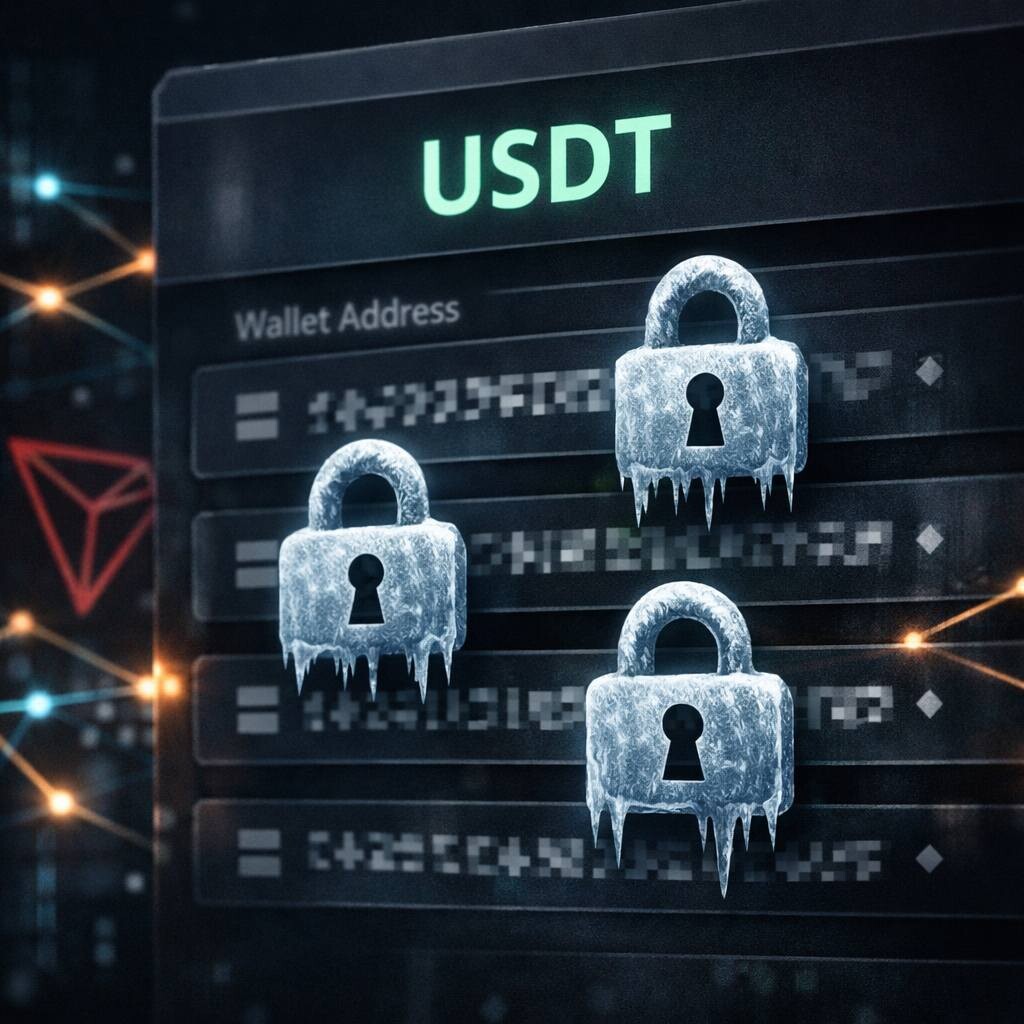
- Tether froze $182 million in USDT across five Tron wallets on Jan 11 after a law enforcement request, extending a policy since Dec 2023 with about $3.3 billion frozen between 2023 and 2025.
- Actions reflect USDT use in Venezuela and Iran under sanctions and weak currencies, with coordination from 310 agencies in 62 locations and a stablecoin market near $307.8 billion with USDT at 60.7%.
Tether continues to play a central role in the global stablecoin market while facing rising pressure from regulators and law enforcement. Since late 2023, the company has run a formal wallet freezing policy that allows it to block or restrict addresses when authorities request action or when the firm considers it necessary under its terms of service. Between 2023 and 2025, this approach led to the freezing of roughly $3.3 billion in USDT across thousands of wallet addresses, showing how often the token now appears in investigations linked to sanctions, fraud, or other financial crime.
Tether wallet freezes and the January 2025 Tron blacklist
One of the most notable recent actions came on Jan. 11, when Tether froze more than $182 million worth of USDT on the Tron blockchain. On-chain data and monitoring tools such as Whale Alert showed that the company blacklisted five Tron addresses on the same day in a coordinated move. Each wallet held balances ranging from about $12 million to around $50 million, which made this one of the largest synchronized blacklist events on Tron in recent months. Rather than a gradual series of freezes, this step showed a single, focused action across several large holders.
A spokesperson for Tether said the asset freeze followed a formal request from law enforcement tied to an ongoing investigation that had been active for months. According to the company, agencies provided information about the target wallets and asked for support to prevent further movement of the funds. Tether stated that it continues to cooperate with global authorities when they present adequate legal grounds to act and that it will block illicit or sanctions linked addresses when rules or court orders require that response. The firm also notes in its terms of service that it may freeze assets or share user information if it receives a lawful request or if it considers such steps reasonable and necessary to protect its business or comply with regulations. This wallet freezing policy gained a formal structure in December 2023, when Tether adopted a voluntary framework to align with demands from the Office of Foreign Assets Control of the U.S. Treasury and similar sanctions authorities. Since then, the company has positioned itself as one of the most active stablecoin issuers in the area of enforcement support. Internal reports and data from blockchain analytics firm AMLBot indicate that since 2023, Tether has obtained technical capacity and legal authority to block well over 3 billion USDT, working with more than 310 law enforcement agencies in 62 jurisdictions. AMLBot estimates that around $3.3 billion in funds were blacklisted between 2023 and late 2025, with about $1.75 billion of that amount linked to Tron based USDT alone, which underlines the importance of that network for USDT activity.
Tether enforcement actions and sanctions pressure in Venezuela and Iran
The growing list of wallet freezes reflects the way stablecoins now function inside economies under sanctions and long term economic stress. In Venezuela, years of bolivar depreciation and a weak banking system have pushed households, merchants, and small exporters to rely heavily on USDT as an alternative settlement and savings tool. People use the token for everyday purchases, basic services, local trade, and cross border payments, because it holds value better than the local currency and can move quickly through digital channels without depending on domestic banks. Reports and investigations have also linked Venezuela’s state owned oil company to the use of USDT in some cross border deals. By settling trades in stablecoins, some counterparties tried to avoid direct exposure to traditional banking rails, which sit under close sanctions monitoring. These patterns drew attention from U.S. authorities and triggered coordinated wallet blacklisting efforts involving Tether and enforcement agencies. When investigators identified specific addresses tied to sanction evasion attempts, Tether used its control over the token’s smart contracts to block transfers or freeze balances, limiting further use of those wallets even when they sat on public blockchains like Tron. Iran has shown similar trends, though driven by its own political and economic context. The country has faced prolonged rial weakness, recurring protests, and tight external sanctions. Under these conditions, Tron based USDT emerged as one of the most widely used digital assets among local users seeking stability and permissionless payment options. People used it to protect savings, support remittances, and move value across borders without relying on fragile local banks. At the same time, blockchain analysts traced some flows from entities linked to Iran’s Revolutionary Guard and other sanctioned groups, which used stablecoins to move funds around controls or to settle certain international transactions. These findings led regulators to view USDT both as a helpful hedge for civilians and as a channel that can support sanctions evasion. As a result, enforcement actions did not slow as adoption grew. Instead, freezes and blacklist events increased as Tether received more formal requests based on stronger blockchain analytics. For regulators, targeted freezes looked like a way to address specific wallets rather than push broad bans that could harm ordinary users. Tether’s ability to lock individual addresses gave authorities a tool that fits within the existing sanctions framework, while the open ledger nature of the blockchains involved allowed investigators to track flows in more detail than in many traditional systems.
Blockchain analytics, Tether and the shift to targeted enforcement
The rise in wallet freezes sits on top of advances in blockchain analytics that give agencies and private firms deeper insight into stablecoin movements. Companies such as AMLBot and other analytics providers cluster addresses, tag known entities, and identify patterns that suggest mixing, layering, or other forms of obfuscation. With these tools, investigators can follow USDT transfers across networks like Tron and Ethereum, link suspicious flows to exchanges or service providers, and build cases that support formal freeze requests. This process has helped authorities distinguish between normal user activity and transactions connected to sanctions violations, fraud rings, or other illicit conduct. Despite repeated attempts by some actors to evade controls by hopping between wallets, using mixers, or switching chains, freezes have become more common rather than less. Regulators see that once they identify a suspect cluster of addresses, they can work with Tether to restrict those wallets even if the underlying chain remains permissionless. Instead of viewing evasion as proof that controls fail, agencies now treat it as a sign that they must adapt methods, invest in better data, and expand information sharing. Tether’s policy of cooperating with more than 310 agencies worldwide fits into this broader shift toward coordinated monitoring and response.
The scale of the stablecoin market gives these steps wider importance. Recent estimates place the global stablecoin market at about $307.8 billion, with USDT alone representing roughly 60.7% of that total.
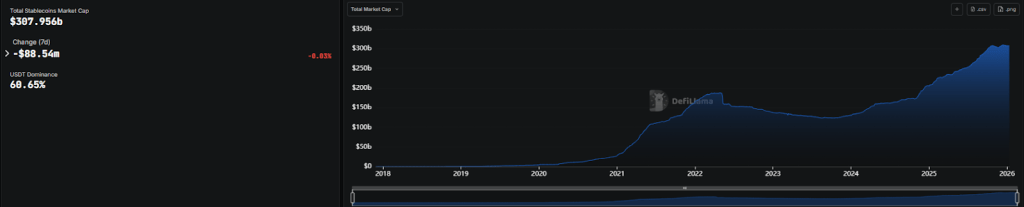
When regulators or Tether freeze hundreds of millions of dollars in USDT on networks like Tron, the impact extends well beyond a single jurisdiction. Exchanges, over the counter desks, and local payment providers feel the effect, since they must track which addresses sit on blacklist lists and adjust their own compliance rules. For users in high risk regions, growing enforcement may lead to more cautious behavior, more use of peer to peer transfers, and increased demand for compliant on and off ramps that can handle sanctions rules. Many regulators in the U.S., the European Union, and other major markets spent much of the early 2020s drafting new rules for crypto assets, including stablecoins. As those frameworks move from design to enforcement, officials are turning more often to tools such as wallet freezes, blacklists, and mandatory reporting. Tether’s own policy anticipates this shift by giving the company a clear mechanism to act when it receives legal orders. The trend points to a 2026 environment in which freezes of crypto assets, including USDT, may rise further as agencies test their new powers and analytics, while stablecoin issuers continue to balance user access with sanctions compliance.
Conclusion
Tether now stands at the center of a complex mix of market growth, user demand, and regulatory pressure. Since late 2023, its formal wallet freezing framework has supported law enforcement by blocking around $3.3 billion in USDT across thousands of addresses, including a high profile Jan. 11 action that froze more than $182 million on Tron over five wallets. These measures reflect the wider role of USDT in countries such as Venezuela and Iran, where people use stablecoins to escape inflation and banking stress, while some sanctioned entities try to exploit the same tools to bypass controls. With blockchain analytics improving and more than 310 agencies already working with the issuer, targeted freezes now serve as a preferred method to enforce sanctions without fully cutting off stablecoin access. As the global stablecoin market holds about $307.8 billion in value and USDT accounts for nearly two thirds of that, the way Tether manages wallet blacklists and responds to regulators will remain a key factor shaping enforcement and user behavior through 2025 and into 2026.
Disclaimer
The information provided in this article is for informational purposes only and should not be considered financial advice. The article does not offer sufficient information to make investment decisions, nor does it constitute an offer, recommendation, or solicitation to buy or sell any financial instrument. The content is opinion of the author and does not reflect any view or suggestion or any kind of advise from CryptoNewsBytes.com. The author declares he does not hold any of the above mentioned tokens or received any incentive from any company.
Featured image created by AI