⚡ Key Facts
- Eric Trump posted on X the same day, calling banks “the greatest hypocrites” in “mass panic” over losing the digital finance race — and tagging World Liberty Financial.
- Democrats have flagged a direct conflict of interest: the Trump family’s World Liberty Financial operates its own stablecoin (USD1) and stands to benefit if stablecoin yield restrictions are removed.
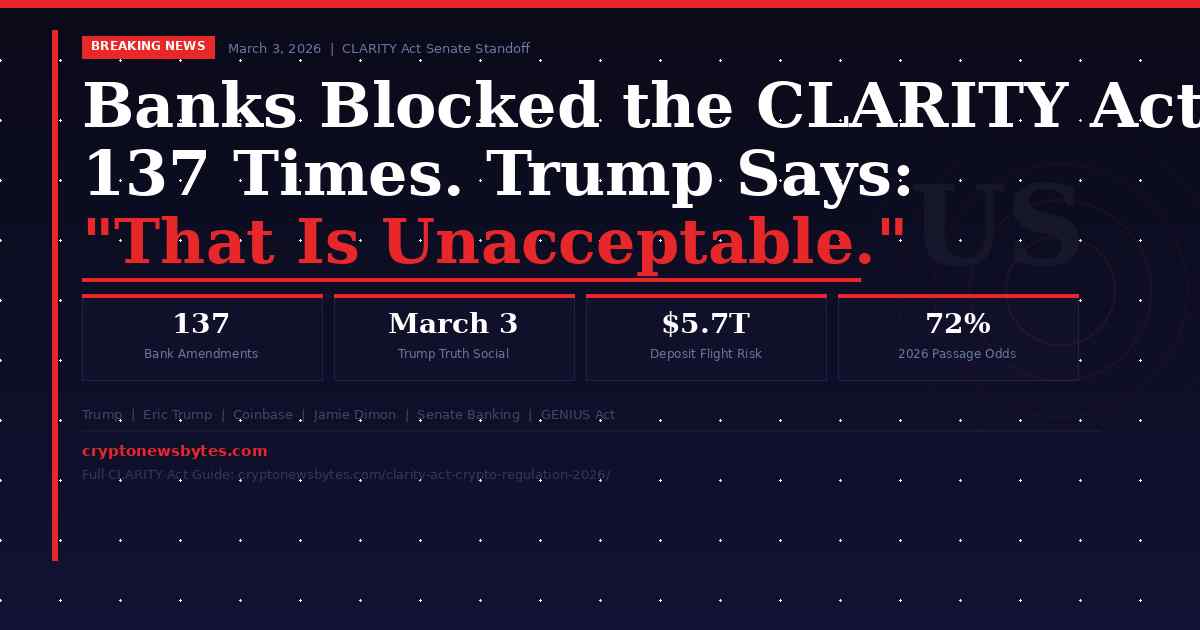
- President Trump posted on Truth Social on March 3, 2026 demanding Congress pass the CLARITY Act immediately, accusing banks of holding the bill “hostage.”
- The White House’s March 1 deadline for banks and crypto firms to resolve the stablecoin yield dispute expired without a public agreement.
- Trump met privately with Coinbase CEO Brian Armstrong at the White House shortly before making the post — a meeting first reported by Politico.
- JPMorgan Chase CEO Jamie Dimon fired back the same day, arguing that stablecoin yield providers are functionally operating as banks and should be regulated as such.
- The Senate Banking Committee markup has no confirmed date. The window is narrowing fast — summer recess and the 2026 election cycle are both approaching.
- Banks warn that unrestricted stablecoin yield could trigger up to $5.7 trillion in deposit flight from traditional accounts.
- Senator Cynthia Lummis reposted Trump’s message, adding: “America can’t afford to wait. Congress must move quickly.”
President Donald Trump escalated his public pressure campaign on U.S. crypto legislation on March 3, 2026, taking to Truth Social to accuse major banks of sabotaging the CLARITY Act — the crypto market structure bill that passed the House in July 2025 with a 294–134 bipartisan vote but has since stalled in the Senate. Hours later, his son Eric Trump followed up on X, calling banks “the greatest hypocrites” and accusing them of being in “mass panic” over losing the digital finance race to crypto. The coordinated posts landed on the same day Trump met privately with Coinbase CEO Brian Armstrong at the White House, just days after the administration’s own March 1 deadline for resolving the stablecoin yield dispute expired without a deal.
The development marks the most direct presidential intervention in the CLARITY Act’s Senate progress to date — and puts fresh pressure on the Senate Banking Committee, which has yet to schedule a markup as of this writing.
“The Banks should not be trying to undercut The Genius Act, or hold The Clarity Act hostage. They need to make a good deal with the Crypto Industry because that’s what’s in best interest of the American People. The U.S. needs to get Market Structure done, ASAP. Americans should earn more money on their money.”
— President Donald J. Trump, Truth Social, March 3, 2026Trump warned that continued delays risk pushing crypto innovation — and the industry itself — to rival nations. “The Banks are hitting record profits, and we are not going to allow them to undermine our powerful Crypto Agenda that will end up going to China, and other Countries if we don’t get The Clarity Act taken care of,” the post continued.
What Triggered the Post: The Stablecoin Yield Standoff
The immediate catalyst is a dispute that has dogged the CLARITY Act’s Senate progress for months: whether crypto platforms should be permitted to offer yield or interest on stablecoin balances. The Senate Banking Committee’s January 2026 draft proposed extending the GENIUS Act’s issuer-level yield ban to digital asset service providers — a provision that would force platforms like Coinbase to discontinue yield products on USDC.
Banks have lobbied hard for this ban, and their reasoning is straightforward: if users can earn competitive yield on stablecoins held at a crypto exchange, the incentive to keep money in low-interest traditional bank accounts evaporates. Analysts have projected that unrestricted stablecoin yield products could trigger as much as $5.7 trillion in deposit flight from conventional banking — a scenario community banks in particular describe as existential.
Coinbase, which publicly withdrew support from the CLARITY Act in January over the yield provision, has argued that its USDC rewards product — currently paying approximately 3.5% — does not constitute a deposit and should not be regulated as one. Armstrong’s White House meeting, which took place shortly before Trump’s Truth Social post, suggests the administration has heard that argument and is now applying public pressure to break the impasse.
Jamie Dimon Pushes Back — The Same Day
The banks were not silent. JPMorgan Chase CEO Jamie Dimon pushed back on the same day Trump posted, speaking on CNBC and drawing a firm line on the yield question. Dimon argued that firms offering yield on stablecoin balances are functionally operating as banks — taking deposits and paying interest — without meeting the capital adequacy requirements, FDIC insurance obligations, anti-money-laundering rules, or community lending mandates that traditional banks must satisfy.
Dimon suggested a potential compromise: platforms could offer rewards tied to transactions rather than idle balances, but drew a clear line at interest-like payments on holdings. The comments framed the banking industry’s position not as obstruction but as a demand for regulatory equivalence — a message clearly aimed at the Senate Banking Committee members who will ultimately decide the yield provision’s fate.
Eric Trump Piles On: Banks Are “The Greatest Hypocrites”
President Trump was not alone. His son Eric Trump — co-founder and Chief Strategy Officer of American Bitcoin Corp. and a key figure in the family’s World Liberty Financial crypto venture — posted on X on the same day, going further than his father in his characterisation of the banking industry’s motives.
The 'Big Banks' — the very institutions that have held a monopoly and screwed their customers for years, offering near-zero yields on retail Money Market Accounts while crushing low-balance accounts with exorbitant fees — are now doing everything they can to block the Crypto industry from offering real benefits, perks, and rewards on their platforms. They are the greatest hypocrites and are in mass panic given they know they are losing the digital finance race!
— Eric Trump (@EricTrump) March 3, 2026
Eric Trump’s post put the banking lobby’s motivations in blunt terms: traditional financial institutions that have profited for years from near-zero yields on retail savings accounts and high fees on low-balance customers are now trying to block crypto companies from offering the very consumer benefits — rewards, yield, and competitive returns — that banks themselves have withheld. His tagging of World Liberty Financial in the post underscored the Trump family’s direct commercial stake in the outcome of the stablecoin yield debate.
The coordinated nature of the Trump family’s public pressure — father and son posting on the same day, covering the same dispute from different angles — signals that the White House views the stablecoin yield question not just as a legislative technicality but as a political fight worth winning publicly. Democrats were quick to highlight the conflict of interest: the Trump family’s World Liberty Financial operates its own stablecoin (USD1) and stands to benefit directly if stablecoin yield restrictions are softened or removed from the CLARITY Act’s final text.
The structural challenge facing the CLARITY Act in the Senate has not changed — but the clock is ticking faster. The Senate Banking Committee and Senate Agriculture Committee must each advance their own drafts before a merged Senate bill can go to a full floor vote. The Agriculture Committee advanced its version in late January 2026. The Banking Committee markup remains unscheduled.
The legislative calendar is becoming a real constraint. Congress takes a summer recess, and the 2026 midterm election cycle is already beginning to consume Senate attention. Industry sources are now pointing to a mid-to-late March markup window as the Senate Banking Committee’s next realistic opportunity — but that window requires the yield dispute to be resolved, or at minimum bracketed, before a markup can proceed.
Adding complexity: Senate Democrats have continued to push for ethics provisions that would bar government officials from profiting off crypto holdings — a demand directly aimed at the Trump family’s involvement in World Liberty Financial, which operates its own stablecoin, USD1, and is pursuing an OCC trust charter for an affiliated firm. Republicans have resisted these provisions, calling them outside the Agriculture Committee’s jurisdiction and politically motivated.
What This Means for Crypto Companies
For exchanges, brokers, custodians, and token issuers waiting for the CLARITY Act’s registration frameworks to take effect, Trump’s intervention is a meaningful signal — but not a resolution. The bill’s core architecture (CFTC jurisdiction over digital commodities, new DCE/DCB/DCD registration categories, DeFi safe harbor) is not in dispute. What is in dispute is the stablecoin yield provision, the ethics clauses, and the precise jurisdictional boundary between the two Senate committee drafts.
The practical advice remains the same: begin compliance planning now based on the House-passed framework, monitor the Senate Banking Committee markup date as the single most important near-term event, and do not let CLARITY Act uncertainty delay MiCA compliance for firms serving EU customers — that July 1, 2026 deadline is fixed regardless of what happens in Washington.
For a complete breakdown of what the CLARITY Act does, who it affects, and what your company should do to prepare, see our CLARITY Act 2026 Complete Guide.