- Uniswap governance proposes a tier-based fee switch model across multiple chains, making protocol fee capture automatic for new v3 pools and potentially increasing annualized revenue beyond current UNI burns
- UNI rises roughly 15% as the market reacts to expected revenue gains, while concerns remain about how higher protocol fees may affect liquidity and competitiveness on layer-2 networks
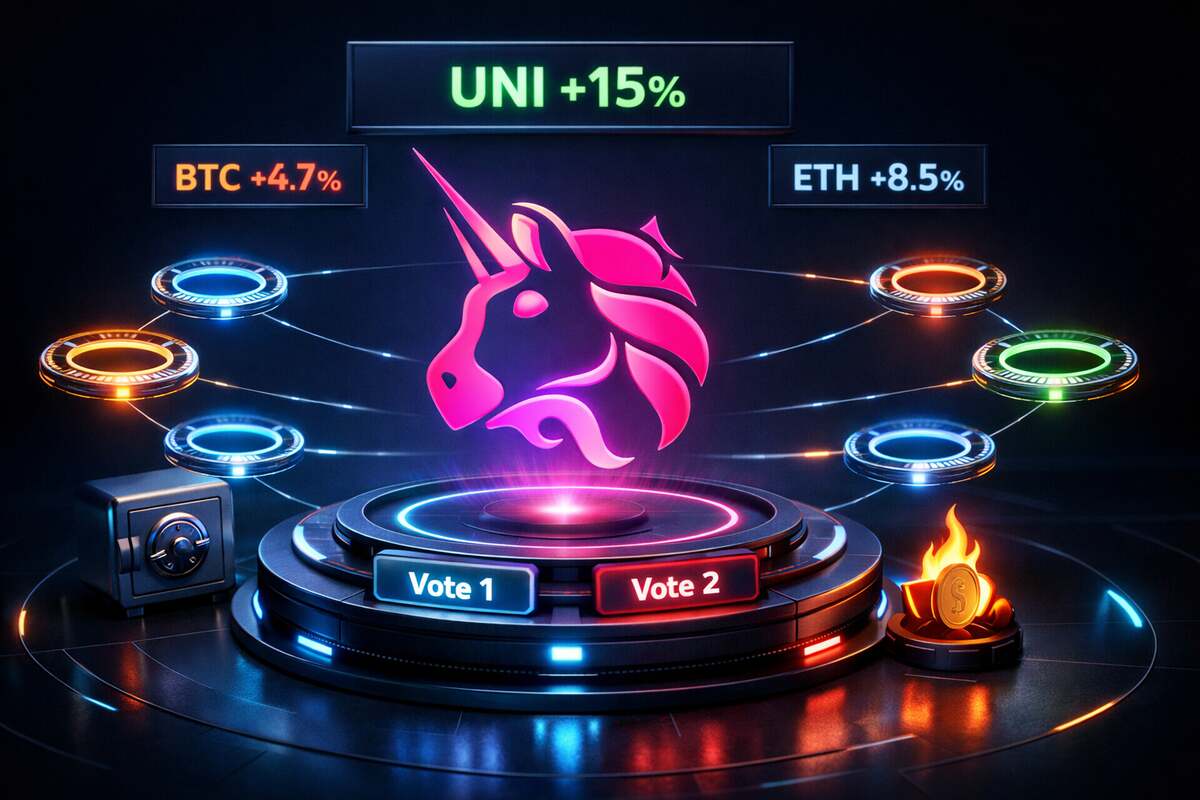
Uniswap governance process has drawn renewed attention after a key proposal triggered a sharp move in its native token. UNI gained roughly 15% over the past 24 hours, outpacing bitcoin’s 4.7% rise and ether’s 8.5% increase, as traders assessed the implications of a planned overhaul of the protocol’s fee structure across multiple chains. The governance initiative centers on expanding protocol-level fee collection and further aligning UNI’s value with trading activity across an expanding layer-2 footprint.
Governance vote targets broader cross-chain fee capture
The proposal under consideration would significantly widen the scope of Uniswap’s so-called fee switch. At present, protocol fees are enabled on a pool-by-pool basis, requiring individual governance actions for each liquidity pool. The new plan would replace that process with a tier-based v3 framework that automatically applies protocol fees across all v3 pools according to their fee tier.
Practically, this involves turning on protocol fees across eight additional blockchains, moving beyond a narrow set of pools on Ethereum. To accomplish this within onchain transaction limits, the governance initiative has been divided into two separate votes. Together, they are designed to ensure protocol fee collection is no longer dependent on a series of isolated governance decisions, but instead operates as a default feature for v3 liquidity.
A central component of the proposal is the introduction of a v3OpenFeeAdapter. This new mechanism would apply protocol fees uniformly across liquidity pools based on their fee tier, simplifying implementation and standardizing conditions across trading pairs. As a result, all new v3 pools launched after activation would have protocol fees enabled automatically, eliminating the need for manual configuration. That shift is particularly relevant for long-tail pairs, where governance attention and intervention have historically been limited but cumulative trading activity can still be meaningful.
How the fee switch reshapes UNI economics
The fee switch redirects a portion of trading fees away from liquidity providers and into the protocol treasury. That captured revenue is then allocated to UNI token buybacks, token burns and treasury reserves, creating a more direct link between trading volumes and UNI’s market performance. Since the first stage of the fee switch went live late last year, the protocol has already burned more than $5.5 million worth of UNI. At current trends, this pace suggests annualized burn-related revenue of around $34 million.
Analysts’ estimates indicate that the latest proposal could add approximately $27 million in yearly revenue to the existing stream. Combined with the roughly $34 million already being generated and directed toward UNI burns, total annualized revenue could reach about $61 million if current conditions hold. Market participants view this as one of the most consequential changes to Uniswap’s token economics since protocol fees were reintroduced late last year, strengthening the link between protocol usage and tokenholder benefit.
Recent data points to a broader shift in the protocol’s financial profile. After years of high trading volumes but little income for token holders, Uniswap has started to record measurable retained revenue. In Q1 2026, the protocol logged about $3.12 million in gross profit, according to DeFi Llama figures, compared with effectively zero in earlier periods. The ongoing fee switch rollout and the proposed expansion to additional networks suggest that this trend toward revenue retention is set to continue if the vote passes and trading activity remains robust.
Market reaction and competitive considerations for uniswap
The market response to the proposal has been swift. UNI’s roughly 15% advance over the past day came against the backdrop of a broader crypto rebound, with bitcoin up around 4–5% and ether gaining roughly 8% in the same window. The token’s outperformance reflects investors’ focus on the prospect of increased protocol revenue and more systematic UNI burns tied to cross-chain activity.
If approved, the vote would formally establish Uniswap as a cross-chain, revenue-generating protocol rather than a platform primarily focused on facilitating trading volume without sustained tokenholder income. Enhanced fee capture on layer-2 networks would mean that UNI burns and treasury growth are driven not only by Ethereum mainnet trading, but by aggregate volumes across an expanding set of chains.
However, the long-term outcome remains uncertain. The proposal raises questions about how higher protocol fees might affect liquidity competition on layer-2 platforms, which tend to be especially sensitive to trading costs. Market makers and active traders could respond to changes in effective fees by evaluating alternative venues that offer lower costs, especially for high-frequency or thin-margin strategies. Any significant migration of liquidity could, in turn, influence Uniswap’s trading volumes, fee generation and the sustainability of the projected revenue uplift.
At the same time, the move to automate fee activation for new v3 pools through the v3OpenFeeAdapter may broaden revenue collection across the platform’s long-tail markets. While individual pools for smaller or niche tokens may not generate large volumes on their own, collectively they can contribute meaningfully once protocol fees are enabled by default. That dynamic underpins expectations that the fee switch extension could materially enhance total fee capture without requiring ongoing governance micromanagement.
Conclusion
Uniswap’s latest governance initiative represents a pivotal stage in its transition from a volume-focused exchange protocol to a cross-chain platform with structured revenue for token holders. By extending the fee switch to eight more networks, standardizing fee activation through a tier-based v3 model, and automating protocol fee capture for new pools, the proposal aims to deepen the economic link between trading activity and UNI’s value.
The protocol has already begun to show the financial effects of this shift, including more than $5.5 million in UNI burned since late last year and an annualized revenue run rate of about $34 million. Projected incremental revenue of roughly $27 million underscores the scale of the potential change if the expanded fee framework goes live. UNI’s recent price performance reflects market anticipation of these developments, but the lasting impact will depend on how traders and liquidity providers respond to higher protocol fee capture across layer-2 networks and multiple chains.
Disclaimer
The information provided in this article is for informational purposes only and should not be considered financial advice. The article does not offer sufficient information to make investment decisions, nor does it constitute an offer, recommendation, or solicitation to buy or sell any financial instrument. The content is opinion of the author and does not reflect any view or suggestion or any kind of advise from CryptoNewsBytes.com. The author declares he does not hold any of the above mentioned tokens or received any incentive from any company.
Featured image created by AI