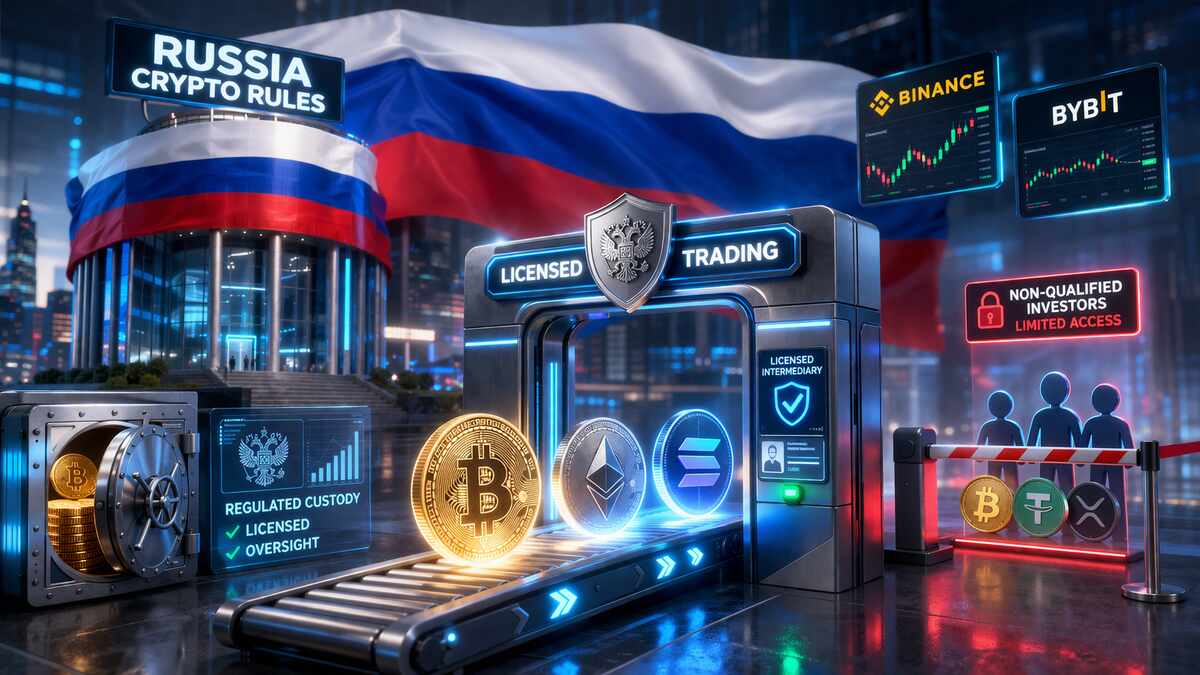
- Russia advances draft laws that route domestic crypto trades through licensed intermediaries and restrict non-qualified investor activity.
- Retail users face annual purchase caps and tests, while unlicensed crypto loans and many DeFi interactions risk falling into a legal grey zone.
Russia is moving to tightly regulate how digital assets are traded and held, advancing a package of draft laws that would reroute most domestic crypto activity through licensed intermediaries and sharply curb retail participation. The measures, announced by the Finance Ministry, aim to formalize the country’s crypto market while preserving limited access for non-professional investors and broader access for qualified players.
New licensing regime and centralized crypto market structure in Russia
The government-approved package covers digital currencies and digital rights, amends several existing laws, and updates the administrative offenses code. At its core, the framework creates a licensing system for businesses that handle crypto operations, including digital exchanges and custodial providers. Banks and brokers will be allowed to participate, but only if they meet specific prudential and regulatory standards, positioning traditional financial institutions as key gateways to digital asset markets.
Under the proposal, any crypto transaction carried out without a regulated intermediary would be banned inside the country. This would effectively outlaw peer-to-peer trading via unlicensed platforms and restrict domestic market access to entities operating under state oversight. The draft also introduces administrative liability for organizations engaged in exchange activity that fail to comply, signaling a clear move to clamp down on unlicensed intermediation and informal crypto infrastructure.
The rules stop short of a full prohibition on crypto. Residents will still be permitted to buy digital assets abroad using foreign accounts, as long as they report these transactions to tax authorities. This approach suggests authorities are attempting to domesticate and supervise crypto activity, rather than eliminate it entirely, by pushing local users toward a controlled, onshore market.
Retail investor restrictions and controlled access to digital assets
The regulatory package places strict limits on non-qualified investors. Retail users will only be allowed to purchase what the framework describes as the “most liquid digital currencies,” with the specific assets to be defined by the Bank of Russia. Before buying, retail participants must pass a test and can only acquire up to 300,000 rubles (about $3,700) worth of digital currency per year, and only through a single licensed intermediary.
This structure creates a tiered market. Qualified investors may access a wider range of digital assets and trading services, while retail users are confined to a narrow set of approved tokens and a low annual cap. The combination of testing, asset selection by the central bank, and per-investor limits indicates a risk-averse approach that prioritizes control and consumer protection over open market access.
The framework also reaches into decentralized finance. According to analysis of the draft law, activities such as issuing crypto loans without the involvement of a licensed intermediary would be prohibited. Interacting with decentralized exchanges could expose users to high legal and operational risks, since these platforms lack a centralized entity that can be licensed or supervised under the new rules.
Industry criticism and risks of an offshore, underground crypto shift
Industry participants warn that Russia’s move may undermine its own oversight goals by driving crypto activity away from compliant channels. Exved founder Sergey Mendeleev argued that, while many jurisdictions are opening up access to tokenized assets and modernizing capital markets, the new rules push digital currencies into a regime modeled on traditional securities, potentially stifling innovation.
He compared the likely outcome to the casino sector, where strict domestic controls failed to reduce activity but instead shifted it to online and underground venues beyond effective state control. A similar pattern in crypto could see Russian users rely more heavily on foreign platforms or unregulated services, weakening the impact of domestic licensing and reporting requirements.
BestChange chief analyst Nikita Zubarev stressed that the draft laws do not seek to outlaw crypto ownership itself. Instead, he said, they appear directed at dismantling the “accessible, transparent infrastructure for converting crypto to fiat,” which would further isolate the domestic financial system from global markets. The legal status of major international exchanges frequently used by Russian traders, such as Binance and Bybit, remains unclear under the proposed regime.
Zubarev warned that DeFi participants and active traders may be pushed into a legal grey area or forced to relocate their activity under foreign jurisdictions. Without clear legal pathways to use decentralized platforms or foreign exchanges from within the country, declaring income from such trading could become practically impossible for compliant users.
Key takeaways
- All domestic crypto transactions must go through licensed intermediaries.
- Retail investors face a 300,000-ruble annual cap and asset restrictions set by the Bank of Russia.
- Banks and brokers can offer crypto services if they meet prudential requirements.
- Unlicensed crypto loans and certain DeFi activities would be banned.
- Analysts warn the rules may push activity offshore and into unregulated channels.
Conclusion
Russia’s draft crypto framework marks a decisive shift toward a highly controlled digital asset market, centered on licensed intermediaries and strict retail limits. While the approach allows continued ownership and even cross-border acquisition of crypto, it narrows the legal routes for trading, lending, and converting assets to fiat within the country. Market participants now face the prospect of a more regulated but less open environment, with unresolved questions over the future of global exchanges, DeFi access, and the risk that a significant share of activity migrates beyond the reach of domestic supervision.
Disclaimer
The information provided in this article is for informational purposes only and should not be considered financial advice. The article does not offer sufficient information to make investment decisions, nor does it constitute an offer, recommendation, or solicitation to buy or sell any financial instrument. The content is opinion of the author and does not reflect any view or suggestion or any kind of advise from CryptoNewsBytes.com. The author declares he does not hold any of the above mentioned tokens or received any incentive from any company.
Featured image created by AI