
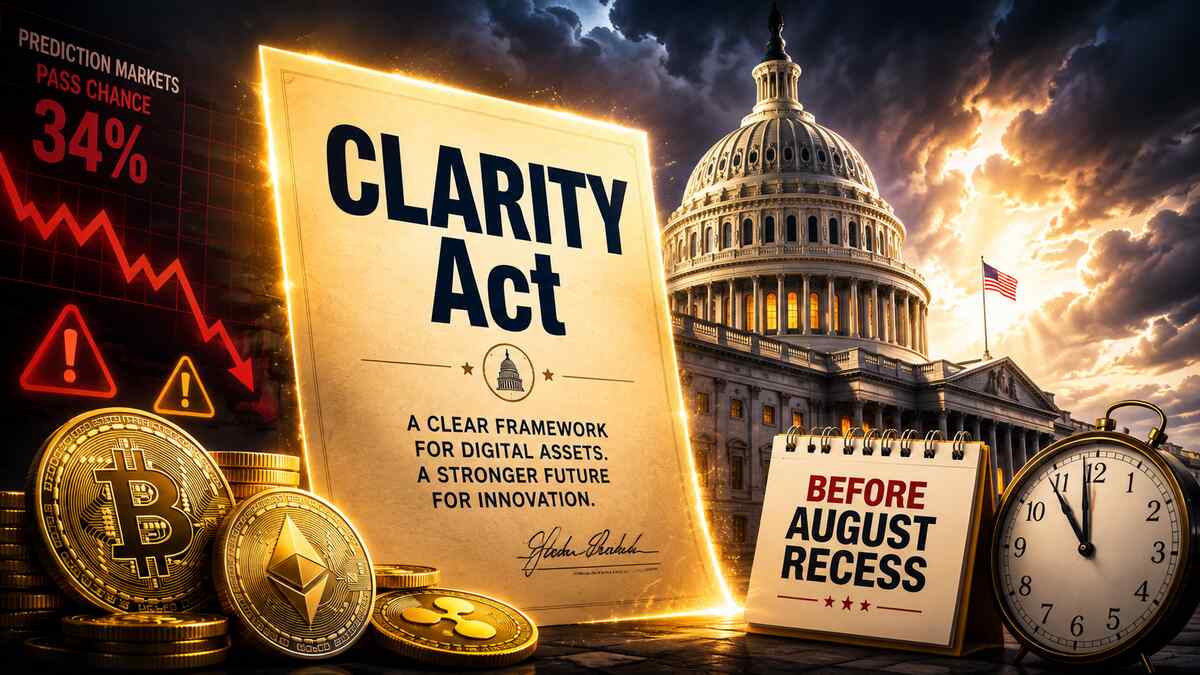
- Prediction market odds fell to about 31% to 35% from highs near 70%.
- Disagreements over ethics enforcement remain a central obstacle.
- Michael Saylor supports bipartisan efforts to advance the bill.
The CLARITY Act is entering another pivotal weekend in Washington as lawmakers continue negotiations over ethics provisions and race toward the Senate’s August recess. Supporters are watching a narrowing window after prediction markets sharply reduced the chances of the bill becoming law this year to about 31% to 35%, down from peaks near 70% earlier in 2026. The current debate centers on a White House counteroffer and an unresolved question over whether state attorneys general should retain a role in enforcing certain ethics rules involving federal officials. Industry support remains visible even as the bill’s legislative path becomes more difficult.
CLARITY Act odds fall as timing pressure builds
Prediction markets now give the CLARITY Act only about a 31% to 35% chance of becoming law this year. That is a steep decline from earlier highs near 70% and reflects growing uncertainty as negotiations continue without a clear breakthrough or an agreed path for resolving the remaining ethics provisions.
The legislative calendar is adding further pressure. With the Senate scheduled to begin its August recess next week, observers see only a limited opportunity to move the bill forward before lawmakers leave Washington. A delay beyond the break could weaken expectations further as attention begins shifting toward the midterm elections and other competing priorities.
Ethics talks shape the CLARITY Act debate
Journalist Eleanor Terrett said the weekend has become a high-stakes waiting period for supporters as the White House considers an ethics counteroffer involving the authority of a state attorney general. The proposal is connected to one of the most important unresolved issues still shaping the CLARITY Act negotiations.
The dispute focuses on whether state attorneys general should retain authority to enforce certain ethics provisions involving federal officials. Terrett also reported that some negotiators believe state attorneys general should be allowed to sue the Department of Justice if it does not enforce ethics laws against federal officials. Another concern is that the White House proposal would keep the provisions in force through January 2029 without clearly explaining what would happen afterward.
CLARITY Act negotiations continue across party lines
Bipartisan talks are still underway between Senator Thom Tillis of North Carolina and Arizona Democrat Ruben Gallego. Both reportedly believe the CLARITY Act needs a stronger ethics package than the version presented by the White House and two Senate Republicans at the end of July.
Terrett, citing three sources familiar with the matter, said the earlier offer did not gain approval from Tillis, Gallego, or other Democrats involved in the discussions. That leaves the bill caught in negotiations over one of its most sensitive components while the legislative calendar continues to tighten and the August recess approaches.
Industry support remains visible
Most major figures in the cryptocurrency industry have supported the legislation over the past year, and that backing has not disappeared as prediction market odds have fallen. The latest public endorsement came from Michael Saylor, who reiterated his support during the previous 24 hours while acknowledging that Bitcoin does not depend on the bill’s passage.
Saylor said Bitcoin will succeed with or without the legislation, but he argued that the United States still needs clearer rules for digital assets. He also supported bipartisan efforts to advance the bill, saying durable regulation could protect property rights, encourage innovation, and strengthen American capital markets.
Conclusion
The CLARITY Act now faces a crucial test as lawmakers try to resolve ethics disagreements before the Senate leaves for its August recess. Falling prediction market odds show that confidence in the bill’s path this year has weakened significantly as time runs short and negotiations remain unsettled. The unresolved role of state attorneys general, concerns about how long the ethics provisions would remain in effect, and the lack of agreement on the latest White House offer are still central to the debate. Even so, continued support from industry voices such as Michael Saylor shows the legislation remains an important part of crypto policy discussions in Washington.
Disclaimer
The information provided in this article is for informational purposes only and should not be considered financial advice. The article does not offer sufficient information to make investment decisions, nor does it constitute an offer, recommendation, or solicitation to buy or sell any financial instrument. The content is opinion of the author and does not reflect any view or suggestion or any kind of advise from CryptoNewsBytes.com. The author declares he does not hold any of the above mentioned tokens or received any incentive from any company.
Featured image created by AI