
📌 What You’ll Learn in This Article
- What World Liberty Financial (WLF) is and how it works as a DeFi protocol
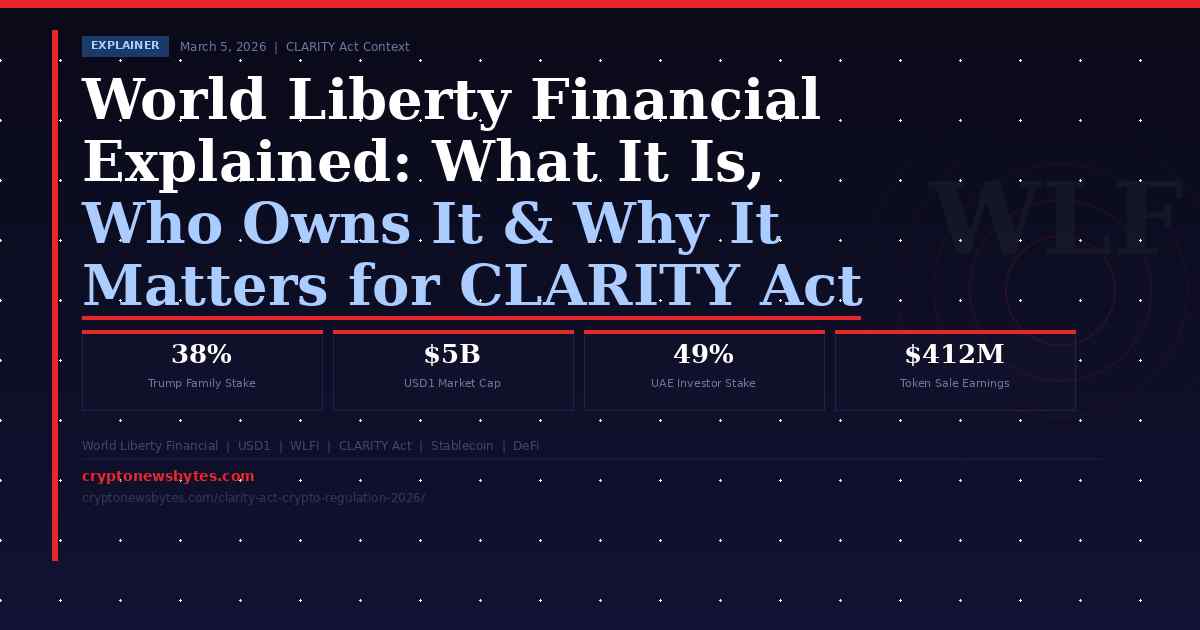
- Who owns WLF — including the Trump family’s 38% stake and the UAE investor stake
- What USD1 is, how it works, and why it has grown to a $5 billion market cap
- Why WLF and USD1 are directly relevant to the CLARITY Act stablecoin debate
- What the Senate ethics debate is about — and what both sides are arguing
- What the WLF situation means for the CLARITY Act’s path through the Senate
If you have been following the CLARITY Act debate and wondering why a DeFi protocol called World Liberty Financial keeps appearing in the conversation — this explainer is for you. World Liberty Financial is a real, operating DeFi project with a fast-growing stablecoin, a publicly disclosed ownership structure that includes the Trump family, and a direct connection to the regulatory outcome of the CLARITY Act. Understanding what it is, who owns it, and how it connects to the bill is essential context for anyone following U.S. crypto regulation in 2026.
What Is World Liberty Financial?
World Liberty Financial (WLF) is a decentralised finance (DeFi) protocol that launched in September 2024. At its core, WLF is a lending and borrowing platform — users can deposit crypto assets as collateral and borrow against them, or supply assets to earn yield from borrowers. The protocol is built on Ethereum and operates through smart contracts.
Since launch, WLF has expanded beyond lending and become most prominently associated with its stablecoin: USD1 — a dollar-pegged token that has grown to a market cap approaching $5 billion, placing it among the largest dollar stablecoins alongside Tether (USDT) and Circle’s USDC.
How USD1 Works
USD1 is a fully-backed stablecoin. Each USD1 in circulation is backed 1:1 by reserves held in U.S. Treasury bills and cash equivalents — the issuer holds one dollar’s worth of short-term government securities for every USD1 token issued. USD1 does not lend out its reserves and does not take on credit risk. This is the same structural model used by USDC and the same model the GENIUS Act proposes to codify in law.
Who Owns World Liberty Financial? The 38% Trump Stake Explained
WLF’s ownership structure is publicly disclosed in its token sale documents. The disclosures show three principal stakeholder groups:
| Stakeholder | Disclosed Stake | Role / Notes |
|---|---|---|
| Trump family | ~38% of WLFI tokens | Donald Trump is listed as “Chief Crypto Advocate.” Donald Trump Jr., Eric Trump, and Barron Trump are listed as Web3 Ambassadors. The family collectively holds approximately 38% of WLFI, the protocol’s governance and revenue-sharing token. |
| UAE-linked investors | ~49% | Disclosed in token sale documents as a stake held by an entity connected to Abu Dhabi sovereign wealth. This was publicly disclosed in the token sale prospectus. |
| Public WLFI token holders | Remainder | WLFI tokens sold publicly in a token sale that raised over $300 million from retail and institutional buyers globally. |
How Much Has the Token Sale Raised for the Trump Family?
Based on publicly available token sale data and financial disclosures, the Trump family’s 38% stake in WLF translates to an estimated $412 million in earnings from WLFI token sales to date. This figure is proportional to the family’s disclosed stake applied to total token sale proceeds — it represents realised earnings from token sales, not unrealised paper gains on remaining holdings.
Why World Liberty Financial Is Relevant to the CLARITY Act
The connection between WLF and the CLARITY Act is structural and straightforward. The CLARITY Act’s stablecoin provisions will determine the regulatory rules that govern USD1 and every other dollar-pegged stablecoin in the U.S. market. Two provisions are particularly relevant:
1. Stablecoin Yield Rules
The most contested provision in the current Senate draft is whether stablecoin issuers and platforms can pay yield on stablecoin balances. Coinbase currently pays 3.5% on USDC. Banks want this banned. The White House wants it permitted. USD1, as a reserve-backed stablecoin, is directly affected by this outcome — the yield rules will shape how USD1 is marketed, distributed, and used on both DeFi platforms and centralised exchanges. For the full breakdown of the yield dispute, see our Dimon vs. Crypto stablecoin analysis.
2. Stablecoin Issuer Licensing and Reserve Requirements
The CLARITY Act — alongside the GENIUS Act — will define the licensing framework, reserve standards, and compliance obligations for stablecoin issuers. These rules will determine which regulator supervises USD1, what audit and disclosure requirements apply, and what capital the issuer must hold. As a growing stablecoin with billions in circulation, USD1’s operational and compliance costs will be directly shaped by how Congress resolves these questions.
The Senate Ethics Debate: Both Sides Explained
The Trump family’s publicly disclosed stake in WLF has become a specific point of contention in the Senate Banking Committee’s CLARITY Act negotiations. Here is what both sides are actually arguing:
What Senate Democrats Are Proposing
Democratic senators on the Banking Committee have proposed adding ethics provisions to the CLARITY Act that would bar senior government officials — including the President and Vice President — from issuing, sponsoring, or holding significant financial interests in digital assets while in office. Proponents argue that when an official holds a financial stake in an industry they are simultaneously regulating, the public interest is best served by clear rules that prevent any overlap between personal financial interests and official regulatory decisions — regardless of intent.
What Senate Republicans Are Arguing
Republican senators and the White House have opposed these provisions on two grounds. First, that the President’s crypto holdings are already fully and publicly disclosed — the information is available to any voter or journalist who looks. Second, that ethics provisions of this scope fall outside the Banking Committee’s legislative jurisdiction and belong in a separate bill. They characterise the amendments as an attempt to stall or kill the CLARITY Act under the cover of ethics reform rather than a genuine legislative priority.
What This Means for the CLARITY Act
World Liberty Financial’s existence and the Trump family’s stake in it do not change the substantive policy arguments for or against any specific CLARITY Act provision. The stablecoin yield debate, the developer protection question, and the SEC-CFTC jurisdiction framework all have independent policy merits that exist regardless of WLF. What the WLF situation adds is political context that affects the Senate negotiation environment — specifically, how Senate Democrats frame their support or opposition, and how the White House balances its role as both the bill’s chief advocate and a financially interested party in its outcome.
For investors, compliance teams, and crypto companies, WLF is relevant context — not a reason to discount the bill’s merits. Understanding it gives you a clearer picture of why the Senate process is taking longer than the House vote suggested, and what a final compromise deal will likely need to include.