- Pakistan’s virtual asset regulator signed an MoU with SC Financial Technologies, an affiliate of World Liberty, to assess USD1 stablecoin for regulated cross-border payments with the central bank.
- CEO Zach Witkoff’s visit aligned with a digital currency pilot plan; Pakistan notes $36 billion in remittances, about 40 million crypto users, and up to $300 billion in annual trading.
The World Liberty Pakistan deal marks a new phase in how Islamabad approaches digital currencies and cross-border payments, linking its financial system with USD1, the stablecoin associated with World Liberty Financial and the Trump family business. Pakistan’s Virtual Asset Regulatory Authority announced that it had signed a memorandum of understanding with SC Financial Technologies, described as an affiliated entity of World Liberty, to study how USD1 could support regulated international transactions. The agreement lands at a time when relations between Pakistan and the United States show signs of improvement, and when Pakistan seeks new tools to manage over $36 billion in annual remittances and rising domestic crypto use.
World Liberty Pakistan deal connects USD1 stablecoin with central bank plans
At the heart of the World Liberty Pakistan deal sits an understanding between Pakistan’s virtual asset regulator and SC Financial Technologies to explore integration of the USD1 stablecoin into the country’s payment landscape. The Pakistan Virtual Asset Regulatory Authority framed the memorandum as a way to build dialogue and technical understanding on emerging digital payment structures, rather than a full launch of the token. SC Financial Technologies, a Delaware-registered company whose chief executive is also the CEO and co-founder of World Liberty, will work with Pakistan’s central bank to see how USD1 might operate within a regulated framework. A source involved in the arrangement explained that the goal is to allow the stablecoin to function alongside Pakistan’s planned digital currency infrastructure, not to replace it. This development stands out because it is one of the first reported partnerships between World Liberty and a sovereign state since the platform launched in September 2024. Pakistan’s willingness to sign the memorandum signals interest in adding private stablecoins to its toolkit for cross-border payments, while still emphasizing regulation and national interest. The link also highlights how the Trump family’s crypto business now reaches into official financial policy abroad. Reuters disclosed the signing before the Pakistani regulator confirmed it, underlining the international attention the agreement has drawn. For World Liberty, the Pakistan deal offers a chance to show that USD1 can integrate with central bank systems rather than sit on the margins of finance.
Political and diplomatic backdrop
The World Liberty Pakistan deal does not exist in a vacuum; it fits into a broader picture of evolving ties between Islamabad and Washington, and the growing role of stablecoins in global finance. Under Donald Trump, the United States introduced federal rules widely viewed in the sector as favorable to digital assets, helping stablecoins grow significantly in value and daily use. World Liberty itself has contributed to a sharp increase in income for the Trump Organization, including payments from foreign entities, during the first half of the previous year. In May, MGX, a state-controlled investment company from Abu Dhabi, used the World Liberty stablecoin to buy a $2 billion equity stake in Binance, the world’s largest crypto exchange by trading volume. Such deals have raised concerns among ethics specialists, who argue that Trump’s oversight of U.S. crypto policy while his family benefits from World Liberty creates a conflict of interest. The White House has rejected these claims and maintains that no conflict exists. Yet, the Pakistan partnership adds another layer to this debate, as it associates a foreign government’s payments infrastructure with a private platform linked to a sitting U.S. president. For Pakistan, however, the focus lies more on practical needs than on U.S. domestic ethics. The country faces pressure to modernize its financial system, reduce reliance on cash, and make remittances faster and cheaper for millions of overseas workers who send money home each year. The visit of Zach Witkoff, World Liberty’s co-founder and chief executive, underlined the diplomatic and commercial weight behind the arrangement. Witkoff, the son of U.S. special envoy Steve Witkoff, traveled to Pakistan for the announcement and appeared in an official government photograph. In the image, Finance Minister Muhammad Aurangzeb and Witkoff sign the memorandum while Prime Minister Shehbaz Sharif and army chief General Asim Munir stand behind them. This setting sent a clear message that the World Liberty Pakistan deal has backing at the highest political and security levels in Islamabad, and not just at the regulatory or technical layer.
How the World Liberty Pakistan deal fits into Islamabad’s digital currency agenda
Pakistan has already started building a policy base for digital assets, and the World Liberty Pakistan deal now plugs into that effort. The central bank governor said in July that the country was preparing to launch a pilot for a digital currency and was finalizing legislation to regulate virtual assets. Authorities see digital tools as a way to cut down on cash-based transactions, improve tax collection, and tighten oversight of capital flows. At the same time, Pakistan must manage a booming informal crypto market, which the regulator estimates involves about 40 million users and up to $300 billion in annual trading volumes. These figures suggest that a large share of the population interacts with digital assets, often without clear legal protections or regulatory oversight. In this context, the memorandum with SC Financial Technologies offers a chance to test whether a privately issued stablecoin like USD1 can support safer and cheaper cross-border payments, particularly remittances. Pakistan receives over $36 billion each year from workers abroad, and even small efficiency gains in fees or settlement times could have visible effects on household incomes and foreign exchange reserves. Finance Minister Aurangzeb stated that the government aims to stay ahead of the curve by engaging with credible global players, learning about new financial models, and making sure any experiments align with regulation, stability, and national interest. That comment suggests Pakistan will move cautiously and insists on a supervised structure, rather than allowing uncontrolled adoption of USD1. The structure of the World Liberty Pakistan deal reflects that cautious stance. Rather than commit to a blanket rollout, Pakistan and SC Financial Technologies agreed to explore integration within a regulated digital payments architecture. This means any use of USD1 would need to fit inside rules set by the central bank and the virtual asset authority, including oversight of reserves, tracking of flows, and compliance with anti-money-laundering norms. Documentation from July 2025 on the stablecoin’s reserves shows that SC Financial Technologies co-owns the USD1 brand with World Liberty, giving regulators a clearer view of who controls backing assets and issuance. World Liberty did not issue an immediate comment on the visit or the memorandum, but its earlier disclosures stress reserve transparency as a key element of the token’s design.
Future outlook for the World Liberty Pakistan deal and global stablecoin use
The next phase of the World Liberty Pakistan deal will depend on technical feasibility studies, regulatory comfort, and political calculations in both countries. For Pakistan, one question will be how to balance a foreign stablecoin with its own planned digital currency, so that the state retains control over monetary policy and financial stability. Policymakers may decide to restrict USD1 use to specific corridors or sectors, such as remittances from particular countries or settlements for defined trade flows. Another issue involves how to manage the large existing base of informal crypto use, which the regulator estimates at up to $300 billion of trading each year, and whether to encourage users to move into regulated channels that include USD1 and domestic digital tokens. Globally, the partnership adds to a list of cases where countries test stablecoins as part of their payments mix. The MGX deal in Abu Dhabi showed that large state-linked investors are willing to use the World Liberty stablecoin for major transactions, including a $2 billion equity purchase in Binance, the world’s largest crypto exchange by trading volume. Pakistan’s move broadens this pattern by bringing a sovereign regulator and central bank into direct cooperation with SC Financial Technologies and World Liberty. If the experiments in Pakistan show cost or speed gains without introducing new risks, other emerging markets with large remittance flows may study similar arrangements. On the other hand, if concerns over conflicts of interest, sanctions compliance, or financial stability grow, some governments could step back from close partnerships with private stablecoin issuers linked to political figures. For now, the memorandum of understanding underscores how rapidly stablecoins have shifted from a niche instrument to a topic of state-level policy, and how a single platform can shape flows worth billions of dollars across borders. The World Liberty Pakistan deal stands at the meeting point of domestic modernization, global finance, and U.S. political dynamics, with each side looking for gains that fit its own priorities. Whether USD1 eventually becomes a standard tool for Pakistani workers sending money home, or remains a pilot within a broader digital strategy, will show how far such public-private collaborations can go in reshaping practical payments.
Conclusion
The World Liberty Pakistan deal ties together Pakistan’s search for efficient digital payments, the rise of USD1 as a cross-border stablecoin, and the Trump family’s expanding role in global crypto finance. By signing a memorandum with SC Financial Technologies, Pakistan’s virtual asset regulator and central bank opened the door to testing how a private token can sit inside a regulated framework, alongside a future state-backed digital currency. The arrangement unfolds against a backdrop of warming U.S.–Pakistan relations, growing scrutiny of potential conflicts of interest, and a domestic market where an estimated 40 million crypto users already move up to $300 billion in trades each year. What happens next will depend on detailed technical work and careful regulatory judgment, but the agreement already shows how digital assets now intersect with national policy, diplomacy, and everyday financial flows on a global scale.
Disclaimer
The information provided in this article is for informational purposes only and should not be considered financial advice. The article does not offer sufficient information to make investment decisions, nor does it constitute an offer, recommendation, or solicitation to buy or sell any financial instrument. The content is opinion of the author and does not reflect any view or suggestion or any kind of advise from CryptoNewsBytes.com. The author declares he does not hold any of the above mentioned tokens or received any incentive from any company.
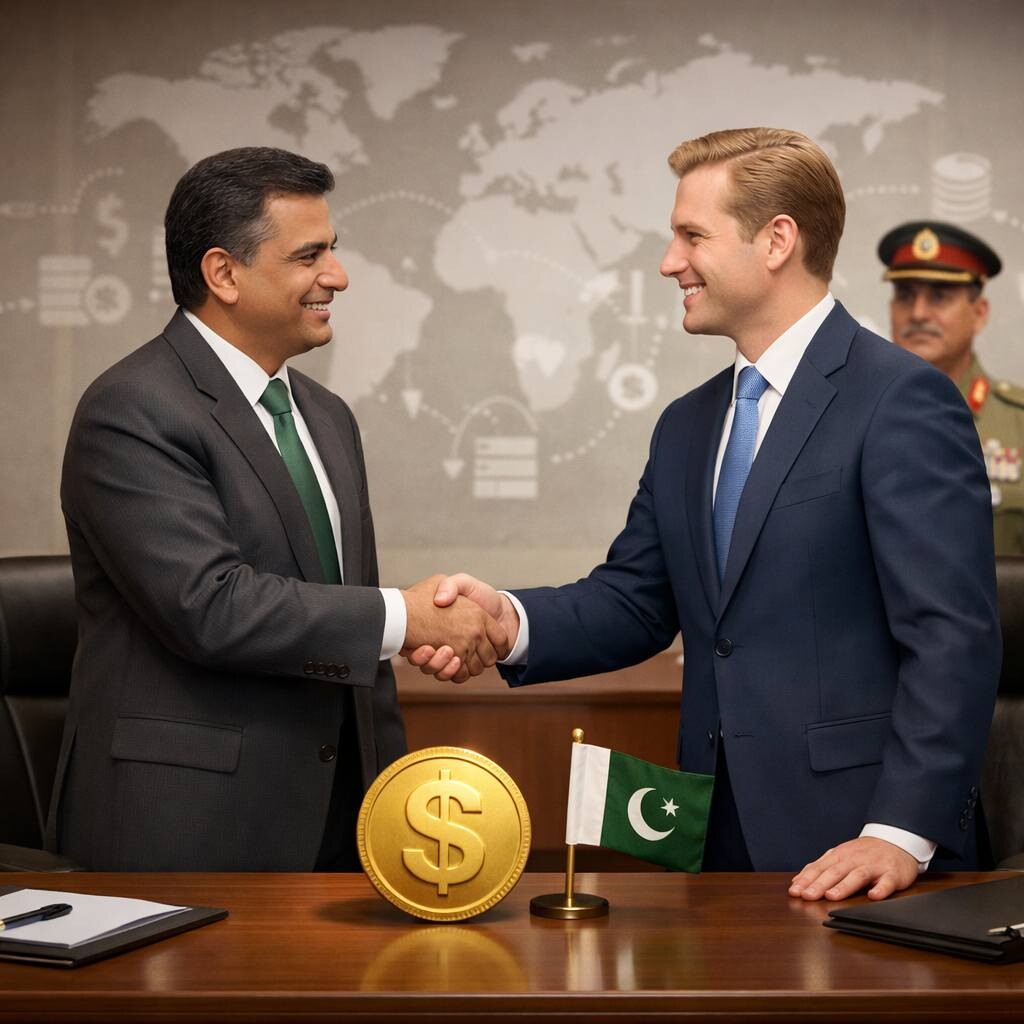
Featured image created by AI