
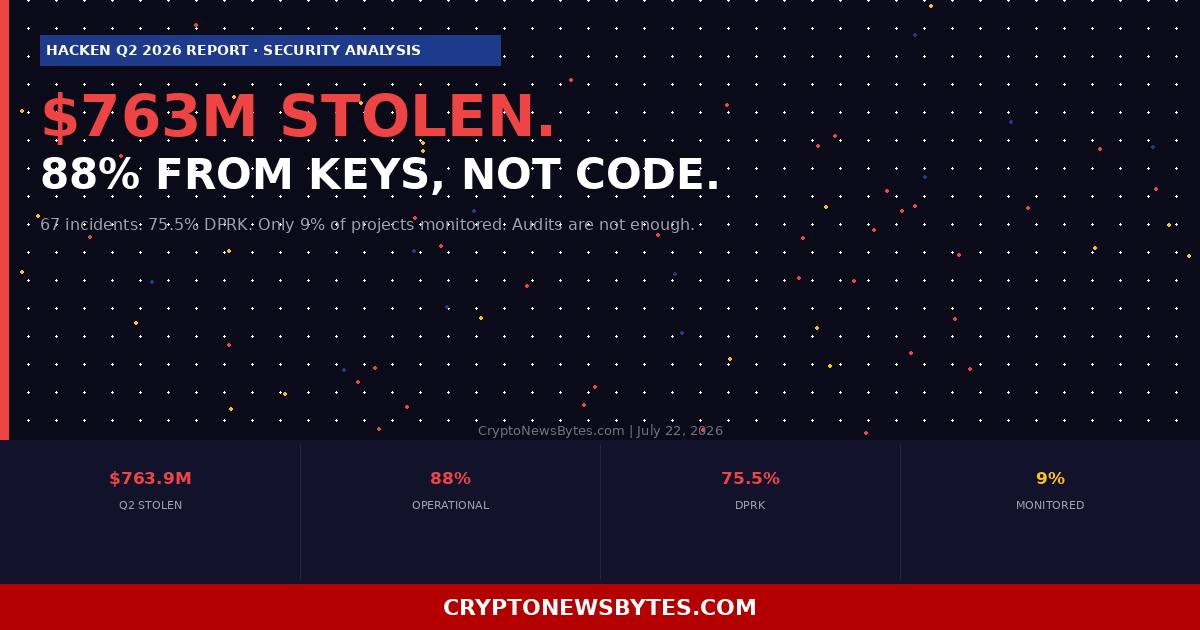
The headline number from Hacken’s Q2 2026 Security and Compliance Report is $763,971,791 stolen across 67 incidents between April and June 2026, a 58.3% increase from Q1’s $482.7 million and the worst quarter since Q2 2025. But the headline number is the least interesting part of the report. The structurally important finding is the ratio hidden underneath it: smart contract vulnerabilities caused 44 of the 67 incidents, two-thirds of the total incident count, yet they account for just 11% of the funds stolen. Operational failures, compromised keys, compromised signers, exploited bridge validators, and unmonitored backend infrastructure caused the remaining 88% of losses. Two categories. Opposite relationship between frequency and damage.
That ratio is the finding every DeFi security conversation should be structured around in 2026 but mostly is not. The industry’s security spending, audit culture, and institutional due diligence process are heavily weighted toward smart contract review. Fourteen of the protocols exploited in Q2 had previously been audited. One protocol had eighteen prior audits before being successfully attacked. The attack that bypassed all of them did not exploit a single line of smart contract code. Hacken’s Q2 report calls this the Architecture of Trust problem: what good security evidence looks like is changing, and most of the industry is still presenting the old kind.
The other number that reframes the entire quarter is the attribution figure. Hacken found that 75.5% of funds stolen in Q2 2026 were attributed to DPRK actors, meaning North Korean state-sponsored groups. That is not a rounding error in the data. Three-quarters of the quarter’s losses trace back to one national threat actor running coordinated campaigns against crypto infrastructure. The same week the Hacken report published, Consensys, the company behind Ethereum’s MetaMask wallet, acknowledged that it had hired a software developer later found to be linked to North Korea. The threat is not abstract.
The 88/11 Split: Why Audits Are Not Enough
The Hacken Q2 2026 report is precise about which operational surfaces were most exploited. The five most affected attack surfaces identified are: signer devices, bridge validators, backend infrastructure, admin keys, and older contracts that remained live despite being deprecated. These are not areas that smart contract audits typically examine. An audit reviews the code of the deployed contracts. It does not test whether the private key used to upgrade those contracts is stored on a hardware security module or in a developer’s email. It does not review the operational security of the signer committee for a bridge. It does not check whether a deprecated pool from 2021 is still holding funds. The Hacken Q2 2026 Security and Compliance Report is available at hacken.io for the full methodology and incident breakdown.
The 9% monitoring figure is the most damning number in the report for anyone running a DeFi protocol or evaluating one. Hacken tracked 1,427 projects with market capitalizations above $1 million listed on exchanges ranked among the top 50 by CoinGecko Trust Score. Of those 1,427 projects, only 9% had any form of third-party real-time monitoring. Only 4% combined monitoring with an active bug bounty and a security audit. The industry has spent years developing a culture around pre-launch audits. It has almost entirely failed to develop an equivalent culture around post-launch monitoring. The audit tells you the code was safe at the moment it was deployed. The monitor tells you whether it is safe right now.
The fourteen audited protocols that were exploited in Q2 illustrate why. An audit conducted months before an exploit cannot protect against a key being phished, a validator being socially engineered, or a new integration introducing a vulnerability into a previously clean contract. Real-time monitoring can. CNB documented exactly this pattern in July 2026: Ostium lost $18M on July 15 when an oracle signer key was compromised, not through any flaw in its audited contracts, and Blockaid detected the exploit in real time within minutes. That detection speed is what monitoring buys.
The North Korea Problem Is Getting Worse
The 75.5% DPRK attribution in Q2 2026 is Hacken’s finding across the quarter’s incidents. The two largest single-protocol losses were Drift Protocol and KelpDAO, both at approximately $290 million each, both attributed to DPRK-linked actors. The playbook Hacken documents is consistent with what the firm identified in its Q1 2026 and prior annual reports: fake venture capital calls, malware disguised as software updates, and compromised employee devices. The innovation in 2026 is scale and targeting precision. DPRK actors are not randomly scanning for vulnerabilities. They are researching specific teams, mapping their infrastructure, identifying which individuals have privileged access, and running tailored social engineering campaigns against those individuals.
The Consensys acknowledgment that a North Korean developer had been embedded in its engineering team is the clearest institutional example of how sophisticated this targeting has become. Consensys is the company behind MetaMask, the most widely used Ethereum wallet. If a North Korean actor was inside Consensys’s development team, they had access to the roadmap, the codebase, the internal tooling, and potentially the signing keys for MetaMask updates. The Consensys case was discovered and disclosed. The Hacken report’s implicit point is that similar infiltrations at smaller, less-resourced teams may not be discovered at all.
Hacken’s Architecture of Trust framework makes a specific argument in response: the criteria by which institutions evaluate whether a protocol is safe enough to work with need to expand from static evidence, we were audited by a reputable firm, to continuous evidence, we have real-time monitoring, active bug bounties, operational security training, and demonstrably safe key management. The twelve contributors to the Q2 report, including Chainlink Labs, Bybit, Moody’s Ratings, Stellar Development Foundation, and Abraxas Capital Management, represent the institutional perspective on what that continuous evidence should look like. The CLARITY Act Senate vote CNB has been tracking directly intersects here: regulatory frameworks like MiCA’s DORA requirements mandate exactly the operational resilience standards Hacken finds missing from 91% of tracked protocols.
What MiCA and Regulation Have to Do With This
The Q2 report frames the security findings against the MiCA compliance backdrop deliberately. The 20% authorization rate among MiCA applicants, roughly 210 of more than 1,200 firms that declared intent, means the vast majority of European crypto operations are working without a licence. MiCA’s operational risk requirements under the DORA framework mandate exactly the kind of continuous monitoring and incident reporting that Hacken finds missing from 91% of tracked protocols. A MiCA-licensed firm operating under DORA has to demonstrate real-time operational resilience. An unlicensed firm has no such requirement.
This creates an accelerating divergence in institutional trust. The regulated tier of the market is building continuous verifiable security evidence. The unregulated tier is presenting static audit certificates that the Hacken Q2 data shows are insufficient. Institutional capital increasingly cannot touch the second tier regardless of asset performance because the counterparty risk cannot be verified continuously. That gap is the Architecture of Trust problem in practice. The Q3 2026 question is whether it narrows or accelerates.
The Numbers That Define Q2 2026
Q2 2026 Losses by Attack Category
Source: Hacken Q2 2026 Security and Compliance Report | @cryptonewsbytes
Source: Hacken Q2 2026 Security and Compliance Report (hacken.io) | @cryptonewsbytes. Not financial advice.
The five attack surfaces Hacken identifies as most exploited translate directly into the questions any institution or sophisticated investor should be asking a DeFi protocol before allocating capital. Who controls the admin keys and how are they stored? Does the bridge have an independent validator committee or a single controlled signer? Is the backend infrastructure monitored in real time by a third party? Are deprecated contracts decommissioned or still live with funds? What is the social engineering training protocol for developers with privileged access? These are not questions a smart contract audit answers. They are questions a security posture assessment answers. Only 4% of the 1,427 projects Hacken tracked had even the basic combination of audit, monitoring, and bug bounty.
Frequently Asked Questions
What is the difference between smart contract exploits and operational failures?
A smart contract exploit targets a bug in deployed contract code. An operational failure targets the infrastructure surrounding that contract: the private key used to upgrade it, the signer committee authorizing transactions, the bridge validator set, or the developer socially engineered into handing over credentials. Smart contract audits review code. They do not review key management, validator security, or employee susceptibility to phishing. In Q2 2026, smart contract bugs caused 65% of incidents but only 11% of losses. Operational failures caused 35% of incidents but 88% of losses.
Why is North Korea stealing so much crypto?
DPRK uses cryptocurrency theft to fund its weapons programs and circumvent international sanctions. Blockchain analytics firms have documented over $3 billion stolen by DPRK-linked groups since 2017. The Lazarus Group and its offshoots use sophisticated social engineering, fake job applications, and long-term infiltration of development teams. Crypto is attractive because transfers are irreversible, pseudonymous, and bypass the SWIFT banking system that sanctions target. Hacken’s Q2 2026 report attributes 75.5% of the quarter’s $763.9M in losses to DPRK actors.
What is Hacken’s Architecture of Trust framework?
Hacken’s Q2 report argues that the old trust metrics, primarily audit reports from reputable firms, are no longer sufficient for institutional due diligence because they are static evidence of a moment in time. The Architecture of Trust framework describes what continuous evidence looks like: real-time third-party monitoring, active bug bounties, demonstrably secure key management, operational security training, and verifiable incident response capacity. The report argues that institutional capital allocation will increasingly require this continuous evidence rather than static audit certificates.
Further Reading
The July 15 live example of Hacken’s dominant Q2 failure mode: an operational key compromise, not a smart contract bug. Blockaid detected it in real time, exactly the monitoring Hacken says 91% of protocols lack.
The regulatory framework that will determine which protocols face MiCA/DORA-style operational resilience mandates. The 9% of projects with monitoring are the ones most likely to qualify under both.
This article is for informational purposes only and does not constitute financial advice. Sources: Hacken Q2 2026 Security and Compliance Report (hacken.io), Hacken Q1 2026 Security and Compliance Report (hacken.io/insights/q1-2026-security-report/). Published July 22, 2026.