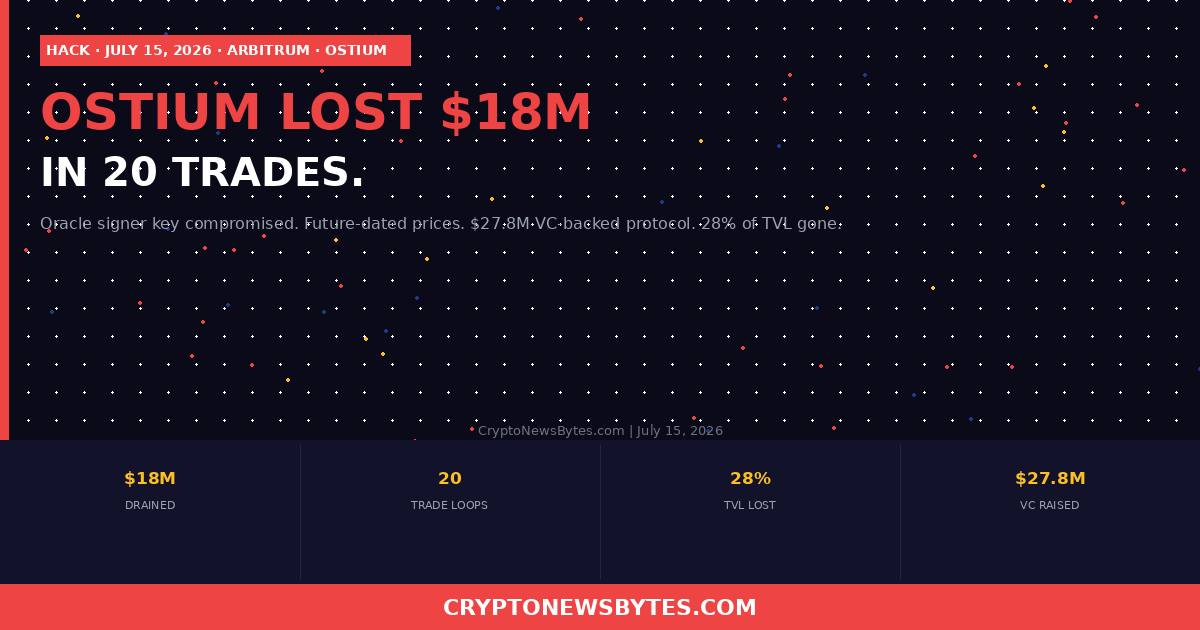
Ostium, a decentralized perpetuals exchange on Arbitrum focused on real-world assets including gold, forex, equity indices and commodities, lost approximately $18 million in USDC from its liquidity vault on July 15, 2026. Security firm Blockaid detected the exploit in real time. The attacker used a registered PriceUpKeep forwarder and future-dated authorized oracle reports to create artificial trading profits, triggering the vault to pay out $18 million as though the trades were legitimate winning positions. The exploit transaction is publicly verifiable on Arbiscan. Ostium had processed over $50 billion in trading volume across 26,000 users before the incident and had raised $27.8 million from investors including General Catalyst, Jump Crypto, Coinbase Ventures, Wintermute, and GSR.
The root cause was a compromised oracle signer private key. The oracle signer is the component responsible for writing real-world asset prices onto the blockchain at the moments when trades need to be executed. With the private key in hand, the attacker could sign any price data they chose, including prices set at future timestamps that had not yet occurred. They submitted roughly 20 looped trade cycles through Gelato’s PriceUpKeep automation network, each one using future-dated favorable prices to make losing positions appear instantly profitable. The vault paid out each time. The total drain represented approximately 28% of Ostium’s $63 million TVL at the time of the attack, per DefiLlama data cited by BeInCrypto.
Ostium had not issued an official response as of the time of writing. The protocol holds approximately $34 million in remaining assets. No user wallet was directly compromised. The exploit targeted the protocol’s custody of liquidity providers’ funds, not individual trading accounts. This is structurally similar to the class of exploit that hit Summer.fi for $6 million the previous week, where an attacker gained access to a privileged keeper role and used it to manipulate the timing or content of price data to extract funds from a liquidity pool.
How the Oracle Attack Actually Worked
Ostium uses a custom price-feed system to track real-world asset prices. A third-party automation network called Gelato is responsible for pushing those prices on-chain at the right moments. A smart contract called PriceUpKeep sits at the center of that process, acting as the trigger that writes the latest price data to the blockchain whenever a trade needs to be executed. CoinDesk’s technical breakdown describes the attack as exploiting a registered component of Ostium’s own price-feed automation system, meaning the attacker was not breaking into the system from outside but hijacking infrastructure that was already trusted by the protocol.
The sequence: the attacker compromised the private key of an oracle signer, the credential that authorizes price data as legitimate. Using that key, they created oracle reports with manipulated future timestamps, effectively telling the protocol that certain assets were trading at favorable prices at moments that had not yet occurred. The PriceUpKeep forwarder, operating through Gelato’s automation, pushed those reports on-chain as though they were routine price updates. The trade execution system saw the reports, calculated that positions opened at current prices would be profitable against the future-dated oracle data, and triggered vault payouts accordingly. Twenty cycles of this loop drained $18 million before the exploit was detected by Blockaid’s real-time monitoring.
The mechanism is closely related to the keeper manipulation exploits that have been running through DeFi since 2024. What distinguishes Ostium is the specific attack surface: not the smart contracts themselves, which auditors had reviewed, but the operational security of the key material used to authenticate price data. This is the exact same class of failure that allowed the Taiko bridge exploit in June 2026, where a leaked SGX signing key let an attacker forge withdrawal proofs and drain $1.7 million. As CNB covered in that incident, the Taiko hack demonstrated that smart contract audits miss an entire category of vulnerability: the operational discipline around who holds signing keys and whether those keys are properly isolated. The same gap is visible here.
How the Ostium Oracle Attack Unfolded
Five steps from compromised key to $18M drained | Sources: CoinDesk, BeInCrypto, Blockaid, KuCoin Jul 15 2026 | @cryptonewsbytes
Oracle signer private key compromised
Method of compromise not yet publicly disclosed
Future-dated oracle reports created and signed
Prices set at timestamps that had not yet occurred
PriceUpKeep forwarder pushes reports on-chain
Gelato automation treated reports as legitimate
~20 looped trade cycles executed
Each position appeared instantly profitable vs future price
$18M USDC paid from vault
28% of $63M TVL. Detected by Blockaid real-time monitoring.
What was never broken: Ostium’s smart contracts
The contracts executed correctly. The oracle data they trusted was fraudulent.
Sources: CoinDesk Jul 15 2026, BeInCrypto Jul 15 2026, Blockaid on X Jul 15 2026, KuCoin flash news Jul 15 2026 | @cryptonewsbytes
What Could Have Prevented This
Oracle security for DeFi protocols that trade real-world assets has a specific set of known defences that Ostium’s incident highlights as absent or insufficient. Key isolation is the most fundamental: oracle signing keys should never exist in a configuration where a single compromise allows unlimited price manipulation. Hardware security modules, multi-signature oracle committees requiring multiple independent signers before a price is accepted, and time-delay validation between price submission and trade execution are all established practices. A time delay of even 30 to 60 seconds between oracle submission and execution would have created a window for Blockaid’s real-time detection to trigger an automated pause before funds left the vault.
Timestamp validation is the second gap. Future-dated price reports should be rejected by the PriceUpKeep system immediately, without requiring manual review. A hard check that oracle timestamps cannot exceed current block time by more than a few seconds is a one-line contract modification. That a production system accepting 200x leveraged trades on real-world assets was not enforcing this constraint is the architectural detail that will define the post-mortem analysis.
The broader pattern across 2026 oracle exploits shows a consistent failure mode: protocols prioritize contract-level security audits while treating the operational security of the infrastructure feeding those contracts as an afterthought. The Polymarket supply chain attack in June 2026 followed the same logic: the contracts were untouched, the pre-contract layer was compromised. The Summer.fi exploit the week before Ostium followed the same logic. DeFi security in 2026 is failing at the infrastructure layer, not the smart contract layer.
Oracle Exploits in 2026: The Running Total
2026 Oracle and Keeper Exploits: The Pattern
Six incidents, same root cause category | Sources: CoinDesk, BeInCrypto, PeckShield | @cryptonewsbytes
Sources: CoinDesk Jul 15 2026, CertiK Oracle Wars report, BeInCrypto, Blockaid postmortem | @cryptonewsbytes. Not financial advice.
Frequently Asked Questions
What is an oracle in DeFi and why does it matter?
An oracle is the infrastructure that feeds real-world data, such as asset prices, into a blockchain where smart contracts can use it. DeFi protocols cannot access external data directly, so they rely on oracle systems to bring in prices for assets like gold, forex rates, or stock prices. If the oracle data is incorrect or manipulated, every smart contract that trusts that data will behave incorrectly. The Ostium exploit did not break any smart contract logic. It manipulated the data the contracts trusted, so the contracts executed correctly according to fraudulent inputs.
Why did audits not catch this vulnerability?
Smart contract audits examine the code of the contracts themselves: logic errors, access controls, mathematical flaws. They do not typically examine the operational security of the key material used to authenticate external data sources, because that is an infrastructure and DevOps question rather than a code question. The Ostium attack required no exploit of the contract code. It required compromising a private key held outside the contract environment. OpenZeppelin conducted three comprehensive audits of Taiko before a leaked SGX key drained it in June. The same pattern applies here.
Is Ostium likely to reimburse affected liquidity providers?
Ostium has not issued an official statement on reimbursement as of the time of writing. The $27.8 million in VC funding from General Catalyst, Jump Crypto, Coinbase Ventures, Wintermute, and GSR provides a potential source of recovery capital, but no commitment has been made. Liquidity providers in affected pools should monitor Ostium’s official channels for updates.
Further Reading
Polymarket’s $3.1M supply chain attack in June followed the same pattern: contracts untouched, pre-contract infrastructure compromised. The regulatory aftermath is covered here.
The USDC regulatory framework that governs the stablecoin drained from Ostium’s vault. USDC is the settlement currency for every Ostium trade, and its regulatory status under the CLARITY Act affects how recovery and enforcement proceed.
This article is for informational purposes only and does not constitute financial advice. Sources: CoinDesk Jul 15 2026, BeInCrypto Jul 15 2026, Blockaid on X Jul 15 2026, KuCoin flash news Jul 15 2026, Wu Blockchain on X Jul 15 2026, Phemex News Jul 15 2026, CertiK Oracle Wars report, DefiLlama TVL data, Immunefi Ostium bug bounty scope. Published July 15, 2026.