TL;DR
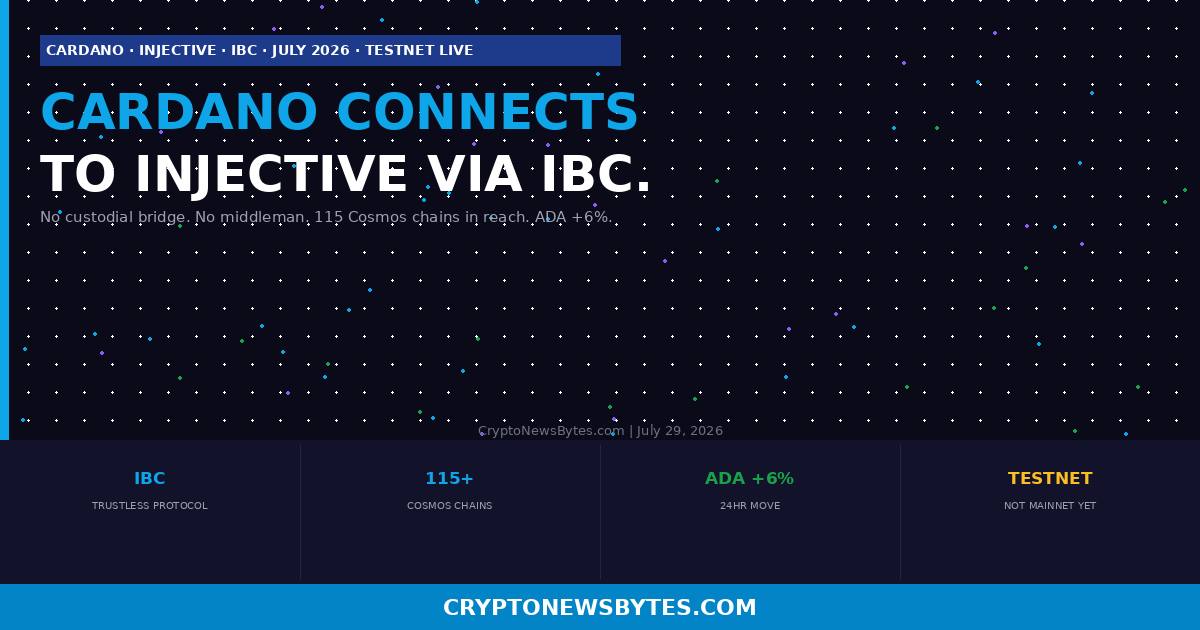
▶ Cardano and Injective have activated a live IBC connection on testnet in July 2026, confirmed in the Cardano Foundation May 2026 monthly update and Q1 2026 development report.
▶ IBC stands for Inter-Blockchain Communication. It is the messaging protocol that connects over 115 blockchains in the Cosmos ecosystem. Cardano is joining that network.
▶ This is not a custodial bridge. No third-party holds your assets. Each chain verifies the other’s state using light clients, cryptographic proof of what happened on the other chain.
▶ The practical outcome: native ADA on Injective and native INJ on Cardano without wrapping or trusting a middleman. Direct, on-chain, bidirectional.
▶ ADA rose 6% in 24 hours on July 29 as the news circulated. The connection is testnet only. Mainnet deployment timeline has not been confirmed.
▶ Osmosis is also targeted. Connecting to Osmosis means access to the Cosmos DEX with the deepest IBC liquidity and swap routing across the entire interchain ecosystem.
Cardano and Injective have activated a live Inter-Blockchain Communication connection on testnet. The Cardano Foundation confirmed in its May 2026 monthly update that pull requests were submitted to both Injective and Osmosis to integrate the Cardano light client, and the Q1 2026 development report confirmed Caribic, Cardano’s IBC bridge tool, was extended with Injective testnet support. As of July 29, 2026, that connection is live on testnet. ADA rose 6% in 24 hours as the news circulated.
Before explaining why this matters, a clear explanation of what IBC actually is, because the technical framing that most coverage uses means nothing to the majority of readers who do not live in the Cosmos ecosystem and have never heard the term.
If you already know what IBC is, skip to the section titled “Why Injective and Osmosis First.” If you are not sure, the next three sections are for you. By the end of them you will understand exactly what Cardano just connected to, why it took this long, and what it unlocks.
What Is IBC? The Clearest Possible Explanation
Start here: the internet analogy
The internet is not one network. It is thousands of separate networks, each run by a different company, that agree to communicate using the same protocol called TCP/IP. When you send an email from Gmail to Yahoo, two completely separate systems exchange a message using TCP/IP as the common language. Neither system needs to trust the other’s infrastructure. The protocol handles the verification. IBC (Inter-Blockchain Communication) is trying to be the TCP/IP of blockchains. Each blockchain stays independent, runs its own consensus, holds its own assets. IBC is the shared protocol that lets them exchange messages and assets without trusting each other’s validators or handing anything to a middleman.
Right now, if you want to move your ADA from Cardano to Injective, you have two options and neither of them is good. Option one: sell your ADA on a centralised exchange, buy INJ, and move it to Injective. You have exited your position, paid trading fees, and trusted a centralised exchange to handle the conversion. Option two: use a custodial bridge. A company holds your ADA, gives you a wrapped version on Injective, and you trust that company not to get hacked or go bankrupt. The AFX Trade bridge exploit in July 2026 that drained $24 million is what happens when you trust a custodial bridge.
IBC eliminates both options. When Cardano connects to Injective via IBC, you can send native ADA directly from your Cardano wallet to your Injective address. No exchange. No bridge company. No wrapped token. No custodian. The transaction is verified by the chains themselves using light clients, which are small cryptographic programs that each chain runs to verify what happened on the other chain. Injective runs a Cardano light client that can read and verify Cardano block headers. When you send ADA, Injective’s light client verifies that the Cardano chain actually processed your transaction before crediting your Injective account.
What is a light client?
A full blockchain node downloads and verifies every transaction ever made on the chain. A light client does something much smaller: it only downloads block headers, the summary of each block, and uses cryptographic proofs to verify specific transactions without processing the entire chain. A Cardano light client on Injective can verify that a specific ADA transfer happened on Cardano by checking the block header and the cryptographic proof included in the IBC packet. It does not need to run a full Cardano node. It just needs enough information to confirm the transaction is real and final. This is what makes IBC trustless: no third party, just math.
The security model this creates is fundamentally different from custodial bridges. A custodial bridge is as secure as the team running it, their key management, and their smart contract code. That is why bridge hacks happen. The Midnight Wanchain bridge exploit on July 22 drained $13 million through an encoding flaw in a trusted third-party bridge. An IBC connection is as secure as the two chains themselves. To compromise an IBC transfer, an attacker would need to compromise the consensus of either Cardano or Injective, which is exponentially harder than compromising a bridge company’s private key.
The Cosmos Ecosystem: What Cardano Is Actually Joining
What is the Cosmos ecosystem?
Cosmos is not a single blockchain. It is an ecosystem of over 115 independent blockchains that all communicate using IBC. Each chain is sovereign: it runs its own validators, its own consensus, its own governance. But they can all send tokens and messages to each other using IBC as the shared protocol. The ecosystem includes Osmosis (the largest IBC DEX with billions in liquidity), Injective (a decentralised derivatives and trading platform), Celestia (a data availability layer), Neutron (a smart contract platform), Stride (a liquid staking protocol), and dozens more. When Cardano connects to this ecosystem via IBC, it does not just connect to Injective. It potentially connects to all 115 chains that Injective and Osmosis are already connected to.
The scale of what Cardano is connecting to is the part most coverage has missed. The Cosmos ecosystem processed over $2 billion in IBC volume in May 2026 alone. Osmosis, which is also being targeted in the Cardano IBC rollout, is the primary DEX for the entire interchain ecosystem. When ADA can flow via IBC, it does not just reach Injective or Osmosis directly. Through Osmosis’s Packet Forward Middleware, ADA can be routed across the entire Cosmos ecosystem in a single transaction. The GitHub repository for Caribic already contains test code demonstrating exactly this: sending a token from Cardano to Osmosis via IBC, swapping it to uOSMO on an Osmosis pool, and sending the swapped token back to Cardano, all in one routed packet.
This is significant for Cardano specifically because liquidity access has been one of the most consistent criticisms of the ecosystem. Cardano has a functioning DEX ecosystem with DEX protocols including Minswap and SundaeSwap, but ADA’s liquidity on those platforms is limited compared to the depth available on Ethereum DEXes or the Cosmos ecosystem. IBC connectivity to Osmosis does not instantly solve that problem. It creates the infrastructure through which external liquidity can flow into Cardano and Cardano-native assets can access external markets.
How the Cardano-Injective Connection Actually Works: The Technical Picture Simplified
How an IBC Transfer Works: ADA from Cardano to Injective
Step by step, without the jargon | Source: Cardano Foundation IBC documentation, GitHub cf-cardano-ibc-incubator | @cryptonewsbytes
You initiate the transfer
You tell your Cardano wallet to send ADA to your Injective address. This looks identical to any other transaction from your end.
Cardano locks the ADA
Your ADA is locked in a Cardano smart contract (an IBC escrow). It does not leave Cardano. It is locked and provably inaccessible until the transfer is complete or reversed.
A relayer detects the lock
A relayer, a piece of software anyone can run, notices the locked ADA on Cardano and creates an IBC packet containing proof of the lock.
The packet is submitted to Injective
The relayer submits the packet to Injective. This packet contains a cryptographic proof that the ADA was locked on Cardano.
Injective’s light client verifies the proof
Injective’s Cardano light client checks the cryptographic proof against the Cardano block headers it has been tracking. If the proof is valid, the lock really happened.
Injective mints IBC-ADA
Injective mints a native IBC-wrapped ADA token in your Injective wallet. This token is backed 1:1 by the locked ADA on Cardano. It is redeemable at any time.
To return: burn and unlock
When you want your ADA back on Cardano, the process reverses. The IBC-ADA is burned on Injective, proof is submitted to Cardano, and your original ADA is released from escrow.
Source: Cardano Foundation IBC documentation, GitHub blinklabs-io/cf-cardano-ibc-incubator | No custodian handles your assets at any step. | @cryptonewsbytes
What is a relayer and who runs it?
A relayer is a piece of software that watches two IBC-connected chains and passes packets between them. It does not hold your funds and cannot steal them: the cryptographic proof system means the relayer can only submit valid packets, not fake ones. If a relayer submits an invalid packet, the light client rejects it. Anyone can run a relayer, which means the system does not depend on any single company staying operational. In practice, infrastructure teams and validator operators run relayers because they earn transaction fees for doing so. Hermes, built by Informal Systems, is the most widely used IBC relayer and is what Cardano’s Caribic tool integrates with.
Why Injective and Osmosis First? The Strategic Logic
Injective is not a random first choice. It is one of the fastest-growing DeFi platforms in the Cosmos ecosystem, focused on decentralised derivatives, perpetual contracts, and on-chain orderbook trading. Its native token INJ has been one of the stronger performers in the Cosmos ecosystem. Injective is also built as an EVM-compatible chain with CosmWasm smart contract support, meaning it attracts developers from both the Ethereum and Cosmos ecosystems simultaneously. Connecting Cardano to Injective gives ADA holders access to derivatives and leveraged trading products that do not exist in Cardano’s native DeFi ecosystem.
Osmosis is the most strategically important of the two. It is the largest decentralised exchange in the Cosmos ecosystem by volume and the primary liquidity hub for IBC tokens. Osmosis has implemented Packet Forward Middleware, which allows tokens to be routed across multiple IBC hops in a single transaction. When a Cardano token reaches Osmosis, it can be swapped for any other IBC-connected token and sent onward to any of the 115 connected chains in a single routed transaction. Osmosis is effectively the Uniswap of the interchain, and connecting Cardano to it is the gateway to the entire Cosmos liquidity ecosystem.
The sequencing also makes technical sense. Both Injective and Osmosis use the Cosmos SDK and support IBC natively. Their developer teams are familiar with IBC client integrations. The pull requests the Cardano Foundation submitted are asking each chain’s governance or technical team to add the Cardano light client to their allowed clients list, which is a standard, well-understood process in the Cosmos ecosystem. The Cardano Foundation chose chains likely to approve and implement the request quickly.
What Is Caribic and Who Built the Infrastructure?
Caribic is the Cardano Foundation’s IBC bridge tool, built in collaboration with Blink Labs. The name is both a portmanteau (Cardano IBC) and a reference to the Caribbean, consistent with Cardano’s island-naming convention for its eras. Caribic handles the technical components of an IBC connection on the Cardano side: running the Cardano node and supporting infrastructure (Mithril for state proofs, Ogmios for transaction submission, Kupo for chain indexing), managing the IBC channel and connection lifecycle, and integrating with the Hermes relayer to pass packets to connected chains.
The GitHub repository for the IBC incubator is public and shows the actual implementation status. The testnet version has been running Osmosis and Injective connections. The test code in the repository includes a demonstration of the full round-trip: sending a mock Cardano token to Osmosis via IBC, swapping it for uOSMO on a liquidity pool, and sending the swapped token back to Cardano via Packet Forward Middleware. That is the full interoperability story in a single test transaction.
One important technical clarification from the GitHub repository: the Caribic implementation currently uses an experimental 08-cardano-probabilistic light client rather than a Mithril-based approach described in earlier documentation. The Mithril light client setup is deprecated and disabled in the current codebase. The probabilistic light client uses configured settlement heuristics and observer data to authenticate Cardano history, and the repository explicitly describes this as a pre-production trust assumption: the security model is not yet equivalent to a Tendermint light client with BFT finality. The repository’s own disclaimer states the implementation is neither complete nor sufficiently tested for production bridge deployment. That is an important caveat for anyone evaluating the current testnet connection.
What Is Not Confirmed Yet and What to Watch
The testnet connection is confirmed. Mainnet deployment has no confirmed timeline. Moving from testnet to mainnet requires the Injective and Osmosis governance processes to formally approve adding the Cardano light client to their production allowed-clients list. It requires the relayer infrastructure to be live and funded on mainnet. It requires audits of the light client code. And for Osmosis, it requires liquidity to exist in ADA-denominated pools before the connection is commercially useful to most users.
The 70 million ADA Critical Integrations Budget proposal, supported by IOG, EMURGO, the Cardano Foundation, Intersect, and the Midnight Foundation, includes cross-chain bridge development as one of its five pillars. That proposal has received endorsement from six of seven Constitutional Committee members and over 85% of DReps. If the treasury allocation passes, it funds the operational infrastructure needed to bring IBC connectivity from testnet to mainnet and to support the relayer ecosystem. Without that funding, timelines are uncertain.
The honest assessment: this is a genuine technical achievement that most other major blockchains cannot match in terms of security model. The IBC light-client approach is architecturally superior to custodial bridges. The connection to Injective is real and testable. The path to mainnet is clear but not funded or scheduled. ADA’s 6% move on the news reflects genuine enthusiasm for an ecosystem development that critics said would never come. Whether it translates into real liquidity flows depends on mainnet deployment, relayer uptime, and whether Cardano DeFi can attract assets from the Cosmos ecosystem once the rails exist.
The honest counterargument
IBC connectivity is necessary but not sufficient for Cardano’s liquidity problem. Ethereum had bridges to every major chain for years before DeFi liquidity concentrated where yield was highest. ADA flowing to Osmosis is only useful if there are ADA-denominated pools with sufficient depth for meaningful trades. Those pools require liquidity providers to deposit ADA alongside other tokens. Liquidity providers deposit where they earn fees. They earn fees where there is trading volume. Trading volume comes from users who want to trade ADA on Osmosis. That circular dependency is the challenge every IBC-connected chain faces on launch. Cosmos chains typically solve it with token incentives: projects seed initial pool liquidity with their own tokens to attract the first wave of LPs. Whether Cardano’s ecosystem will coordinate that kind of launch incentive is the question that determines whether IBC connectivity becomes commercially significant in 2026 or remains a technical proof of concept.
Frequently Asked Questions
What does IBC mean in crypto?
IBC stands for Inter-Blockchain Communication. It is the standard protocol used by over 115 blockchains in the Cosmos ecosystem to send tokens and messages to each other without using a custodial bridge or centralized intermediary. Each chain verifies the other’s transactions using light clients, small cryptographic programs that can check transactions on another chain without downloading the entire blockchain. IBC is to blockchains what TCP/IP is to internet networks: a shared communication standard that lets independent systems talk to each other.
Is the Cardano-Injective IBC connection live?
A live IBC connection between Cardano and Injective is confirmed on testnet as of July 2026, based on the Cardano Foundation’s May 2026 monthly update and Q1 2026 development report. The connection has not been confirmed on mainnet. Moving to mainnet requires Injective governance approval, relayer infrastructure, code audits, and funded operations. The 70 million ADA Critical Integrations Budget proposal, if passed, would help fund the mainnet rollout.
What is Caribic?
Caribic is the Cardano Foundation’s IBC bridge tool, built in collaboration with Blink Labs. It handles the Cardano side of an IBC connection: running the supporting node infrastructure, managing IBC channel lifecycles, and integrating with the Hermes relayer to pass packets to connected chains. The name is a portmanteau of Cardano and IBC. The GitHub repository is public at github.com/blinklabs-io/cf-cardano-ibc-incubator.
What is Osmosis and why does it matter for Cardano?
Osmosis is the largest decentralised exchange in the Cosmos ecosystem by volume and the primary liquidity hub for IBC tokens. It has implemented Packet Forward Middleware, which lets tokens be routed across multiple IBC hops in a single transaction. When Cardano connects to Osmosis, ADA can be swapped for any IBC-connected token and routed onward to any of the 115 chains in the Cosmos ecosystem in a single transaction. Osmosis is the Uniswap of the interchain, and connecting to it is the gateway to the entire Cosmos liquidity network.
What is Mithril and why does it matter for IBC?
The Caribic implementation currently uses an experimental 08-cardano-probabilistic light client, not the Mithril-based approach described in earlier documentation. Mithril is deprecated and disabled in the current codebase. The probabilistic light client authenticates Cardano history using configured settlement heuristics and observer data. The repository explicitly describes this as a pre-production trust assumption: the security model is not yet equivalent to a BFT finality light client. Anyone evaluating the current testnet connection should treat it as experimental infrastructure, not production-grade security.
Further Reading
The governance context for Cardano’s 2026 infrastructure push: the Voltaire era, DRep voting, and the Constitutional Committee that must approve the 70M ADA Critical Integrations Budget.
The architectural comparison that frames why Cardano’s eUTXO model required different IBC implementation work than Cosmos SDK chains, and what Ethereum’s move toward similar designs signals.
Why the IBC security model matters: the custodial bridge model that IBC replaces has produced $37M in losses on a single day in July 2026. IBC’s light-client verification eliminates the trusted-custodian attack surface.
Sources: Cardano Foundation May 2026 Monthly Update (cardanofoundation.org/blog/may-2026-activities, primary source), Cardano Foundation Q1 2026 Development Report (developers.cardano.org, primary source), GitHub cf-cardano-ibc-incubator (blinklabs-io, primary technical source), Cardano Foundation IBC blog post June 27 2024 (cardanofoundation.org/blog/enhancing-connectivity-cosmos-ethereum-cardano), dmarketforces.com July 29 2026 (testnet confirmation), Intersect Critical Integrations Budget proposal (intersectmbo.org) | Published July 29, 2026 | CryptoNewsBytes.com | Not financial or legal advice.