Key Points
Hoskinson UN speech October 2, 2026: 35 minutes at UN headquarters arguing that blockchain is the only tool that can regulate exponential technologies at the speed they move.
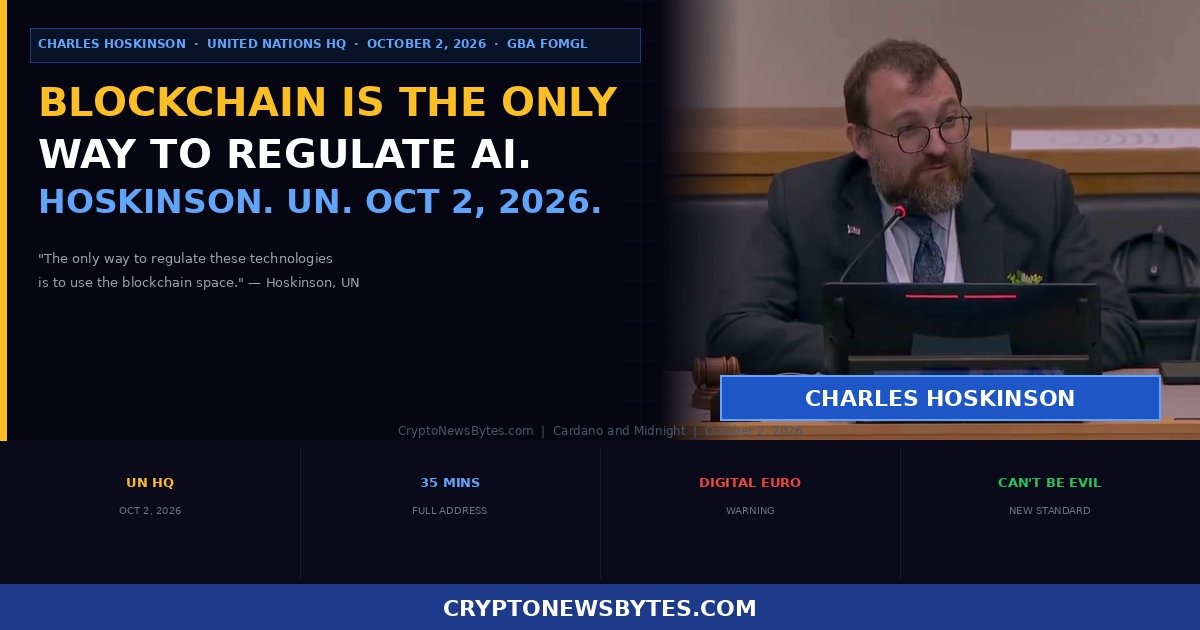
▶ Charles Hoskinson delivered a 35-minute address at UN headquarters in New York on October 2, 2026, at the closing session of the Government Blockchain Association’s Future of Money, Governance and the Law summit.
▶ His central claim: “The only way to regulate these types of technologies is to use the blockchain space, the blockchain industry.” and directed at AI, synthetic biology, and other exponential technologies that outpace legislation.
▶ He proposed a role swap: regulators publish what they want to protect; industry writes open-source code implementing it; certified code becomes compliance. He called the end state “settlement is compliance.”
▶ His sharpest line on the digital euro: “I don’t trust Europeans with it” and predicting that within a decade a card will be declined at a petrol pump despite €2,000 in the account because a monthly fuel quota has been reached. He called this “asset and transaction discrimination.”
▶ His warning on identity and money combined: “If you control the money and the identity, you control humanity.” He described blockchain as a meta-technology whose job is to constrain governments as much as users.
▶ He closed with his definition of the blockchain industry’s core product: “What we sell in the blockchain industry are structures of trust. That’s what we sell. That’s our core product.”
On October 2, 2026, Charles Hoskinson took the podium at United Nations headquarters in New York and spent thirty-five minutes making the case that the next century of money, identity, and governance will be determined by who writes the rules into code and and whether those rules can be trusted. The Hoskinson UN speech was delivered at the closing FinTech session of the Government Blockchain Association’s Future of Money, Governance and the Law summit, introduced by GBA founder Gerard Dache. Hoskinson posted the full video that day under a single line: “Here’s my speech at the UN.”
What followed was not a product pitch. It was a theory of how governments should approach technologies that evolve faster than statutes, a direct challenge to the architects of the digital euro, and a philosophical argument for why blockchain is not merely a financial instrument but a constitutional one. New Hampshire state representative Keith Ammon, who was in the room, later described it simply: “A good speech.”
This article reconstructs the full address in order, using direct quotations from the speech as reported by BeInCrypto, Kryptorevolution, and SIPO, and the GBA’s own recording. Where a statement is Hoskinson’s forecast rather than a documented fact, it is clearly marked as such.
Part 1: The Problem and Exponential Technologies That Outpace Law
Hoskinson opened by grouping nuclear weapons, the internet, artificial intelligence, and synthetic biology as what he called exponential technologies: systems where a small increase in capability changes the world irreversibly. The twentieth-century response to the first of these and nuclear power and was containment inside state monopolies and thick regulatory frameworks built on international treaty. That model worked, he argued, because the technology stayed inside institutional hands.
Today’s equivalents are different. AI models are updated monthly. Synthetic biology tools are available to university laboratories. Open-source repositories contain knowledge that no export control can fully contain. Law does not move at that speed. A regulation passed today may be obsolete before the ink is dry on the implementing guidance. That speed gap was the structural frame for everything that followed.
“I would posit that the only way to regulate these types of technologies is to use the blockchain space, the blockchain industry.”
Charles Hoskinson and UN Headquarters, October 2, 2026
The reason he gave: blockchain technology has itself evolved at roughly the same pace as the technologies it would police. It is the one regulatory infrastructure that is not playing catch-up. He acknowledged frameworks already in motion and the EU’s MiCA, Abu Dhabi’s ADGM regulatory structure, Japan’s Financial Services Agency digital asset framework and and then made a harder argument: treating decentralised networks like ordinary financial products has a structural limit. He was pointed about the enforcement-first period of the U.S. Securities and Exchange Commission under Gary Gensler, without detailing the specific cases he had in mind.
Part 2: The Proposal and Regulators Set the Goal, Industry Writes the Code
The substantive centre of the Hoskinson UN speech was a specific institutional proposal. He called it a role swap. Instead of regulators writing 400-page rulebooks that industries spend years litigating, regulators would publish a statement of what they are trying to protect and an X Prize-style declaration of intent. Industry would then implement that intent as open-source software: tax logic, identity checks, transaction restrictions, whatever the regulatory goal requires. That code would be handed back to the regulator for certification.
Once certified, using the code would itself constitute compliance. He named this end state “settlement is compliance”: the act of settling a transaction on a certified blockchain proves the rules were followed. The separate audit ritual and the quarterly compliance review, the external examiner, the attestation and becomes redundant because the proof is generated automatically by the settlement event.
“Settlement is compliance.”
Charles Hoskinson and describing the proposed end state of his regulatory model, UN Headquarters, October 2, 2026
The architecture he sketched was a library of rules per jurisdiction. A user in Mexico pulls the Mexican rules library. A user in Germany pulls the German one. A transaction touching ten countries could satisfy ten separate rule sets simultaneously, because each party’s software already encodes that country’s certified regulatory intent. The rules travel by function rather than by passport. A good regulatory framework in Singapore can be adopted in Nigeria not through diplomatic negotiation but through software deployment.
He said this design would accomplish two things beyond efficiency. First, it turns adversaries into partners: industry has a reason to write rules it will actually live under. The incentive to write compliant code is not fear of enforcement but the business case of operating in a certified environment. Second, it attacks cost. He estimated global spending on audits, know-your-customer checks, anti-money-laundering compliance, and regulatory fines at approximately $500 billion per year and and argued for replacing compliance officers with compliance engineers, with the bill falling by an order of magnitude each decade.
Editorial note on the $500 billion figure
Hoskinson’s $500 billion annual global compliance cost estimate is his from the podium, not an audited industry total. Estimates vary widely depending on scope. The Financial Stability Board’s 2023 review of correspondent banking compliance costs, LexisNexis’s 2023 True Cost of Financial Crime report, and similar industry analyses support figures in the hundreds of billions globally when AML, KYC, regulatory reporting, and associated fines are aggregated. The order of magnitude is consistent with available data, but the specific figure should be treated as an illustrative estimate, not a cited statistic.
Part 3: Midnight as the Missing Piece and Privacy Without Exposure
Having described the regulatory architecture, Hoskinson identified what he said was still missing from it: a privacy layer that lets a system prove a rule was met without putting a person’s entire financial history onto a public ledger.
He positioned Midnight, the privacy network he is building as a Cardano partner chain, as this component. Selective disclosure and zero-knowledge proofs let a transaction prove compliance and that a KYC check was passed, that a tax obligation was met, that an age restriction was satisfied and without revealing the underlying personal data to every node in the network. In his framing, this resolves a tension that current blockchain designs cannot resolve: you can have a public, auditable ledger or you can have privacy, but not both. Midnight is the attempt to have both simultaneously.
He described a “third option”: one where privacy and identity coexist with compliance in the same technical layer. He framed selective disclosure and zero-knowledge proofs as what “unify blockchains that otherwise cannot talk about compliance and freedom in the same sentence.”
The standard he wants written into the software he articulated as a rewrite of a famous Silicon Valley motto. Not “don’t be evil” and a voluntary commitment that can be abandoned. But “can’t be evil”: a cryptographic guarantee enforced by mathematics, not by managerial good intentions.
“Can’t be evil.”
Charles Hoskinson and his proposed standard for blockchain governance infrastructure, UN Headquarters, October 2, 2026
What Did the Hoskinson UN Speech Say About the Digital Euro? The Line That Left the Room
The passage that circulated widest after the address and the one that hit social media the same afternoon and was directed at the digital euro and at the European authorities building it.
“I do not trust Europeans with it and because we all know what you’re gonna do with it and asset and transaction discrimination.”
Charles Hoskinson and on the digital euro, UN Headquarters, October 2, 2026 (as quoted by BeInCrypto, Kryptorevolution, and SIPO)
The specific scenario he painted for a decade out: a card declined at a petrol pump despite €2,000 in the account, because the holder has already purchased their monthly allowance of fifty litres of fuel. He offered a direct dare to the room: if that scenario will not happen, write a binding legal prohibition on it. Not a draft. Not a political assurance. A law that closes the gap between today’s regulatory proposal and tomorrow’s deployed software.
He connected the digital euro warning to a broader claim about the combination of monetary control and identity systems:
“If you control the money and the identity, you control humanity. Switch off the payments, and speech, travel, and food become conditional.”
Charles Hoskinson and UN Headquarters, October 2, 2026 (widely quoted from the address)
What the ECB has actually said and and what remains unresolved
Hoskinson’s digital euro scenario is his forecast from the podium, not an announced European Central Bank policy. The European Commission’s 2023 legislative proposal states that the digital euro should not be programmable money in the sense of restricting where it can be spent. A former ECB Executive Board member told European lawmakers in 2023 that the ECB would not limit where, when, or to whom people pay. However, those statements are not yet binding law. Trilogue talks between the European Parliament, Council, and Commission were still open in late September 2026 with no final agreement on holding limits or merchant fees. The ECB’s own published timeline points to a 12-month preparation phase from late 2027 and possible issuance in 2029 at the earliest. Hoskinson’s argument is that only a hard statutory prohibition and not a draft proposal or a political speech and would close the gap between current reassurances and future technical capability.
Why Did Hoskinson Frame Blockchain as Constitutional Technology at the UN?
The philosophical core of the speech was a reframing of what blockchain is for. In the dominant public narrative, blockchain regulation is about protecting consumers from volatile assets and bad actors in an unregulated industry. Hoskinson inverted this. His argument: blockchain is a meta-technology whose primary purpose is not to facilitate transactions but to encode constraints and on users, yes, but equally on governments.
He described the historical function of constitutional limits as constraints written on paper: a government could not seize property without due process, could not search without a warrant, could not silence speech without consequence, because the paper said so. The enforceability of those constraints depended on institutions and courts, legislatures, civil society and that could be pressured, corrupted, or reorganised. Code enforced by cryptographic consensus cannot be pressured in the same way. It either runs or it does not. This, in Hoskinson’s framing, is not a threat to governance but a restoration of the function that governance documents were always supposed to serve.
He described unconstrained digital money as a danger and deliberately phrasing the risk as applying both to unconstrained private money and to unconstrained state-controlled money. The blockchain architecture he is advocating would constrain both: private actors could not evade tax obligations encoded in certified software, and governments could not implement spending restrictions that were not explicitly authorised in public law and encoded in the same certified software.
Part 6 of the Hoskinson UN Speech: The Closing: Trust as the Core Product
Hoskinson closed the address with a story from a Wyoming ranch. Buy land from a neighbour you trust, and the deal is two dinners and a handshake. Buy the same land without that trust, and the transaction costs lawyers, title searches, escrow accounts, and two years of litigation. The land does not change. The cost is entirely a function of the trust infrastructure between the parties.
“What we sell in the blockchain industry are structures of trust. That’s what we sell. That’s our core product.”
Charles Hoskinson and closing the UN address, October 2, 2026
He asked the regulators, diplomats, and policy officials in the room to remember who they work for and to make the decision about where the next century of money should go with that in mind. He asked them to decide how to make it fair. The address ended there.
What the Speech Does Not Settle and Honest Limitations
The Hoskinson UN speech is a vision, not a specification. The regulatory architecture he described and jurisdiction libraries, certified open-source compliance code, settlement as proof and does not yet exist at the scale he described. The technical and political work required to build certified jurisdiction libraries for 195 countries, integrate them with existing financial infrastructure, and get regulators to accept code certification as a substitute for audit processes is enormous and largely unbegun.
The digital euro warning is his strongest rhetorical moment and his most speculative claim simultaneously. The scenario of a card declined at a petrol station because of a fuel quota is vivid and plausible as a technical capability. It is not a plan the ECB has published. The gap between “technically possible” and “politically intended” is exactly the gap he is pointing to and but that gap cuts both ways. Blockchain architectures can also be used to implement surveillance and restriction, not only to prevent it. The question of who controls the certified code libraries he is proposing, and what prevents those from becoming instruments of control rather than guarantees against it, was not addressed in the speech as reconstructed here.
New Hampshire state representative Keith Ammon, present at the address, described it as a good speech. That is probably the right summary: ambitious, coherent, provocative in the best sense, and incomplete in the ways that a 35-minute address at a policy conference can be incomplete. The work of filling in the gaps is where the decade ahead actually lives.
The Hoskinson UN Speech: Key Claims and Editorial Status
| Claim | Status | Notes |
|---|---|---|
| Blockchain is the only way to regulate exponential tech | His argument | Stated from podium. Not a policy outcome. Contested position. |
| $500B annual global compliance cost | His estimate | From podium. Industry reports support hundreds of billions range. Not audited. |
| Digital euro = asset and transaction discrimination | His forecast | EC proposal says no programmable restrictions. ECB executive board echoed. Not binding law. |
| Card declined at petrol pump in 10 years | His scenario | Technically possible, not published policy. ECB target date 2029 at earliest. |
| Settlement is compliance and end state | His proposal | Architecture does not yet exist at described scale. |
| “Can’t be evil” as software standard | His proposed standard | Aspiration, not specification. Technical implementation not detailed. |
| If you control money and identity, you control humanity | His warning | Opinion/argument. Consistent with documented debanking cases globally. |
| GBA summit at UN headquarters, October 2 | Confirmed fact | GBA programme and Hoskinson X post confirm date and venue. |
| NH Rep. Keith Ammon was in the room | Confirmed fact | Ammon’s own comments confirm his attendance and assessment. |
Sources: Hoskinson X post October 2 2026, BeInCrypto, Kryptorevolution, SIPO (direct quote sources), ECB digital euro documentation, European Commission 2023 legislative proposal | @cryptonewsbytes
Frequently Asked Questions
What did Hoskinson say at the UN?
Charles Hoskinson delivered a 35-minute address at UN headquarters in New York on October 2, 2026, at the GBA’s Future of Money, Governance and the Law summit. He argued that blockchain is the only technology that can regulate exponential technologies including AI and synthetic biology at the speed they evolve. He proposed a model where regulators publish intent and industry writes certified open-source compliance code, calling the end state ‘settlement is compliance.’ He warned against the digital euro enabling financial discrimination and closed with his definition of the blockchain industry’s product: ‘structures of trust.’
What did Hoskinson say about the digital euro?
Hoskinson said he does not trust European authorities with a digital euro, predicting it would enable what he called ‘asset and transaction discrimination.’ His specific scenario: a card declined at a petrol pump despite €2,000 in the account because a monthly fuel quota has been reached. He challenged anyone who disputes this scenario to write a binding legal prohibition on it into law rather than relying on draft proposals or political assurances. The ECB has stated the digital euro will not be programmable money. Trilogue talks on the legislation were still ongoing in late September 2026.
What did Hoskinson mean by settlement is compliance?
Hoskinson’s proposal is that regulators publish what they want to protect rather than a detailed rulebook. Industry implements that intent as open-source software and submits it for regulatory certification. Once certified, the act of settling a transaction on that blockchain proves the rules were followed and generating proof automatically. This eliminates the separate audit process because the compliance proof is produced by the settlement event itself. He called the architecture a library of rules per jurisdiction, where a transaction touching multiple countries satisfies all relevant rule sets simultaneously.
What is the blockchain industry’s core product according to Hoskinson?
In his closing analogy, Hoskinson compared buying land from a trusted neighbour (two dinners and a handshake) to buying the same land without trust (lawyers and two years of litigation). The land is identical. The cost is entirely a function of trust infrastructure. His conclusion: ‘What we sell in the blockchain industry are structures of trust. That’s what we sell. That’s our core product.’
What is Midnight’s role in Hoskinson’s regulatory vision?
Hoskinson positioned Midnight as the privacy layer that his proposed regulatory architecture currently lacks. He argued that zero-knowledge proofs and selective disclosure allow a system to prove that a compliance rule was met and KYC passed, tax obligation satisfied, age restriction confirmed and without putting personal data onto a public ledger. He framed this as a ‘third option’ beyond the current choice between a public ledger and privacy, and described it as what ‘unifies blockchains that otherwise cannot talk about compliance and freedom in the same sentence.’
Further Reading
CNB’s coverage of the GBA FoMGL summit that preceded the UN address: the full programme, speaker list, and why this government-facing audience was the most relevant Hoskinson could address for Midnight’s enterprise positioning.
The earlier privacy argument that directly underpins the UN speech’s Midnight section: why AI model training on user inputs represents a data ownership problem that selective disclosure and ZK proofs are designed to solve.
CNB’s technical breakdown of the Midnight thesis Hoskinson elaborated at the UN: selective disclosure, private agents, DeFi Kernel, ZK+TEE+MPC, and the Japan partnership still pending.
Sources: Charles Hoskinson X post @IOHK_Charles October 2 2026 (primary: full video posted, ‘Here’s my speech at the UN’), BeInCrypto October 2-3 2026 (primary: direct quote source for digital euro passage and identity/control quote), Kryptorevolution October 2 2026 (primary: direct quote source), SIPO October 2 2026 (primary: quote corroboration), GBA Future of Money Governance and the Law programme September-October 2026 (primary: event documentation, Gerard Dache introduction confirmed), New Hampshire state representative Keith Ammon public comments October 2 2026, European Commission digital euro legislative proposal 2023 (primary for ECB position), ECB digital euro FAQ and board member statements 2023 (primary for programmability position), ECB digital euro preparation phase timeline (primary: late 2027 preparation, 2029 issuance target) | Published October 2, 2026 | CryptoNewsBytes.com | Not financial advice.