TL;DR
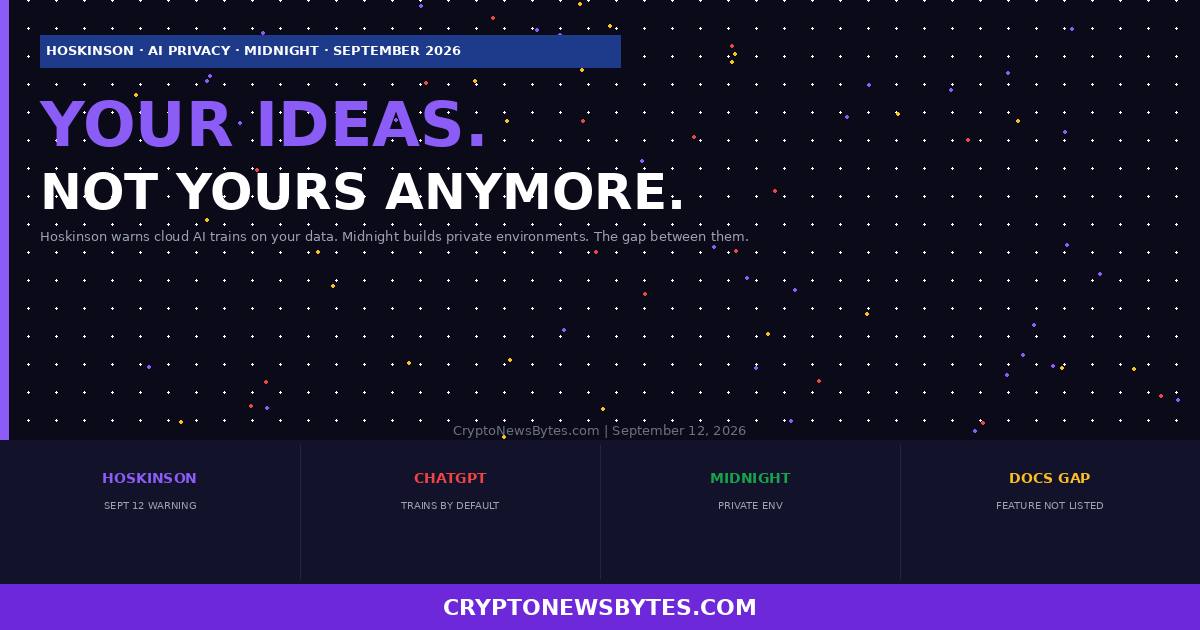
▶ Hoskinson said in a September 2026 YouTube video: “If you share your ideas in AI with these frontier models in the cloud, they are not your ideas anymore.”
▶ The trigger: mathematician Jay Cummings alleged ChatGPT used his unpublished research on a long-standing mathematical problem. The allegation is unconfirmed. Hoskinson says the evidence warrants scrutiny.
▶ OpenAI confirms: personal ChatGPT conversations can feed model improvement unless you disable the setting. Enterprise and API users are excluded by default.
▶ Hoskinson’s proposed fix: Midnight’s private AI environments where the infrastructure operator cannot read your logs. His quote: “They can’t read your logs.”
▶ Important caveat: Midnight’s official documentation does not list AI-log protection as a feature. The architecture supports it in theory. The implementation is not yet documented.
On September 12, 2026, Charles Hoskinson published a YouTube video responding to a controversy involving mathematician Jay Cummings, a professor at the University of California San Diego, who alleged that ChatGPT may have used his unpublished research on a long-standing mathematical problem to generate a solution OpenAI then publicly claimed as its own. Hoskinson, the founder of the Cardano blockchain, did not simply comment on the Cummings case. He used it as a launching point for a broader warning that any academic or entrepreneur who shares unpublished ideas with cloud-hosted AI models may have already lost control of them.
The direct quote from Hoskinson’s video: “If you’re an academic, if you’re an entrepreneur, know that your ideas, if you share them in AI with these frontier models in the cloud, they’re not your ideas anymore.” He then connected the concern directly to Midnight, the privacy blockchain he has been building as a partner chain to Cardano, arguing that AI systems running inside Midnight’s private environments would allow users to access inference capabilities without giving infrastructure operators access to their conversations or logs.
This article covers the Cummings case that triggered Hoskinson’s remarks, the actual OpenAI data policies that determine what happens to your conversations, Hoskinson’s full argument, what Midnight’s architecture actually offers today, and where the gap between his claim and the documented implementation sits. The concern Hoskinson raises is legitimate. The solution he proposes is architecturally plausible. The honest picture requires both.
What Triggered Hoskinson: The Jay Cummings ChatGPT Controversy
Jay Cummings, a mathematics professor at the University of California San Diego, publicly alleged that ChatGPT appeared to have drawn on his unpublished research when generating a solution to a mathematical problem. According to Hoskinson’s account of the situation, Cummings has chat logs that could potentially support his claim. Hoskinson questioned OpenAI’s assertion that the AI had arrived at the result entirely independently.
This is the critical context for everything Hoskinson says next: the Cummings allegation is unconfirmed. OpenAI has not acknowledged using Cummings’ unpublished work. No independent verification of Cummings’ claim has been published. Hoskinson himself framed it carefully, saying the available evidence “could warrant closer examination” rather than asserting it as fact.
The broader backdrop that makes the concern feel plausible is OpenAI’s own disclosure in August 2026 that its internal Astra model produced results on long-unsolved mathematics problems, with human researchers formalizing the arguments into Lean proof certificates. That disclosure sharpened debate about data use and credit attribution in AI mathematical research. The Cummings case arrived in that context. Whether the specific allegation holds up is a separate question from whether the underlying concern about AI and intellectual property is legitimate.
What does OpenAI actually do with your conversations?
OpenAI’s published data policies (as of September 2026) state: personal ChatGPT conversations can be used to train and improve models unless the user disables the ‘Improve the model for everyone’ toggle in settings. Temporary chats are excluded from training and deleted after 30 days. Enterprise accounts and API users are excluded from model training by default, with no opt-out required. This means the vast majority of casual ChatGPT users have their conversations available for model improvement unless they specifically change the setting. The setting exists. Most users have never changed it.
Hoskinson’s Full Argument: AI as an Optimization System
Hoskinson’s argument is not simply that OpenAI might steal your ideas. It is more precise than that. He characterizes frontier AI models as optimization systems that attempt to find the most efficient route to a solution. In his framing, when an AI model is presented with an unusually difficult problem, it searches through information available to it, including information from previous conversations, rather than constructing a wholly independent approach from first principles.
The implication: if you have shared your unpublished research with a cloud AI in a previous session, that research becomes part of the information space the model can draw on when a similar problem arises later. You do not receive attribution. You do not receive compensation. You cannot prove the model used your specific input. The optimization process is opaque and the output emerges without traceable lineage to any specific training input.
He then extends the argument deliberately beyond mathematics to any intellectual property. A business plan shared with ChatGPT to help draft a pitch deck. A novel hypothesis shared to get feedback on its logic. A pharmaceutical compound structure shared to help write a research paper. In each case, the information you provided is potentially in the system, potentially influencing outputs the system generates for other users, and you have no visibility into whether or how that is happening.
What Midnight Actually Offers: The Architecture vs the Claim
What is Midnight’s dual-state ledger?
Midnight is built around a dual-state ledger that separates private state from public state. Private state lives on the user’s device or wallet and is never broadcast to the network. Public state lives on the distributed ledger and is visible to validators. Between the two states, zero-knowledge proofs allow the public network to verify that private computations were executed correctly without seeing the private inputs. In theory, an AI model running inside a Midnight environment would generate ZK proofs that the inference happened correctly without revealing the input (your research idea) or the output (the AI’s response) to the infrastructure operator.
Hoskinson’s claim: “Because it creates private environments that you can run the AI in. So they can’t read your logs.” The architecture of Midnight’s dual-state ledger is consistent with this claim in principle. If an AI inference engine were deployed as a private smart contract on Midnight, the inputs and outputs of that inference could stay in the user’s private state rather than flowing to any central operator.
The honest gap: Midnight’s official documentation does not currently list dedicated AI-execution or AI-log protection as a documented feature. The Midnight Network website describes privacy for financial transactions, identity credentials, and selective disclosure of compliance data. It does not describe a production AI inference environment. The architecture that could support private AI exists. The specific implementation that would actually prevent an infrastructure operator from reading AI logs has not been publicly documented as of September 2026.
This does not make Hoskinson’s claim false. It makes it a forward-looking architectural argument rather than a statement about a live feature. Midnight could support private AI environments. Whether it currently does, and whether “they can’t read your logs” applies to any specific AI tool running on Midnight today, requires documentation that does not yet exist publicly. That is a meaningful distinction for anyone considering Midnight as a practical solution to the concern Hoskinson raises.
Is the Concern About Cloud AI and IP Actually Valid?
Separate from the Midnight solution, the underlying concern Hoskinson raises is worth evaluating on its own terms. The question is whether sharing unpublished ideas with a cloud AI model genuinely risks losing control of them.
The legal picture is genuinely unsettled. Copyright law protects expression, not ideas. If you share an unpublished research idea with ChatGPT and the model later generates a similar result independently, you may have no legal claim to the model’s output even if your input influenced its trajectory. The Cummings case has not been tested in court. The OpenAI copyright litigation currently in US federal courts involves authors and publishers alleging their published works were used without permission. The question of whether unpublished research shared interactively in a chat session creates any legal claim is even further from settled.
The practical concern is more tractable than the legal one. OpenAI’s training data policies mean that for standard free ChatGPT users, conversations can influence future model behaviour unless the user opts out. The opt-out exists and works. The problem is that most users do not know about it, have not changed the default, and are sharing sensitive information under the assumption that what happens in the chat stays in the chat. That assumption is wrong for the default setting.
Hoskinson is not wrong to flag this. He is connecting a real policy gap to a specific architectural solution he has an obvious interest in promoting. Both of those things can be true simultaneously.
The honest counterargument
Hoskinson’s framing conflates two distinct risks. The first is model training risk: your input potentially influencing future model outputs. This is real but mitigated by OpenAI’s opt-out, enterprise defaults, and the practical difficulty of attributing any specific output to any specific training input. The second is log access risk: OpenAI being able to read your conversations directly. This is also real but addressed by OpenAI’s privacy policy and, more meaningfully, by enterprise contracts that prohibit data use. Neither risk is unique to AI. Google has read your Gmail for ad targeting since 2004. The question is whether AI is categorically different from other cloud services that have always had access to your data. Hoskinson argues it is, because AI can act on your ideas in ways other cloud services cannot. That argument is stronger than the alternatives but not without its own complications.
What This Means for Midnight’s Positioning in 2026
Hoskinson has been making a consistent argument across 2026 that privacy is not a feature for privacy maximalists but a fundamental requirement for the next phase of the internet, particularly as AI agents take on operational and financial roles. At Consensus Miami in June 2026, he framed privacy as a prerequisite for AI agents to act on behalf of users without permanently exposing everything those agents know about them.
The September 12 remarks fit into that arc. The Cummings case gave Hoskinson a concrete, emotionally resonant example of what he has been describing abstractly: a real person, a real research claim, a real AI company, and a real inability to prove what happened. Whether or not the Cummings allegation is verified, it illustrates the structural problem he has been pointing to.
The Midnight OFAC FinCEN comment CNB covered and the Midnight Japan partnership still pending are building toward the same institutional audience Hoskinson described in his remarks: academics who need unpublished research to stay unpublished, entrepreneurs who need business plans to stay confidential, and eventually AI agents that need to operate without handing all their operational data to an infrastructure operator. That is the market Midnight is positioning for, regardless of whether the documentation currently describes AI-log protection as a live feature.
Frequently Asked Questions
What did Hoskinson say about AI and privacy?
In a September 2026 YouTube video, Charles Hoskinson warned that sharing ideas with cloud-based frontier AI models means losing control of them. His exact quote: ‘If you’re an academic, if you’re an entrepreneur, know that your ideas, if you share them in AI with these frontier models in the cloud, they’re not your ideas anymore.’ He cited a controversy involving mathematician Jay Cummings, who alleged ChatGPT used his unpublished research, to illustrate the concern.
Is the Jay Cummings ChatGPT allegation confirmed?
No. Jay Cummings, a mathematics professor at UC San Diego, alleged that ChatGPT may have drawn on his unpublished research when generating a solution to a mathematical problem. As of September 12, 2026, the allegation is unconfirmed. OpenAI has not acknowledged using Cummings’ unpublished work. No independent verification has been published. Hoskinson said the evidence warrants closer examination but did not assert the allegation as fact.
Does OpenAI train on your conversations?
By default, personal ChatGPT conversations can be used to train and improve OpenAI’s models unless the user disables the ‘Improve the model for everyone’ setting. Temporary chats are excluded from training and deleted after 30 days. Enterprise accounts and API users are excluded from model training by default. The opt-out exists for standard users but requires knowing to change a setting most users have never touched.
How does Midnight claim to fix this?
Hoskinson argues Midnight creates private AI environments where infrastructure operators cannot read user logs. Midnight’s dual-state ledger keeps private state on the user’s device and uses zero-knowledge proofs to verify computations without revealing inputs or outputs to the network. In theory, an AI model running inside a Midnight environment would generate ZK proofs without exposing the user’s inputs to any central operator.
Does Midnight actually have private AI environments?
Midnight’s official documentation does not currently list AI-execution or AI-log protection as a documented feature. The architecture supports private computation through its dual-state ZK proof system. Whether a production AI inference environment currently exists on Midnight where logs cannot be read by operators has not been publicly documented as of September 12, 2026. Hoskinson’s claim is architecturally plausible but forward-looking rather than describing a live feature.
Further Reading
The OFAC FinCEN comment Midnight filed in July 2026, arguing that compliance should be measured by outcomes not architecture. The same privacy-as-infrastructure argument Hoskinson is making for AI.
ZK proofs, selective disclosure, NIGHT and DUST tokens, real-world use cases, and honest risk assessment. The full technical picture behind the architecture Hoskinson is referencing.
The Japan partnership still pending from June 2026. The same institutional audience that needs private AI environments also needs private financial rails.
Sources: Hoskinson YouTube video September 2026 (primary source: youtube.com/watch?v=dcQxe9ohHOw), U.Today September 12 2026 (direct quotes and Cummings context), COINOTAG September 12 2026 (Midnight architecture detail and documented gap), coin-turk.com September 12 2026, bitcoinethereumnews.com September 12 2026, OpenAI data use policy (openai.com/policies/privacy-policy, primary), National Law Review January 5 2026 (OpenAI 20M chat logs court ruling) | Published September 10, 2026 | CryptoNewsBytes.com | Not financial advice.