TL;DR
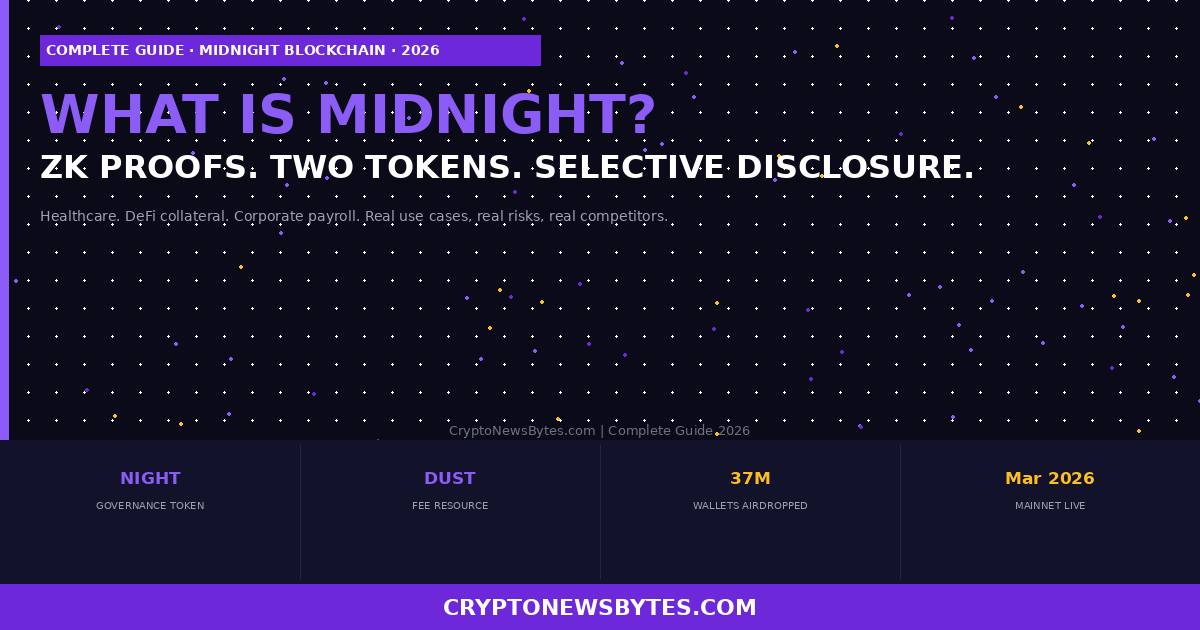
▶ Midnight is a privacy blockchain that launched March 30, 2026, funded by $200M of Charles Hoskinson’s personal capital.
▶ It uses zero-knowledge proofs to let users prove facts without revealing data. A hospital can prove a patient is insured without handing over medical records.
▶ Two tokens: NIGHT (governance and staking, publicly traded) and DUST (renewable transaction resource, generated by holding NIGHT, not buyable).
▶ 37 million wallets received NIGHT in the Glacier Drop. No venture capital. No institutional lockup schedules.
▶ Monument Bank, Google Cloud, MoneyGram, Worldpay are live node operators. A major Japan partnership is pending.
▶ Real risks: NIGHT is down from its ATH, Cardano governance DReps rejected key IOG funding proposals in 2026, and the Wanchain bridge was exploited for $13M in July.
Most blockchain explainers start with the technology. This one starts with the problem, because Midnight blockchain only makes sense if you understand what it is trying to fix.
If you send someone $500 in cash, they know you had it and now they do not. If you send $500 in Bitcoin, a determined analyst can trace every transaction you have ever made, every wallet you have ever touched, and every exchange you have ever used. That transparency was sold as a feature when Bitcoin launched in 2009. By 2026, it is the reason most of the world’s real economic activity, payroll, healthcare payments, private equity, regulated financial products, has declined to move on-chain. Not because of regulation. Because no CFO is going to broadcast their company’s transaction history to every competitor who can run a blockchain explorer.
Midnight is Charles Hoskinson’s structural answer to that problem. It launched on March 30, 2026 as a Layer 1 blockchain and partner chain to Cardano, built on $200 million of Hoskinson’s personal capital, designed to give users control over exactly what they reveal and to whom. It does this using zero-knowledge proofs, a branch of mathematics that lets you prove something is true without revealing why it is true. The headline: you can prove you have enough collateral for a loan without showing your portfolio. You can prove you are over 18 without showing your date of birth. You can prove your company made payroll without revealing individual salaries. The blockchain verifies the proof. The underlying data never leaves your control.
What Is a Zero-Knowledge Proof? The Simplest Possible Explanation
The colourblind friend thought experiment
Imagine your friend is colourblind and cannot tell red from green. You claim you can tell them apart. To prove it without just saying so, you hand them two balls and one red, one green and and turn away. They can swap the balls or keep them the same. Then they show you the result and ask: did you swap? You correctly identify whether they swapped, every time, across dozens of rounds. Eventually your friend accepts that you can tell the colours apart, even though they never once saw you perceive the difference. That is the essence of a zero-knowledge proof. You proved knowledge without revealing the knowledge itself.
In Midnight’s case, the zero-knowledge proof works the same way on-chain. The blockchain runs the proof like your colourblind friend runs the experiment: it asks questions whose answers, if consistently correct, prove the underlying claim is true. But the underlying data, the medical record, the salary figure, the portfolio value, never touches the public ledger. What goes on-chain is the proof of truth, not the truth itself.
Midnight uses a specific type of ZK proof called zk-SNARKs (zero-knowledge Succinct Non-interactive Arguments of Knowledge). These are compact, fast to verify, and do not require back-and-forth between the prover and verifier. The system Midnight built on top of them is called Kachina, which manages two simultaneous states: a public settlement layer where consensus happens and proof data is visible, and a private execution layer where the sensitive computation runs without exposure. Think of it as a courtroom where the verdict is public record but the deliberations are sealed.
How Midnight Works in Real Life: Three Use Cases Explained
The technology is easier to understand through what it does to specific problems. Here are three use cases where Midnight’s selective disclosure model produces an outcome that no existing blockchain can match.
Midnight Selective Disclosure: Three Real-World Use Cases
How zero-knowledge proofs change what goes on-chain | Source: midnight.network, IOG | @cryptonewsbytes
01 and Healthcare Credentialing
Old way: A hospital sends a patient’s full insurance record to verify coverage. The insurer receives name, DOB, policy number, claim history, diagnosis codes.
Midnight way: The hospital submits a ZK proof that answers only: “Is this patient covered for this procedure?” The blockchain confirms yes or no. No name, no DOB, no claim history ever leaves the hospital’s system.
Result: Same verification. Zero data exposure. Compliant with HIPAA without trusting a third party to handle the data safely.
02 and DeFi Collateral Verification
Old way: A borrower on a DeFi protocol locks collateral in a public smart contract. Every competitor and front-runner can see the position size, the liquidation price, and the timing of deposits and withdrawals.
Midnight way: The borrower submits a ZK proof that their loan-to-value ratio is within the required range. The protocol confirms eligibility. The actual portfolio composition, size, and specific assets stay private.
Result: Institutional fund managers can participate in on-chain credit without broadcasting their book to competitors. This is the use case multiple investment banks told Hoskinson was a prerequisite for on-chain participation.
03 and Corporate Payroll
Old way: A company settles payroll on a public blockchain. Every salary, every payment date, every employee wallet address becomes permanently visible to any competitor, regulator, or journalist who looks.
Midnight way: The company submits ZK proofs that all payroll obligations were met on time and in full. Regulators can verify compliance. Employees can verify their individual payments. Competitors cannot see anyone else’s compensation.
Result: The audit trail exists. The privacy exists. These two things are no longer in conflict.
Source: IOG technical documentation, midnight.network use case library, Catalyze Research March 2026 | @cryptonewsbytes
NIGHT and DUST: Why Midnight Uses Two Tokens
Why two tokens?
Most blockchains use one token for everything: staking, fees, governance, and speculation. When that token’s price spikes, transaction fees spike with it. Ethereum in 2021 had gas fees above $100 for a simple token transfer because ETH’s price drove fee costs. Midnight separates these functions deliberately. NIGHT is the public, tradeable governance and security token. DUST is the renewable transaction resource generated by holding NIGHT. DUST is not buyable or tradeable, so fee costs are insulated from NIGHT’s market price volatility. Enterprises can model their Midnight operating costs without worrying that a bull market triples their fees overnight.
NIGHT is the token you can buy on exchanges. It is publicly visible, tradeable, and unshielded. Holding NIGHT gives you governance rights over protocol decisions and generates DUST at a predictable rate. The total supply is 24 billion NIGHT. As of late July 2026, NIGHT trades near $0.047 with a market cap approaching $776 million, down from its peak near $1 billion at launch. The Glacier Drop distributed NIGHT to 37 million wallets across eight blockchains in the largest airdrop by wallet count in the industry’s history. No venture capital received an allocation. No institutional lockup schedules exist to create predictable cliff selling.
DUST works like a phone battery. Holding NIGHT continuously generates DUST. Spending DUST on transactions and smart contract execution depletes it. It recharges over time based on how much NIGHT you hold. DUST is shielded and non-transferable: you cannot buy it, sell it, or send it. It can only be spent on network activity. The DUST Capacity Exchange, coming in the Mohalu phase of the roadmap, will let users with excess DUST trade capacity with users who need more, without exposing the underlying balances. This is the mechanism that makes Midnight’s fee model predictable for enterprise deployments.
How Midnight Compares to Aztec, Aleo, Zcash, and Monero
Midnight vs the Privacy Blockchain Landscape in 2026
Source: dev.to/onlyonealexia May 2026, VaaSBlock June 2026, midnight.network | @cryptonewsbytes
Key distinction: Zcash and Monero hide transactions. Aztec and Aleo add programmable privacy. Midnight adds programmable privacy WITH selective disclosure, the ability to reveal to specific parties without revealing to all. Sources: dev.to May 2026, VaaSBlock June 2026 | @cryptonewsbytes. Not financial advice.
The clearest way to understand Midnight’s positioning: Zcash and Monero hide transactions but cannot run smart contracts. Aztec and Aleo add programmable privacy but default to all-or-nothing. Midnight adds a third option: programmable privacy where you choose what to reveal, to whom, and when, enforced by cryptography rather than trust. The selective disclosure model is the differentiator. A hospital using Zcash has private payments but no way to issue selective proofs to multiple parties. A hospital using Midnight can prove different things to a patient, an insurer, and a regulator without any of them seeing what the others see.
Aztec is the most direct technical competitor. It launched its alpha on Ethereum in March 2026 and had a critical vulnerability patched in July 2026. Its advantage is Ethereum’s existing liquidity and developer base. Its constraint is that it operates as an L2, inheriting Ethereum’s base layer transparency for settlement. Midnight is an independent L1 with its own consensus, which gives it more architectural freedom but means it must build its liquidity and developer ecosystem from scratch. The Glacier Drop to 37 million wallets was Hoskinson’s answer to the cold start problem that has historically killed privacy chains before they reach critical mass.
What Has Gone Wrong: The Honest Risk Assessment
No article about Midnight is complete without the risk section. There are four material risks as of July 2026 that any investor or developer evaluating Midnight should understand.
Risk 1: NIGHT price is down from its ATH. NIGHT launched near $0.058, briefly approached a $1 billion market cap, and now sits near $0.047, approximately 19% below its opening price. The Wanchain bridge exploit on July 22 pushed it to an all-time low before a partial recovery. A token that is down from launch after four months is not unusual in crypto, but it is not the outcome the 37 million airdrop recipients were hoping for.
Risk 2: The Wanchain bridge exploit. On July 22, 2026, a third-party bridge used to move NIGHT cross-chain was exploited for $13 million. The Midnight blockchain itself was not compromised. But the exploit revealed that Midnight’s ecosystem is dependent on third-party bridge infrastructure that does not meet the ZK security standard Midnight’s own protocol uses. Hoskinson called this the point: bridges built on trust rather than cryptographic proof are the attack surface. He is right, but that is cold comfort for the 515 million NIGHT drained in the exploit. The full technical breakdown is in CNB’s Wanchain hack article.
Risk 3: Cardano governance DRep resistance. IOG’s 2026 treasury proposal requesting 32.9 million ADA to fund the research team behind Midnight’s ZK proof work faced 81% opposition from DReps at one point, with Japanese delegated representatives leading the resistance. The core research bundle remained contested even after partial approval of build proposals. The Cardano Summit 2026 was cancelled after a separate treasury vote failed. Pogun, the Bitcoin DeFi bridge tied to Midnight, did not pass its governance vote. IOG subsequently cut its treasury request by 50% as a gesture toward self-sufficiency. If IOG loses funding for its ZK research team, the academic work underpinning Midnight’s cryptography is at risk.
Risk 4: Hoskinson’s timeline history. Midnight was in development for years before its March 2026 launch. The Mohalu decentralization phase was targeted for Q2 to Q3 2026 and has not shipped. The Pogun Bitcoin bridge did not pass its governance vote. The Japan partnership was teased in June and has not been announced. “Huge things” were promised July 22 without a timeline. Hoskinson is a visionary builder with a documented pattern of ambitious projections and stretched delivery windows. The fall 2026 showcase he described may arrive on time. Based on the record, patience is required.
The honest counterargument to all four risks
Aztec had a critical vulnerability in its first four months. Aleo launched with minimal adoption. Zcash has been running since 2016 with a small user base. Every privacy blockchain has a difficult launch. Midnight has something most of them did not: a live institutional partner base before the network was four months old. Monument Bank committed £250M in retail deposit tokenization. Google Cloud is running a node. MoneyGram is a validator. These are not theoretical partnerships. They are contractual commitments from regulated institutions that evaluated the technology and signed. The risks are real. So is the institutional foundation.
Where Midnight Is Right Now and What Comes Next
Midnight is currently in the Kukolu phase: a federated mainnet secured by institutional node operators, with application deployment underway. Monument Bank’s retail deposit tokenization is the headline use case live in this phase. The Midnight City simulation runs continuously at midnight.city, generating real ZK proofs through autonomous AI agents in a live network stress test that doubles as a public showcase for institutional partners.
The Mohalu phase opens the network to Cardano Stake Pool Operators, moves toward decentralization, and activates the DUST Capacity Exchange. It was targeted Q2 to Q3 2026. The Hua phase, expected late 2026, integrates LayerZero to make Midnight a privacy layer for any blockchain, not only Cardano. This is the phase that turns Midnight from a standalone privacy chain into privacy-as-a-service infrastructure for the entire multi-chain ecosystem. If Hua delivers, the addressable market is every chain that currently lacks a native privacy layer.
Three announcements remain pending as of July 27, 2026. A major Japan partnership tied to NIGHT token liquidity, first teased in June and confirmed still on track July 14 after the community incorrectly assumed it was SBI Group. A non-crypto announcement Hoskinson described as “Joe Rogan-level” on July 7. And the broader “huge things” roadmap items he referenced July 22. The full timeline and context for all three is in CNB’s dedicated coverage.
Frequently Asked Questions
Is Midnight the same as Cardano?
No. Midnight is a separate Layer 1 blockchain that operates as a partner chain to Cardano. It has its own consensus mechanism (Minotaur), its own tokens (NIGHT and DUST), its own programming language (Compact), and its own ledger. It interoperates with Cardano rather than running on it. An earlier CoinDesk report described it as built on Cardano; that was corrected March 31, 2026.
How do I get NIGHT tokens?
NIGHT trades on centralised and decentralised exchanges. The Glacier Drop distributed NIGHT to 37 million wallets across eight blockchains between December 2025 and March 2026; if you held qualifying assets on those chains you may have received an allocation. New NIGHT can be purchased on exchanges that list it. DUST cannot be purchased; it is generated by holding NIGHT.
What is selective disclosure and why does it matter?
Selective disclosure is the ability to prove a specific fact to a specific party without revealing all your underlying data. It matters because it resolves the fundamental tension between blockchain transparency (which enables verification and trust) and data privacy (which enables institutional participation and regulatory compliance). Without selective disclosure, institutions must choose between on-chain transparency they cannot accept and off-chain systems they cannot verify. Midnight removes that trade-off.
How does Midnight compare to Zcash?
Zcash hides transaction amounts and addresses using zk-SNARKs. It does not support smart contracts or programmable logic. Midnight uses zk-SNARKs for programmable privacy: developers can build applications with selective disclosure built in at the contract level. A Zcash user can send privately. A Midnight developer can build a payroll system, a DeFi collateral protocol, or a healthcare credentialing application where the privacy rules are programmed in, not tacked on.
What happened in the Wanchain bridge exploit?
On July 22, 2026, a third-party Wanchain bridge used to move NIGHT tokens cross-chain was exploited through an encoding flaw in its signature verification logic. Approximately 515 million NIGHT tokens worth $13 million were drained. The Midnight blockchain itself, the NIGHT smart contract on Cardano, and the Glacier Drop distribution were unaffected. Hoskinson used the incident to argue for replacing bridge infrastructure built on trusted intermediaries with ZK proof-based bridges.
Further Reading
The full technical deep dive on architecture, Kachina protocol, the Hawaiian roadmap, and how Monument Bank is using Midnight today.
The July 22 Wanchain exploit in full: 515M NIGHT drained, the encoding flaw, price action, and Hoskinson’s ZK infrastructure thesis.
The pending Japan partnership, the SBI denial, the Joe Rogan-level announcement, and the full timeline of Hoskinson’s 2026 Midnight statements.
Why Midnight City is not a marketing gimmick: the live stress test, Monument Bank’s institutional evaluation, and what autonomous AI agents reveal about proof generation performance.
This article is for informational purposes only and does not constitute financial advice. Sources: midnight.network (primary source), IOG press release March 30 2026, CoinDesk March 30 2026 and July 22 2026, dev.to/onlyonealexia May 2026 (privacy chain comparison), VaaSBlock June 2026, Catalyze Research March 2026, CryptoSlate May 26 2026 (governance/hospital), crypto.news May 22 2026 (DRep vote), livemakers.com W22 brief May 30 2026 (treasury vote outcomes), CryptoBasic July 17 2026 (Japan update), ZyCrypto July 23 2026. Published July 22, 2026.