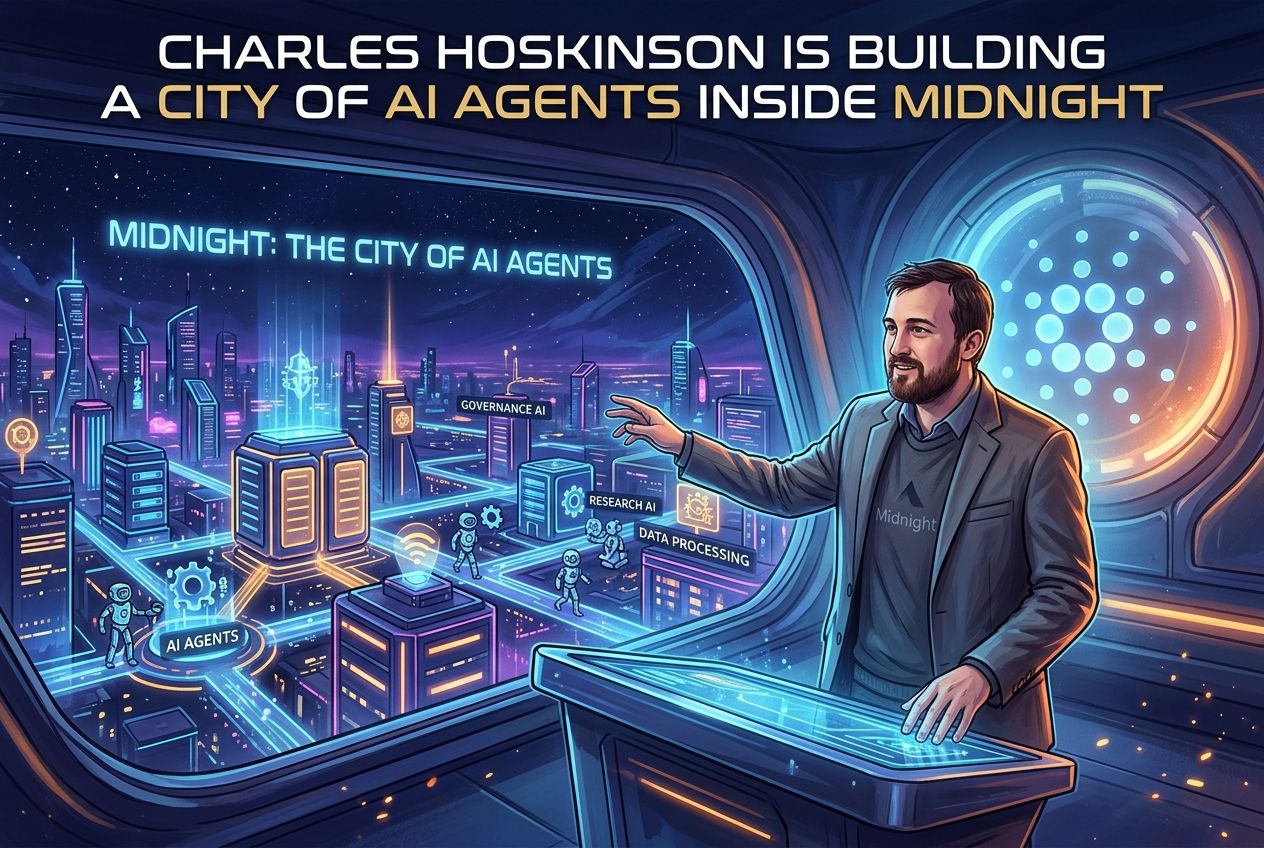
On June 20, 2026, Input Output’s official X account posted content generated by an AI influencer. The crypto community reacted with the usual outrage. Charles Hoskinson posted a thread titled ‘AI Slop, IOG X, and the Future of Marketing’ and did not apologize. He explained it. The post was an experiment, he said, part of ongoing work on Midnight City. He added that it was the beginning of a strategy the team would be executing for years. Content creator Big Pey called Midnight City a waste of millions of dollars that had attracted no users. Hoskinson replied: ‘I’ve just lost all respect for you as an entrepreneur. You clearly have no clue how adoption or consumer experiences work. Save this tweet and come back in a year to apologize.’
The exchange is worth examining carefully because beneath the founder defensiveness there is an argument that is structurally different from most blockchain marketing experiments. Midnight City is not a branding exercise. It is a live simulation running on the Midnight Network where autonomous AI agents work, trade, form relationships, and generate real transactions. Hoskinson has called it one of the most important projects in the Cardano ecosystem. Understanding why requires understanding the problem it is designed to solve.
What Midnight City Actually Is
Midnight City is an interactive simulation hosted at midnight.city, built on the Midnight Network. It launched in restricted preview at Consensus Hong Kong on February 12, 2026, opened to the public on February 26, and has been running continuously since the Midnight mainnet went live on March 30. The official description is specific: ‘They work, sleep, trade and talk. They form bonds and rivalries. They pick favorites and hold grudges. Sometimes they act a little too human.’
Each resident of Midnight City is an autonomous AI agent. These agents do not follow scripts. They generate real transactions on the Midnight Network, produce real zero-knowledge proofs, and create the kind of continuous, varied economic activity that stress-tests a blockchain under conditions that resemble actual usage rather than synthetic benchmarks. The three viewing modes, public, auditor, and regulatory, directly demonstrate Midnight’s selective disclosure model: the same activity looks different depending on who is looking and what permissions they hold. It is a live proof of the core product thesis without needing any human user to participate.
The February 26 Midnight City Simulation that preceded mainnet launch was explicitly described by IOG as a stress test of the blockchain’s ability to generate and process proofs at scale under real-world-like transaction loads. Midnight did not use standard load-testing software. It built a city populated by AI agents because the transaction patterns AI agents produce, irregular, relationship-driven, economically motivated, are closer to human behaviour than synthetic benchmarks. That is not marketing. That is a research methodology.
Why Hoskinson Says AI Is Core Infrastructure, Not a Gimmick
Hoskinson’s argument is structural and worth taking seriously. Cardano currently has millions of ADA holders, thousands of active wallet addresses, and a community spread across dozens of countries and languages. If Midnight succeeds and brings institutional adoption at the scale Hoskinson projects, that community grows from millions to tens of millions. The question is not whether that growth is desirable. The question is how you manage communication, moderation, content, and community coordination at that scale without linearly scaling human headcount.
‘We are going to need agents and AI to be able to organize and sort all that out and broadcast on a regular basis what is going on in Midnight City,’ Hoskinson said in his June podcast. He cited OpenClaw, the open-source AI agent platform that crossed 350,000 GitHub stars in five months, as a template for the kind of autonomous community coordination he envisions. The model he is describing is one where AI agents handle the routine layer: posting updates, moderating channels, flagging anomalies, generating reports, freeing human team members for strategic and creative work. Hoskinson also mentioned AI chief marketing officers, lifelike broadcasting tools, and agentic trading as near-term applications.
The honest version of the critic’s argument is not that AI is useless in this context. It is that building an AI-populated city inside a privacy blockchain is an expensive, complex way to demonstrate a concept that could be shown more cheaply. Hoskinson’s counter is that cheap demonstrations do not attract Monument Bank, Google Cloud, or the investment banks he says are in active conversations with Midnight. What attracts institutions is seeing a live network under real load, with real economic behaviour, producing real proof-generation performance data. Midnight City is the only blockchain project providing that kind of continuous institutional showcase.
How Midnight City Works as Infrastructure
The AI agents are doing real work on a real network | Sources: IOG, CoinDesk Feb 2026, DailyCoin, crypto.news | @cryptonewsbytes
1
AI agents live, trade and interact inside the city
Each agent has goals, memory, preferences and economic motivations. Activity is unpredictable by design, matching real human usage patterns.
2
Every transaction generates real ZK proofs on Midnight Network
Not simulated. Real proof generation, real throughput data, real performance evidence for institutional partners evaluating the chain.
3
Three viewing modes demonstrate selective disclosure live
Public, auditor, and regulatory views show the same activity at different permission levels. The core product proposition visible in real time.
4
Serves as AI marketing and community infrastructure template
The same agents that stress-test Midnight become the model for how Cardano scales community coordination as users grow from millions to tens of millions.
Sources: CoinDesk Feb 12 2026, DailyCoin June 23, crypto.news June 2026, BeInCrypto July 2026 | @cryptonewsbytes
The Institutional Traction That Critics Are Missing
The argument against Midnight City rests on user numbers. Big Pey’s criticism was that it attracted no users. Hoskinson’s response was that the wrong metric was being applied. Midnight is not currently competing for retail users. It is competing for institutional node operators and enterprise partners who need to see a privacy blockchain performing under sustained load before committing compliance infrastructure to it. By that metric, the early results are not nothing.
Monument Bank, regulated by the Bank of England with roughly seven billion pounds in deposits, committed to tokenize up to 250 million pounds in retail deposits on Midnight in phase one. Google Cloud is running a node. MoneyGram, Worldpay, and Pairpoint by Vodafone are active node operators. Hoskinson mentioned in a July 2 podcast that Midnight is in active conversations with investment banks in the United States and Europe. None of those institutions made those commitments after reading a tweet. They made them after evaluating a live network producing verifiable proof-generation performance data. Midnight City is how that data gets produced continuously.
Hoskinson has described 2026 as the beta year for Midnight. The Hawaiian four-phase roadmap has the network currently in Kukolu, the federated mainnet phase. Mohalu, the decentralization phase opening the network to Cardano Stake Pool Operators, is targeted for Q2 to Q3. Hua, the LayerZero integration phase that turns Midnight into a privacy layer for any blockchain, is scheduled for late 2026. The full institutional pitch, privacy as a service for any chain, depends on the Hua phase delivering. Midnight City is the continuous proof that the network can handle that load. Whether it can is still being demonstrated.
Frequently Asked Questions
Is Midnight City open to the public?
Yes. The Midnight City simulation is accessible at midnight.city. It opened to unrestricted public access on February 26, 2026, after a restricted preview at Consensus Hong Kong on February 12. Anyone can visit and observe the AI agents through the public, auditor, or regulatory viewing modes.
What is the relationship between Midnight City and the Midnight Network?
Midnight City runs on the live Midnight Network. It is not a separate testnet. The AI agents inside Midnight City generate real transactions that produce real zero-knowledge proofs on the actual Midnight mainnet, which has been live since March 30, 2026. This means Midnight City serves simultaneously as a user-facing showcase, a continuous stress test of the network’s proof-generation capacity, and a live demonstration of the selective disclosure model.
Why does Hoskinson say AI agents are essential for Cardano’s future?
His argument is a scaling problem. A blockchain community that grows from millions to tens of millions of users cannot be managed by a linearly scaled human team. AI agents can handle routine communication, moderation, content generation and community reporting at scale without proportionally increasing headcount. Midnight City is the template for that model: AI agents managing economic activity inside the city become the blueprint for AI agents managing community activity outside it.
Further Reading
The complete technical breakdown of Midnight’s architecture, NIGHT and DUST dual-token model, and the four-phase Hawaiian roadmap.
The governance system Hoskinson says will eventually be adopted by Ethereum. Now proven through a clean on-chain ratification.
This article is for informational purposes only and does not constitute financial advice. Sources: BeInCrypto June 2026 and July 2 2026, CoinDesk Feb 12 2026 (Midnight City announcement), crypto.news June 2026, DailyCoin June 23 2026, Blockonomi June 2026, Cointribune June 2026, Hoskinson X post June 20 2026 AI Slop thread, midnight.city, IOG press release March 30 2026. Published July 2, 2026.