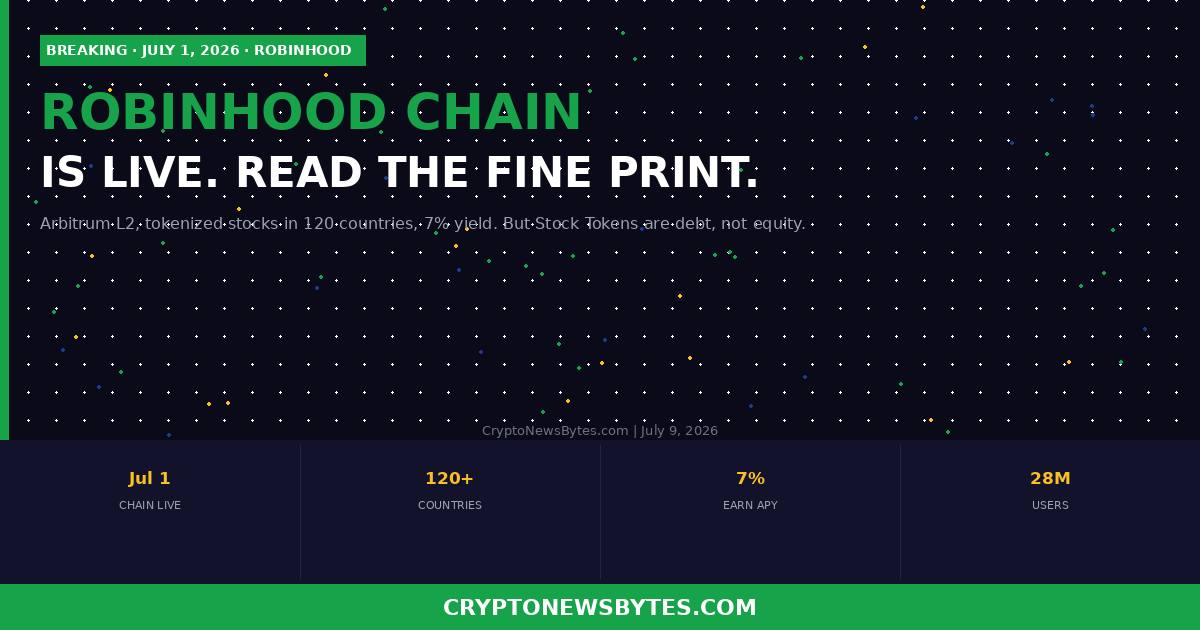
Robinhood launched the public mainnet of Robinhood Chain on July 1, 2026, during an event in London. The company that pioneered zero-commission stock trading in 2013 just built its own Ethereum Layer 2 blockchain. Not a wallet. Not a custodian. A public, permissionless blockchain with day-one integrations from Uniswap, Chainlink, BitGo, Morpho, 1inch and Arcus, which is the team from dYdX. Twenty-eight million Robinhood customers now have access to a DeFi-native financial infrastructure that their brokerage built from the ground up.
CEO Vlad Tenev’s framing at the London event was specific: this is the next major phase of digital assets, tokenization of real-world financial instruments rather than creation of speculative tokens. Robinhood’s crypto revenue fell 47% in Q1 2026 compared to Q1 2025. This launch is not happening despite that decline. It is happening because of it. Robinhood is building the infrastructure for the next revenue cycle before the current one recovers.
What Robinhood Chain Is and How It Works
Robinhood Chain is an Ethereum Layer 2 blockchain built on Arbitrum. That means transactions settle on Ethereum mainnet for security but execute on Robinhood’s chain for speed and low cost, the same architecture as Base (Coinbase) and Blast. Robinhood describes it as AI-native and purpose-built for real-world assets. The permissionless design means any developer can build on it, not just Robinhood’s own products. Day-one partners include Uniswap running a dedicated automated market maker, Lighter and 1inch for trading infrastructure, Arcus (the dYdX team) for derivatives, BitGo for custody, Chainlink as the official oracle provider, and Alchemy for developer tooling.
The primary product launched alongside the chain is Stock Tokens: on-chain representations of US equities including NVDA, GOOG and AAPL that trade 24 hours a day, seven days a week. These are accessible through Robinhood Wallet in more than 120 countries, though availability varies by jurisdiction. The more consequential detail for DeFi users is what the tokens can do once they are on-chain: they can be used as trading collateral and deployed into lending pools across the broader DeFi ecosystem. A tokenized Apple share becomes a composable on-chain asset. That is structurally different from holding AAPL in a brokerage account.
Robinhood Earn, powered by Morpho, offers an estimated 7% annual yield on the USDG stablecoin, insured through Lloyd’s of London and RELM. In Europe, Robinhood launched perpetual futures tied to commodities, ETFs and foreign exchange with up to 10x leverage, an extension of what has already become one of the company’s fastest-growing product lines in the region.
Robinhood Chain: What Launched on July 1, 2026
Full product stack at mainnet | Sources: CoinDesk, Forbes, TechTimes, Robinhood newsroom | @cryptonewsbytes
Sources: CoinDesk July 1, Forbes July 1, DEXTools July 4, CryptoRank July 1, TechTimes July 2 | @cryptonewsbytes. Not financial advice.
The Ownership Caveat That Every Retail User Needs to Read
Robinhood’s Stock Tokens are structured as tokenized debt securities, not equity. This distinction is not buried in fine print. TechTimes reported it prominently the day of the launch: holders receive no voting rights, no shareholder rights, and no direct ownership claim on the underlying shares. They receive economic exposure to the price, similar to a contract-for-difference, rather than actual stock ownership.
This matters because the SEC drew exactly this line in its January 2026 guidance on tokenized securities. The guidance distinguished between issuer-sponsored tokenized securities, where the issuer or an authorised agent mints tokens representing real ownership, and third-party products providing only synthetic exposure or custodial entitlements. Ondo Finance’s launch of tokenized IVV and Micron shares on July 2, which CNB covered, specifically followed the SEC’s issuer-sponsored custodial model, with the underlying shares held by a regulated custodian and a registered transfer agent minting tokens backed 1:1. Robinhood’s Stock Tokens do not follow that model. They are closer to the offshore tokenized stock products that brokers like Bybit have offered internationally, with economic exposure but without equity ownership. That is not illegal under current frameworks. It is structurally different from what Ondo launched, and retail users making decisions based on the word tokenized without reading the fine print face a meaningful risk of misunderstanding what they own.
The Bigger Picture: Corporate Chains Are Eating Neutral Infrastructure
Robinhood Chain joins Coinbase’s Base, Stripe’s Tempo, PayPal’s chain efforts and now Robinhood in a growing category of corporate-backed Layer 2 networks. The pattern is consistent: a financial company with existing customer distribution builds its own chain rather than building on a neutral public chain, capturing the fee revenue, the data, and the network effects for itself. Forbes noted the structural dynamic precisely: ‘The blockchain’s launch places Robinhood in a growing category of corporate-backed networks, where crypto and payments companies are increasingly building their own rails rather than simply relying on existing public blockchains.’
For Ethereum, this is net positive: Robinhood Chain settles on Ethereum and uses Arbitrum’s technology, so every Robinhood transaction ultimately accrues some value to the Ethereum ecosystem. For neutral DeFi protocols built without a corporate parent, the dynamic is more complex. When 28 million Robinhood users access DeFi through Robinhood’s own chain rather than through MetaMask on Ethereum mainnet or on a neutral L2, Robinhood captures the customer relationship, the yield, and the trading fees. The open question is whether corporate chains pull DeFi toward mass adoption faster than they pull it away from decentralization. Robinhood’s 28 million customers dwarf the current DeFi user base. If even a fraction of them engage with Robinhood Earn or Stock Token collateral, the volumes would exceed most existing DeFi protocols.
Robinhood Chain vs Other Corporate L2s
The growing category of company-owned blockchain rails | @cryptonewsbytes
| Chain | Built by | Tech base | Primary use | Users |
|---|---|---|---|---|
| Robinhood Chain | Robinhood | Arbitrum (ETH L2) | Tokenized stocks, DeFi, AI trading | 28M potential |
| Base | Coinbase | OP Stack (ETH L2) | General DeFi, consumer apps | 110M Coinbase users |
| Stripe Tempo | Stripe | Stablecoin payments | Business stablecoin payments | Millions of businesses |
| PayPal / PYUSD | PayPal | Ethereum + Solana | Stablecoin payments | 430M users |
Sources: Forbes July 1 2026, CoinDesk July 1, Robinhood newsroom | @cryptonewsbytes
Frequently Asked Questions
Is Robinhood Chain the same as the Robinhood Wallet?
No. Robinhood Wallet is the self-custody crypto wallet Robinhood offers for holding and transacting digital assets. Robinhood Chain is the underlying Ethereum Layer 2 blockchain that the wallet and other Robinhood products now connect to. The chain is also permissionless, meaning external developers can build on it independently of Robinhood’s own products.
Do Robinhood Stock Tokens give you actual ownership of shares?
No. Robinhood’s Stock Tokens are structured as tokenized debt securities, not equity. Holders receive economic exposure to the stock price but no voting rights, shareholder rights, or direct ownership claim on underlying shares. This is materially different from Ondo Finance’s tokenized securities, which use an SEC-approved custodial model where underlying shares are held 1:1 by a regulated custodian. Robinhood’s structure is similar to offshore tokenized stock products that provide price exposure without equity ownership.
What is Robinhood Earn and how does the 7% yield work?
Robinhood Earn is a decentralized lending product powered by Morpho, a DeFi lending protocol. Users deposit USDG stablecoin and earn an estimated 7% annual yield. The product is insured through Lloyd’s of London and RELM. Morpho’s architecture uses peer-to-peer lending matching to achieve higher yields than traditional money market rates by connecting lenders and borrowers directly on-chain rather than through a pooled intermediary.
Further Reading
Ondo launched the day after Robinhood Chain using the SEC’s custodial model. Real equity ownership, not debt exposure. The structural comparison matters.
The offshore tokenized stock model Robinhood’s Stock Tokens structurally resemble, available internationally but without SEC-compliant equity ownership.
This article is for informational purposes only and does not constitute financial advice. Sources: CoinDesk July 1 2026 (Johann Kerbrat interview), Forbes July 1 2026 (Nina Bambysheva), TechTimes July 2 2026, DEXTools July 4 2026, CryptoRank July 1, Robinhood official newsroom July 1, BigGo Finance July 2026, Cobo Agentic July 2026, LetsDatScience July 2026. Published July 2, 2026.