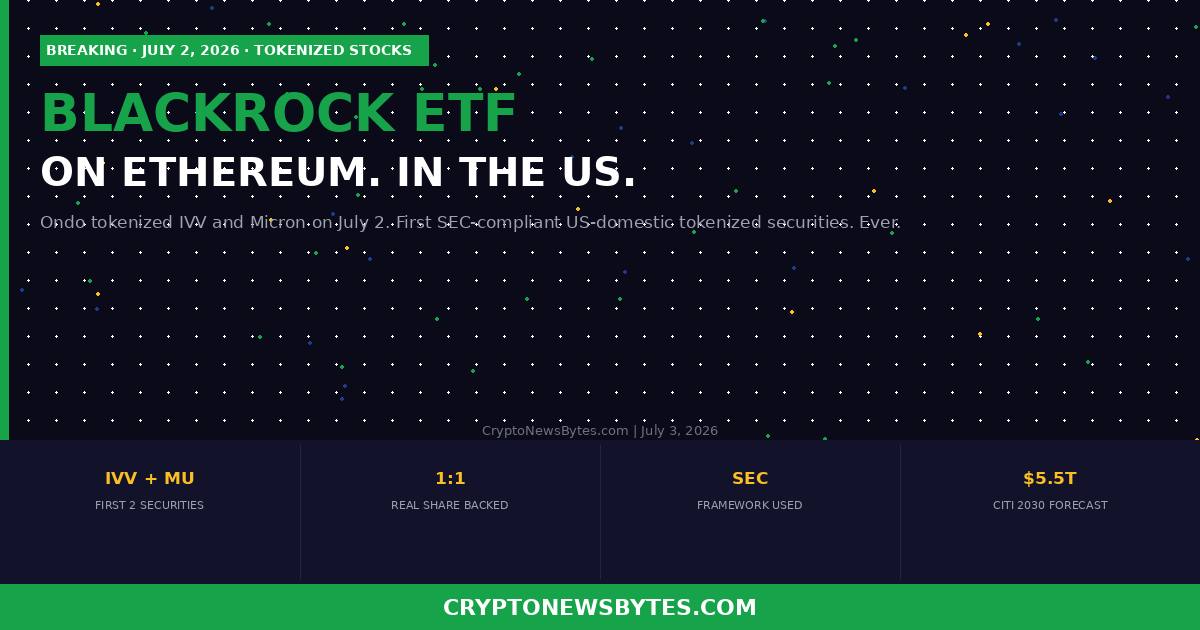
Ondo Finance launched tokenized versions of BlackRock’s iShares Core S&P 500 ETF (IVV) and Micron Technology (MU) shares on Ethereum on July 2, 2026, and the thing that makes this different from every other tokenized stock announcement is where it happened. Inside the US. Under the SEC’s own framework. Using a registered transfer agent. With the underlying shares never leaving the conventional US custody chain. Ondo’s CEO Ian De Bode called it ‘the first live solution of third-party tokenized US securities operating entirely within the existing regulatory perimeter.’ That is not marketing language. It is a legal distinction that the market has been waiting two years to see someone clear.
The SEC laid the groundwork in a January 2026 statement describing a third-party custodial model for tokenized securities: a regulated party holds the underlying shares, issues blockchain tokens representing ownership, and keeps everything connected to existing US market infrastructure. Ondo is the first firm to put that model into production. Tokens are minted through Oasis Pro TA, an SEC-registered transfer agent Ondo acquired last year. Holders receive full shareholder rights including proxy voting through Broadridge’s ProxyVote platform. Transfer restrictions are enforced by participating broker-dealers and custodians. This is not a wrapper around a futures contract. The token is a representation of a real share, and the real share is sitting in a real regulated custodian.
Why This Is Different From Every Tokenized Stock That Came Before
Tokenized stocks have existed in various forms since 2019. FTX had them. Binance had them. Synthetix has them. The problem is that most of these products were either synthetic derivatives, cash-settled claims tracking a price rather than representing ownership, or they existed outside the US regulatory perimeter, meaning they were not available to US investors and carried counterparty risk the traditional securities system does not. When FTX collapsed, its tokenized stock holders discovered exactly how much those tokens were worth without proper custody: nothing.
Ondo’s model eliminates that problem at the structural level. The shares sit in a US regulated custodian. A registered transfer agent issues tokens on a 1:1 basis. Shareholder rights travel with the token. Ondo already manages more than $1 billion in tokenized stocks and ETFs across 430 securities outside the US, so the infrastructure is not new. What is new is the US-domestic version, built to the SEC’s January specification rather than around it. CoinDesk described the launch as the first production deployment of the SEC’s custodial tokenization model.
The timing against July 4 was deliberate. Ondo framed it as: ‘As America turns 250, US securities have come on-chain on US rails.’ The framing is correct. The prior tokenized stock infrastructure for US investors ran on offshore rails. This runs on domestic ones. That changes the addressable market from global retail comfortable with offshore venues to every US-regulated fund, brokerage, and custodian that operates within the existing securities framework.
Tokenized Securities: The Spectrum From Synthetic to Real
Where Ondo’s new launch sits relative to prior products | @cryptonewsbytes
Sources: CoinDesk July 2, Unchained Crypto, Ondo Finance press release, Citi June 2026 report | @cryptonewsbytes. Not financial advice.
What It Opens Up
Ondo is starting with IVV and Micron. Two securities is a proof of concept. The infrastructure it built can scale to any US-listed security Oasis Pro TA is willing to register. Ondo already covers 430 securities offshore. The US domestic version could follow the same path. The implications are specific: a tokenized IVV can be used as DeFi collateral without the holder selling the position. It can be transferred on-chain in seconds rather than T+1. It can be held in a crypto wallet and used in permissioned DeFi markets where the underlying is a regulated securities token rather than a stablecoin. None of that was possible with compliant US-domestic infrastructure before July 2.
The broader picture: Robinhood has launched a public blockchain for tokenized stocks. DTCC has expanded its blockchain infrastructure. NYSE and Nasdaq have both disclosed tokenization initiatives. Ondo’s launch is the first live product under a domestic SEC-compliant model, but it is not the last company coming. The Securitize CEO told ETHConf in June that just 2 to 3% of the $150 trillion global equities market moving on-chain gets you to $5 trillion in tokenized assets. Ondo put the first two securities on US rails today. The rest of the 430 they cover offshore, and every security beyond that, is the market.
Frequently Asked Questions
Can US retail investors buy Ondo’s tokenized IVV and Micron tokens?
Ondo has not disclosed specific eligibility rules for the US domestic launch. Transfer restrictions are enforced by participating broker-dealers, transfer agents, and custodians under existing US regulatory requirements. The initial rollout is focused on demonstrating regulatory compliance rather than broad retail access. Ondo’s offshore tokenized products across 430 securities already serve a global investor base; US retail access to the domestic product will depend on how Ondo and its broker-dealer partners structure distribution.
What happens to the token if Ondo shuts down?
The underlying shares remain in a US regulated custodian, not with Ondo directly. Oasis Pro TA, the SEC-registered transfer agent, handles issuance. If Ondo ceased operations, the custodied shares would remain in the traditional US custody chain, and holders would retain their entitlement to the underlying securities through the transfer agent record. This is materially different from offshore tokenized stock platforms where the issuer’s solvency was the only thing backing the token.
Further Reading
The vision Ondo just took the first live US step toward. Securitize runs the same playbook for BlackRock’s BUIDL fund.
The offshore version of the same idea. xStocks uses real equity in foreign custody. Ondo’s launch is the domestic regulatory compliant answer to that model.
This article is for informational purposes only and does not constitute financial advice. Sources: Ondo Finance press release July 2 2026, CoinDesk July 2, Unchained Crypto July 2, crypto.news July 2, StockTitan, RWA Times, Blockonomi, CoinGape, Citi June 2026 tokenized securities report, SEC January 2026 third-party custodial model statement. Published July 2, 2026.